Week-4 Challenge WOT Condition Part-2
1-What is the difference between mapped and dynamic model of engine, motor and generator? How can you change the model type?
Ans:
Mapped Model: This model of a motor/engine/generator is based on pre-defined parameters and lookup tables. The parameters do not change with time. For example, The mapped motor model has input parameters such as torque range, motor response time constant and a parametrized electrical loss.
To switch between model types, select the
Model(motor) > variant subsystem from menu bar > toggle between mapped and dynamic models.
Also
Inactive model > variant manager > select desired variant > right click > set as active label model
2- How does the model calculate miles per gallon? Which factors are considered to model fuel flow?
Ans-
Miles per gallon is derived from vehicle speed and battery power.
- Vehicle speed in m/s > integrate > distance in metres > convert to miles >
- Battery power in Wh > divide by 1000 to get it in kWh > convert kWh to US Gallon by dividing by 33.7 EPA equivalent > Gallon divided by 3600 to get Gallon/s > convert to m^3/s using gain block > integrate to get m^3 > convert to gallon using gain block
Divide miles by gallon to get MPGe
Factors considered to model fuel flow:
- The current speed of the vehicle
- Battery SOC
- Engine, Motor and Generator power.
3-Run the HEV ReferenceApplication with WOT drive cycle. Change the grade and wind velocity in the environment block. Comment on the results.
Ans:
Grade- 2% Wind velocity in x direction 5 m/s
WOT Drive Cycle: 0-100mph and descent at 30seconds
Total simulation time 60seconds, throttle starts at 1st second.
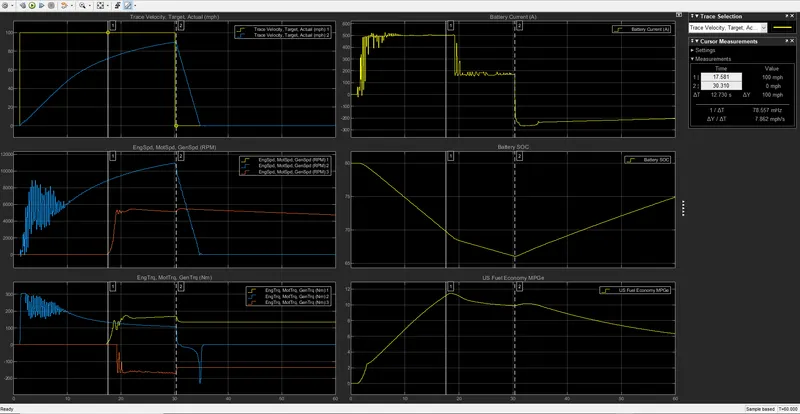
figure 4.1
As figure 4.1 shows, Both the motor and engine run to achieve the top speed of 100mph.
- First, the motor provides power up to marker-1 for 18seconds, after which the engine starts and the generator runs to replenish the used energy, as the Battery SOC has dropped to 70%.
- Marker-2 marks the deceleration of the vehicle at 30seconds and thus the motor torque goes negative( regenerative braking) and goes to zero.
- The engine and generator still run to achieve the upper limit of Battery SOC (80%).
- The battery SOC plot shows the value increasing from the start of deceleration(marker-2) to the end of the 60th second, which is the simulation end time.
4-Keeping all other parameters the same, compare the simulated results of hybrid and pure electric powertrains.
Ans:
PARAMETERS:
Environment variables- 0 grade and default temperature, pressure and wind velocity.
Drive cycle-NYCC (New York City Cycle) simulated for 600seconds.
Pure EV powertrain:
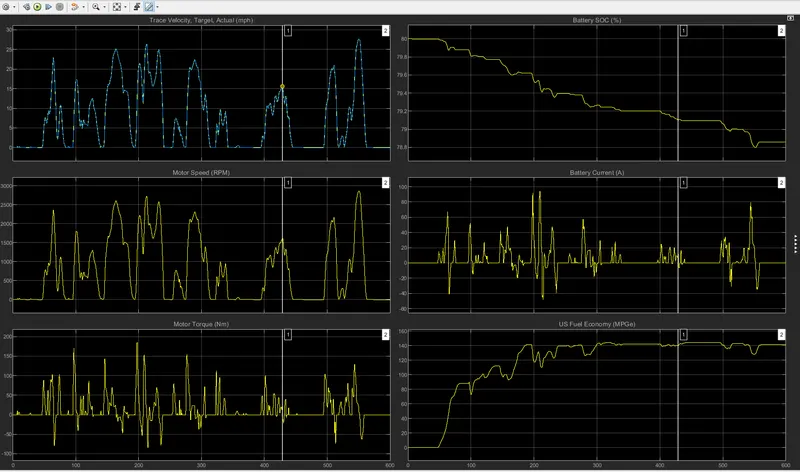
figure 4.2
Figure 4.2 shows the typical city drive cycle with constant acceleration and braking. The battery SOC has gone down from 80% to 78.8% by driving the pure EV powertrain for 60 seconds.
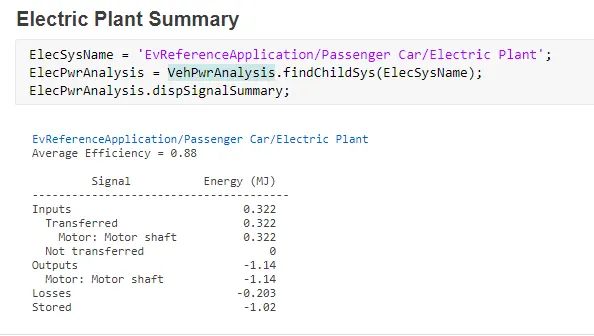
figure 4.3
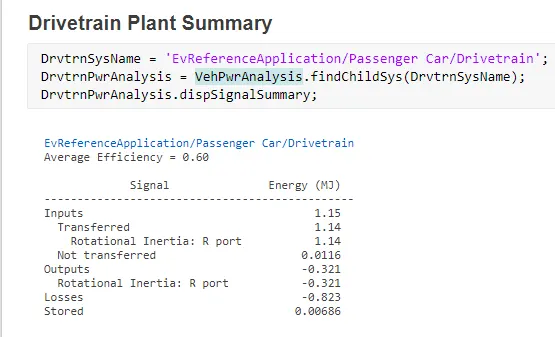
figure 4.4
Figure 4.2 shows the typical city drive cycle with constant acceleration and braking. The battery SOC has gone down from 80% to 78.8% by driving the pure EV powertrain for 60 seconds.
HEV Powertrain:
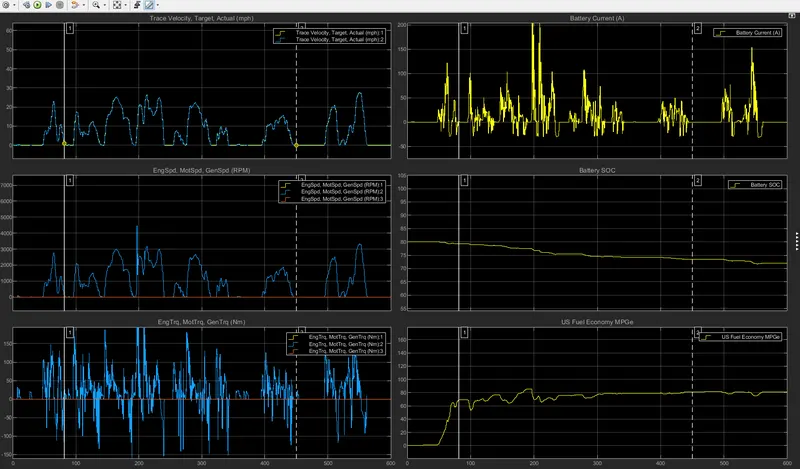
figure 4.5
The above plots show that for an NYCC drive cycle for 600seconds, the engine and generator do not produce any torque, meaning the motor could produce enough power and the energy from the battery was used.
The battery SOC dropped from 80% to 72%, this is due to the reduced size of the motor and battery capacity (since this is an HEV drive-train).
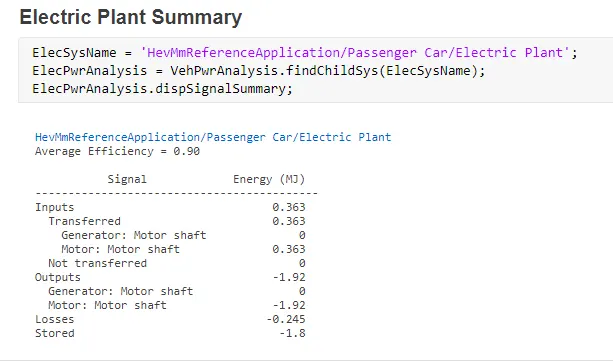
Figure 4.6
The electric plant of the HEV model has an efficiency of 90% which is more than that of the EV plant(88%) .
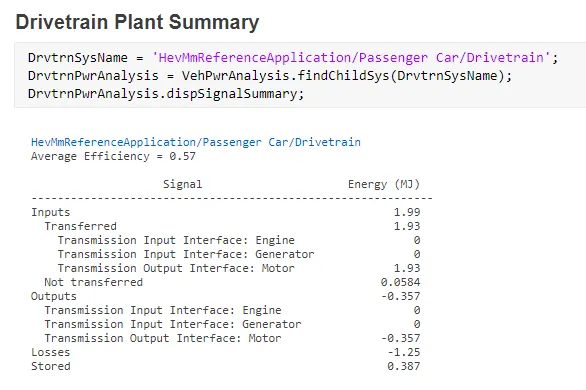
figure 4.7
The drivetrain efficiency has no change compared to the pure EV drivetrain.
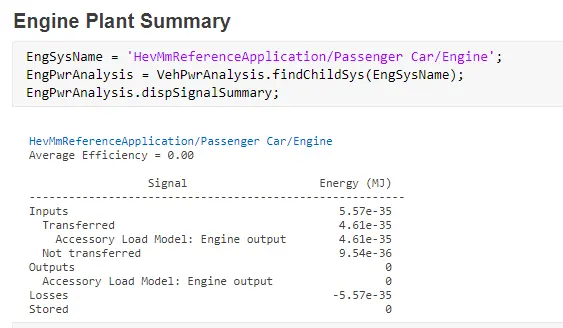
figure 4.8
Here the average efficiency is 0% meaning the engine never ran to produce power for the generator to replenish SOC in the battery, for the NYCC cycle.
Note: please refer to week4.rar for the original files