Week-6 Challenge: EV Drivetrain
- Which types of power converter circuits are employed in an electric and hybrid electric vehicle?
The various types of power converters used in electric vehicles and Hybrid-electric vehicles are as follows:
- DC-DC converters
- AC-DC converters
- DC-AC converters
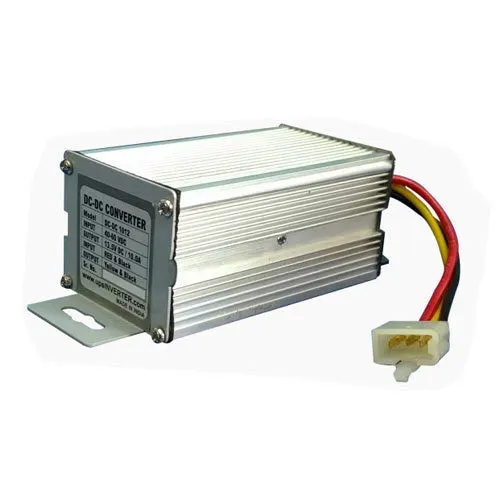
DC-DC converters:
These converters are employed in EVs and HEVs to either reduce or increase the voltage from the battery. Here, the conversion is the level of voltage and not the form.
Types of DC-DC converters employed are as follows:
- Buck converter (Output voltage is always lesser than the input voltage)
- Boost converter (Output voltage is always higher than the input voltage)
- Buck-Boost converter (Output voltage can be lesser or higher than the input voltage)
- Chopper(2-quadrant/4-quadrant) : This converter is used to invert polarity of voltage or current to operate the motor in various modes (Forward motoring, Reverse motoring, Forward braking, Reverse motoring).
DC-AC Converters:
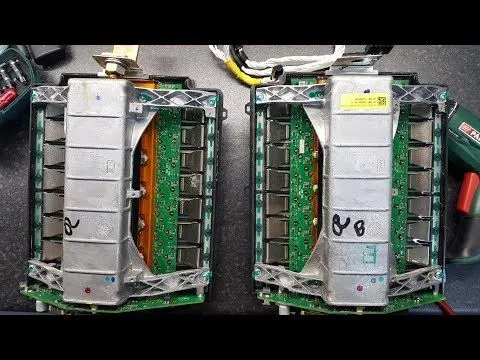
These converters are employed to convert the battery DC voltage to AC current as an input to drive the 3-Phase Induction motor. Here the form and level of the current are altered. These are used along with DC-DC converters.
AC-DC converters:
These converters are not employed directly in the EV or HEV. But are used in the chargers of Plug-in HEVs and EVs. These converters convert the AC current from the power grid into DC and store them in the battery. Along with the AC-DC converter, DC-DC converters are used to reduce the voltage level according to the battery.
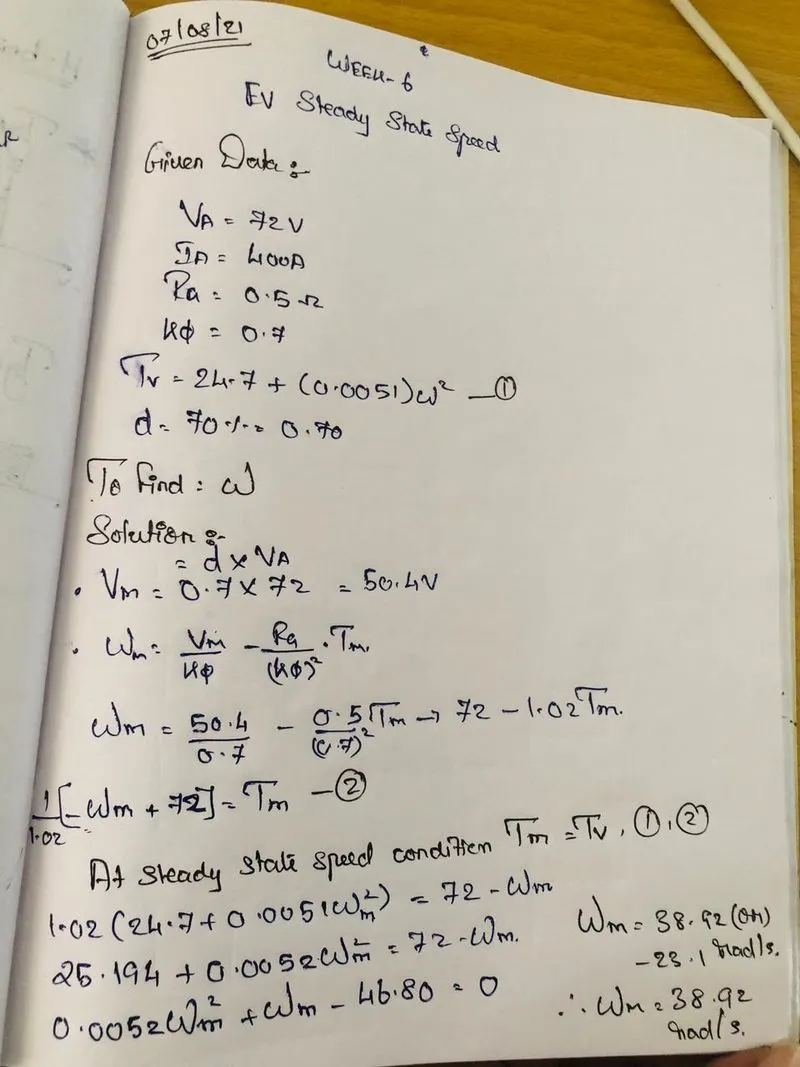
2. An Electric Vehicle's powertrain with 72V battery pack in shown in the diagram below. The duty ratio for acceleration operation is 'd1' and for the braking operation the duty ratio is 'd2'.What is EV steady state speed if duty cycle is 70%?
Ans: At steady-state condition, the motor and vehicle torque are equal. Thus the two characteristic equations are equated and the steady state speed is found.
3. Develop a mathematical model of a DC Motor for the below equation using Simulink.
ωω= V/Kϕϕ -Ra/Kϕϕ^2 .T
Ans: Please refer to the attached file "Torque Speed_slx"
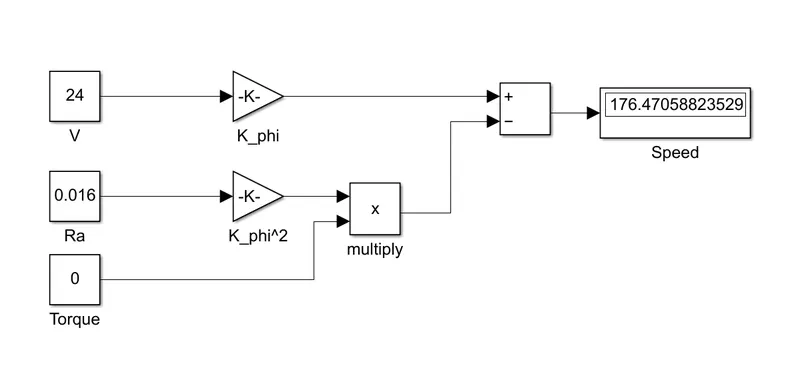
The equation has been modelled in Simulink by Mathworks and the speed value at Torque=0 is shown which is 176.47 rad/s. This is the max speed condition.
- Refer to the blog on below topic:
Induction Versus DC brushless motors by Wally Rippel, Tesla
Explain in brief about author’s perspective.
Ans:
The author Wally Rippel, who has been a long-time proponent of Electric Vehicles feels that the EV evolution will be the same as IC engines. Though there are various models and makes for the IC engine, there is no “One size fit all” engine that can satisfy everyone. Similarly, the electric vehicle industry has evolved from brushed dc motors and contactor controllers to brushless dc motors and modulating inverters. The lead in batteries has been replaced with lithium. These technologies may or may not go obsolete but will definitely stay as rivalries for a long period of time.
The author moves on to explain the 2 concepts along with their similarities, advantages and disadvantages.
Brushless DC motor:
The rotor of a DC brushless machine has two or more permanent magnets that produce the DC magnetic field. The stator has thin laminations and windings with current passing through them. The rotor magnetic field interacts with the current in stator to produce the torque. The current magnitude and polarity in the stator are to be varied such that the output torque is constant. For this purpose the DC brushless machine requires an inverter without which the machine would be redundant.
Induction motor:
The stator of the induction motor is similar to that of the CD brushless motor with thin laminations with three sets of windings for the three-phase current.
The rotor is the significant difference between the two motors. The rotor of the induction motor has a squirrel cage structure or a stacked laminations with slip ring. The rotor structure is shorted.
Working: The currents flowing through the stator windings produce a rotating magnetic field. This RMF induces a voltage across the rotor and in response a current is developed in the rotor windings. This current interacts with the original RMF and produces forces and a desired component of it produces the torque in the rotor.
The disadvantages of the induction motor are as follows:
- They can’t run on DC
- When used with utility power they are constant speed machines
- They have low starting torque and limited peak torque capabilities
Overcoming the dis-advantages:
Adding an inverter would facilitate variable speed operation. This is done by varying the inverter frequency.
To improve torque performance, adding feedback loops would help attain the desired frequency of the induction motor resulting in high torque performance.
Relative differences between Induction motors and Brushless DC motors:
- The two motors have different inverter controls. With digital control its basically just different codes. The BLDC requires an absolute position sensor whereas the Induction Motor requires a speed sensor for feedback.
- The rotor cooling is relatively easy with the BLDC motor and its peak point energy efficiency is more than the Induction motor.
- The strength of the magnetic field has to be varied according to torque requirements to reduce eddy current losses and hysteresis loss. The Induction motor has no permanent magnet hence the variation of value B is possible.
- With increase in size of the motor the losses in BLDC machines increase as they have permanent magnets. Whereas in induction motor, the losses do not essentially increase.
- The peak power efficiency of BLDC may be higher but the average efficiency of the induction motor is higher comparatively making it the favourable choice when very high performance is desired.(example : TESLA Roadster)
- The costs associated with Induction motor and its inverter are less as there are no permanent magnets ($50 per kg) involved. However, the control of induction motors is difficult and the development costs are high. The recurring costs are negligible with induction motors.
Conclusion:
The author feels that both induction and BLDC motors will survive in the upcoming era, as hybrids desire BLDC motors and performance pure-electric vehicles require induction motors and both the drives share common hardware.