Week-4 Challenge WOT Condition Part-2
WEEK-4 CHALLENGE WOT CONDITION PART-2
AIM:
To run the HEV reference application with WOT drive cycle with different parameters and comment on the results.
OBJECTIVES:
- What is the different between mapped and dynamic model of engine, motor and generator? How can you change model type?
- How does the model calculate miles per gallon? Which factors are considered to model fuel flow?
- Run the HEV reference application with WOT drive cycle. Change the grade and wind velocity in the environment block. Comment on the results.
- Keeping all other parameters same, compare the simulated results of hybrid and pure electric powertrains.
QUESTION:1 What is the difference between mapped and dynamic model of engine, motor and generator? How can you change model type?
Powertrain block set provides two types of combustion engine models
- Mapped model
- Dynamic model
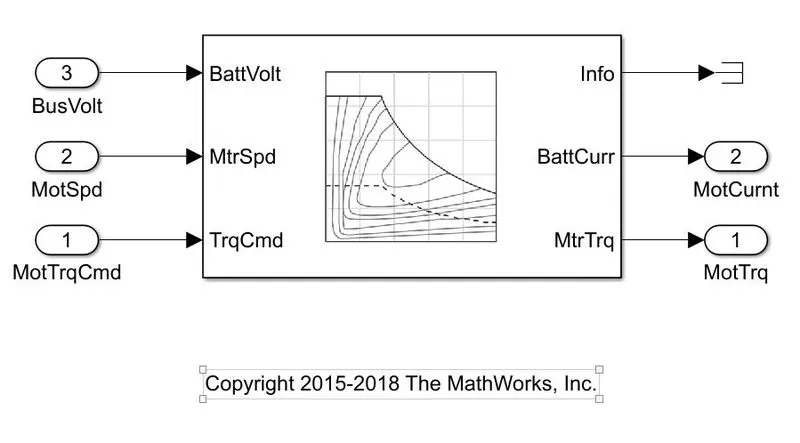
MAPPED ENGINE MODEL:
- Mapped engines represent macro engine behaviour as a set of lookup tables (brake torque, fuel flow, air mass flow, exhaust temperature, efficiency, and emissions) as functions of commanded load and measured engine speed
- Mapped engine models are suitable for analysis and design activities that do not require engine subsystem dynamic characteristics, for example, in engine and transmission powertrain matching analysis for fuel economy, emissions, and performance trade-offs.
DYNAMIC ENGINE MODEL:
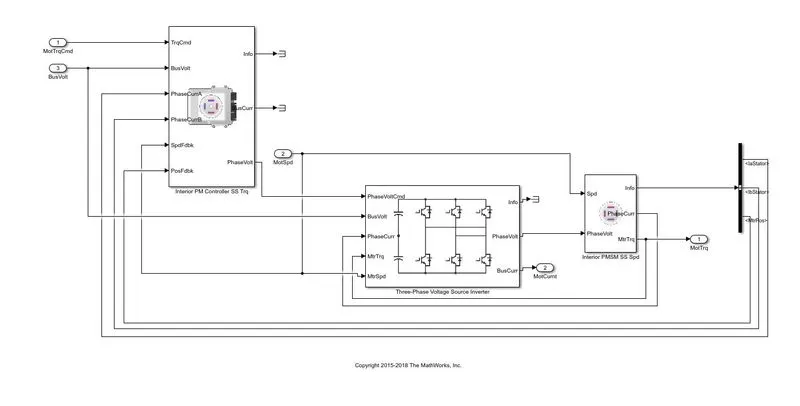
- Dynamic engines decompose engine behaviour into individual component models that account for engine dynamics, most notably intake airflow and turbocharger dynamics.
- Dynamic engine models are suitable for designing control, estimator, and diagnostic algorithms that depend on dynamic subsystem states, for example, in closed-loop AFR (Air-Fuel Ratio) control algorithm development.
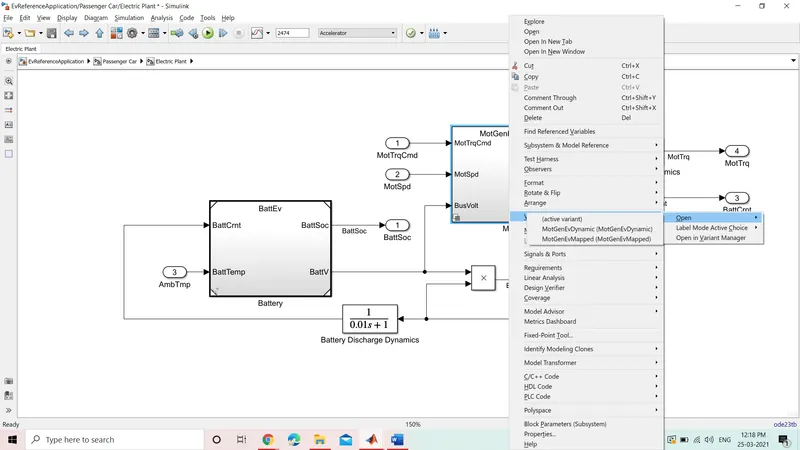
We can switch between mapped and dynamic engines by following the below procedures:
- Open the EV model in Simulink.
- Enter the passenger car block by double clicking it.
- Then go to Electric plant block.
- Inside the motor block right-click to find the variant option.
- Now it can change the desired variant.
QUESTION:2 How does the model calculate miles per gallon? Which factors are considered to model fuel flow?
Miles per Gallon (MPG) & Miles per Gallon-equivalent (MPGe): -
- For a conventional gasoline vehicle, the fuel efficiency is calculated via miles-per-gallon (MPG). However, fuel efficiency for hybrid models is calculated via miles-per-gallon equivalent (MPGe).
- MPG is the number of miles your car can drive per gallon of gas. Figuring out an MPGe rating is a little more complicated. Since engines that use an alternative source of fuel can’t be measured by liquid gallons of fuel, the MPGe rating is calculated by figuring out the number of miles a vehicle can go using the same energy content as a gallon of gas.
- The EPA calculates that 33.7 kilowatt-hours of electricity is the equivalent to one gallon of gas.
- In case of our EV model, inside the visualization block we have another block named Performance Calculations.
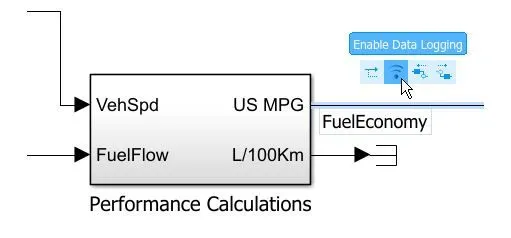
If we get inside this block, we find the actual (MPG) calculations,
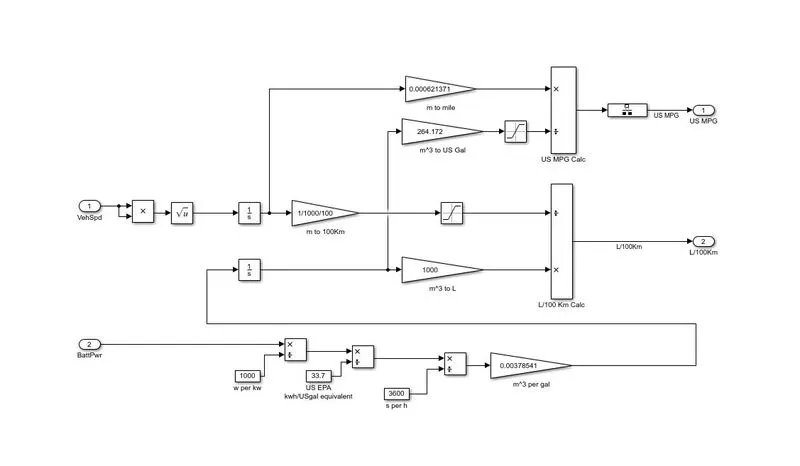
Here, three different inputs are taken into consideration:
- Vehicle Speed
- Fuel flow
- Battery power
- The vehicle speed input is in m/s which is converted into miles by multiplying with 0.000621371.
- Similarly, the kilogram of fuel is converted into cubic meter by multiplying by 1/ (1000*0.739).
- This cubic meter value is then converted into gallons by multiplying it with 264.172. The mile value and gallon value are used to find MPG of the vehicle.
- Now the battery value is initially converted from watts to kwh by dividing with 1000 and then to gallon equivalent by again dividing it with 33.7 (since 33.7 kwh = 1 gallon).
- Then divide the value by 3600 to get in per seconds and multiply by 0.00378541 to get the value in cubic meter per gallons.
QUESTION:3 Run the HEV reference application with WOT drive cycle. Change the grade and wind velocity in the environment block. Comment on the results.
Explore the hybrid electric vehicle multimode reference application:
The hybrid electric vehicle reference application represents a full multimode hybrid electric vehicle (HEV) model with an internal combustion engine, transmission, battery, motor, generator, and associated powertrain control algorithms. Use the reference application for powertrain matching analysis and component selection, control and diagnostic algorithm design, and hardware-in-the-loop (HIL) testing.
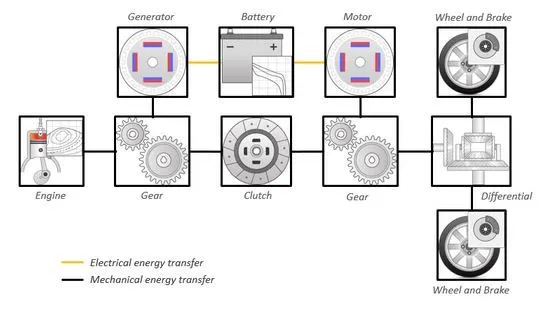
By default, the HEV multimode reference application is configured with:
- Mapped motor and generator
- 5–L spark-ignition (SI) dynamic engine
This diagram shows the powertrain configuration.
SIMULINK MODEL OF HEV VEHICLE:
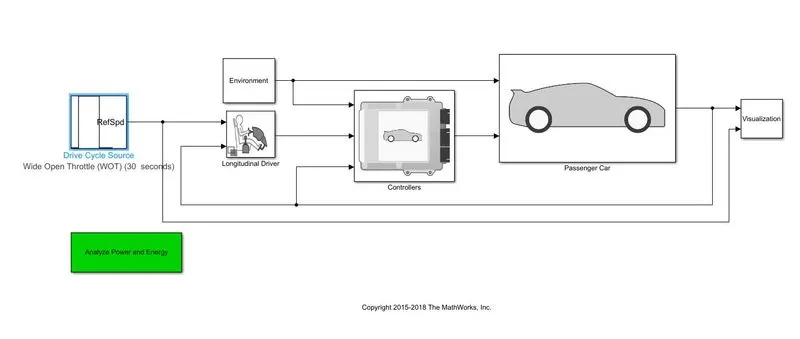
The above picture the drive cycle to be changed the wide-open throttle condition.
- HEV & Environment with default conditions:
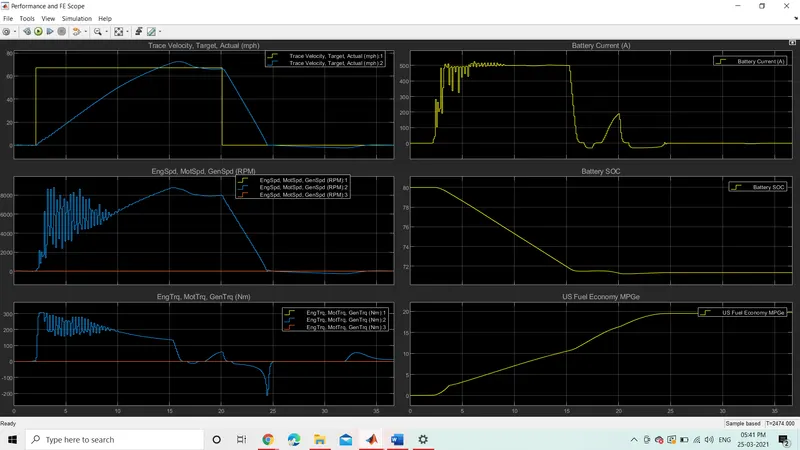
Environment Conditions: - Grade = 5; & Wind Velocity = 10 m/s
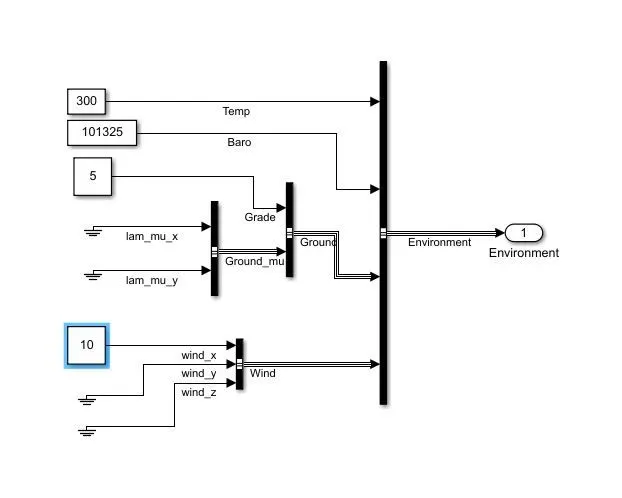
2.HEV & Environment with conditions given:
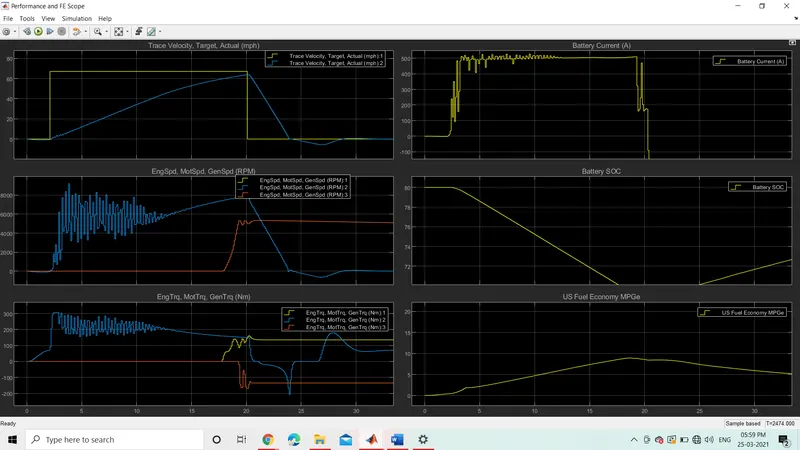
From the above results;
Plot 1: - Trace velocity – Target vs Actual
The yellow indication is the target path and the blue indication is the actual vehicle speed. Here it is seen that vehicles requited around 20 sec to attend the maximum speed toward the target path by using battery power own. After that vehicle starts to decelerates.
Plot 2: - Engine, Motor & Generator Speed.
As the battery is fully charged, at initial condition, only motor speed (blue indication) is used which high at starting because of resistance due to slope & wind velocity. The engine speed (yellow indication) is overlapped with generator speed (orange indication) indicating both running at on the same rpm. Initial there is no need for engine & generator speed as the motor is fulfilling the requirement to achieve the maximum speed of the vehicle. Therefore, they are at 0 rpm. But when the battery will be discharging or when the State of Charge (SOC) becomes below 70% then only Engine will start to rotate to provide & maintain the speed of the vehicle & so far generator will also start to charge the battery at the same time. Hence their rpm is the same.
Plot 3: - Engine Torque, Motor Torque & Generator torque
As the battery is being used at the start, so torque will also maximum for the motor in this case until the vehicle acquires its maximum speed. Once the vehicle reached at a constant speed, the torque requirement will reduce. Here also when there is deceleration, the torque value becomes negative indicating no need of toque. Also, it becomes constant once the battery goes into charging state cause now, here Engine torque is being used due below 70% SOC. Also, generator torque will be negative indicating that Electric Motor is charging & in this period Engine has overcome the torque requirement of the vehicle successfully.
Blue indication – Motor Torque
Yellow indication – Engine Torque
Orange indication – Generator Torque
Plot 4: - Battery Current
Battery current is a simple term. When a vehicle uses Electric Motor then only it is used to generate power for the Motor. When the vehicle decelerates, then no current is extracted to produce power for the motor. From the graph also you can see, the current requirement becomes stable while charging the mode of the battery.
Plot 5: - SOC
Sate of Charge (SOC) is important for battery-driven vehicles. From the graph, it can be seen that when the battery used is bellowed 70%, it goes in charging mode & hence SOC is also increased due to charging of the battery through the generator. Hence it can be used further once it gets fully charged.
Plot 6: - MPGe
The graph shows the miles per gallon equivalent require to run the vehicle.
QUESTION:4 Keeping all other parameters same, compare the simulated results of hybrid and pure electric powertrains.
ELECTRIC VEHICLE REFERENCE APPLICATION:
The electric vehicle reference application represents a full electric vehicle model with a motor-generator, battery, direct-drive transmission, and associated powertrain control algorithms. Use the electric vehicle reference application for powertrain matching analysis and component selection, control and diagnostic algorithm design, and hardware-in-the-loop (HIL) testing.
The electric vehicle reference application is configured with a mapped motor and battery. This diagram shows the powertrain configuration.
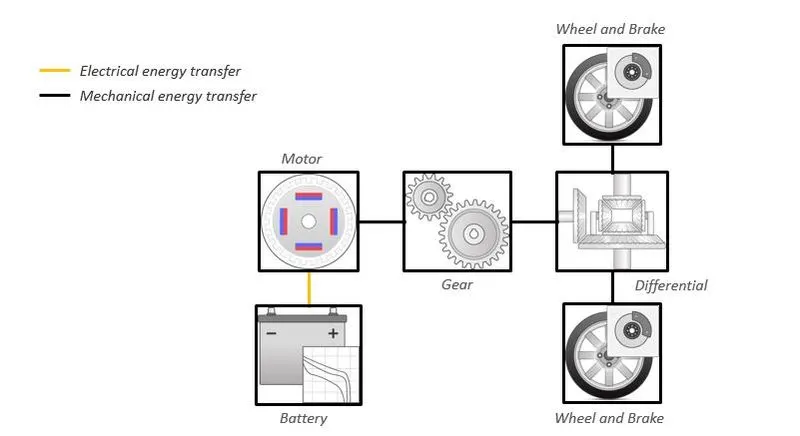
SIMULINK MODEL OF ELECTRIC VEHICLE:
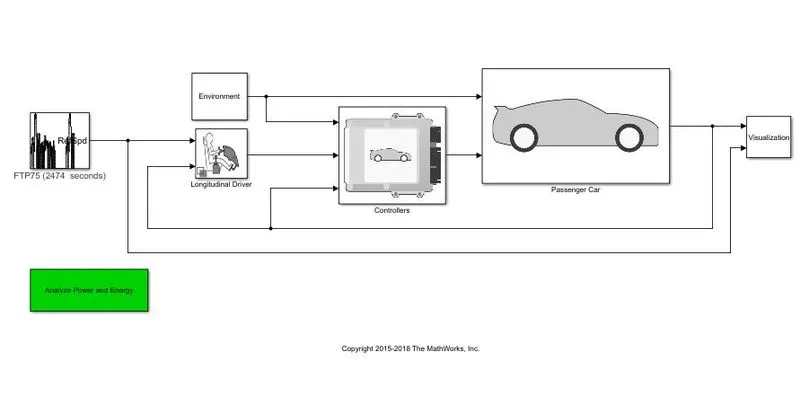
VISULAZATION PLOTS:
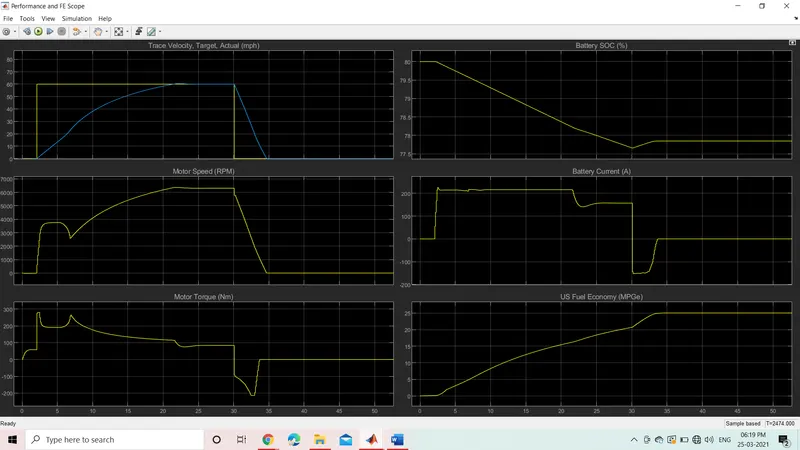
From the above electric vehicle plots: -
- Pure EV can achieve less velocity than that of HEV. HEV can attend velocity above 60 mph but in pure EV velocity is less than 60 mph.
- Motor speed in rpm is also less than that of HEV. But path tracing is the same as that of HEV.
- But Motor torque of pure EV is almost the same as that of HEV.
- Battery current uses is almost half in pure EV to produce power as that of HEV.
- Also, as battery use is less, battery draining is low & it can be seen from the SOC graph. From the SOC graph, it can be seen that for the same parameter’s battery uses is 5 times more in the case of HEV than that of pure EV, battery drains fast in the case of HEV.
- Fuel economy is also almost double in the case of pure EV than that of HEV.
CONCLUSIONS:
- The mapped model calculation is very fast compared to dynamic data and the change of systems can be done through Variant Manager.
- The factors to consider to model the fuel flow areCI Engine or SI Engine, Flue mass Flow Rate (Kg/s), Engine feedback out, Fuel flow all things are studied.
- The HEV Reference Application with WOT drive cycle and the grade and wind velocity to be change the environment block and the results are obtained.
- The obtained HEV and pure electric power train simulated results are compared.