Week 4 Challenge- Compiling C++ libraries
Compiling C++ libraries
1) Copy the solver DPMFoam from the lagrangian library ( $FOAM_SOLVERS ) into your run folder ( $FOAM_RUN ) (use visual studio)
- Use wmake libso to compile the shared library associated with this, after making the appropriate changes
- Where is the resulting .so file found? (Attach image of the shared object file location)
- Write a report on what you did and the challenges you faced
---------------
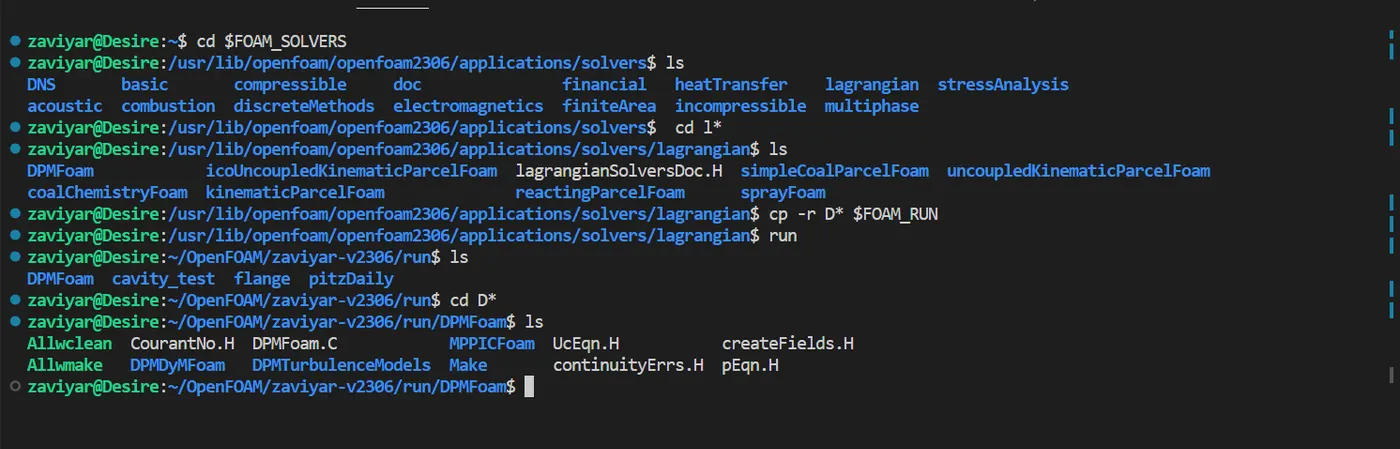
- First of all we have entered in openFOAM application/solvers folder using '$FOAM_SOLVERS' command
- Then ' cp -r D* $FOAM_RUN' command will help us to copy the required folder from openFOAM library to our run folder
- Now by navigating the run folder we can confirm that the required folder is pasted in the specified folder and further we can proceed
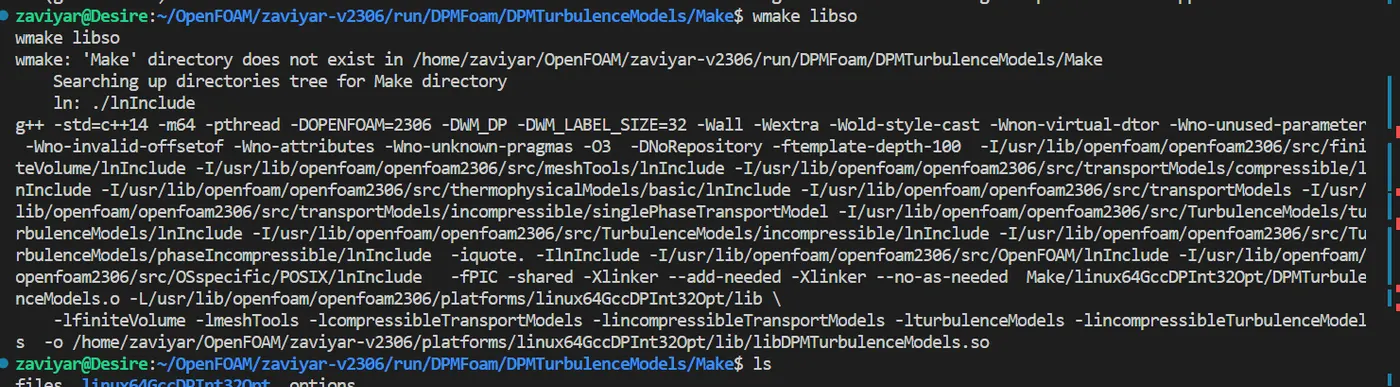
- Now here we have used 'wmake libso' for compiling the required library file
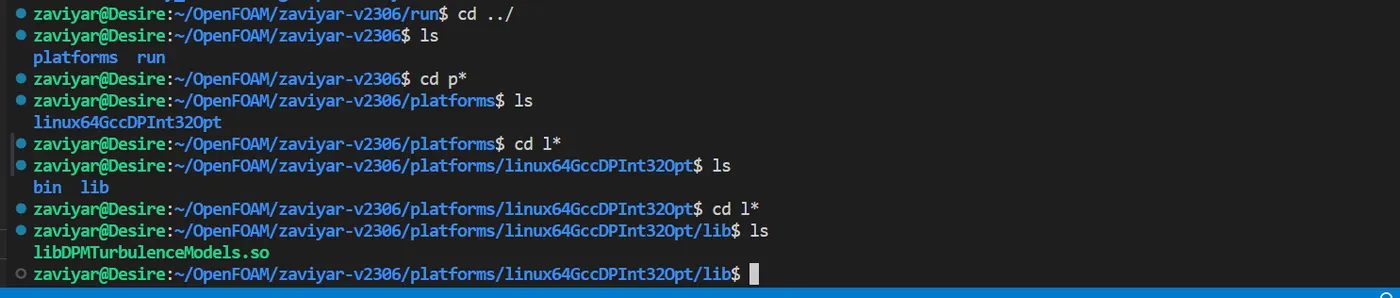
- Here is the required '.so' file
Challenges Faced
- Nothing as such
--------
- Github Link - https://github.com/Zaviyar786/dpmfoam
-------
Write detailed explanations on the following decomposition algorithms:
- simple (2 2 1)
- scotch (Write a short note about how scotch decomposition is carried out)
- hierarchical
| Simple | Scotch | Hierarchical |
| In this case the compuatational domain is divided into sub-domains using a straightforward geometric approach | It aims to balance the computational workload across different processors by partitioning the mesh based on graph theory principles | It involves breaking down of the compuational domain into sub-domains in a hierarchical manner.It is used for parallel architectures with varying levels of computing resources |
| The number in parenthesis indicate that the domain is divided into two parts along x-axis, two parts along y-axis and one part along z-axis | The Scotch library is used to partition this graph into subdomains.The objective is to minimize the no.of connections between subdomains while ensuring a rough no of mesh elements in each sub-domain | It divides the domain into smaller and more mangeable subdomains in a hierarchical fashion.It involves multiple level of decomposition, allowing for flexibility in adapting to different parallel computing architectures |
| It works well for simple and regular geometries, but it doesnot provide optimal loading balancing for complex cases | It considers the computational cost associated with each mesh element and aims to achieve load balancing among the processors | It also aims to achieve load balancing to ensure that each processor has a comparable amount of computational work |
| To use simple decomposition, we modify method as 'method simple' in decomposepardict | To use scotch decomposition, we modify method as 'method scotch' in decomposepardict | To use hierarchical decomposition, we modify method as 'method hierarchical' in decomposepardict |
--------------------------
3. Take the incompressible/simpleFoam/pitzDaily case and visualize the decomposed mesh (use decomposeParDict) in ParaView for:
- simple (2 2 1)
- scotch (Write a short note about how scotch decomposition is carried out)
- hierarchical
--------------------------
- First of all we need to create decomposeParDict inside system folder and modify it according to the decompostion method
- Then 'blockMesh' command is used to create the mesh
- Then 'decomposePar' command is used to decompose the domain for parallel computing
- Then ' mpirun -np 4(no of processors) simpleFoam(solver name) -parallel is used to run the simulation
- At last 'reconstructPar' is used to reconstruct the domain and to visualize the results
Output Result
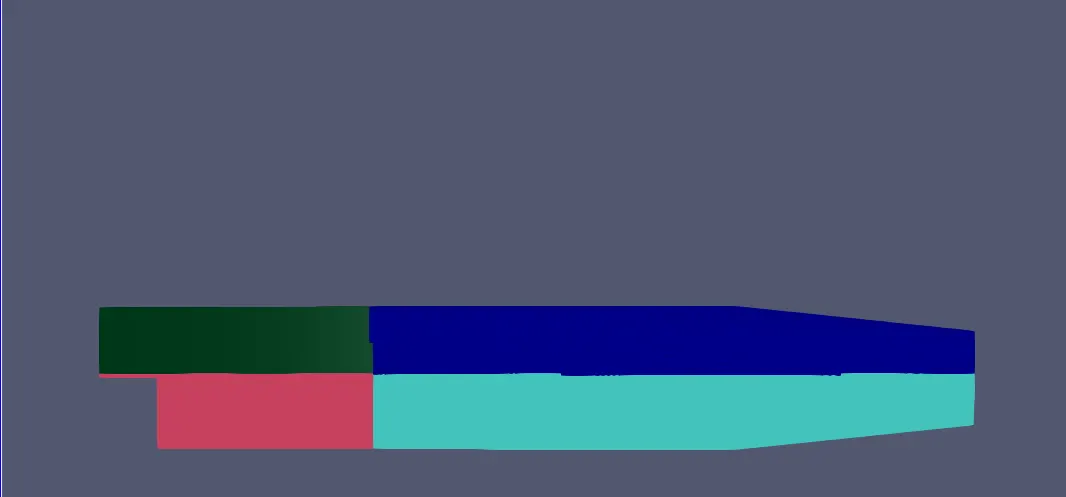
- Simple(2 2 1) :

- Scotch :

- Hierarchical :
Conclusion
- According to our analysis, we can conclude that Scotch Decompostion provides better decomposition over other methods
- Simple and Hierarchical Method are nearly similar in decomposition except the user specification in which the directional split is done in i.e first in y-direction and then in the x-direction for hierarchical case
- The Hierarchy of precedence of choosing the methods be alike : Manual > Scotch > Hierarchical > Simple