Week 4 Challenge(Nerst equation,To find operating points in voltage vs current density curve and find the best operating point)
CHALLENGE 4
Objective:
1)To define Nernst equation for fuel cell and then define what parameters affect the reaction in a fuel cell in what way.
2)To find the given operating points in given Voltage Vs Current passing per cm2 characteristics curve.
3)To find the best operating point among all the points.
Discussions:
1) Nerst equation of a fuel cell.
The Nerst equation enables the determination of cell potential under non-standard conditions.It relates the measured cell potential to the reaction quotient and allows accurate determination of equilibrium constants(including solubility constants).
The nerst equation is derived from the Gibbs free energy under standard conditions.

Delta G is related to E under general conditions as,
 ......(1)
where ,
n= No.of electrons transfered through the reaction(from balanced reaction).
F=Faraday constant (96500C/mol)
E=Potential difference.
Under standard condition,
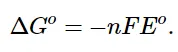 .....(2)
When E0 is positive the reaction is spontanious and when E0 is negative,reaction is non-spontanious.
The energy change under standard condition and non standard condition can be related by,
 ......(3)
Sub (!) and (2) in (3)
 .....(4)
Equation (4) becomes,
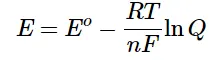 ....(5)
Eq (5) written with log10 form as,

At standard temperature T=298K, the term 2.303RT/F becomes 0.0592 V.
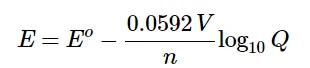
This above equations gives the electric potential of a cell depends upon the reaction quotient Q of the reactiion.
And this equation is given as Nerst equation of a fuel cell.As redox reactions proceeds,reactants are consumed and thus the concentration of reactants are decreases.And its product concentration increases due to increased in product formation.
As this happens the cell potential gradually decreases untill the reaction is at equilibrium, at which delta G=0.
Factors affecting the reactions in fuel cell:
The performance of a fuel cell can be affected by many factors . They are,
- Load current.
- Temperature.
- Relative humidity.
- Membrane thickness.
- Membrane active area.
- Electrode active area.
- Corrosion.
- Purity.
- Pressure.
- Concentration of hydrogen fuel.
- Maintenance of water inside fuel cell.
- Pressure on electrodes particular on both sides of membrane.
Initially increased in load current usage increases the reaction rate makes cell temperature increase which ultimately reduces the voltage level of fuel cell.
As more heat is produced the humidity maintenance on proton exchange membrane is carefully maintained as increase in heat reduces the humidity content in membrane.
The membrane thickness plays a major role in reactions of fuel cell as thickness increased thickness reduces the ions flow makes reaction rate to reduce.Also lesser the water content in membrane reduces its thickness makes the fuel cell life to reduce.
Membrane active area created by incorporation of catalyst layer over the both sides of membrane to make membrane as active to receive ions.Lesser the active area lesser will be the potential of fuel cell.
However increase in active area on membrane increases fuel cell cost.
The unused water as the formation of byproduct is carefully removed from the fuel cell as improper removal of water from fuel cell makes more corrosin damages.
The injecting fuel from fuel injector must in a perified manner as it increase the efficiency of fuel cell.Mixture of other gases in fuel reduces its overall potential as its efficiency gets reduced.
The pressure of fuel as well as the oxygen should be in a certain limit to attain the reaction inside the fuel cell.Thus the gases are treated and compressed to certain range before injecting into fuel cell.
Conclusion:
Thus to operate a fuel cell in its maximum operating point with best efficiency the above discussed parameters are maintained and controlled at every part of the fuel cell reaction process.
2) To find the given operating points in the given voltage-current flow curve.
Given:
Operating points-
- 0.15 W/cm2
- 0.3 W/cm2
- 0.27 W/cm2
Curve-
Discussion:
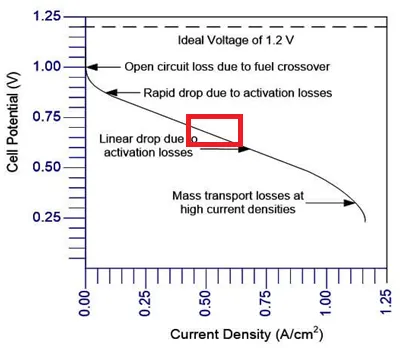
From the given above curve we can see that the operating voltage gets reducing as current floe gets increse.
The curve is classsified into three operating regions,
- Rapid voltage drop due to activation losses.(Low current density) say Zone 1.
- Linear gradual voltage drop due to activation losses.(Medium current density) say Zone 2.
- Voltage drop due to huge current flow.(High current density) say Zone 3.
This cure with its power density at various pressure can be shown as,
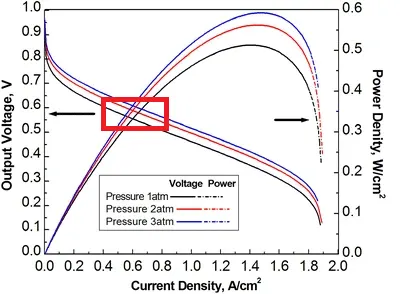
The best operatind zone is represented in rectangular box(red).
We are having three points and their operating zones are as,
- 0.15W/cm2 : It clearly seen that the this operating point is present in the Zone 1 region where rapid voltage drop occuring due to activation losses.Here its current density is also lesser nearly 0.125A/cm2 and operating voltage as 0.87 V
- 0.3W/cm2: This operating point is placed in the Zone 3 region where current density is high with reduced voltage level. Its nearly operating in 0.37V with current density of 1.12 A/cm2.
- 0.27W/cm2: This point is represented in Zone 2 where voltage drop is linear and current density is controlled medium level.Here the voltage level as nearly 0.62V with current density 0.45A/cm2.
3)Best operating point among three given points:
From the above discussions the best operating point among three points is,
0.27W/cm2 from Zone 2. As in this region the fuel cell gives its maximum efficiency with betten Voltage and current density.
Thank you.
Submitted by,
Praveen Kumar L V.
Date:2/9/2021.