Week 4 Challenge
Week 4 Challenge
1) Nernst equation for fuel cell:
Aim:
To define the Nernst equation for fuel cell and the parameters affecting the reaction in the fuel cell.
Explanation:
Nernst equation:
Nernst equation is an equation that relates the reduction potential of a reaction (half-cell or full cell reaction) to the standard electrode potential, temperature, and thermodynamic activities (often approximated by concentrations) of the chemical species undergoing reduction and oxidation.
For fuel cell:
The Nernst equation provides a relationship between the standard potential (E_T°) for the cell reaction and the open circuit voltage. The open circuit voltage is the maximum operating voltage (when no current is flowing) of a fuel cell and is determined by the chemical thermodynamics of the overall cell reaction. Once the standard potential is known for the desired temperature (E_T°), the open circuit voltage can be determined at other partial pressures of reactants and products at that temperature.
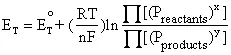 ……….(1)
where E_T= open circuit voltage
E_T°= standard potential of the reaction
F = Faraday’s number, 96487 C/equiv
R = universal gas constant, 8.314 J/ °K-mol
T = absolute temperature of cell, °K
P_reactants, P_products = partial pressures or activity of the species involved
n = the number of electrons involved (equiv/mol)
x, y = stoichiometric coefficients
The open circuit voltage E_T of the cell by convention is measured as the potential difference between E_C,T the potential drop at the cathode and E_A,T the potential drop at the anode at some temperature T.
`E_T= E_(C,T) – E_(A,T)`……………(2)
The Nernst equation for PEM fuel cell found using equation 2 and the Nernst equation for the overall cell reaction of the PEM fuel cell using equation 1 are equal.
Parameters affecting reaction of fuel cell:
- Temperature
- Catalyst
- Load Current
- Pressure
- Moisture
- Membrane
- Purity of fuel
Temperature:
Temperature of a fuel cell affects the chemical reaction, proton exchange, and water production. Water flow is used for temperature maintenance in the fuel cell. Rising current density accelerates the reaction process. The heat production in the fuel cell is proportional to the rate of the reaction process. The proton exchange membrane becomes dried as the water get evaporates, because of the rising temperature. This affects the chemical reaction takes place because water is important medium for conduction of ions. Inappropriate thermal energy will decrease the performance of the proton exchange membrane.
Catalyst:
Catalyst helps in speed up the reaction in fuel cells. Hydrogen gas is fed to the anode where it adsorbs onto the catalyst surface. The oxygen reduction reaction in the cathode is a slow reaction process. Platinum is used as a catalyst which is used to splits up hydrogen into protons and electrons. The electrons flow to the cathode as current through an external circuit and the protons flow across the PEM towards the cathode. Air is fed to the cathode and oxygen is adsorbed onto the catalyst surface. This bound oxygen is subsequently protonated by incoming H+ and reduced by incoming electrons to produce water which is then released from the catalyst surface. If the binding interaction is too weak, the substrate will fail to adsorb well on the catalyst and the reaction will be slow or not take place. if the binding interaction is too strong, the catalytic surface will quickly become blocked by bound substrate, intermediate or product and the reaction will stop.
Load Current:
When the load current increases, the chemical reaction increases, the heat gets generated. According to the current, ohmic loss comes into picture. The density of electron flow rate decreases.
Pressure:
The fuel pressure plays an important role in the fuel cell. If the pressure is low the rate of chemical reaction reduces and may sometimes it does not occur. If the pressure is very high, some of the hydrogen does not involve in chemical reaction and escapes. It reduces the efficiency.
Moisture:
Moisture is an important medium for conduction of ions in the fuel cell. The hydrogen atom gets adsorbed with the water molecules and diffuses through the membrane in MEA. If the water flow is high, the cell gets flooded and the reaction stops. It increases the resistance of the cell. If the water flow is less, there is no enough water to carry the ions, the reaction slows down and stops. It also leads to cracking of membrane if it is dried.
Membrane:
If the thickness of the membrane is high, then less number of ions flows through it. Hence the cell reaction slows down. If the thickness of the membrane is thin, then more number of ions can pass through it.
Purity of fuel:
If the fuel contains impurities it may leads to unwanted reactions and may produces carbon dioxide. And it may affect the cell life. PEMFC are sensitive to the purity of fuel.
2) Operating points of fuel cell in the polarization curve:
Aim:
To find the operating points of fuel cell in the polarization curve. The operating points are 3W/cm^2, 15W/cm^2 and 27W/cm^2.
Explanation:
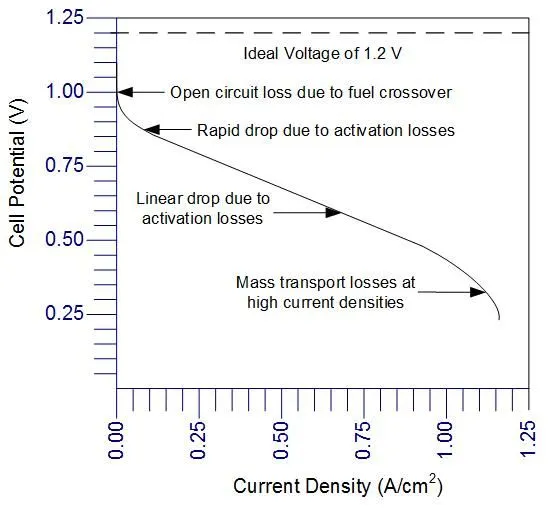
Plot for one fuel cell:
Power density with Polarization curve:
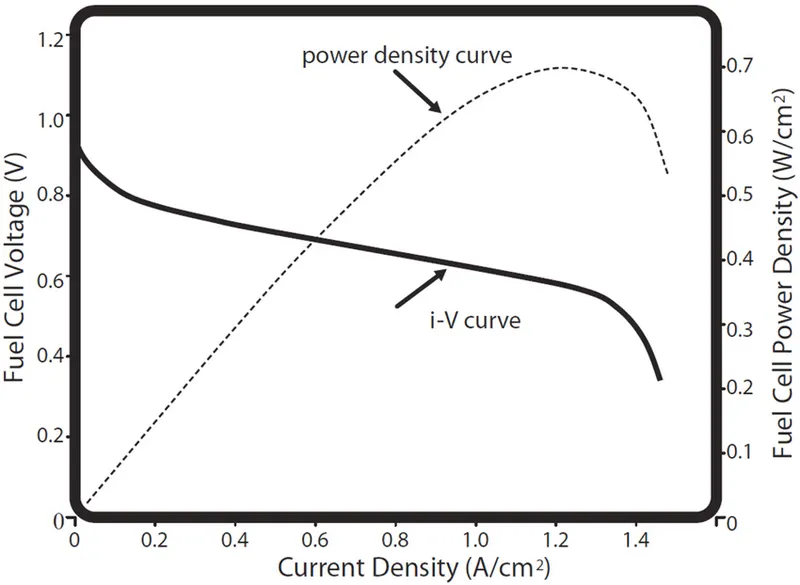
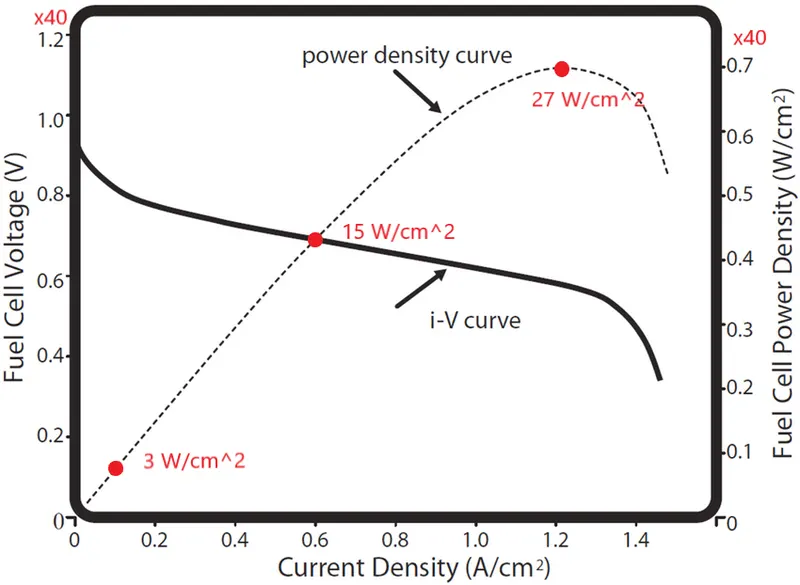
When 40 such cells are connected in series, the voltage gets increased. Then the plot follows the same characteristics. The power density of 3 W/cm^2, 15 W/cm^2 and 27 W/cm^2 are plotted in the polarization curve.
3) Best Operating point in polarization curve:
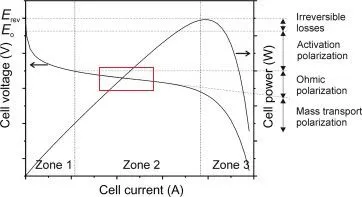
In the above plot, the area mentioned within the rectangle is the best operating point.
Zone 1 is the active polarization zone. Activation polarization is the voltage overpotential required to overcome the activation energy of the electrochemical reaction on the catalytic surface. This type of polarization dominates losses at low current density.
Zone 2 is the ohmic polarization zone. Conductors have an intrinsic resistance to charge flow, which results in a loss in cell voltage. This phenomenon is called ohmic polarization and it occurs because of the electrical resistance in the cell components. The cell components that contribute to the electrical resistance are the electrolyte, the catalyst layer, the gas diffusion layer, bipolar plates, interface contacts and terminal connections. The reduction in voltage is dominated by internal ohmic losses through the fuel cell. This voltage loss is called ohmic loss.
Zone 2 is the concentration polarization. Voltage loss due to mass transport. High current density. A fuel cell must continuously be supplied with fuel and oxidant to produce electricity. Products must also be continuously removed to have maximum fuel cell efficiency. The study of mass transfer of uncharged species is important because it can lead to significant fuel cell performance losses. The reactant and product concentrations within the catalyst layer determine the fuel cell performance. Concentration loss can be minimized by optimizing the mass transport in the fuel cell electrode.
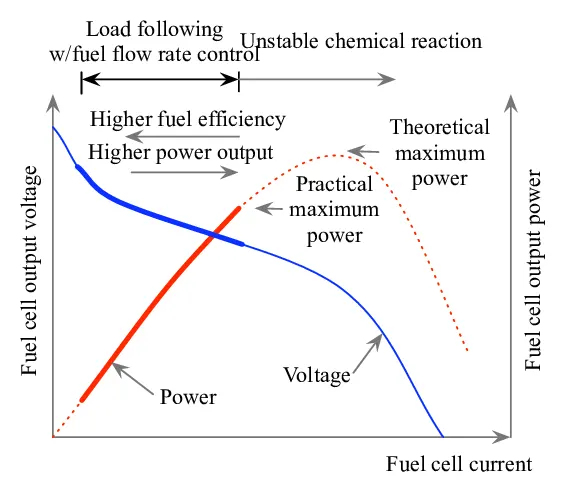
In 3 W/cm^2 operating point, the fuel efficiency is high and the power output is very less.
In 15 W/cm^2 operating point, both the efficiency and the power output are at optimum range.
In 27 W/cm^2 operating point, it undergoes the unstable reaction and the efficiency is very low.
From above three points of 3 W/cm^2, 15 W/cm^2 and 27 W/cm^2, the 15 W/cm^2 falls under the area of best operating point in the plot.