Week 4 Challenge
Aim: To calculate the Earth pressure acting on the abutment wall and apply on Staad pro.
Given data:
Length of the abutment wall=5M
Height of the abutment wall =10M
Height of the backfill soil =7M
Height of ground level from foundation top =3M
Height of foundation =1M
Water table at ground level
Density of water =10kN/m3
Density of dry soil =18kN/m3
Density of saturated soil =18kN/m3
Theory:
The lateral earth pressure is important because it affects the consolidation behaviour and strength of the soil and because it is considered in the design of geotechnical engineering structures such as retaining walls, basements, tunnels, deep foundations and braced excavations.
There are three types of earth pressures on the basis of the movement of the wall.
- Earth Pressure at rest.
- Active Earth Pressure.
- Passive Earth Pressure.
Rest earth pressure behind the abutment is assumed when there is no thermal movement
Active earth pressure is the earth pressure when the wall retaining the soil moves away from backfill.
Passive earth pressure is the earth pressure exerted when the wall moves towards the backfill.
Dry unit weight: it is defined as the weight of dry soil Ws per unit volume V.
Saturated unit weight: it is the ratio of weight of fully saturated soil Wsat to total volume V.
Submerged unit weight: it is equal to saturated unit weight minus unit weight of water.
Uplift pressure which is also known as hydrostatic uplift, is an upward pressure applied to a structure that has the potential to raise it relative to its surroundings.
Calculation:
The Earth pressure is calculated as shown below.
K1 = ka(ɣsat- ɣw)h1
= 0.35(19-10)3
= 9.45kN/m2
K2 = ka(ɣ)h2
= 0.35(18)4
= 25.2kN/m2
K3 = k1+k2
= 34.65kN/m2
The soil loads on the foundation is calculation as below.
P1 = ɣ*h1
= 18*3
= 54kN/m2
P2 = ɣ*h2
= 18*7
= 126kN/m2
The uplift pressure is calculated as follows.
Pu = ɣw*hw
= 10*(1+3)
= 40kN/m2
Draw 2 node with 0.5m distance with z direction
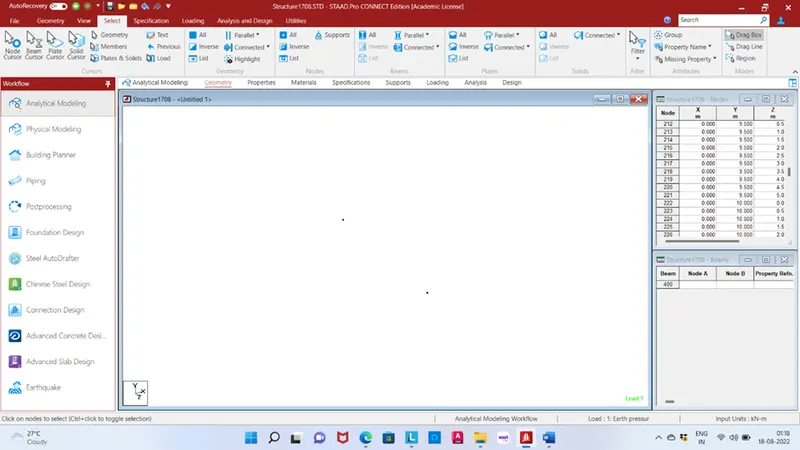
draw 2 node with 0.5m distance again in y direction
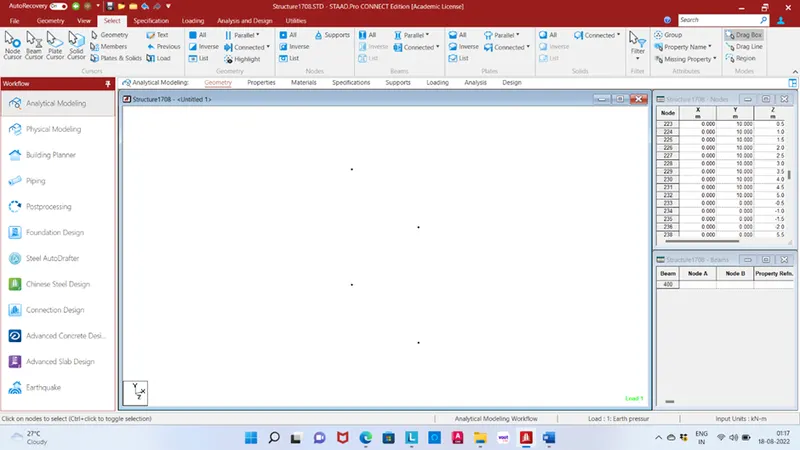
Add plate with connected 4 node
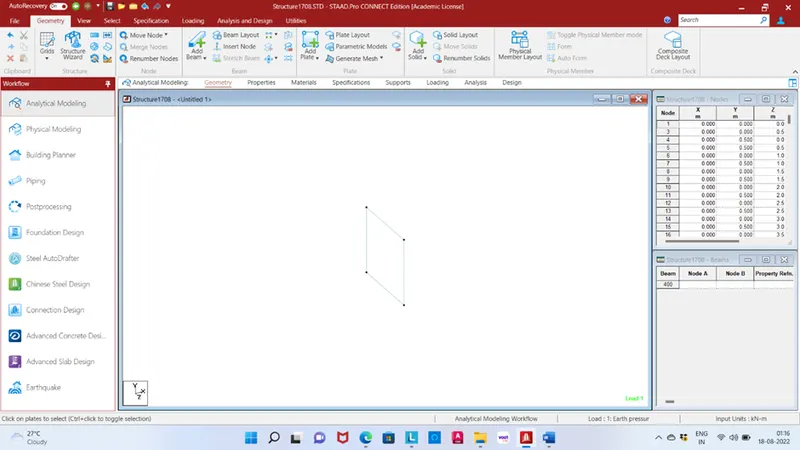
Use translational repeat with 0.5m distance in Z directional
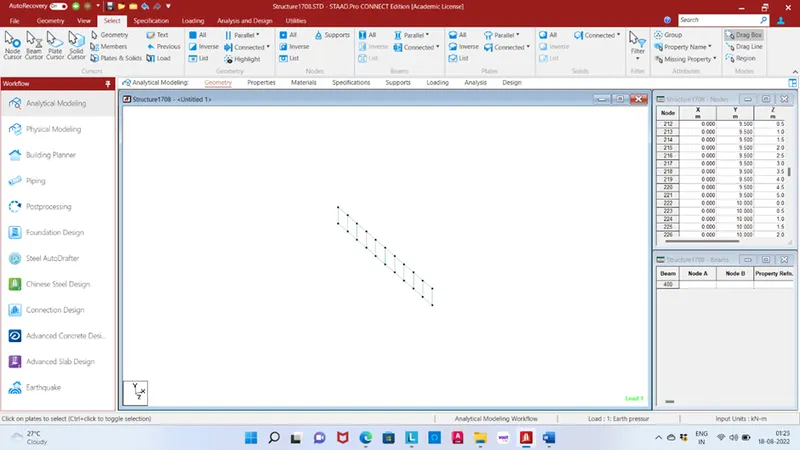
Use translational repeat with 0.5m distance abutment wall in Y directional
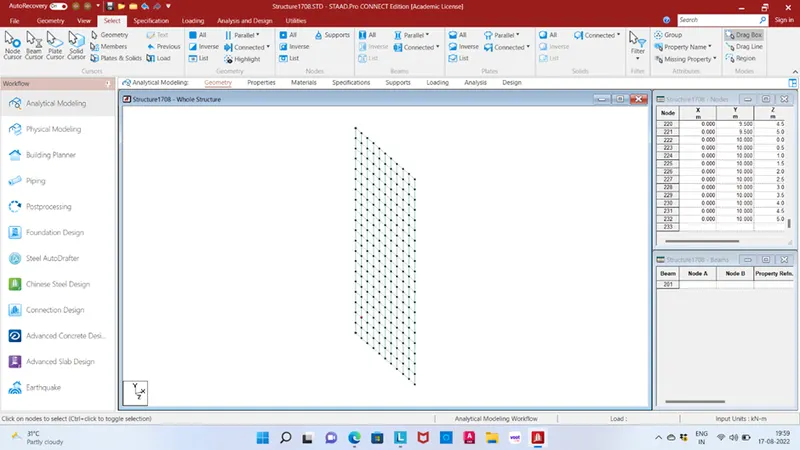
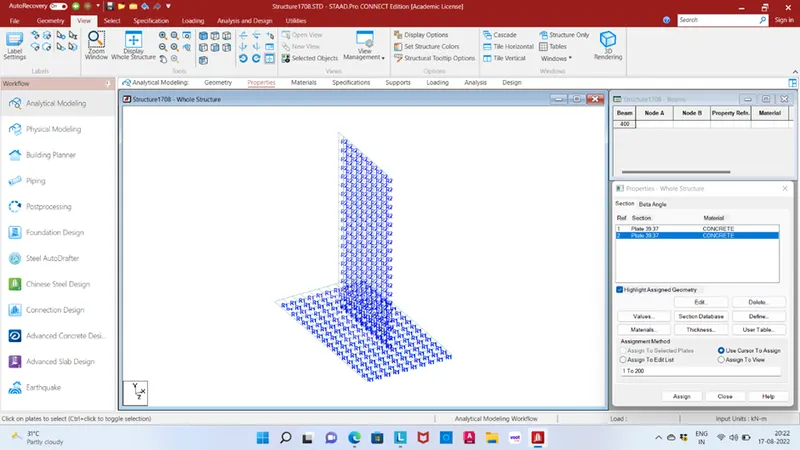
Add plate thickness 1m abutment wall and foundation
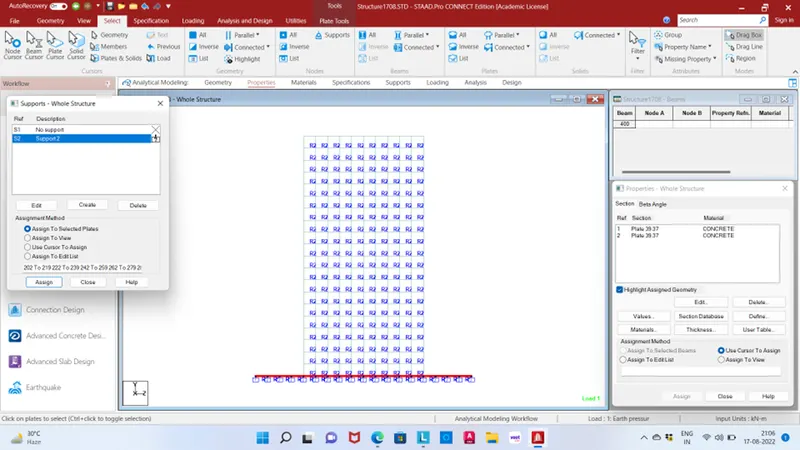
Add foundation support in foundation mat plate with modulus 12500kN/m2/m
Apply earth pressure in abutment wall k1=-9.45kN/m2, k2=25.2kN/m2 and k3=34.65kN/m2
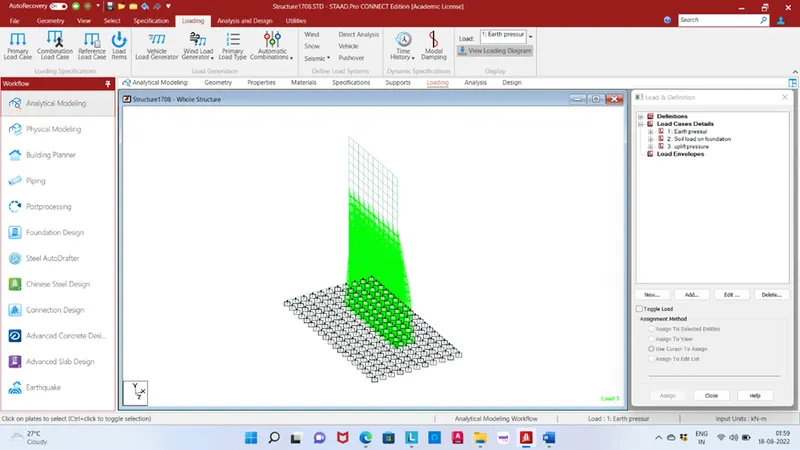
Apply soil loads on the foundation P1= -54kN/m2 and P2= -126kN/m2
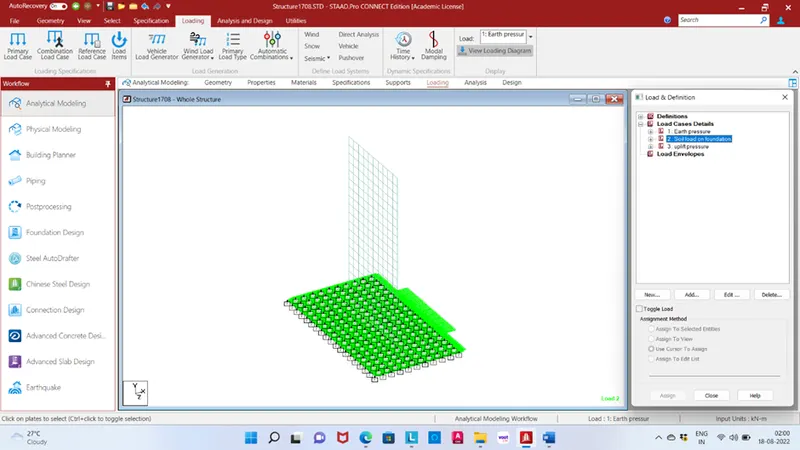
Apply uplift pressure in foundation Pu= 40kN/m2
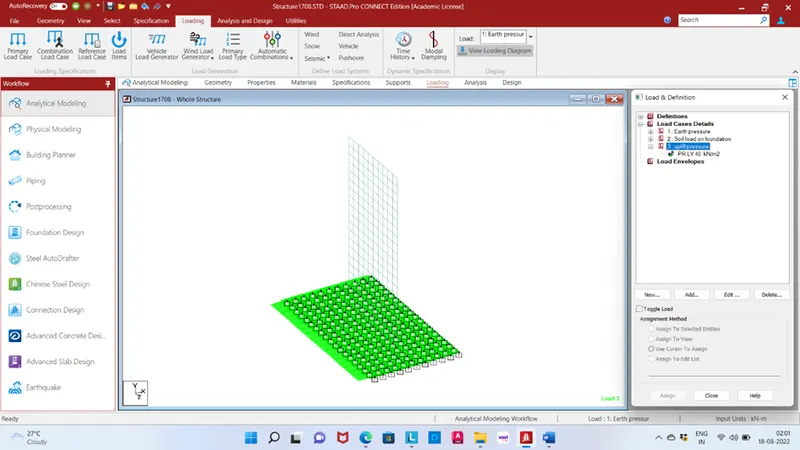
Perform Run analysis
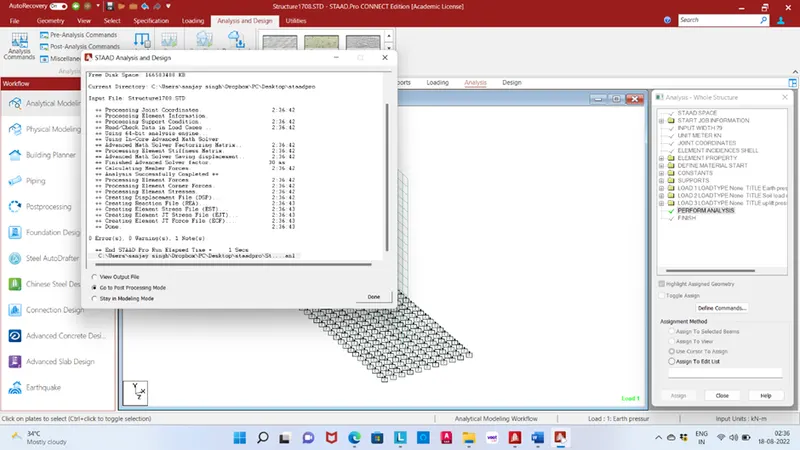
Result:
Plate reaction
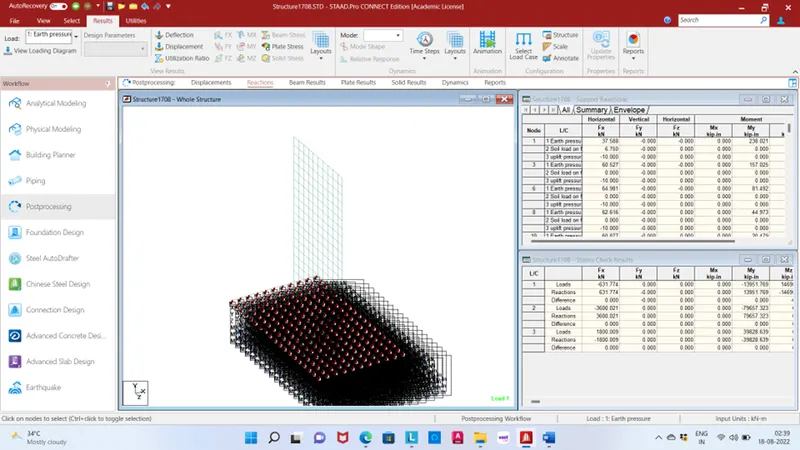
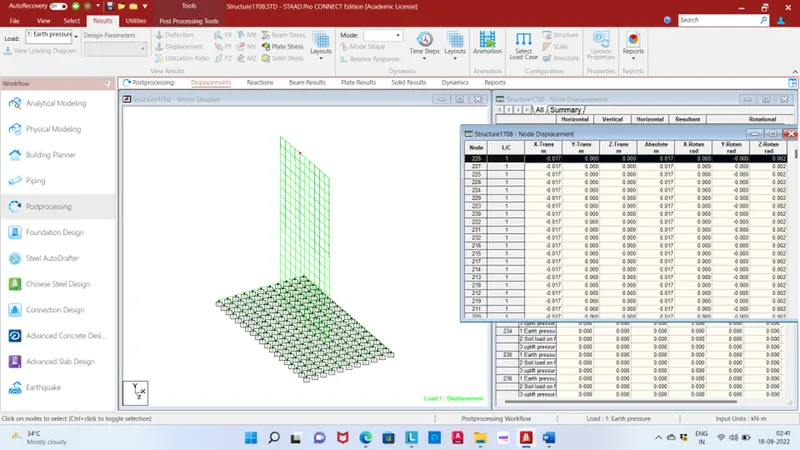
Max. Node displacement in X translational node no. 226, load case no. 1 value -0.17m
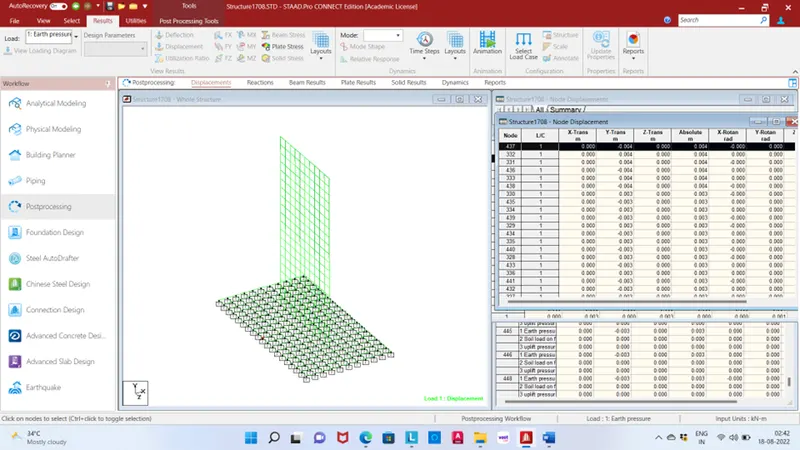
Max. Node displacement in Y translational node no. 437, load case no. 1 value -0.004m
Max. Node displacement in Z rotational node no. 145, load case no. 1 value 0.002m
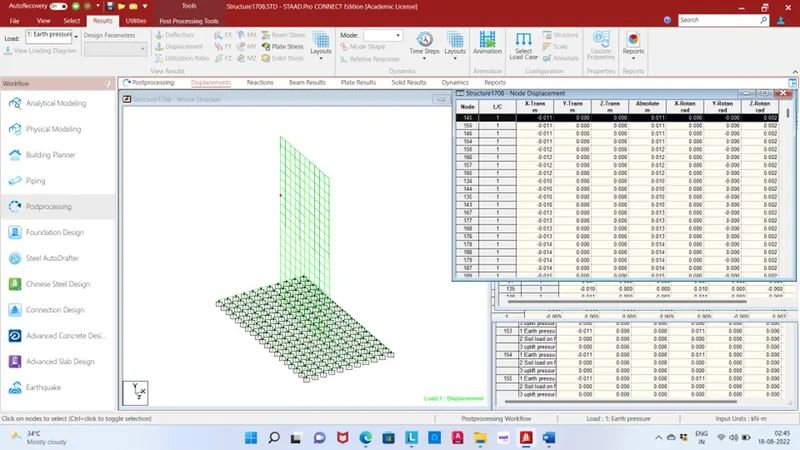
Plate:
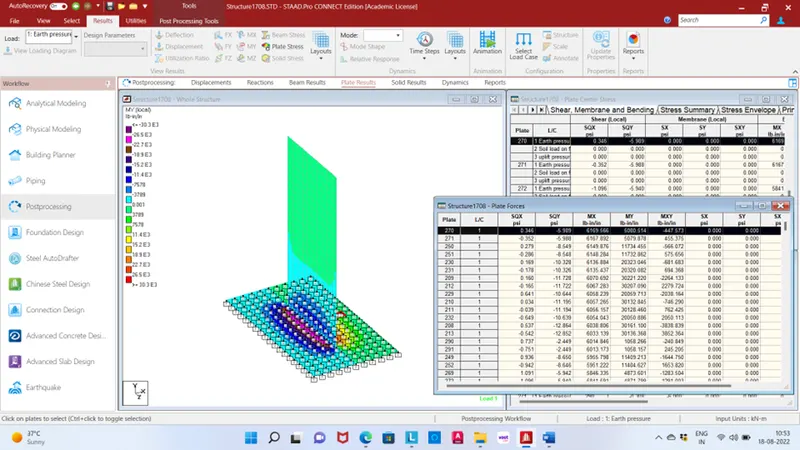
Max. bending stress in Mx direction plate no. 270, load case no. 1 value 6169.566Lb-in/in
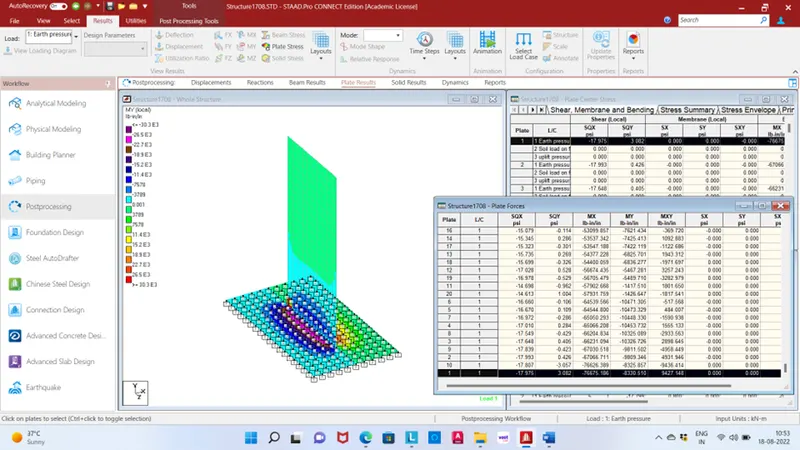
Min. bending stress in Mx direction plate no.1, load case no. 1 value -76675.186Lb-in/in
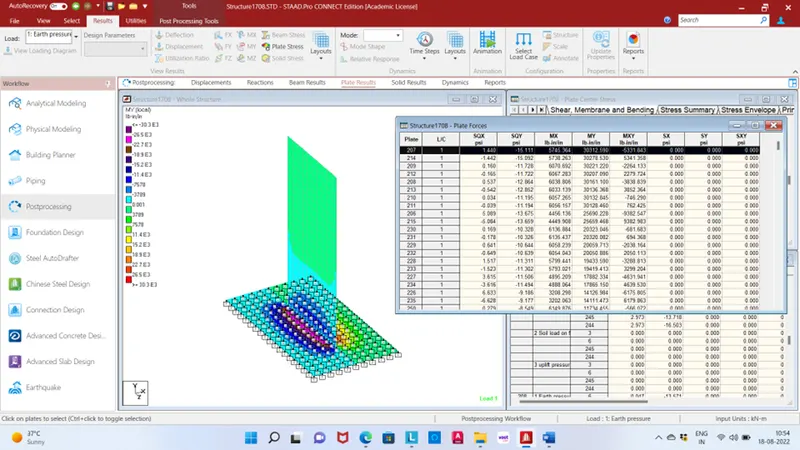
Max. bending stress in My direction plate no. 207, load case no. 1 value 30312.590Lb-in/in
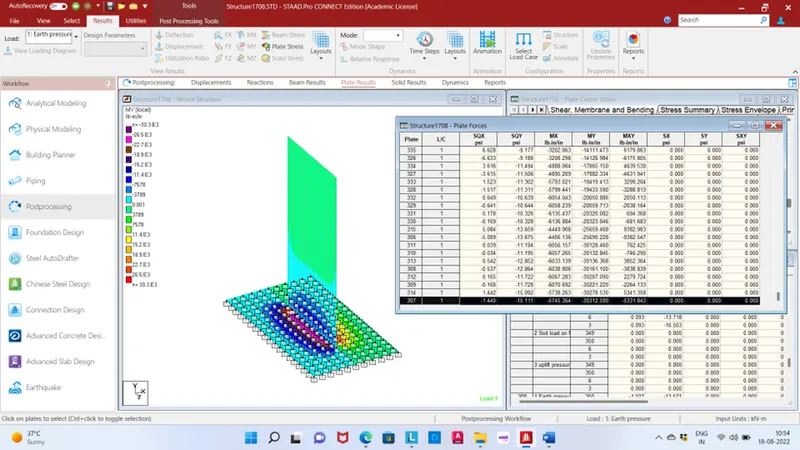
Min. bending stress in My direction plate no. 307, load case no. 1 value -30312.590Lb-in/in
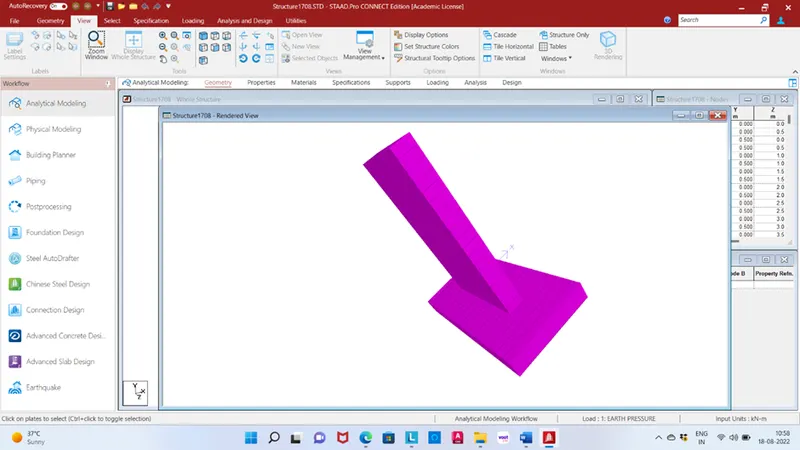
3D view