Combustion Efficiency Calculation after Preheating
Introduction
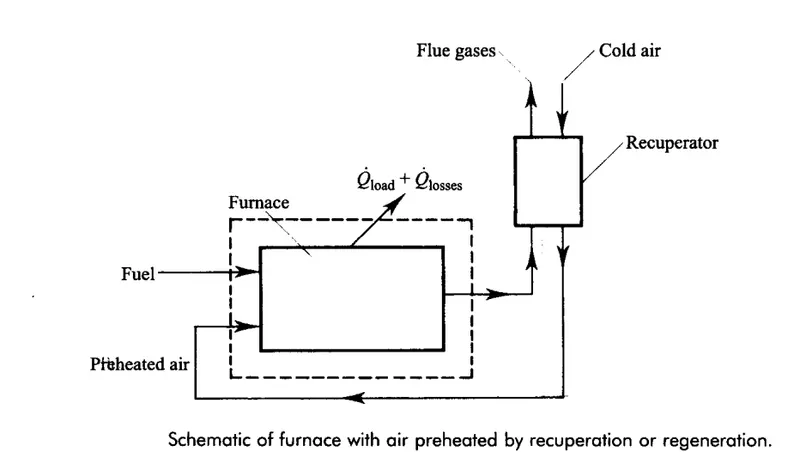
A recuperator is a device where hot air from flue gases is used to pre-heat air that is supposed to mix with fuel. Heat transfer can occur through radiation, or through combustion.
Aim
In this study the following will be analyzed and studied:
1. The effect of preheating adiabatic temperature from (298 to 600K)
2. Understanding whether pre-heating increases combustion efficiency
For both parts, first only the results and code explaination will be provided. Later, in the discussion section the observations will be discussed.
Part 1
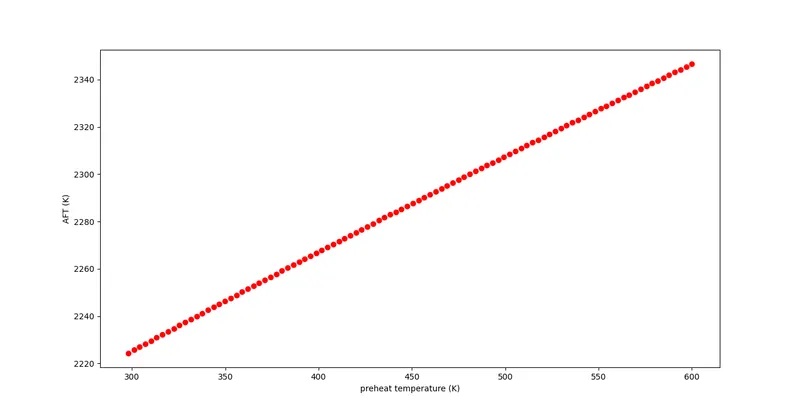
Effect of preheating on AFT.
Code:
import cantera as ct
import math
import numpy
import matplotlib.pyplot as plt

gas = ct.Solution('gri30.cti')

#Fuel
B = ct.Quantity(gas)
B.TPX = 298.15,ct.one_atm,{'CH4':1546}
B.moles = 1

#Air
A = ct.Quantity(gas)

temperature_array = numpy.linspace(298,600,100)
#print(temperature_array)

for temp in temperature_array:
	A.TPX = temp,ct.one_atm,{'O2':0.21,'N2':0.79}
	A.moles = 9.52

	M = A+B
	M.equilibrate('HP')
	#rint(M.T)
	plt.plot(temp,M.T,'o',color = 'red')

plt.xlabel('preheat temperature (K)')
plt.ylabel('AFT (K)')
plt.show()
Explaination:
The gas object is initalized from the soultions class ct in cantera
B represents CH4 for a basic stoiciometric combustion at standard temperature and pressure conditions.
A represents the air, whose mole fractions are specified for O2 and N2 as 0.21 and 0.79.
A.moles sets the number of moles of fuel to 9.52 (4 moles of O and 7.52 moles of N = 9.52 total moles).
An array consisting the variation of temperature is also defined, and a simple for loop is run.
Result:
Part 2
Understanding whether preheating affects combustion efficiency.
Heat tansferred out of the control volume (Qload + Qlosses):

Combustion efficiency:

Code:
import cantera as ct
import math
import numpy
import matplotlib.pyplot as plt

gas = ct.Solution('gri30.cti')
LHV = 50e6
A_F = 17.1

#Fuel
B = ct.Quantity(gas)
B.TPX = 298.15,ct.one_atm,{'CH4':1546}
B.moles = 1
enthalpy_b = B.enthalpy_mass

#Air
A = ct.Quantity(gas)

#Products
P = ct.Quantity(gas)
P.TPX = 1700, ct.one_atm,{'CO2':0.094,'H2O':0.189,'N2':0.715}
P.moles = 10.56


temperature_array = numpy.linspace(298,600,100)
#print(temperature_array)

for temp in temperature_array:
	A.TPX = temp,ct.one_atm,{'O2':0.21,'N2':0.79}
	A.moles = 9.52

	Q = ((A.mass*A.h) + ((B.mass)*B.h - (P.mass)*P.h))
	efficiency = Q/(LHV*B.mass)


	plt.plot(temp,efficiency,'o',color = 'red')

"""
plt.xlabel('preheat temperature (K)')
plt.ylabel('AFT (K)')
plt.show()
"""
plt.xlabel('preheat temperature (K)')
plt.ylabel('combustion efficiency')
plt.show()
Result
Fuel saving = 1 - (efficiency 298/600)
= 1 - (0.33/0.45)
= 26 % aprox
Discussion
Part 1
Preheating temperature leads to a linear rise in the AFT between 298 to 600 K. This affect can be attributed to dissociation and to the larger specific heat of gases when compared to air.
Part 2
A 26% fuel saving is seen due to preheating.
It is wrong to assume a constant value at the furnace of 1700 K as different compositions of fuel may change this temperature, and provide us with completely different values.