Week 4.2 - Combustion Efficiency Calculation after Preheating
Combustion Efficiency Calculation after Preheating
AIM
- In this assignment, we shall calculate the effect of preheating on the adiabatic flame temperature by changing the pre-heating temperature(PHT) from 298K to 600K. Also, we will cross-verify whether preheating helps with fuel saving by plotting the effect of pre-heat temperature on combustion efficiency.
THEORY
- A recuperator is a special purpose counter-flow energy recovery heat exchanger positioned within the supply and exhaust air streams of an air handling system, or in the exhaust gases of an industrial process, in order to recover the waste heat. Generally, they are used to extract heat from the exhaust and use it to preheat air entering the combustion system. In this way they use waste energy to heat the air, offsetting some of the fuel, and thereby improve the energy efficiency of the system as a whole.
- In many types of processes, combustion is used to generate heat, and the recuperator serves to recuperate, or reclaim this heat, in order to reuse or recycle it. The term recuperator refers as well to liquid-liquid counterflow heat exchangers used for heat recovery in the chemical and refinery industries and in closed processes such as ammonia-water or LiBr-water absorption refrigeration cycle.
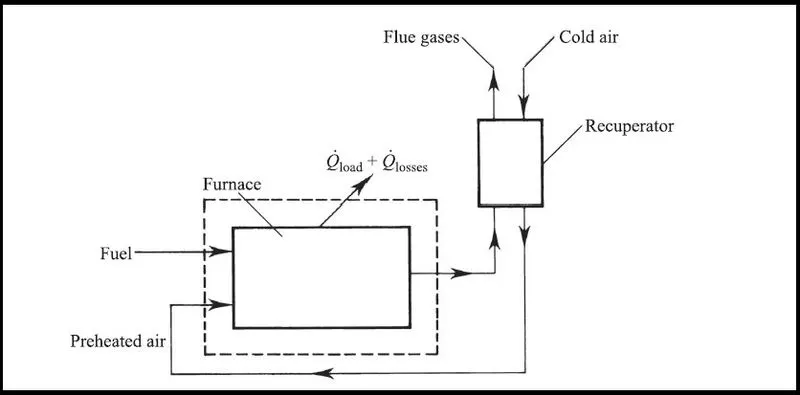
(Fig:A schematic representation of Recuperator activity. Source:Combustion by S R Turns)
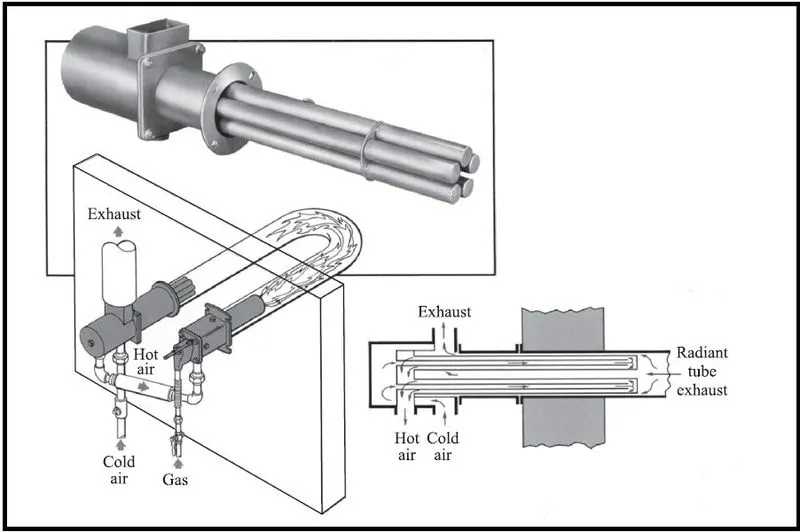
- Recuperators are often used in association with the burner portion of a heat engine, to increase the overall efficiency. For example, in a gas turbine engine, air is compressed, mixed with fuel, which is then burned and used to drive a turbine. The recuperator transfers some of the waste heat in the exhaust to the compressed air, thus preheating it before entering the fuel burner stage. Since the gases have been pre-heated, less fuel is needed to heat the gases up to the turbine inlet temperature. By recovering some of the energy usually lost as waste heat, the recuperator can make a heat engine or gas turbine significantly more efficient.
- Normally the heat transfer between airstreams provided by the device is termed as "sensible heat", which is the exchange of energy, or enthalpy, resulting in a change in temperature of the medium (air in this case), but with no change in moisture content. However, if moisture or relative humidity levels in the return air stream are high enough to allow condensation to take place in the device, then this will cause "latent heat" to be released and the heat transfer material will be covered with a film of water. Despite a corresponding absorption of latent heat, as some of the water film is evaporated in the opposite airstream, the water will reduce the thermal resistance of the boundary layer of the heat exchanger material and thus improve the heat transfer coefficient of the device, and hence increase efficiency. The energy exchange of such devices now comprises both sensible and latent heat transfer; in addition to a change in temperature, there is also a change in moisture content of the exhaust air stream.
- In heating, ventilation and air-conditioning systems, HVAC, recuperators are commonly used to re-use waste heat from exhaust air normally expelled to atmosphere. Devices typically comprises a series of parallel plates of aluminium, plastic, stainless steel, or synthetic fiber, copper alternate pairs of which are enclosed on two sides to form twin sets of ducts at right angles to each other, and which contain the supply and extract air streams. In this manner heat from the exhaust air stream is transferred through the separating plates, and into the supply air stream. Manufacturers claim gross efficiencies of up to 95% depending upon the specification of the unit.
- The characteristics of this device are attributable to the relationship between the physical size of the unit, in particular the air path distance, and the spacing of the plates. For an equal air pressure drop through the device, a small unit will have a narrower plate spacing and a lower air velocity than a larger unit, but both units may be just as efficient. Because of the cross-flow design of the unit, its physical size will dictate the air path length, and as this increases, heat transfer will increase but pressure drop will also increase, and so plate spacing is increased to reduce pressure drop, but this in turn will reduce heat transfer.
- As a general rule a recuperator selected for a pressure drop of between 150–250 pascals (0.022–0.036 psi) will have a good efficiency, while having a small effect on fan power consumption, but will have in turn a higher seasonal efficiency than that for physically smaller, but higher pressure drop recuperator.
- When heat recovery is not required, it is typical for the device to be bypassed by use of dampers arranged within the ventilation distribution system. Assuming the fans are fitted with inverter speed controls, set to maintain a constant pressure in the ventilation system, then the reduced pressure drop leads to a slowing of the fan motor and thus reducing power consumption, and in turn improves the seasonal efficiency of the system.
- Recuperators have also been used to recover heat from waste gasses to preheat combustion air and fuel for many years by metallic recuperators to reduce energy costs and carbon footprint of operation. Compared to alternatives such as regenerative furnaces, initial costs are lesser, there are no valves to be switching back and forth, there are no induced-draft fans and it does not require a web of gas ducts spread up all over the furnace.
- Historically the recovery ratios of recuperators compared to regenerative burners were low. However, recent improvements to technology have allowed recuperators to recover 70-80% of the waste heat and pre-heated air up to 850–900 °C (1,560–1,650 °F) is now possible.
Logic behind this program
The simple logic behind this programming is the extensive use of Cantera and OOP(Object-Oriented-Programming) in Sublime text editor.
Cantera
- Cantera is an open-source suite of tools for problems involving chemical kinetics, thermodynamics, and transport processes.
- Cantera automates the chemical kinetic, thermodynamic, and transport calculations so that the users can efficiently incorporate detailed chemical thermo-kinetics and transport models into their calculations.
- Cantera utilizes object-oriented concepts for robust yet flexible phase models, and algorithms are generalized so that users can explore different phase models with minimal changes to their overall code.
- Cantera can be used from Python and Matlab, or in applications written in C/C++ and Fortran 90.
- Cantera is currently used for applications including combustion, detonations, electrochemical energy conversion and storage, fuel cells, batteries, aqueous electrolyte solutions, plasmas, and thin film deposition.
class cantera.Solution
- A class for chemically-reacting solutions.
- Instances can be created to represent any type of solution – a mixture of gases, a liquid solution, or a solid solution, for example.
- Class Solution derives from classes Thermophase, Kinetics and Transport. It defines no methods of its own, and is provided so that a single object can be used to compute thermodynamic, kinetic, and transport properties of a solution.
- To skip initialization of the Transport object, pass the keyword argument
transport_model=Noneto the Solutionconstructor. - The most common way to instantiate Solution objects is by using a phase definition, species and reactions defined in an input file:
import cantera as ca
gas=ca.Solution('gri30.cti')
class cantera.Quantity
- A class representing a specific quantity of a Solution.
- In addition to the properties which can be computed for class Solution class Quantity provides several additional capabilities.
- A Quantity object is created from a Solution with either the mass or number of moles specified:
import cantera as ca
gas=ca.Solution('gri30.cti')
A=ca.Quantity(gas)- First, we will create an instance of class(Solution) as gas1.
- Once done, we will create two instances of the class gas1 as A and F denoting air and fuel respectively.
- Next, we will be specifying the values of Temperature and Pressure.
- Along with that,we will also be specifying the number of moles of fuel and oxidizer respectively.
- Once done, to plot the variation of Adiabatic flame temperature with the Air temperature which is preheated, we declare empty arrays so that we get a list of values for comparing at the end as shown in the plots below.
- A loop is created to vary the value of preheated air temperature all the way from 300K to 600K.
- Once done, we will be using the extensive tool called matplotlib to visualise the plots.
1. What is the effect of preheating on the adiabatic flame temperature?
The input file for the program require the definition of the fuel by providing the number of carbon, hydrogen, oxygen and nitrogen atoms constituting the fuel molecules, the equivalence ratio, a guess for the adiabatic flame temperature, the pressure and the reactants enthalpy. The input file for this example treating natural gas as methane.
Procedure
- First of all import cantera and matplotlib to done reaction and different plottings.
- Then define the solution as “gri30.cti”.Then define the quantity function for air and fuel i.e. (O2,N2) and CH4.
- Then define the standerd temperature, pressure and mole fraction for 1 mole fuel.
- Use for loop to calculate preheating temperature from temperature 298 to 600k.Here air moles =9.52.
- Append the air & fuel mixture into the adiabatic flame temperature.
- For mixture use constant enthalpy and pressure solver.
- Finally print and plot the Adiabatic flame temperature & preheating temperature.
#to plot variation of AFT as a function of preheated air
import cantera as ca
import matplotlib.pyplot as plt
import numpy as np
gas1=ca.Solution('gri30.cti')
A=ca.Quantity(gas1)#oxidizer(air)
F=ca.Quantity(gas1)#fuel
F.TPX=300,101325,'CH4:1'
F.moles=1   #no of moles of fuel=1
temp=[]
air_temp=np.linspace(300,601,50)	#different values of Air temp
for i in air_temp:
	A.TPX=i,None,'O2:1,N2:3.76'
	A.moles=9.52	#no of moles of air
	M=A+F
	M.equilibrate('HP')
	temp.append(M.T)
print(temp)
plt.plot(air_temp,temp,color='red',linewidth='2')
plt.title('Variation of AFT with preheating')
plt.xlabel('Air Temperature')
plt.ylabel('AFT')
plt.grid()
plt.show()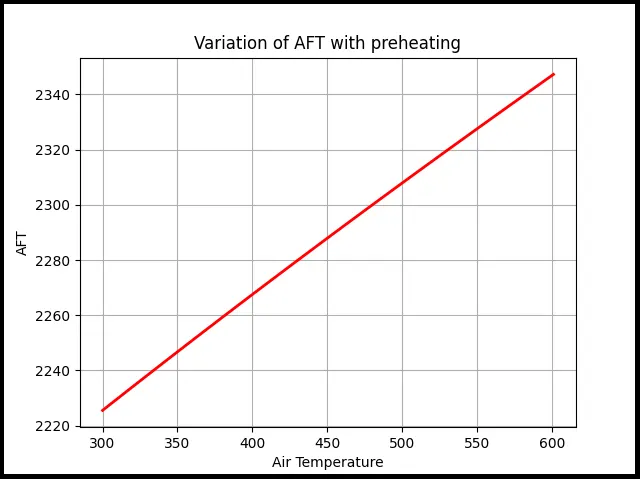
- As can be observed from the above figure , we can infer that the preheating has a major effect on the adiabatic flame temperature attained in the furnace.
- It can be seen that as the air is heated more and more, the fuel spent to increase the temperature will drastically reduce and it also achieves the following:
- Absorption of maximum waste heat from flue gases
- Air preheaters increase the efficiency of the steam boiler by 2% to 3%
- Low payback time
- Enhanced stability by using hot air
- Proper combustion of poor quality fuels
- High heat transfer rate and low heat transfer area requirement
- Reduced unburnt fuel particles result in high combustion efficiency.
Adiabatic Flame Temperature array
2. Does preheating help with fuel saving? If yes, how does combustion efficiency go up as a function of pre-heating temperature?
`eta_(comb)=Q^**/(m_f^**(LHV))`
where `Q^**`->net heat content raised in the system
LHV->Lower heating value of the fuel
`m_f^**`->mass flow rate of fuel
The above equation can be modified as:
`eta_(comb)=(-([A/F]+1)*h_(pro)-(A/F)*h_A-h_F)/(LHV)`
where A/F->Air to fuel ratio
`h_(pro)`->enthalpy of products
`h_A &h_f`->Enthalpies of air and fuel respectively.
Procedure
- Here we have three quantity functions i.e. Air, Fuel and Product.
- No of moles of air -> 9.52 and no of moles of fuel-> 1.
- Lower heating value is i.e. LHV = 50MJ/KG.
- For standerd air temperature use O2 & N2 but, for 1700k use CO2, H2O and N2 is 1, 2, 7.52 moles.
- Total moles i.e. Product moles is 10.52.Use the formula for mass of air-fuel = mass_air/mass_fuel.
- Then calculate efficiency for 298k by using the formula.For calculating preheat temperature, efficiency and fuel saving use for loop.
- Calculate efficiency at 600k.From two efficiency calculate fuel savings.
# to plot the variation of efficiency as a function of preheat temperature
import cantera as ca
import matplotlib.pyplot as plt
import numpy as np
import math as ma
"""efficiency=Output/Input
Input is the Lower heating value of the fuel-50MJ/kg
formula is n=-([(A/F)+1]h_prod -(A/F)h_A -h_f)/LHV
where A/F-Air-fuel ratio  || h_prod->Enthalpy of product ||
h_A->Enthalpy of air || h_f->Enthalpy of fuel"""
gas1=ca.Solution('gri30.cti')
A=ca.Quantity(gas1)	#Air
F=ca.Quantity(gas1)	#Fuel
P=ca.Quantity(gas1)
pre_heat_temp=np.linspace(300,601,50)
eff=[]
for i in pre_heat_temp:
	A.TPX=i,ca.one_atm,'O2:1,N2:3.76'
	A.moles=9.52
	F.TPX=298.15,ca.one_atm,'CH4:1'
	F.moles=1
	M=A+F          #mixture of air and fuel
	M.equilibrate('HP')
	h_prod=M.h
	h_A=A.h
	h_f=F.h
	LHV=50*ma.pow(10,6)
	P.TPX=1700,ca.one_atm,'CO2:1,H2O:2,N2:7.52'
	P.moles=10.52
	h_P=P.h
	Air_to_Fuel_ratio=17.16	#which is calculated by dividing mass of air by mass of methane
	#calculate efficiency
	efficiency=((A.mass*h_A)+(F.mass*h_f)-(P.mass*h_P))/(F.mass*LHV)
	eff.append(efficiency)
#calculate savings
#savings=1-(efficiency(at298K)/efficiency(600K))
savings=1-(eff[0]/eff[49])
print(savings)
print(F.report())
print(eff)
plt.plot(pre_heat_temp,eff,color='red')
plt.grid()
plt.xlabel('Air Temperature')
plt.ylabel('Efficiency of furnace')
plt.title('Variation of efficiency as a function of increasing preheat temperature')
plt.show()
The fuel saving is calculated as
`SAVINGS=(m_(F,600K)^* - m_(F,298K)^*)/m_(F,600K)^*`
which can be written as `SAVINGS=1-(eta_(298K)/eta_(600K))`=0.23
Efficiency array:

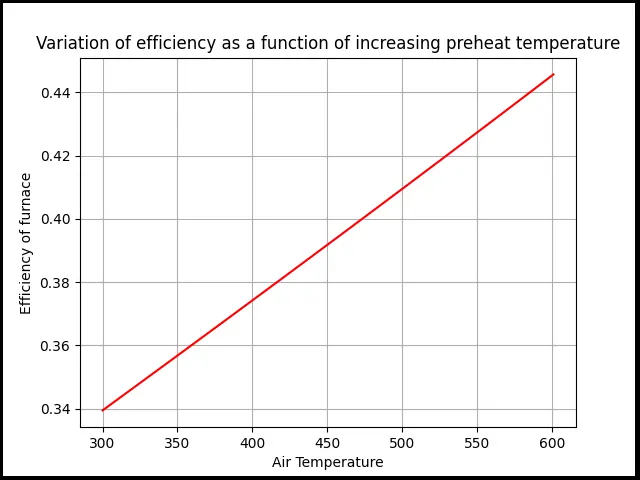
- Because of preheating the air, the efficiency of combustor has improved showing variations north of 40%.
- Which ideally states that a combustor is better efficient at higher temperatures.
- Now this may sound dorky, but the material constraints that are used on combustor liner have their limitations and hence we cannot preheat the air as such.
- Combustor material presents its own constraints.
- At 300K, the efficiency is 34%. At 600K, the efficiency is 44%.
- Better efficiency of the combustor leads to better usage of fuel energy and hence better performance of the combustor.
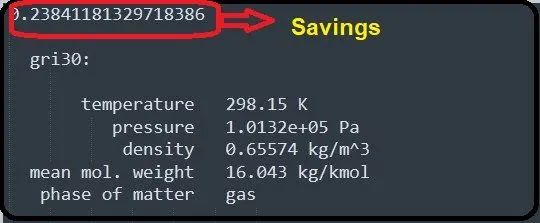
- By preheating the air, we can achieve fuel saving upwards of 23%.
- The exit temperature depends upon the product temperature of the reaction which is necessary for the recuperator to preheat the air.
- If the exit temperature of the high then the preheating of the air will be faster which will help in increasing the thermal efficiency or the combustion efficiency which in turns helps in saving the fuel.
- This means that the exit temperature is directly proportional to the preheat temperature of the air.
Conclusion
Thus the Combustor efficiency has been calculated by varying the Air temperature and the results are studied.