Week 4.2 - Combustion Efficiency Calculation after Preheating
1. Effect of preheating on aft, inlet temperature from 298 to 600 K
The methane is mixed with air in a furnace with recuperator (preheating)
CH4 + 2(O2 + 3.76N2) = CO2 + 2H2O + 7.52N2
Methane is considered as Fuel, Air is Oxygen and Nitrogen, products are (CO2, H2O, and N2)
Effect of preheating on AFT
import cantera as ct
import matplotlib.pyplot as plt
import numpy as np

gas = ct.Solution('gri30.cti') # gas instance for Solutions class

methane = ct.Quantity(gas) # fuel instance for Quantity class
methane.TPX = 298.15, ct.one_atm, 'CH4:1'
methane.moles =1 # One Mole of CH4 for leaner mix


air = ct.Quantity(gas) # air instance for Quantity class
Temperature = np.linspace(298,600,50) # 50 temperature intervals between 298 to 600 K


for T_pre in Temperature:
	air.TPX = T_pre, ct.one_atm, {'O2':0.21, 'N2':0.79}
	air.moles = 4.76*2 # 1 mol O2 + 3.76 mol N2 = 4.76 mol air

	M = methane + air # combined instance of methane & air
	M.equilibrate('HP', 'auto')

	print(M.T) # Print AFTs only
	plt.plot(T_pre,M.T, 'o')


plt.xlabel('Preheating Temperature')
plt.ylabel('Adiabatic Flame Temperature')
plt.title('Effect of preheating on AFT')
plt.show()
Plot
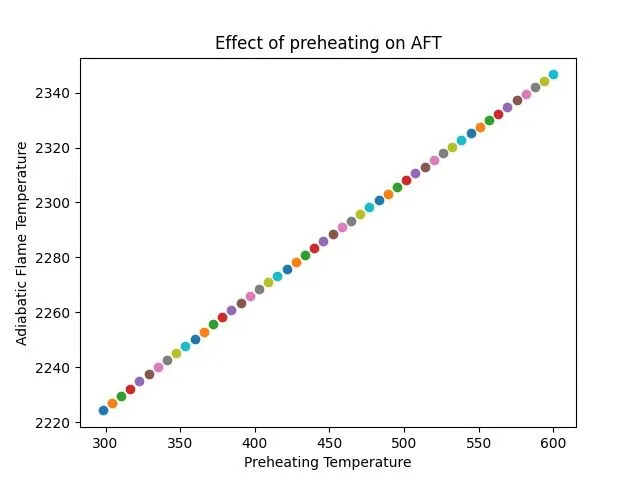
Observation : AFT increases as preheating temperature increases linearly.
2.How does combustion efficiency go up as a function of pre-heating temperature? Say exit temperature is 1700K
Formulae used in the code:
- Availabe heat at outlet = outlet heat/mass of fuel
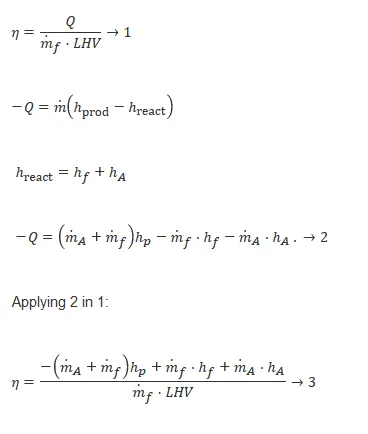
combustion gain efficiency = (available heat generated) / (maximum possible heat generation) => η=Q / (m_f * LHV)
where, m is mass flow rate of (a=air , f =fuel)
LHV is lower heating Value ,ie, Heat extraction value from fuel
h is enthalpy
hp is enthalpy of Exhaust gas
Stoichiometry combustion reaction of CH4 with air
CH4 + 2(O2 + 3.76N2) = CO2 + 2H2O + 7.52N2
mole fraction of CH4 = 1/(1+2+7.52) = 0.095
mole fraction of O2 = 2/(1+2+7.52) = 0.190
mole fraction of N2 = 7.52/(1+2+7.52) = 0.714
number of moles at reagent side = 1+2+7.52 = 10.52
Effect of preheating on Efficiency
import numpy as np
import matplotlib.pyplot as plt
import cantera as ct

gas = ct.Solution('gri30.cti')

Temperature = np.linspace(298, 600, 50) # pre-heating range from 298 to 600K
LHV = 50*pow(10,6) #  Assume the LHV of combustion of Methane as 50 MJ/KG.

fuel = ct.Quantity(gas)
fuel.TPX = 298.15, ct.one_atm, {'CH4':1} # 1 mole of CH4 at STP
fuel.moles = 1


products = ct.Quantity(gas)
products.TPX = 1700, ct.one_atm, {'CO2':0.095, 'H2O':0.190, 'N2':0.714} # Furnace Exit Temperature 1700 K , moles calculated above in explaination
products.moles = 10.52 # Total moles of Air and Fuel in the Reactants side


for T_pre in Temperature:
	air = ct.Quantity(gas)
	air.TPX = T_pre, ct.one_atm, {'O2':0.21, 'N2':0.79}
	air.moles = 2/0.21 # mole fraction of O2 in air = 0.21 conributing to burning of fuel

	Q = ((air.mass*air.h) + ((fuel.mass)*fuel.h - (products.mass)*products.h ))/fuel.mass # Total Heat FLowing out after combustion includes losses as well


	efficiency = (Q/LHV)
	plt.plot(T_pre, efficiency, 'o')


plt.xlabel('Pre Heating Temperature')
plt.ylabel('efficiency')
plt.title('Effect of preheating on efficiency')
plt.show()
PLOT
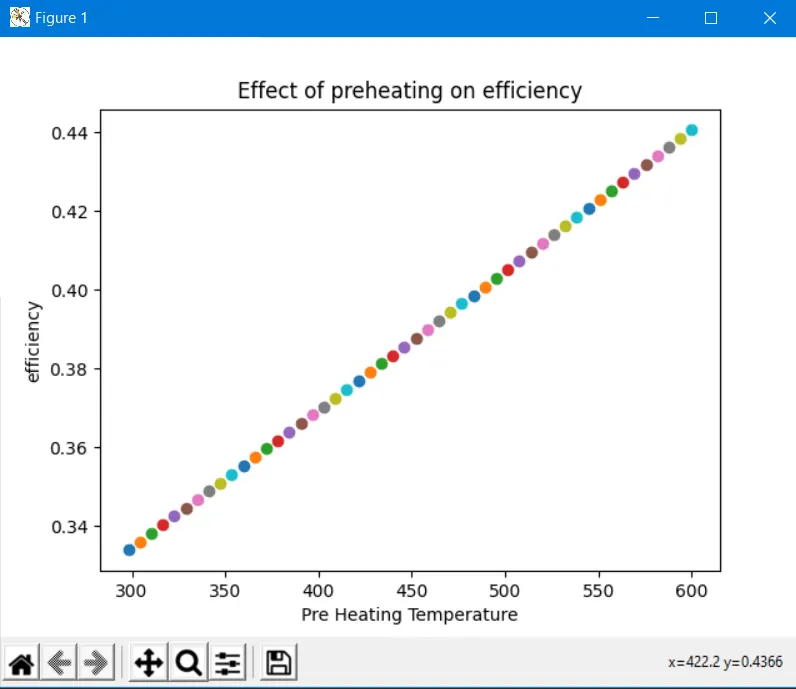
Observation: Efficiency is directly proportional to preheat temperature and recuperator benefits the overall heat output to fuel burn ratio .