Week 4.2 - Combustion Efficiency Calculation after Preheating
A recuperator is a heat exchanger in which energy from a steady flow of hot combustion products, i.e., flue gases, is transferred to the air supplied to the combustion process. A general flow diagram is shown in the figure below.
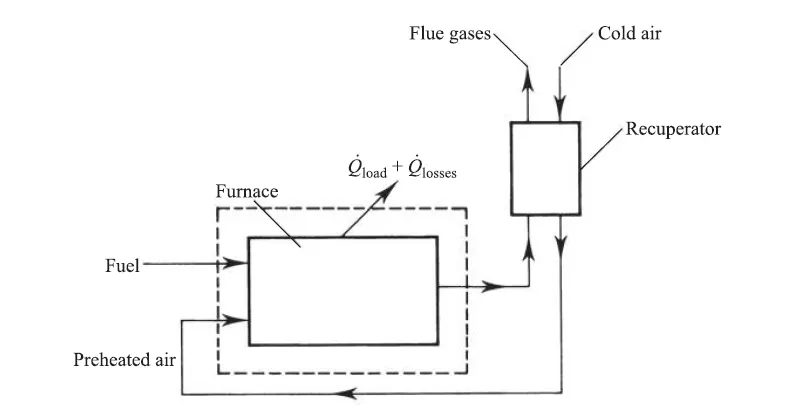
Fig. Schematic of the furnace with air preheated by recuperator
A wide variety of recuperators is used in practice, many of which employ radiation heat transfer from the flue gases, as well as convection. An example of a recuperator for an indirect-fired application is illustrated in the figure below.
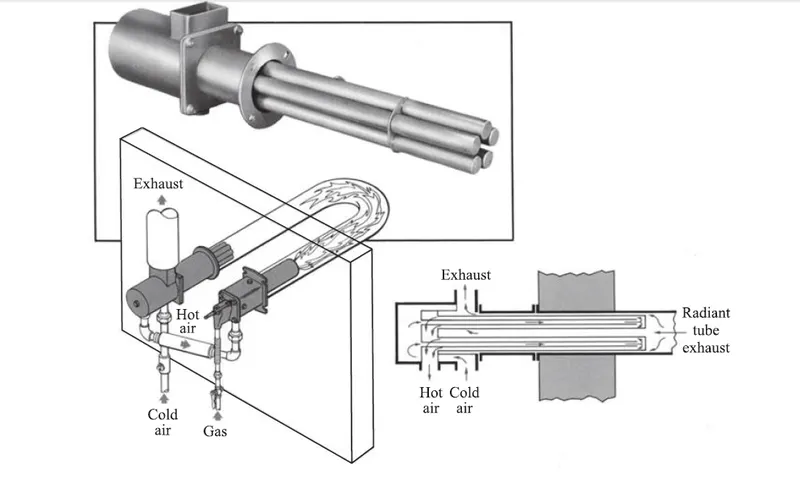
Fig. Radiant-tube burner with coupled recuperator for indirect firing
- What is the effect of preheating on the adiabatic flame temperature?
- Change pre-heating from 298 to 600K
- Explain your results
1.
import cantera as ct
import matplotlib.pyplot as plt

gas = ct.Solution('gri30.cti')


B = ct.Quantity(gas)
B.TPX = 298.15,ct.one_atm,'CH4:1'
B.moles=1
T_pre = []
AFT = []

for T in range(298,600):
	A = ct.Quantity(gas)
	A.TPX = T,ct.one_atm,{'O2':0.21,'N2':0.79}
	A.moles=9.52
	T_pre.append(T)

	M=A+B
	M.equilibrate('HP')
	AFT.append(M.T)

	if (T%10==0):
		plt.plot(T_pre,AFT,'-',color='red')
plt.title('AFT Vs Preheated Inlet Air')
plt.xlabel('Preheated Air (K)')
plt.ylabel('Adaibatic Flame Temperature(K)')
plt.show()
Output:
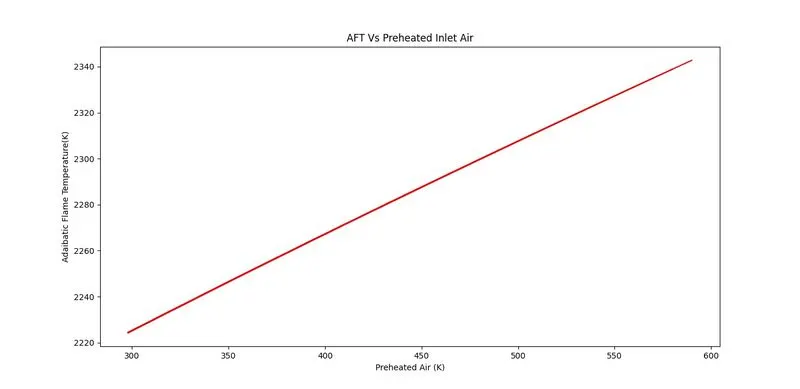
From the Ablove plot it can be concluded that with the increase in temperature of inlet air the Adiabatic flame temperature also gets increased and which is treated as a big advantage.
2. Does preheating help with fuel saving? If yes, how does combustion efficiency go up as a function of pre-heating temperature? Assume that the furnace exit temperature is 1700K (For this case assume that the combustion products are CO2, H20, and N2).
- Write the formula for combustion efficiency
- Plot the effect of pre-heat temeprature on combustion efficiency
- Is it right or wrong to assume a fixed furnace exit temperature? Explain your answer.
Combustion Efficiency:
`(m_(fuel)*H_(fuel)+m_(air)*H_(air))-Q_(out)-m_(exhaust)*H_(exhaust)=0`
`Q_(out)=(m_(fuel)*H_(fuel)+m_(air)*H_(air))-m_(exhaust)*H_(exhaust)`
also,
`m_(fuel)+m_(air)=m_(exhaust)`
Rearranging we get:
`eta_(combustion)=(Q_(out)/((m_(fuel)*LHV)))*100`
import cantera as ct
import matplotlib.pyplot as plt

gas = ct.Solution('gri30.cti')


B = ct.Quantity(gas)
B.TPX = 298.15,ct.one_atm,'CH4:1'
B.moles=1
T_pre = []
AFT = []

# In the Q calculation we have to calculate the product enthaly and mass of products. So introducing the product object for those calculations.
P = ct.Quantity(gas)
P.TPX = 1700,101325,{'CO2':0.095,'H2O':0.1901,'N2':0.7148}
P.moles = 10.92

h_b = B.h
m_b = B.mass
eff=[]

for T in range(298,600):
	A = ct.Quantity(gas)
	A.TPX = T,ct.one_atm,{'O2':0.21,'N2':0.79}
	A.moles=9.52
	T_pre.append(T)
	h_a = A.h
	m_a = A.mass

	#  Substituted the enthalpy of products and mass of the prodcuts in the Q equation.
	h_p = P.h
	m_p = P.mass

	LHV = 50000000

	Q = ((h_a*m_a)+(h_b*m_b)-(h_p*m_p))
	efficiency = Q/(m_b*LHV)
	eff.append(efficiency)
	print(efficiency)

plt.plot(T_pre,eff)
plt.title('AFT Vs Efficiency')
plt.xlabel('Efficiency')
plt.ylabel('Adaibatic Flame Temperature(K)')
plt.show()
plt.show()
Output:
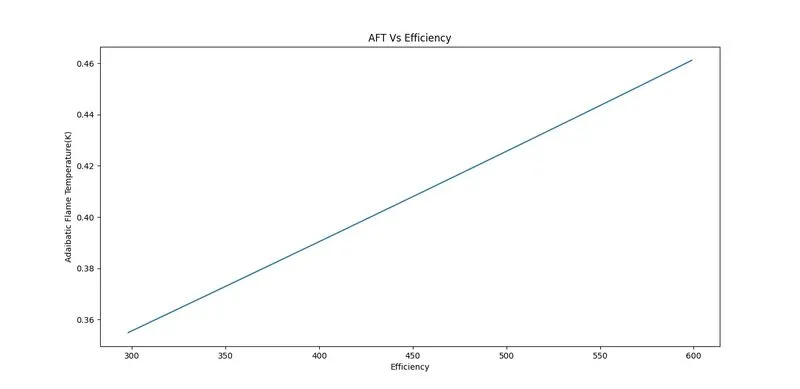
Fuel saving = 1- (efficiency with no preheat/ efficiency with preheat)
At 298 K, efficiency=0.33
At 600 K, efficiency=0.46
fuel saving = 0.2826%
It can be concluded-
- With increase in Adiabatic flame temperature the combustion efficiency also increases.
- There is also fuel savings
- By keeping the exit temperature at constant value we get a control over the process and can get the desired results.