Combustion Efficiency Calculation after Preheating
Aim: To
- Explain the effect of Pre-heating of oxidizer on AFT.
- Explain how combustion efficiency increases as a function of pre-heating temperature
1. Introduction:
After combustion process, exhaust gases will be at high temperatures. This energy can be utilized by using a device called Recupeator. While the hot exhaust is being driven out, at the same time fresh air enters through recuperator in a different channel. This allows for the heat transfer between high temperature exhuast and low temperature oxidizer or air. This process of heating the oxidizer before combustion is called Pre-heating.
Effect of pre-heat temperature on fuel saving:
Air without pre-heating will have low energy (kinetic energy of molecules). So in this scenario high temperature has to be maintained for proper mixing of air and fuel. Even after maintaining high temperature, some portion of air or fuel might not recieve the heat and may not participate in the reaction, due to there will be unburned hydrocarbons - which mean waste of fuel.
Now, the same quantity of air, when preheated will have higher energy to diffuse through and react with the fuel. Since most the air will be at high temperature, no amount of fuel will be left unburned. This way fuel can be saved by pre-heating the air.
2. Coding approach:
- Cantera is imported and quantity class is created for air and methane.
- Pre-heat temperature is varied from 298k to 600k.
- Number of moles are defined for stoichiometric combustion.
- AFT is calculated for every value of pre-heat temperature and plotted against pre-heat temperature in the first case.
- For the second case, exhaust properties are defined.
- Enthalpies of Methane, air and exhaust are defined using pre-defined function to calculate combustion efficiency.
- Combustion efficiency is calculated using the formula mentioned in section 3.2.
- Combustion efficiency is plotted against pre-heat temperature.
3. Code and the results:
3.1 Case 1: Effect of pre-heating on AFT
3.1.1 Code
import cantera as ct
import numpy as py
import matplotlib.pyplot as plt

gas = ct.Solution('gri30.cti')

Air = ct.Quantity(gas)
Air.pre_heat_temp = py.linspace(298,600,5)#Creating an array containing various pre-heat temperatures of the oxidizer

AFT = []

Methane = ct.Quantity(gas)
Methane.TPX = 298.15,ct.one_atm,'CH4:1'
Methane.moles = 1

for a in range(0,len(Air.pre_heat_temp)):

	Air.TPX = Air.pre_heat_temp[a],ct.one_atm,{'O2':0.21,'N2':0.79}
	Air.moles = 9.52

	Mixture = Methane + Air

	Mixture.equilibrate('HP')
	AFT.append(Mixture.T)
	print(Mixture.T)#Printing every value of AFT

plt.plot(Air.pre_heat_temp,AFT,color='orange')
plt.xlabel('Pre-heat temperature of air')
plt.ylabel('Adiabatic Flame Temperature')
plt.title('Variation of AFT wrt change in pre-heat temperature')
plt.show()
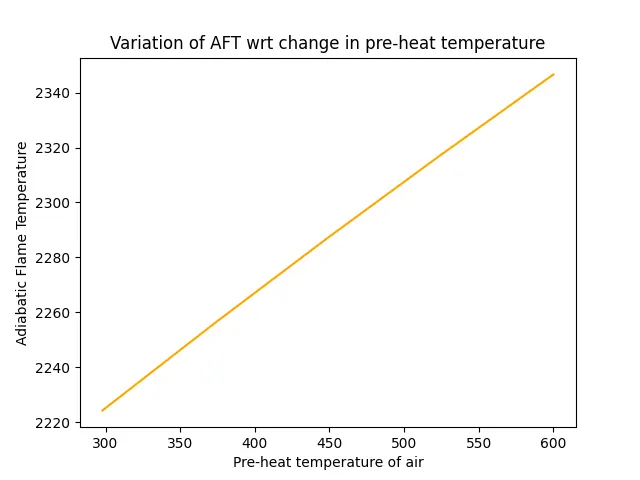
In this case, the pre-heat temperature is varied from 298k to 600k. A total of 5 values are considered.
3.1.2 Results:
 -Fig1
-Fig1 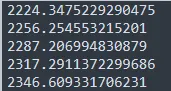 -Fig2
-Fig2
- The above images represents AFT for preheat temperatures ranging from 298k to 600k respectively. It can be observed in the above images that AFT increases with increasing pre-heat temperature.
- The addition of extra heat during the process of pre-heating is responsible for increased AFT. In this case the first temperature is 298k and the next pre-heat temperature is 373.5k, which means 75k increase. Similarly till 600k, a uniform increase of 75k is carried out.
- The same trend of constant increase in AFT (65k) can be seen in the above image. This means that the heat added is directly proportional to the increase in AFT.
3.2 Case 2: Effect of pre-heating on combustion efficiency
3.2.1 Code
import cantera as ct
import numpy as py
import matplotlib.pyplot as plt

gas = ct.Solution('gri30.cti')

Pre_heat_temp = py.linspace(298,600,5)

Methane = ct.Quantity(gas)
Methane.TPX = 298.15,ct.one_atm,{'CH4':1}
Methane.moles = 1
Enthalpy_fuel = Methane.enthalpy_mass

Exhaust = ct.Quantity(gas)
Exhaust.TPX = 1700,ct.one_atm,{'CO2':0.095,'H2O':0.19,'N2':0.71}
Exhaust.moles = 10.52
Enthalpy_exhaust = Exhaust.enthalpy_mass

T_aft = []
LHV_Methane = 50e6
Efficiency_gain = []

for a in range(0,len(Pre_heat_temp)):

	Air = ct.Quantity(gas)
	Air.TPX = Pre_heat_temp[a],101325,{'O2':0.21,'N2':0.79}
	Air.moles = 9.52
	Enthalpy_air = Air.enthalpy_mass

	Mixture = Methane + Air
	Mixture.equilibrate('HP')
	T_aft.append(Mixture.T)
	print(T_aft)

	Usable_work = (Methane.mass*Enthalpy_fuel + Air.mass*Enthalpy_air - (Exhaust.mass*Enthalpy_exhaust))/Methane.mass

	Efficiency = Usable_work/LHV_Methane
	Efficiency_gain.append(Efficiency)

plt.plot(Pre_heat_temp,Efficiency_gain,'--*')
plt.xlabel('Pre-heat temperature of air')
plt.ylabel('Efficiency gain')
plt.title('Effect of pre-heat temperature on Combustion Efficiency')
plt.show()
The above program is written to understand the effect of pre-heat temperature on combustion efficiency. The formula for combustion efficiency is given by: `eta_c = Q_u/(m_f*LHV)`, where `Q_u`is the heat available for useful work which is the output, `m_f`is the mass of fuel - in this case Methane and LHV is the lower heating value.
Lower heating value is the temperature of products in a combustion reaction, when the latent of heat vaporization of water is not utilized.
3.2.2 Results:
 -Fig3
-Fig3
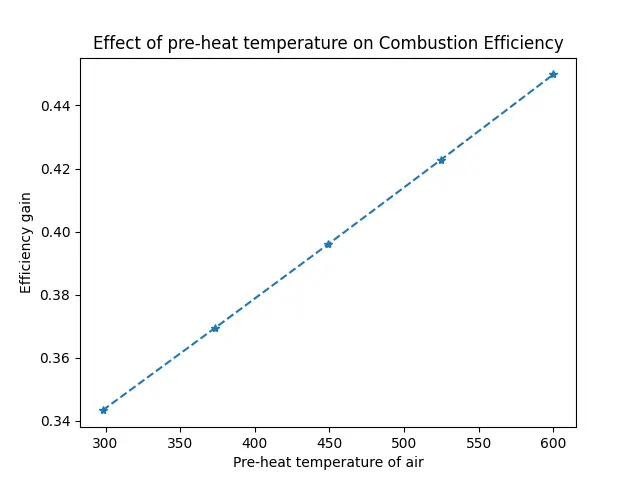
- It can be seen in the above figure that the effciency increases with increase in pre-heat temperature. Pre-heating allows air molecules to reach for fuel in all the areas of the combustion chamber, hence ensuring minimal fuel loss and less unburned hydrocarbons. All of this combined together helps in increasing the efficiency.
- The exhaust temperature when decreased, the combustion efficiency increases. Exhaust temperature can also be called as Furnace exit temperature.
- Furnace exit temperature value can be fixed, but various considerations should be taken into account like the deposition of molten ash over back pass tubes(that carry water) to avoid fouling, over-heating of air causing to the formation of Carbon monoxide, furnace safety, furnace size,etc.
4. Resources:
1. https://www.energy.gov/sites/prod/files/2014/05/f16/et_preheated.pdf