Verification of Weld Joints using Ansys-Workbench
AIM: The aim of this Simulation is to perform a Static Stress Analysis on Weld-joints with different materials but the same load case and will be identifying the Joints experiencing the most force.
OBJECTIVE:
- In this case, the Weld and the plates will have the same materials as Stainless steel.
- In this case, the plates will be stainless steel, and the weld material is Aluminium Alloy.
- In this case, the plates will be stainless steel the ribs as copper, and weld materials like bronze.
PROCEDURE:
Once the Model is uploaded we will be providing the Materials according to the case we are simulating. After the materials are given we will be providing the contact.
All the places where the Weld are connected to the plates are considered Bonded joints and the places where the plates are in contact with each other we give frictional contact. The frictional coefficient will be 0.2.
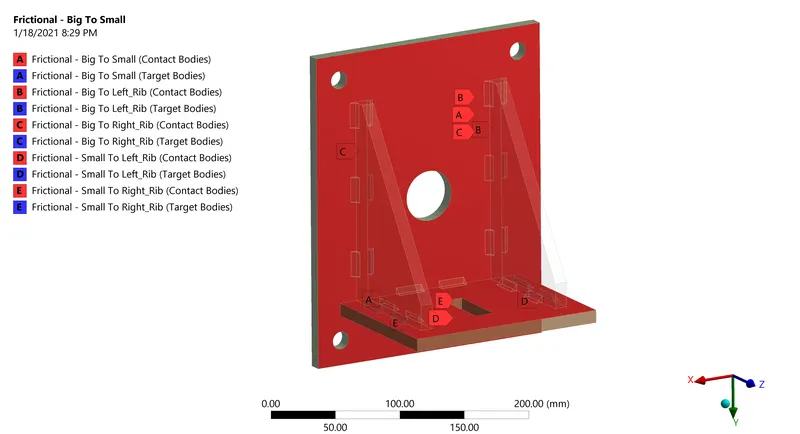
Once the contacts are given we will be meshing the part.
A body sizing of 7mm will be given to the rest of the rectangular plate and the rest of the parts are meshed with the default element size as in ANSYS-WORKBENCH.
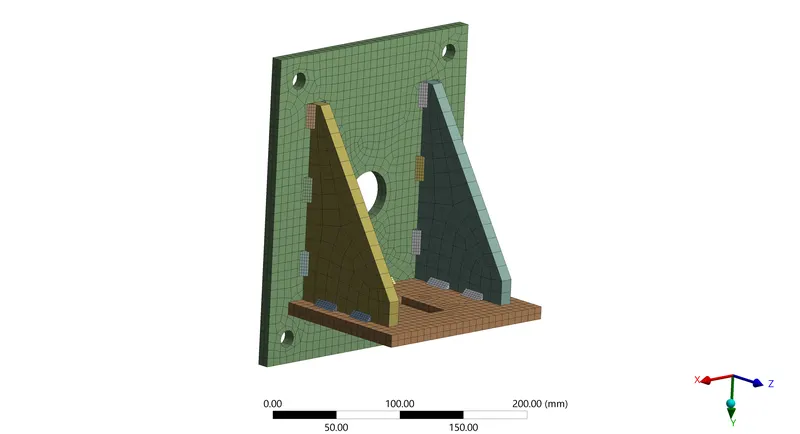
The number of elements is 4168 and the number of nodes is 26031.
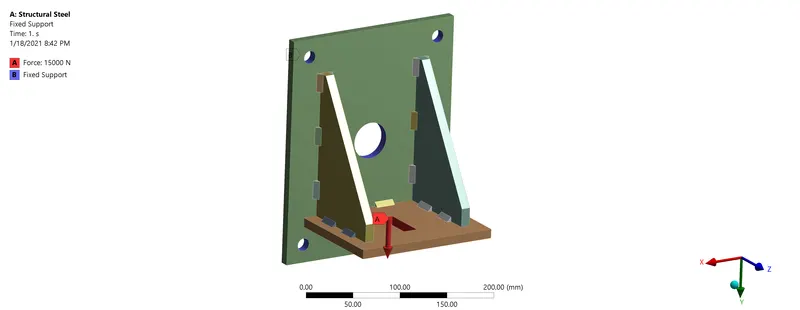
The plates are given Fixed support for the five holes and a load of 15000N is applied at the center rectangular hole.
RESULTS:
CASE:1
Stainless Steel for both weldments and Plates.
Equivalent Stress of the Assembly:
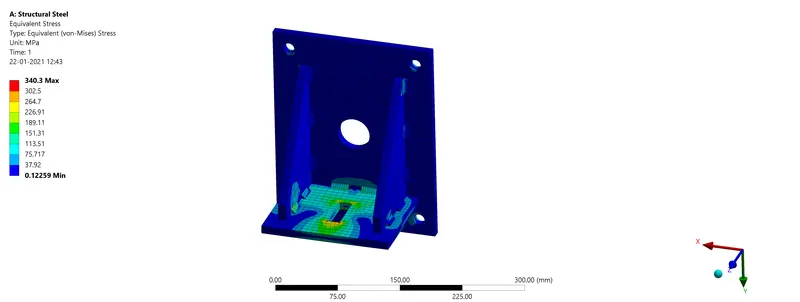
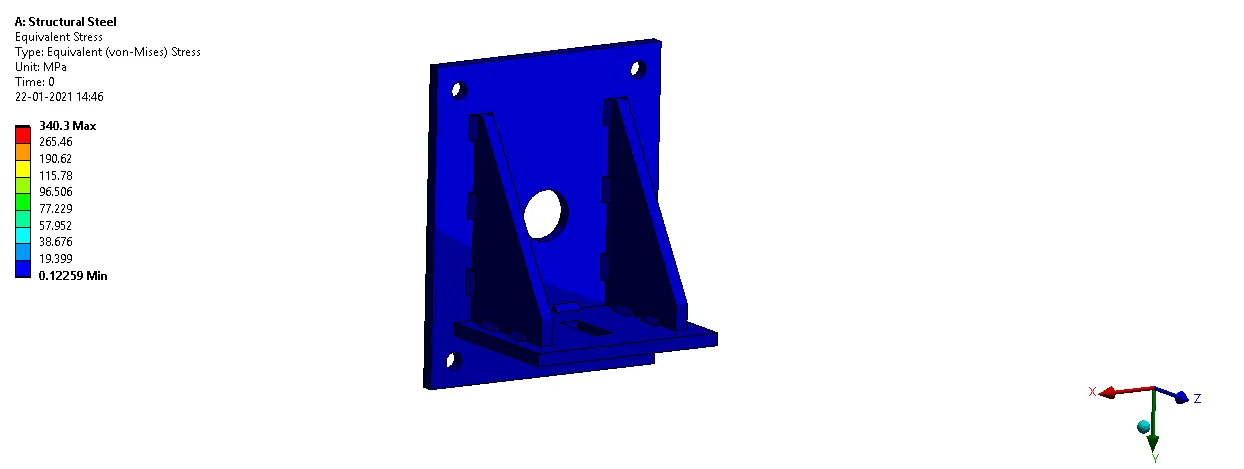
The Maximum Stress in the Assembly is 340.3 Mpa. The maximum Stress formed is more than the yield of the material so the setup is not safe.
Stress at the Welds:
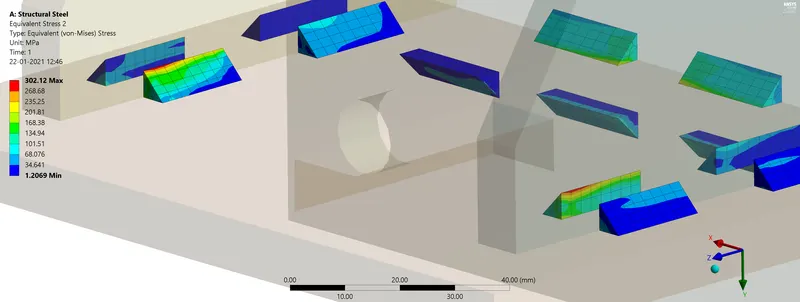
The Maximum Stress formed in the Weld is 302.12 MPa. From the above image, you can see where the maximum stress is formed.
Equivalent Strain of the Assembly:
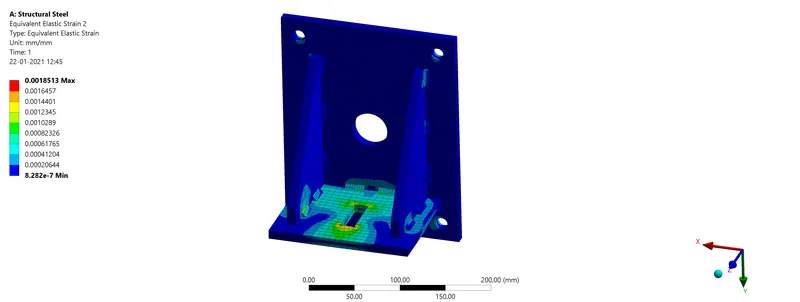
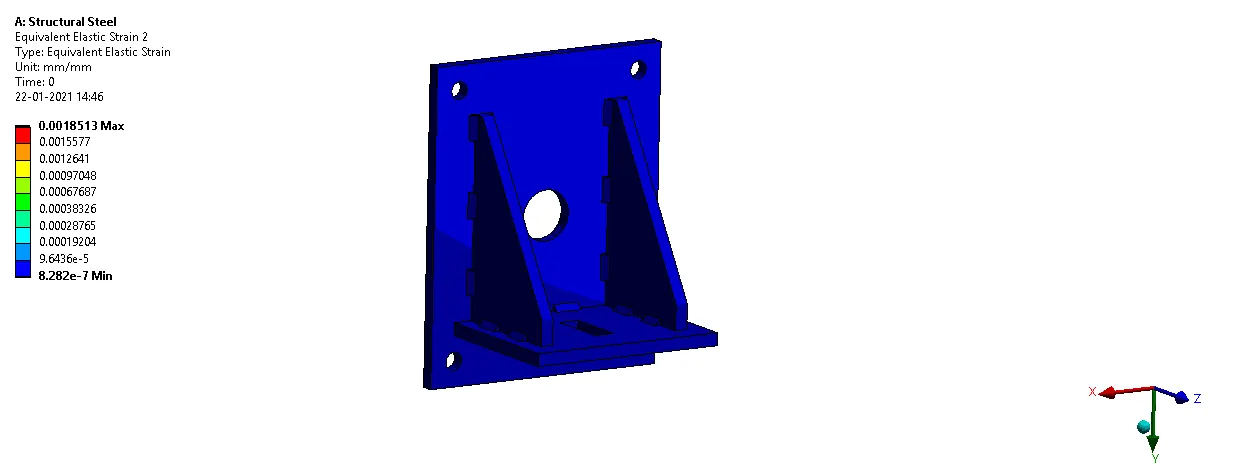
The Maximum Strain formed is 0.0018513 mm/mm.
Directional Deformation of the Assembly(Along y-axis):
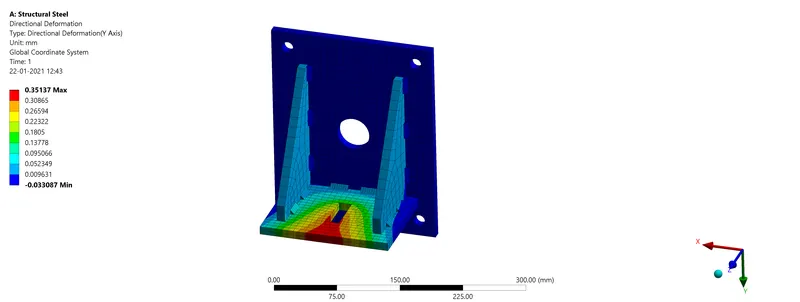
The Maximum deformation formed is 0.35137mm.
CASE:2
Stainless Steel for the Plates and Aluminium Alloy for the Welds.
Equivalent Stress of the Assembly:
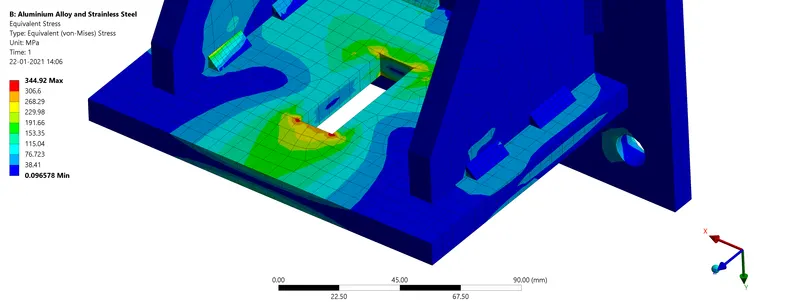
The Maximum Stress in the Assembly is 344.92 Mpa. The maximum Stress formed is more than the yield of the material so the setup is not safe.
Stress at the Welds:
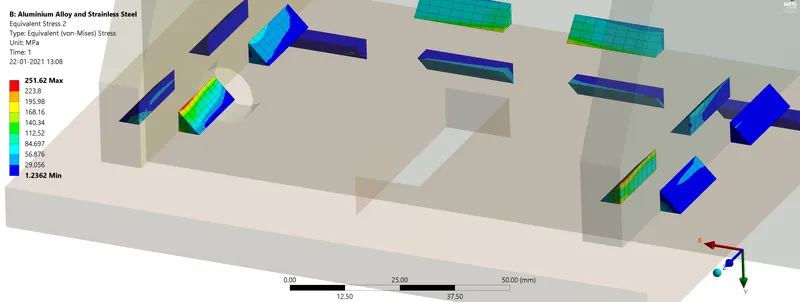
The Maximum Stress formed in the Weld is 251.62 MPa. From the above image, you can see where the maximum stress is formed.
Equivalent Strain of the Assembly:
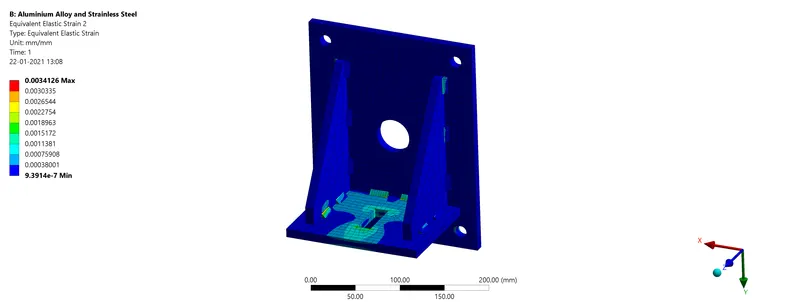
The Maximum Strain formed is 0.0034126 mm/mm.
Directional Deformation of the Assembly(Along y-axis):
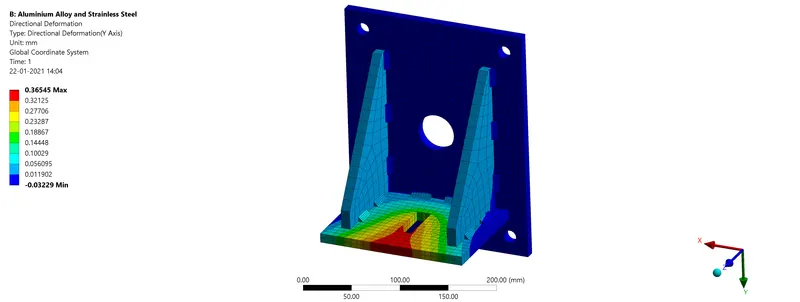
The Maximum deformation formed is 0.36545 mm.
CASE:3
Stainless Steel for the Plates, Bronze for the Welds, and Copper for the two Ribs.
Equivalent Stress of the Assembly:
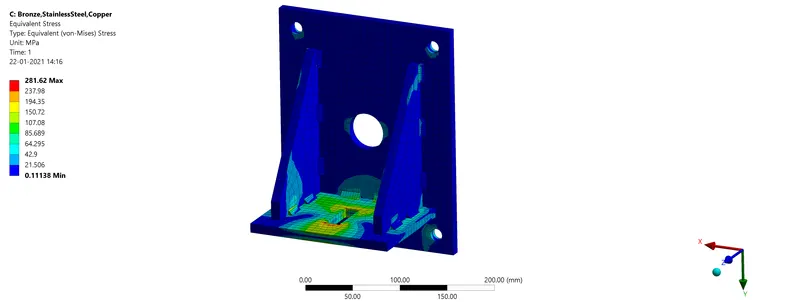
The Maximum Stress in the Assembly is 281.62 Mpa. The maximum Stress formed is more than the yield of the material so the setup is not safe.
Stress at the Welds:
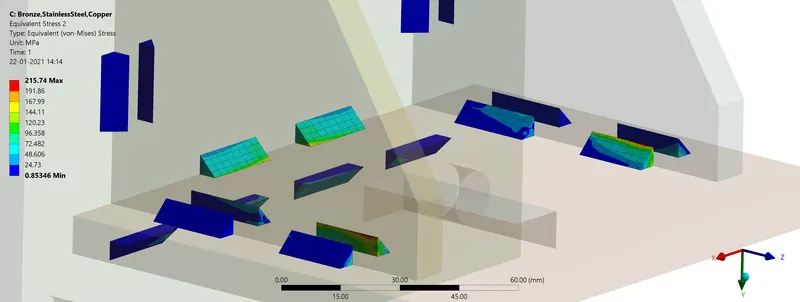
The Maximum Stress formed in the Weld is 215.74 MPa. From the above image, you can see where the maximum stress is formed.
Equivalent Strain of the Assembly:
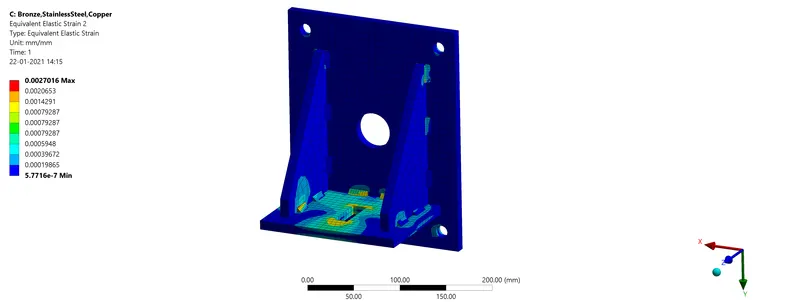
The Maximum Strain formed is 0.0027016 mm/mm.
Directional Deformation of the Assembly(Along y-axis):
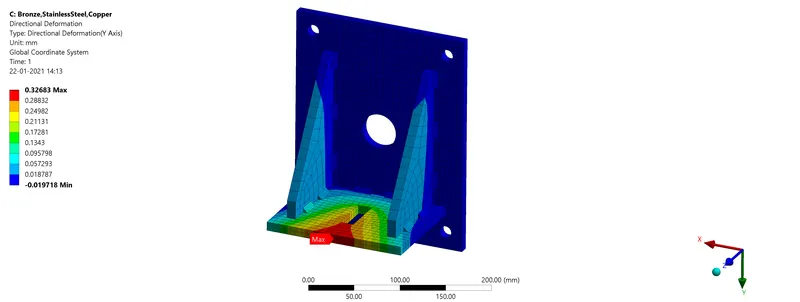
The Maximum deformation formed is 0.32683 mm.
SIMULATION:
CONCLUSION:
Here is a table showing the values obtained in each case.

From the above cases, we can see that the Maximum Weld Stress is formed in Case-1 when all the materials are stainless steel. The Maximum Stress in the Assembly is seen in the second case. The Maximum Strain and Directional deformation are also seen in Case-2. From all the above results we can see that case-3 has the least Stress, Deformation, and Strain values.