Verification of Weld Joints
Aim:
To simulate three different types of welding using three different weld materials.
Objective:
Weld Material used:
Case 1. Stainless Steel: In this case, the material of the plates must also be the same. Use Stainless steel for both weldments and plates. No need to add flux to the weldments.
Case 2. Aluminium Alloy: The material to be chosen for this case is Aluminium alloy (high strength, wrought). [Plate material to be used is stainless steel]
Case 3.Bronze: In order to simulate "Brazing", you should be using bronze as the weld material. Assign Stainless Steel to both plates and Copper to the "Ribs".
Run the simulation for a load of 15000N that is to be applied at the rectangular hole in the small plate.
For each case, find out the Directional Deformation and equivalent strain experienced by the setup. Identify the weld joint that experiences the highest equivalent stress in each case and compare the results for all three cases.
Procedure:
We will be first importing the model into the ANSYS-WORKBENCH and rename the parts according to our knowing so that it will be easy for us to provide the contacts and the joints when there are many parts in the case setup model.
Initially, we will be providing contacts as frictional between the big plate to the small plate which is perpendicular to the big plate.
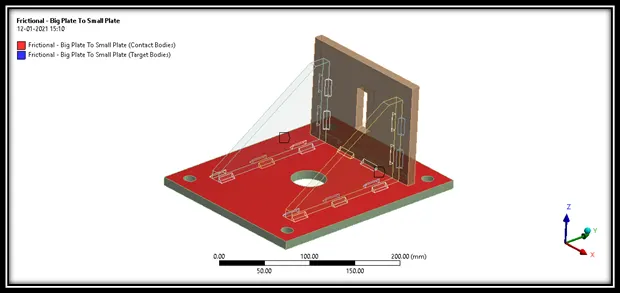
Then we will providing the contacts as frictional to one of the ribs named Rib 1 to the small plate and similarly to the other rib named Rib 2 from the small plate which is parallel to Rib 1 which can be seen in the below two pictures.
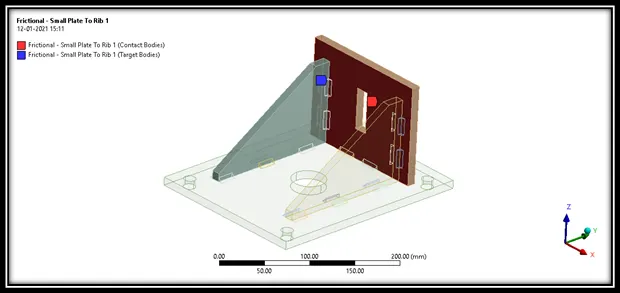
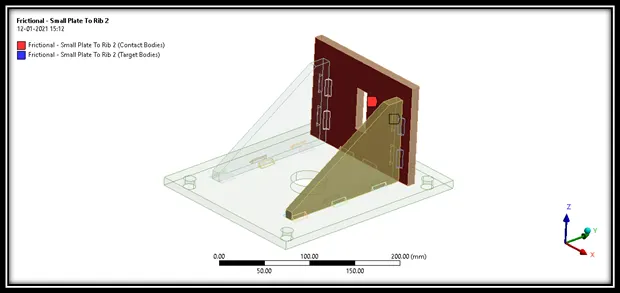
Finally, we will providing the contacts as frictional to one of the ribs named Rib 1 to the big plate and similarly to the other rib named Rib 2 from the big plate which is parallel to Rib 1 which can be seen in the below two pictures.
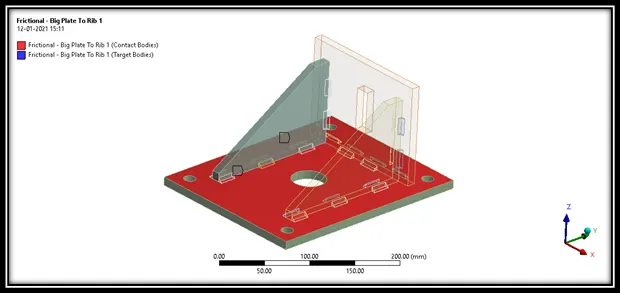
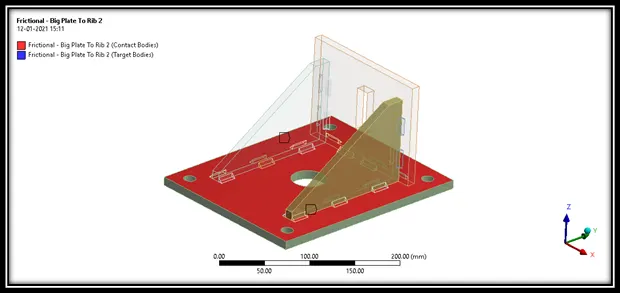
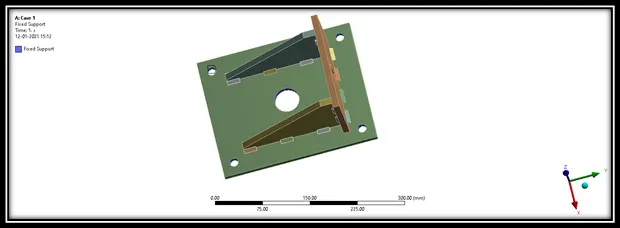
Now, we will be providing boundary conditions for the model. At first, we will provide Fixed Support for the big plate and select the holes on the same to fix the plate.
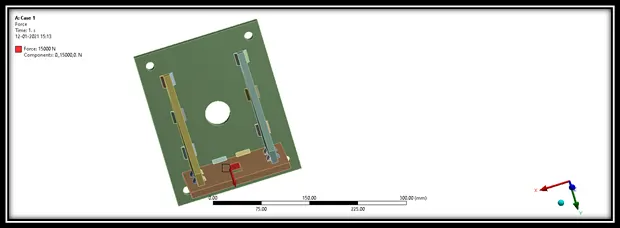
Then we will providing a force of 150000 N as per our requirements to simulate the model, study and check for the solution parameters needed. The force will be provided on the surface of the rectangular hole available in the small plate.
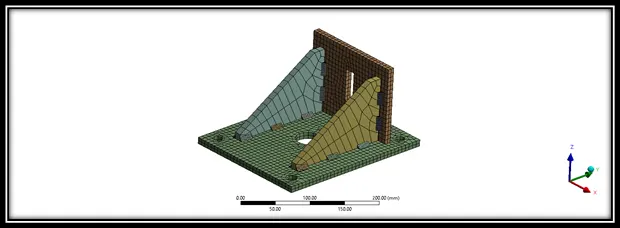
We will proceed to the mesh step and here we will be providing separate mesh sizing for the big plate and small plate since those two parts are given the boundary conditions and we will get better results by doing the same.
Simulation:
Case 1:
Directional Deformation:
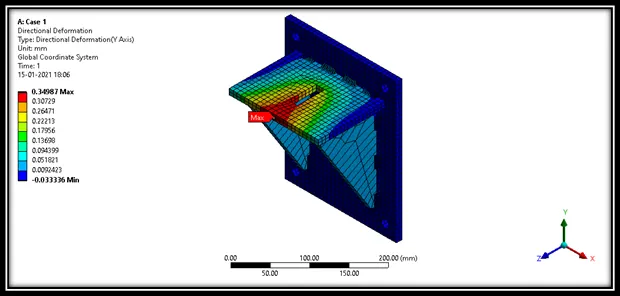
Simulation Video - https://drive.google.com/file/d/1oT4MkPLlMmuV1hgJq5jvLv-tRGkdGTec/view?usp=sharing
Equivalent Elastic Strain:
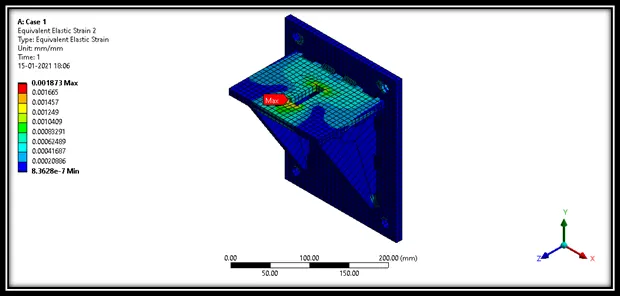
Simulation Video - https://drive.google.com/file/d/1ZWDiZuzBr7Tp9Z9G5Nulnuj9LZRE4jvo/view?usp=sharing
Equivalent Stress:
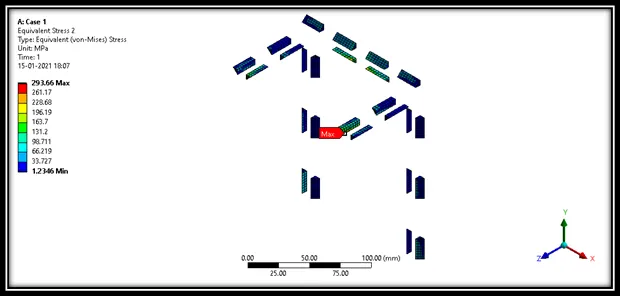
Simulation Video - https://drive.google.com/file/d/1j5yw7hTMOygQ_sdtkRC_vRcxBWpYTCvV/view?usp=sharing
Case 2:
Directional Deformation:
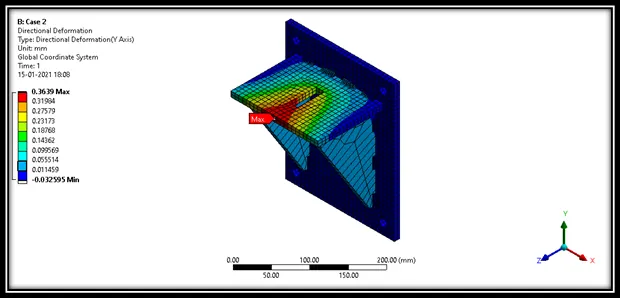
Simulation Video - https://drive.google.com/file/d/1eqJRnsQNN-zkOkCR19Fduu0YUP94pTLi/view?usp=sharing
Equivalent Elastic Strain:
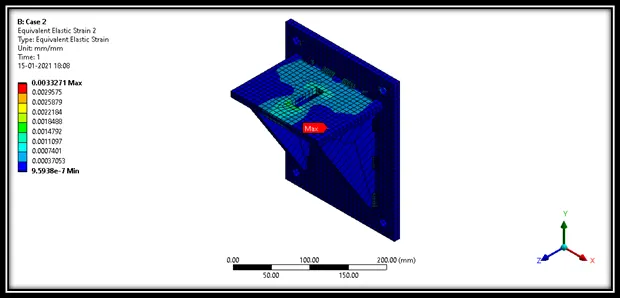
Simulation Video - https://drive.google.com/file/d/1JCnA0Gfyf81mmP8t-vimsEeG80j4ol-r/view?usp=sharing
Equivalent Stress:
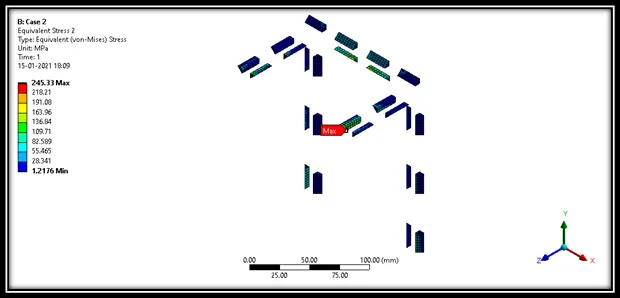
Simulation Video - https://drive.google.com/file/d/1kylVLE6f8AjS4mSuc79UIRCxCDi2FmC-/view?usp=sharing
Case 3:
Directional Deformation:
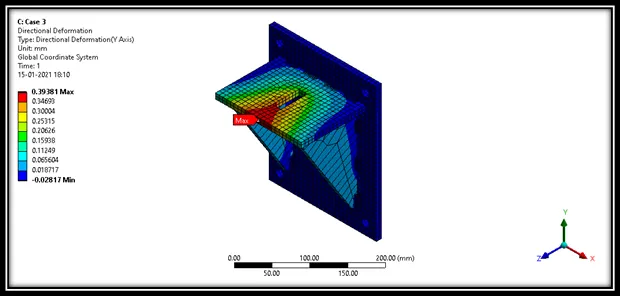
Simulation Video - https://drive.google.com/file/d/1IcLUkTEgFh2xjVJgDlex9PjXPetjj1Qn/view?usp=sharing
Equivalent Elastic Strain:
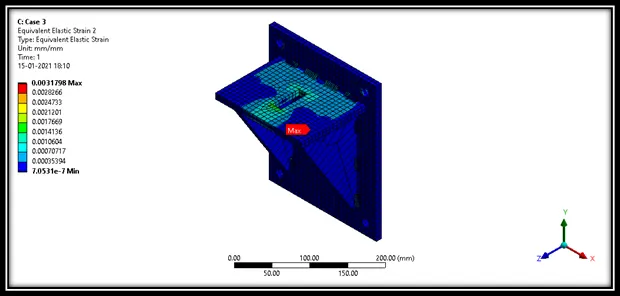
Simulation Video - https://drive.google.com/file/d/1pmWe71FktrHRaH_0D6sRStEo7bbFPY3v/view?usp=sharing
Equivalent Stress:
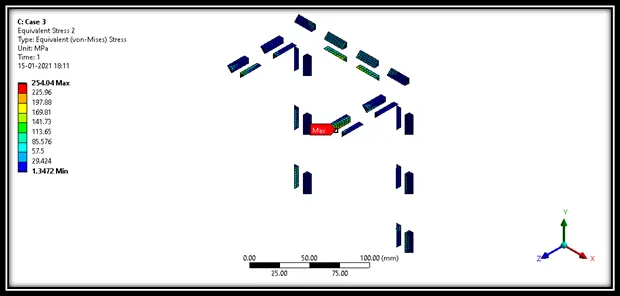
Simulation Video - https://drive.google.com/file/d/14SdJQIldm4hCcFBldNoiQJVEIDlX_UIi/view?usp=sharing
Tabulation:
Whole Model:
|
Cases |
Max. Directional Deformation (mm) |
Max. Equivalent Elastic Strain (mm/mm) |
|
Case 1 |
0.3499 |
1.873e-003 |
|
Case 2 |
0.3639 |
3.3271e-003 |
|
Case 3 |
0.3938 |
3.1798e-003 |
Weldments:
|
Cases |
Max. Equivalent Stress (MPa) |
Tensile Yield Strength |
|
Case 1 |
293.66 |
207 |
|
Case 2 |
245.33 |
363 |
|
Case 3 |
254.04 |
144 |
Comparison:
From the above simulations we can see that the materials used in Case 1 which is Stainless Steel is the suggested material for the case setup model rather than the other two materials in the next cases which are Aluminium Alloy and Bronze as weldments which affects the case setup model.
But considering the Maximum Equivalent Stress of the weld materials used with their Tensile Yield Strength we can see that Stainless Steel and Bronze materials fail while applying the given force and the weldment which is affected is mentioned in the Simulation results as the last image in each cases. And the better material to be used for the case setup model is Aluminium Alloy.