Week 3 Verification of Weld Joints
Verification of Weld Joints Using
ANSYS Workbench 2020 R2
Thejan Sasilal
OBJECTIVES
Simulate three different types of welding using three different weld materials
Weld Material used:
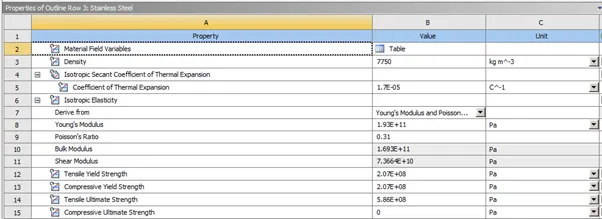
Case 1. Stainless Steel: In this case, the material of the plates must also be the same. Use Stainless steel for both weldments and plates. No need to add flux to the weldments.
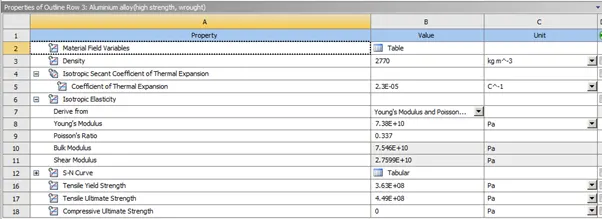
Case 2. Aluminium Alloy: The material to be chosen for this case is Aluminium alloy (high strength, wrought). [Plate material to be used is stainless steel]
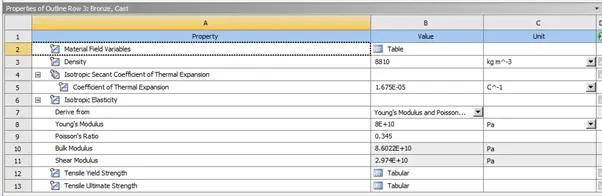
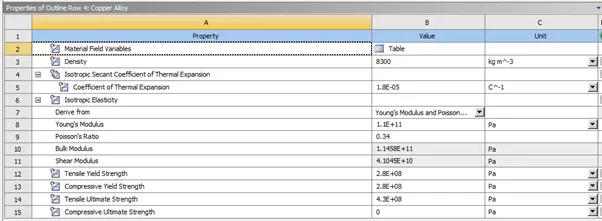
Case 3. Bronze: In order to simulate "Brazing", you should be using bronze as the weld material. Assign Stainless Steel to both plates and Copper to the "Ribs".
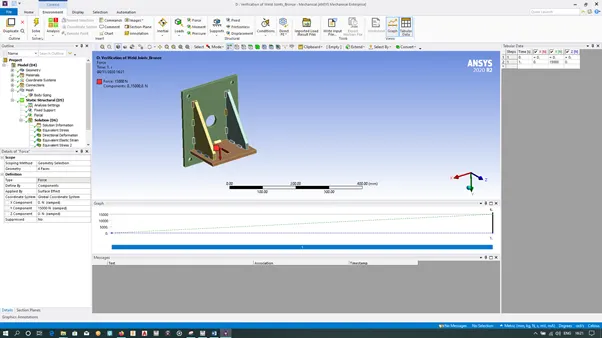
Run the simulation for a load of 15000N that is to be applied at the rectangular hole in the small plate (Same as in the video).
For each case, find out the Directional Deformation and equivalent strain experienced by the setup. Identify the weld joint that experiences the highest equivalent stress in each case and compare the results for all three cases
MATERIAL PROPERTIES
STATIC ANALYSIS
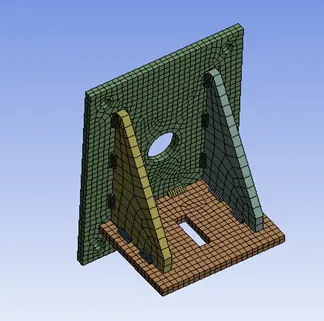
MESHING
7 mm mesh for both plates and others default mesh
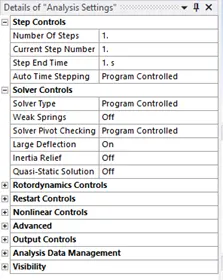
ANALYSIS SETTINGS USED
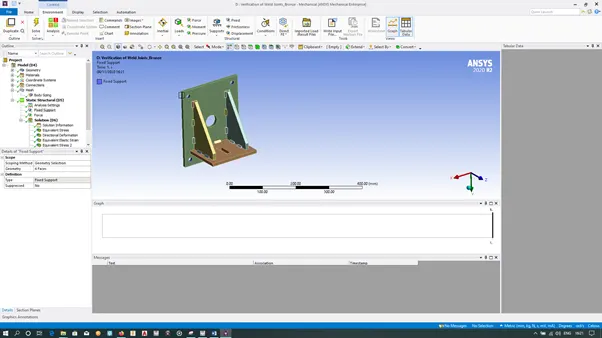
BOUNDARY CONDITIONS
Fixed Support at 4 no’s holes
15000N Force applies at the rectangular hole in Y direction
SOLUTIONS
|
|
Case - 1 : Stainless Steel |
Case - 2 : Aluminium Alloy |
Case - 3 : Bronze |
Comparison |
|
Equivalent elastic strain |
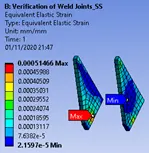 |
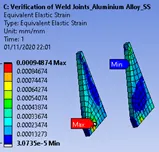 |
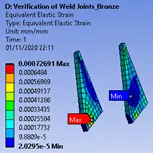 |
1. Due to the lowest youngs modulus of Aluminium alloy, Case 2 deforms more compared to other materials. 2. Due to highest young’s modulus of stailess steel, Case 1 produces less strain. |
|
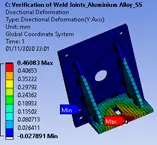
Total Deformation in Y direction |
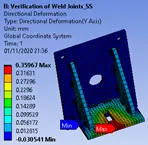 |
 |
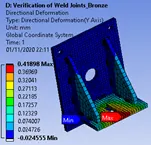 |
1. In all cases plates material are same (SS). Rib material and weldment only changing 2. As the weal aluminium alloy ribs not giving proper reinforcement, case 2 deforms more. 3. Due to superior properties of SS, case 1 is less deforming. |
|
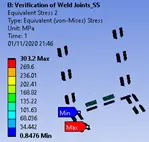
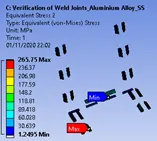
Equivalent stress in Weldment |
 |
 |
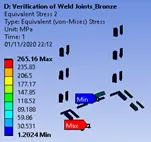 |
1. Due to the elastic behaviour of Aluminium Alloy & Bronze (Poisson’s Ratio: 0.337 & 0.345 respectively) the stress developed in weldment is transferring to the more area of the weldment as compared to Stainless steel (Poisson’s Ratio: 0.31). Hence maximum stress developed in Aluminium alloy & Bronze weldment is less as compared to Stainless Steel. |
CONCLUSSION
Verification of welding joint conducted with different rib & weldment materials. From the analysis it is found that Stainless Steel plates with Aluminium Alloy Ribs and Aluminium Alloy weldment produces maximum stress of 265.75 MPa (Yield Strength of Aluminium Alloy: 363 MPa), hence this weldment has the advantage of highest FOS of 1.36, which is >2 times the FOS of other 2 cases.
Since the superior value of young’s modulus, Stainless Steel produces good performance in resistance to deformation, when it using as material of Plates & Ribs. As a weldment material, Stainless Steel is not suitable, as it has lower yield strength compared to Aluminium Alloy.
From the analysis point of view, Case 2 is recommended due to above mentioned reasons.