Week 3 Verification of Weld Joints
OBJECTIVE: To simulate three different types of welding using three different weld materials.
Procedure:
Step 1: Engineering Data
- For this analysis we will be using different materials and analyzing the results.
- Add Stainless Steel, Aluminum Alloy-wrought-2024-T6, Copper alloy, C90500 cast and Bronze C52400 Cast to the list of materials.
Step 2: Geometry
- Right click on geometry and Import the Skill_lync_Welding.stp extension file
- Rename the Static Structural tab as Verification of Weld joints..
- Update the Static Structural tab and proceed to model.
- Additionally you can rename weld joint from 1-26 by numbering them for convinience and better understanding.
- Rename large plate as big plate and small as small plate. rename side ribs as rib 1 & rib 2.
Step 3: Model and Meshing
- Open Model and under meshing add body sizing with elemenmt size of 7mm for both the plates.
Step 4: Connections
- Contacts:- check if contacts are properly assigned.
Step 5: Setup
- In analysis assign fixed support to top faces of 5 holes on big plate.
- Assign a force of 15000N in Y direction to the 4 side faces of square cavity in small plate.
Step 6: Solution
- Insert results for Equivalent Strain, Equivalent Stress distribution, Total Deformation for each geometry in focus to observe the values and data.
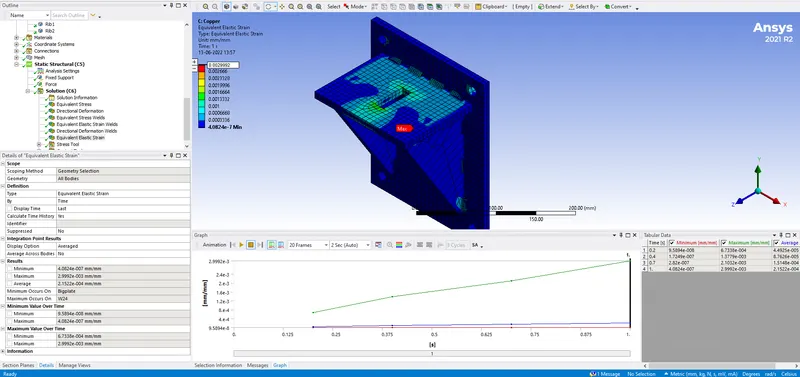
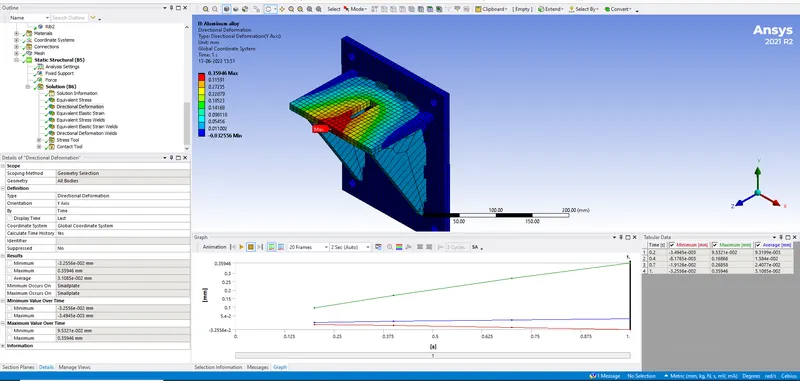
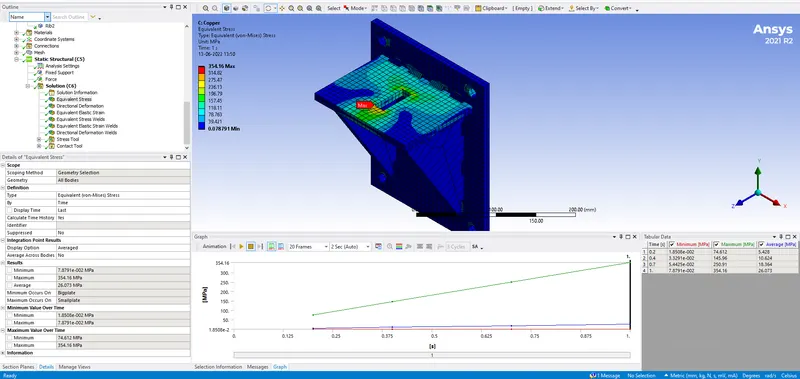
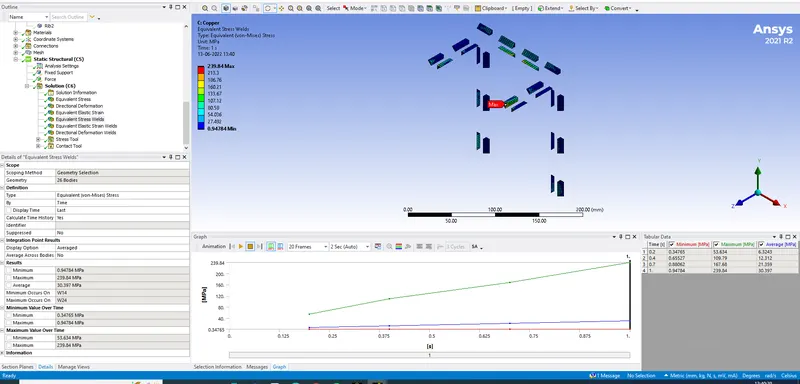
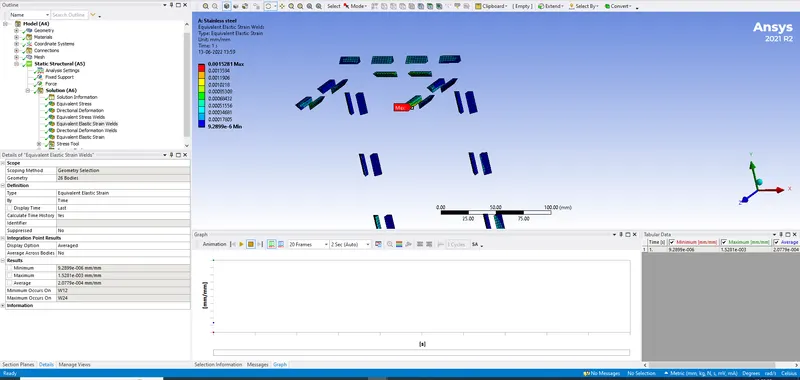
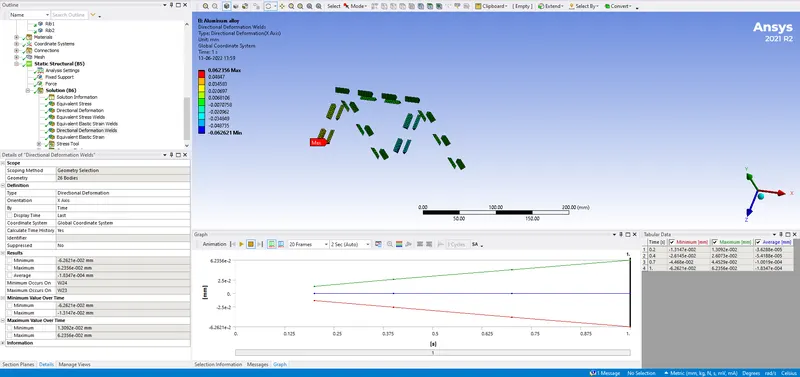
Results and Comaparison:
Case 1: With material as stainless steel for whole body.
| Equivalent stress (Max) | Equivalent elastic strain | Total Deformation in the Y direction |
| Mpa | mm/mm | mm |
| 341.13 | 0.0018738 | 0.3559 |
Case 2: With material as Aluminum for welds, stainless steel for ribs and plates.
| Equivalent stress (Max) | Equivalent elastic strain | Total Deformation in the Y direction |
| Mpa | mm/mm | mm |
| 344.91 | 0.0028629 | 0.35946 |
Case 3: With material as Bronze for welds, Copper for ribs and stainless steel for plates.
| Equivalent stress (Max) | Equivalent elastic strain | Total Deformation in the Y direction |
| Mpa | mm/mm | mm |
| 354.16 | 0.0029992 | 0.40989 |
Case 4: Weld joints that experiences the highest equivalent stress in each case and comparison of the results for all three cases
| Case # | Weld Joint Number | Equivalent stress | Equivalent elastic strain | Total Deformation in the Y direction |
| Units | # | Mpa | mm/mm | mm |
| Case 1 | 24 | 294.02 | 0.0015281 | 0.062372 |
| Case 2 | 24 | 209.21 | 0.0028629 | 0.062356 |
| Case 3 | 24 | 239.84 | 0.0029992 | 0.077326 |
Conclusion:
We can see that copper produces max stress results in three cases. Similarly for strain copper has max values of strain. The results for weld with weld number that experiences max stress and deformation in all three cases is tabulated above.