To create a block diagrams, come up with a forward model for a conventional vehicle .
Aim:
To create a block diagrams, come up with a forward model for a conventional vehicle that includes the driver, controller and vehicle plant. The vehicle plant must at least contain an engine, fuel tank, transmission coupling unit, transmission, differential, wheels and the vehicle.
Forward model for a conventional vehicle
Introduction:
Conventional vehicle:
Conventional vehicles use an internal combustion engine fueled by gasoline or diesel to power the wheels. Electricity is used for some accessories, but is not used to move the vehicle.
Block model of basic conventional vehicle
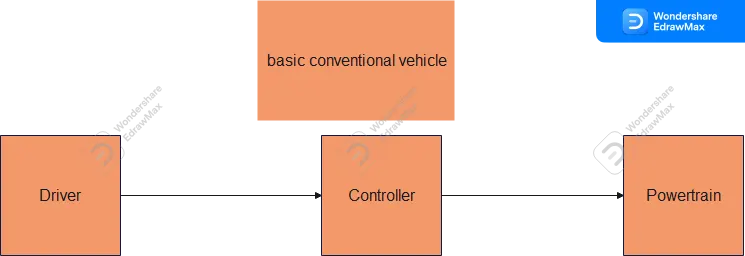
Advantages of using forward model:
- Forward model are dynamic simulation.
- Dynamic model are used for detailed simulation.
- Force,Torque & power are inputs and velocity & acceleration are the outputs in the dynamic model.
- Approach mainly used to simulate a vehicle on a driving cycle,to analyze dynamic behavior
Forward model fig:

Driver:
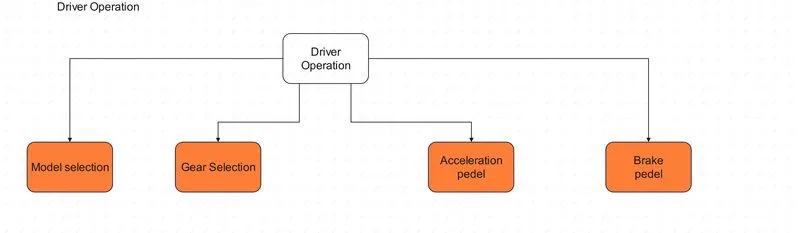
Driver Operation:
In this case the driver operation is knows as user to given the instruction to control the vehicle,the first case is model selection to select the condition of driving i.e (auto pilot or self driving) which is selected by the user.Once the user select the first condition of the self driving option once he simuntioneously change the gear (to provide the proper torque to the vehilcle) while driving.Then the user acclerate the pedel to increace the speed by the vehicle with respect passenger comfortable once the user press the acceleration pedel means the vehicle can increase its speed.Brake pedel is used to stop the vehicle whenever required and also is consider as safety measure to stop the vehicle,once the user press the brake pedel the vehicle suddenly try to stops the vehicle.
Controller:
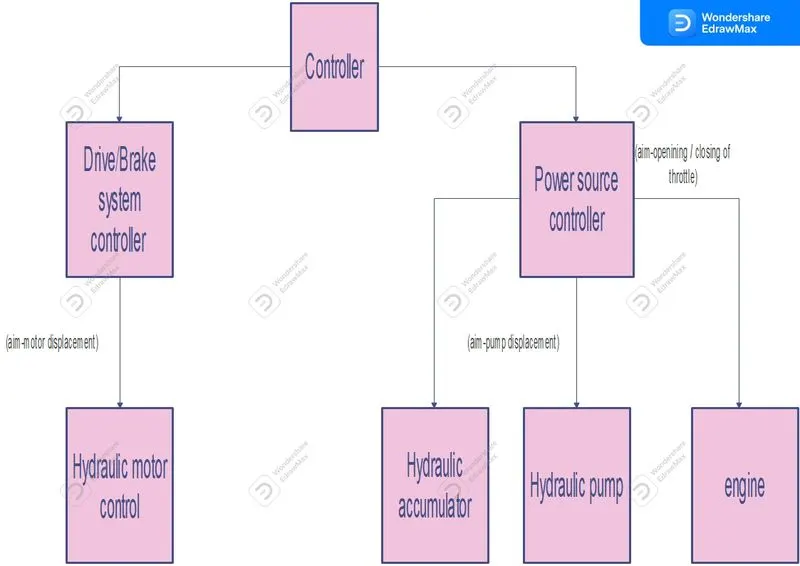
The aim of the Controller in vehicles is used to control the conventional vehicle's and give signals to the powertrain & accessories to the vehicle .It has been divided into two types one is drive / brake system controller & power source controller.Drive and break controller which is considers as accessories of the vehicle it is not used for vehicle dynamics but it is used to consider as improve the vehicle performance and safety measures of the vehicle.when the hydraulic/electric motor plays an vital role to improve the performance of the vehicle it is used to displace the coolent through the engine (raditor) and air conditioning the vehicle and also the motor is used to start the vehicle.
Power source controller:
The aim of power source controller is used to control pump displacement and the opening / closing of throttle.When the is used to improve the performance of the velicle which is transmit the coolent to the engine and hydraulic accumulator is a energy storage device and also accumulator enables a hydraulic system to cope with extremes of demand using a less powerful pump, to respond more quickly to a temporary demand, and to smooth out pulsations for breaking the vehicles.and alsoit controls the powertrains to improve the vehicle dynamics.
Vehicle plant (power train):
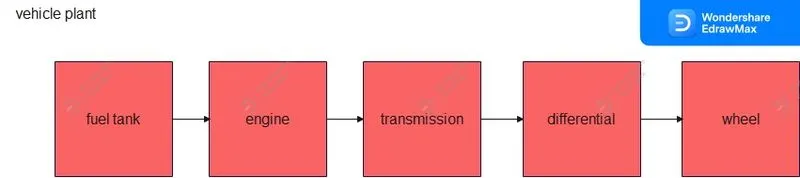
Fuel tank:
- From the pump to the tanks the fuel travels through the fuel pump. The pump sends fuel from the gas tank to the engine. Some vehicles are equipped with multiple gas tanks and even multiple fuel pumps. Multiple fuel pumps are ideal for ensuring the vehicle always has access to fuel no matter the terrain that the vehicle is traveling on. For example, if a vehicle is making a sharp turn or traveling on a steep incline and gravity forces fuel away from one fuel pump, it guarantees that at least one of the pumps has access to fuel.
- The pump forces fuel through the fuel lines that deliver fuel from the tank to the engine for combustion. Fuel lines are made of durable metal, plastic materials and though they are located in the undercarriage of the vehicle, and seemingly in a vulnerable position, they are placed in areas that cannot be damaged due to elements, road conditions, or exposure to heat from the engine’s exhaust or other components.
- The fuel filter is the next stop for gasoline before it reaches your engine. It is imperative that the fuel that enters the engine be uncontaminated and free from dirt or particulates. To prevent any debris from entering the engine. A clogged or dirty fuel filter is unable to trap harmful particulates from entering your engine and cause all sorts of damage. Newer vehicles may not have serviceable fuel filters as they are located in the fuel tank. Replacing the filter requires replacing the entire set up.
- Once passed through the fuel filter, the fuel reaches the engine and is in injected into the combustion chamber to create combustion. utilizing fuel injectors.
I.C engine:
Internal combustion engines is also known for ic engines when the fuel is supplied to the engine,already a high pressure is generated to engine due to upward movement of piston (piston position at tdc),due to this higher compression combustion process is happeneing inside the cylinder due the moment of the piston a linear motion is created inside the cylnder.
Transmission:
A transmission is a machine in a power transmission system, which provides controlled application of power. Often the term 5-speed transmission refers simply to the gearbox, that uses gears and gear trains to provide speed and torque block conversions from a rotating power source to another device.
Differential:
The differential is a device that splits the engine torque two ways, allowing each output to spin at a different speed. The differential is found on all modern cars and trucks, and also in many all-wheel-drive (full-time four-wheel-drive) vehicles.Simply put, a differential is a system that transmits an engine's torque to the wheels. The differential takes the power from the engine and splits it, allowing the wheels to spin at different speeds. At the point you might be asking, why would I want the wheels to spin at different speeds from each other.
Wheels:
Wheels is act on tractive effort of the vehicle which over come the rolling resistance,aero dynamic drag,acceleration force and grading force once we analized that force to find the velocity and speed of the vehicle
To find the performance of the vehicle:
Vehicle parameters:
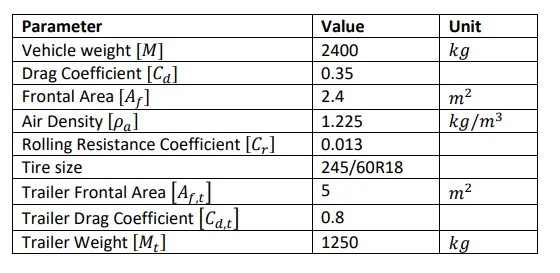
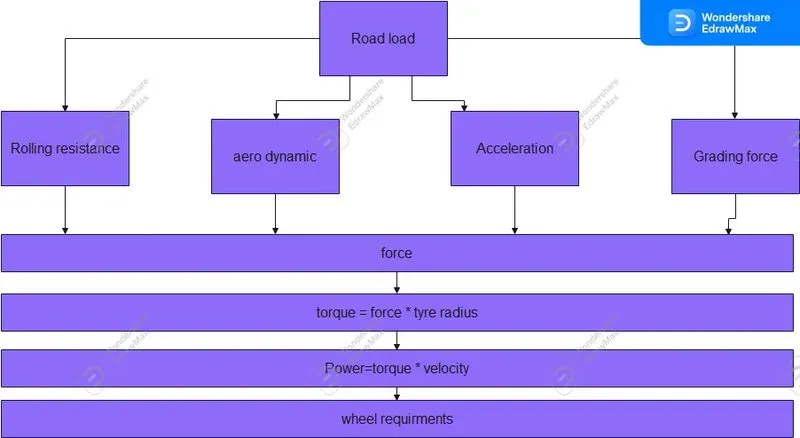
tracive force-The frst step is to the vehicle modelling to finf the equation for tractive effort.the tractive force is defined as when is force is acting on a surface & body on a dry resistance.
Road load- Road is defined as to transmit the vehicle from one direction to another direction.
Rolling resistance-The rolling resistance is primarily due to the friction of the vehicle tyre on the road. Friction in bearings and the gearing system also play their part. The rolling resistance is approximately constant, and hardly depends on vehicle speed. It is proportional to vehicle
weight.
formula:
Roll∈gResistance=Crr⋅m⋅g⋅cos(θ)">Roll∈gResistance=Crr⋅m⋅g⋅cos(θ)Roll∈gResistance=Crr⋅m⋅g⋅cos(θ)
Crr=rolling coefficient
M=mass of vehicle
g=centre of gravity
theta=angle of the vehicle
Aero-dynamic drag-This part of the force is due to the friction of the vehicle body moving through the air. It is a function of the frontal area, shape, protrusions such as side mirrors, ducts and air passages, spoilers, and many other factors. The formula for this component is:
Fad = 1/2ρACd (Vv+Vw)^2
ρ=density of air
cd=drag coefficient
A=frontal area
Vw=velocity of wind & velocity
Vv=velocity
Hill climbing force-The force needed to drive the vehicle up a slope is the most straightforward to find. It is simply the component of the vehicle weight that acts along the slope. By simple resolution of forces.
Fhc = mg *sin(θ">θθ)
mg=mass & gravive
theta=slope of an angle
Acceleration force:If the velocity of the vehicle is changing, then clearly a force will need to be applied in addition to the forces shown in . This force will provide the linear acceleration of the vehicle, and is given by the well-known equation derived from Newton’ssecond law,
Fa=M⋅a">Fa=M⋅aFa=M⋅a
Fa=acceleration force
M=mass of the vehicle
a=acceleration.
Tractive force-For using this formula and equate it with vehicle parameter we find the tractive force of the vehicle.
Powertrain:The power demand on the wheels needv to be instantaneously supplied by the powertrain.
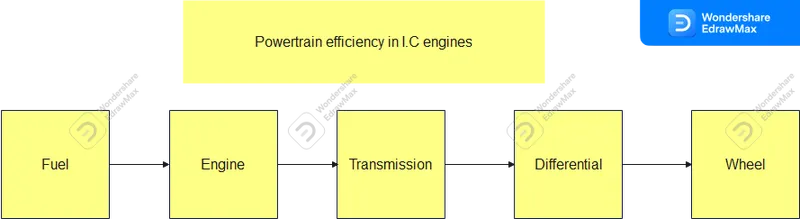
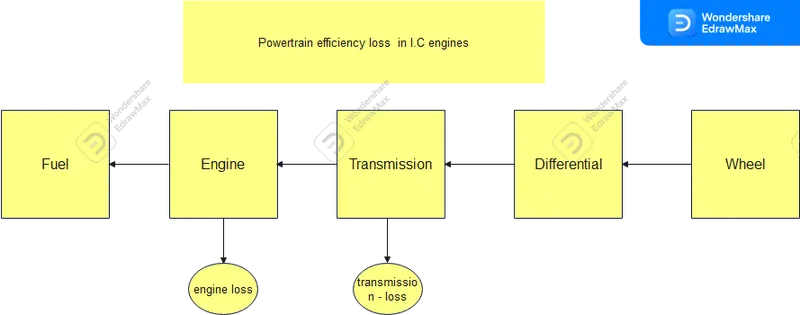
Powertrain efficiency:For conventional I.c vehicle ,the wheel power is supplied by the engine through the transmission drivetrain efficiency
Fossil fuels - made from decomposing plants and animals. These fuels are found in the Earth's crust and contain carbon and hydrogen, which can be burned for energy. Coal, oil, and natural gas are examples of fossil fuels.
I.C Engine-An internal combustion engine (ICE or IC engine) is a heat engine in which the combustion of a fuel occurs with an oxidizer (usually air) in a combustion chamber that is an integral part of the working fluid flow circuit.
Transmission coupling-A coupling is a device used to connect two shafts together at their ends for the purpose of transmitting power. The primary purpose of couplings is to join two pieces of rotating equipment while permitting some degree of misalignment or end movement or both.
Transmission-Transmission systems are systems that take power/energy and transmit it from an engine to a live axle allowing the driver to control the output of energy. The system in a car uses gears and gear trains to provide torque and speed changes from a rotating power source. Usually a transmission system is a gearbox.
Differential-he automotive differential is designed to drive a pair of wheels while allowing them to rotate at different speeds. In vehicles without a differential, such as karts, both driving wheels are forced to rotate at the same speed, usually on a common axle driven by a simple chain-drive mechanism.
Wheels-It creates the power demand and generates the tractive force.
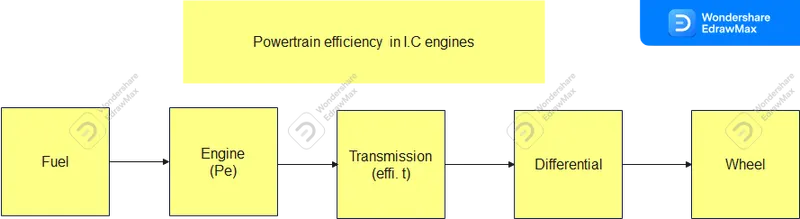
formula for efficiency of the powertrain is Pe=Pw/effi.t
Pe=power of engine
effi.t=efficiency of transmission
powertrain losses: If an vehicle not providing a 100% efficiencty due to some losses in powertrain.
Energy complex system: Every complex system can be defined by asmall number of general elements these elements are defined based on their function.
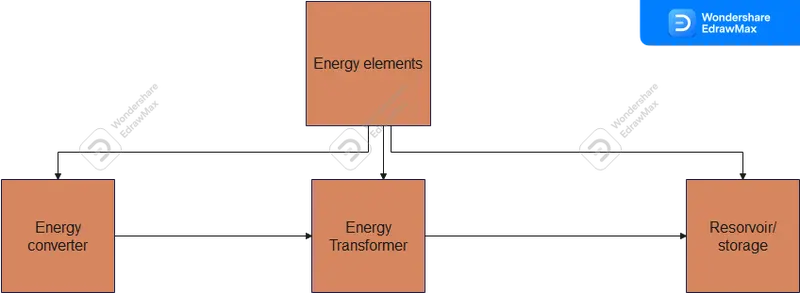
Energy converter:Convert energy from one type to another.
Energy Transformer-Transform the energy with in same type.
Energy storage-Store and relese the energy in the same form or different form.
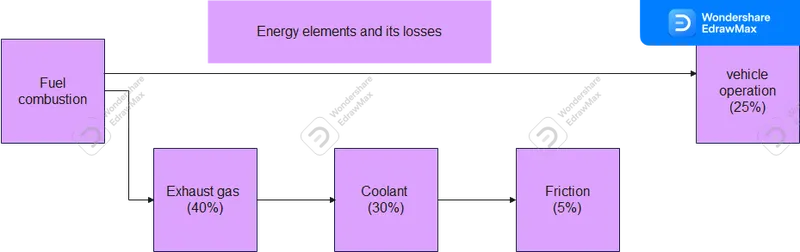
where the energy element are losses in during supply and working.
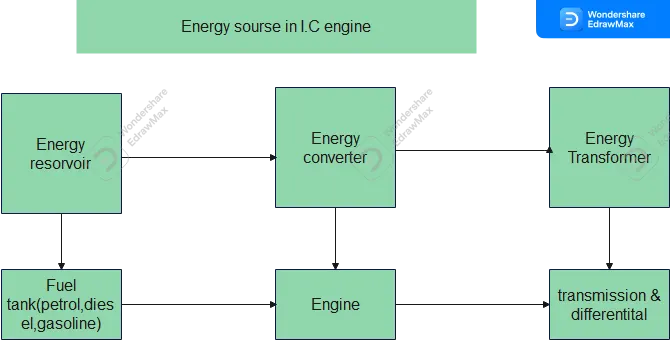
When the energy source has been divided inti three types resorvoir,converter,transformer and its used to power the wheels.