Week 3 Sheet metal Bending challenge
AIM:
Sheet metal bending is to be performed for 3 different materials mentioned below. Variation of certain settings is also to be performed and your conclusions are to be added to the report
Run the analysis for the material :
Case 1:Aluminium Alloy 1199( mentioned in the course video),Copper Alloy NL and Magnesium Alloy NL. Find out the Equivalent stress, Equivalent elastic strain and Total Deformation in Y direction and compare the results for the three materials.
Case 2:With the material as Aluminium Alloy, change the friction coefficient to 0.19 and run the analysis as mentioned in Case 1. Compare the results with that in case 1.
Case 3: Refine the mesh on the plate such that it doesn't cross the academic limit. With Aluminium alloy as material, run the analysis as in Case 1 and compare the results.
Procedure:
Case 1:Aluminium Alloy 1199( mentioned in the course video),Copper Alloy NL and Magnesium Alloy NL. Find out the Equivalent stress, Equivalent elastic strain and Total Deformation in Y direction and compare the results for the three materials.
- Open the Ansys work bench and we should have to extract the Structural Steel from the table.
- Rename name it as the Sheet metal Model and we should have to edit the Engineering Data.
- We should have to add the Aluminium Alloy 1199 and give the sutiable properties and we should have to add the Copper Alloy,Magnesium Alloy in the Engineering Data.
- After edit the engineering data we should go to the model and we should browse and import the model into the GUI.
- After that we should go to the Model>Edit>the geomentry and rename the parts as Punch,Die,Sheet.
- We should have to delete the contact bodies and create the new contact bodies and give the frictional value as 0.1.
- We should have to generate the mesh for the component and give the mesh size as Target element as 4mm and for the sheet as 1mm for the given component.
- we should have to give the Tetra herdal mesh for the sheet by using the method in the mesh and we should generate the mesh for the model.
- After generating the mesh we should have to go to the give the value for the Analysis for the model as 10 steps and large deformation on and normal stiffness.
- We should have to give the output values of the Deformation in Y direction, Equvailent Stress, Equvailent strain.
- We should have to solve the Results for the Model.
Forced Convection:
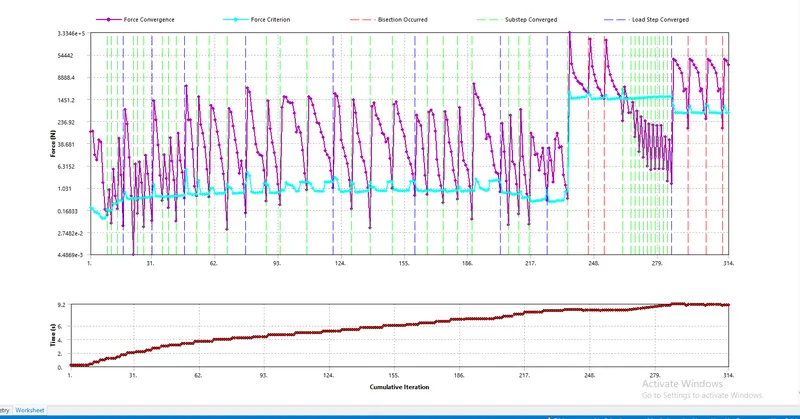
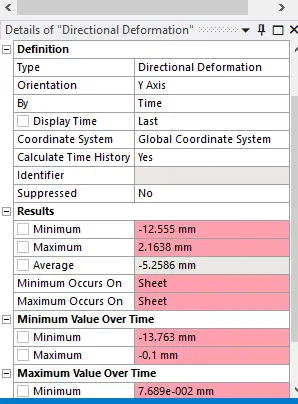
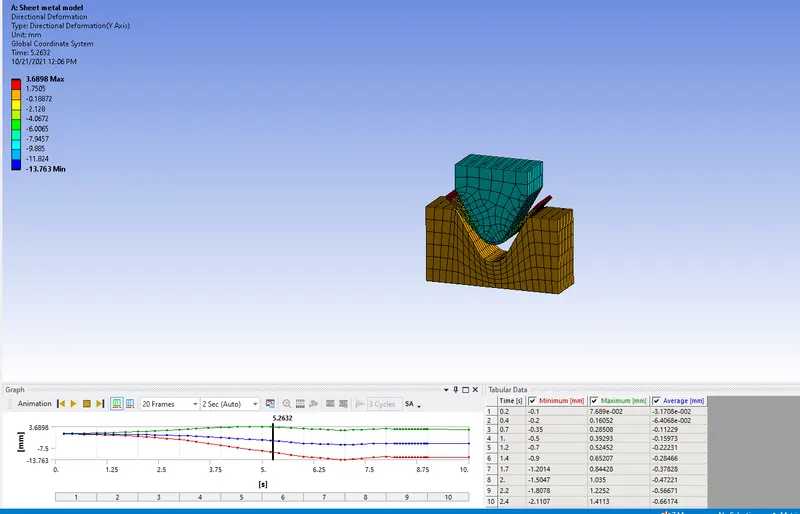
Deformation
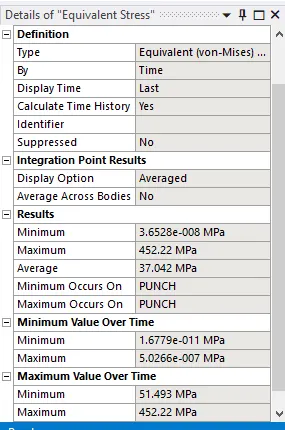
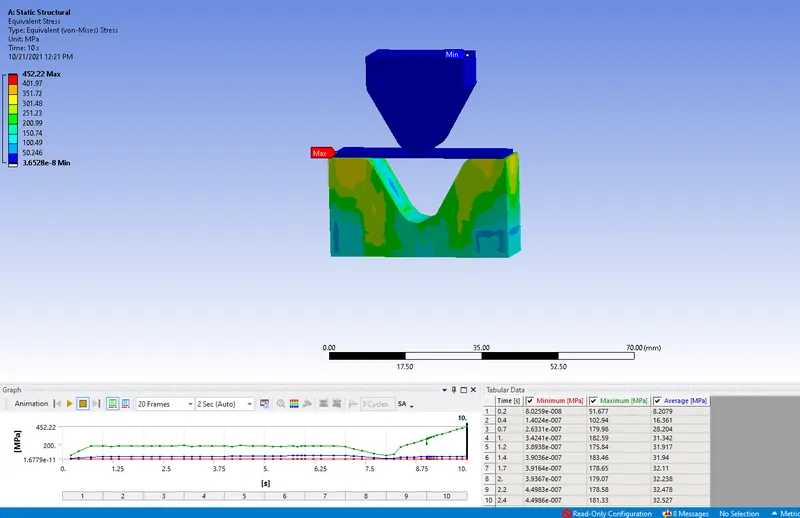
Stress
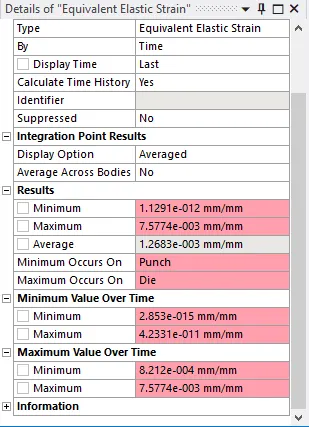
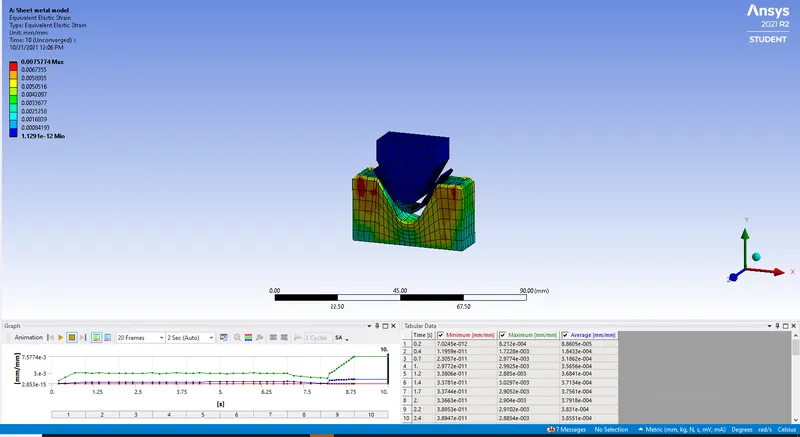
Strain
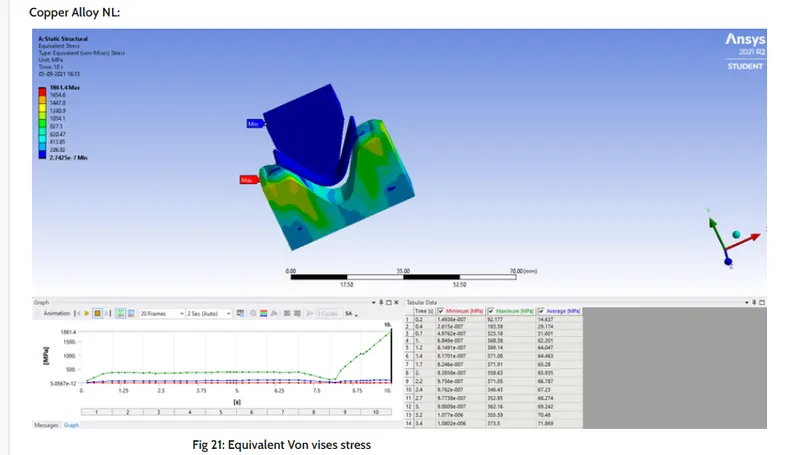
Copper Alloy:
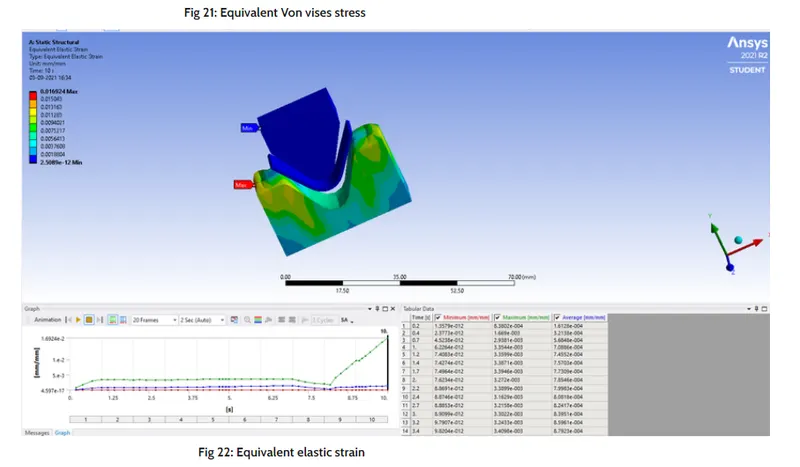
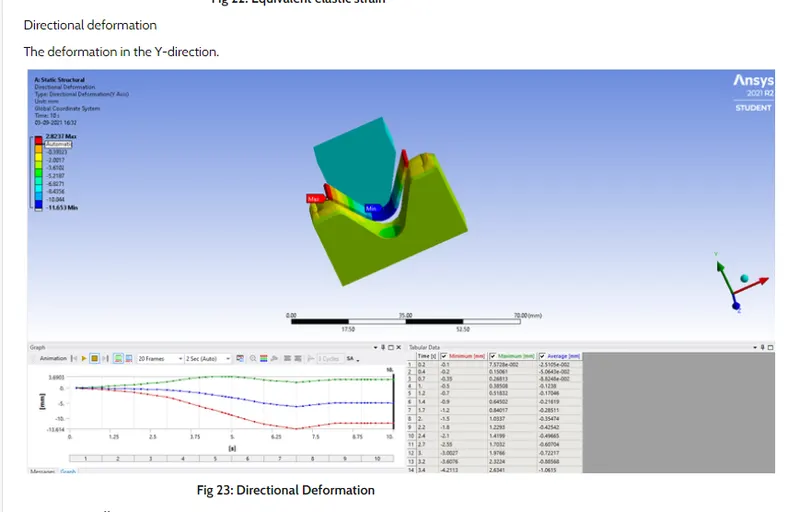
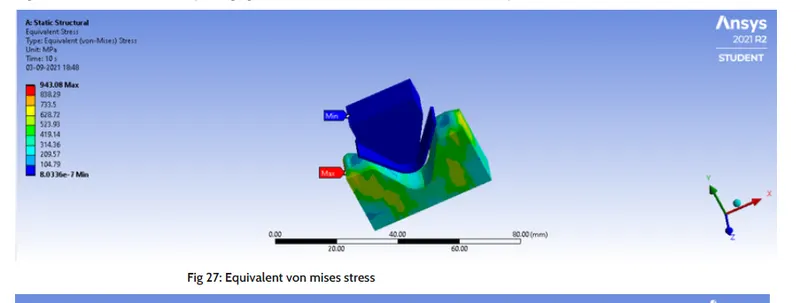
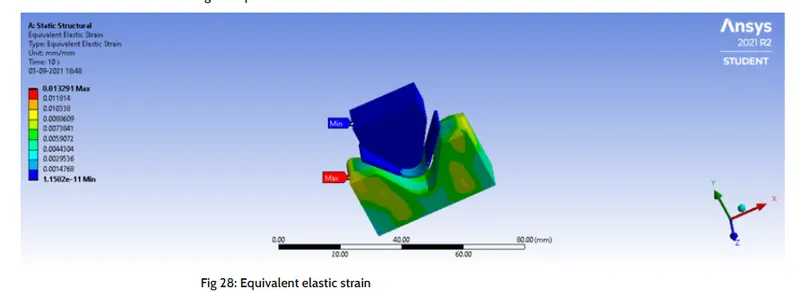
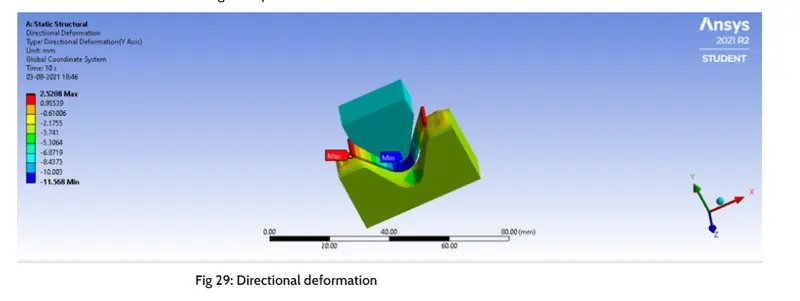
Case 2:With the material as Aluminium Alloy, change the friction coefficient to 0.19 and run the analysis as mentioned in Case 1. Compare the results with that in case 1.
Case 3: Refine the mesh on the plate such that it doesn't cross the academic limit. With Aluminium alloy as material, run the analysis as in Case 1 and compare the results.
Case 1:
Comparison of the result for equivalent von mises stress
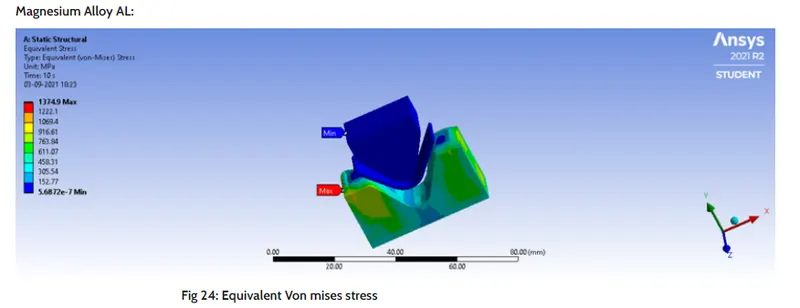
Stress Value Aluminum Alloy AL 1199 (MPa) Copper Alloy CL (MPa) Magnesium Alloy AL (MPa)
Minimum Equivalent Von Mises Stress 3.652e-8 2.3425e-7 5.6872e-7
Maximum Equivalent Von Mises Stress 452.22 1861.4 1374.9
Average Equivalent Von Mises Stress 251.23 1004.1 763.84
The graph and result state that the magnesium alloy has a left effect for equivalent stress compare to copper alloy and aluminum alloy, the
average value for Mg AL is 178.49 MPa, copper alloy is 431.4 MPa, and Aluminium Alloy 1199 is 242.38 MPa.
Comparison of the result for equivalent elastic strain
Strain Value Aluminum Alloy AL 1199 (mm/mm) Copper Alloy CL (mm/mm) Magnesium Alloy AL (mm/mm)
Minimum Equivalent elastic strain 0 2.5089e-12 1.2828e-11
Maximum Equivalent elastic strain 0.0072942 0.016924 0.030566
Average Equivalent elastic strain 0.0042523 0.0094021 0.016981
The result visualizes that the magnesium alloy has the highest value of elastic strain compare to copper alloy and aluminum alloy, magnesium
material has the most elastic strain for the sheet as a material.
Comparison of the result for directional deformation
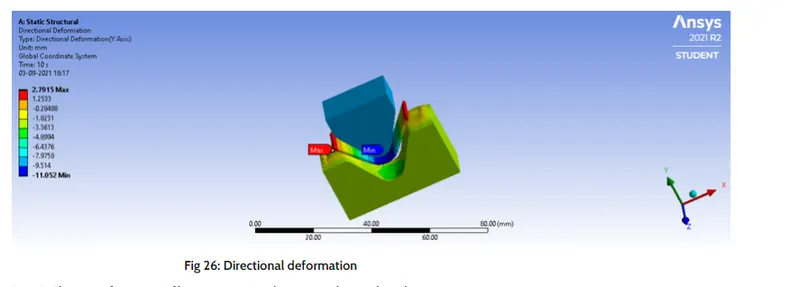
Stress Value Aluminum Alloy AL 1199 (mm) Copper Alloy CL (mm) Magnesium Alloy AL (mm)
Minimum directional deformation -13.757 -11.653 -11.052
Maximum directional deformation 3.6761 2.8237 2.7915
Average Directional deformation -4.072 -3.6702 -3.3613
There is not much effect on the directional deformation for all three materials, the minimum, maximum, and average values are approximately
similar to a minor change in maximum deformation.
Case 2: Change in friction coefficient of 0.19 and comparison with case 1
Material Minimum equivalent von mises stress (MPa) Maximum equivalent von-mises stress (MPa) Average equivalent von-mises stress (MPa) Minimum equivalent elastic strain (mm/mm) Maximum equivalent elastic strain (mm/mm) Average equivalent elastic strain (mm/mm) Minimum directional deformation (mm) Maximum directional deformation (mm) Average directional deformation (mm)
Aluminum alloy 1199 Friction coefficient (0.19) 8.0336e-7 943.08 523.93 1.1502e-11 0.013291 0.0073841 -11.568 2.5208 -3.741
Aluminum alloy 1199 Friction coefficient (0.10) 3.6528e-8 452.22 251.23 0 0.0072942 0.0042523 13.757 3.6361 4.072
The results show that for fiction coefficient 0.19 equivalent von misses stress is less compare to friction coefficient 0.10, as the friction coefficient
decreases the result is more likely accurate in comparison to the stress but for the elastic strain and deformation results are approximately similar
their is much effect of the friction coefficient changed value.
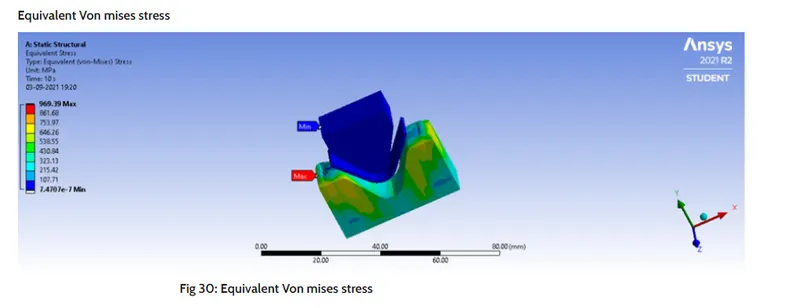
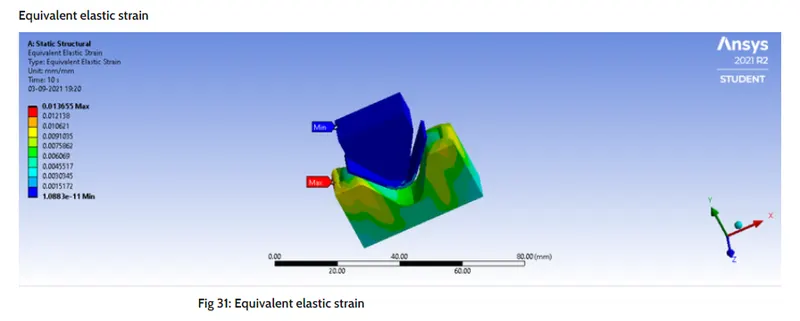
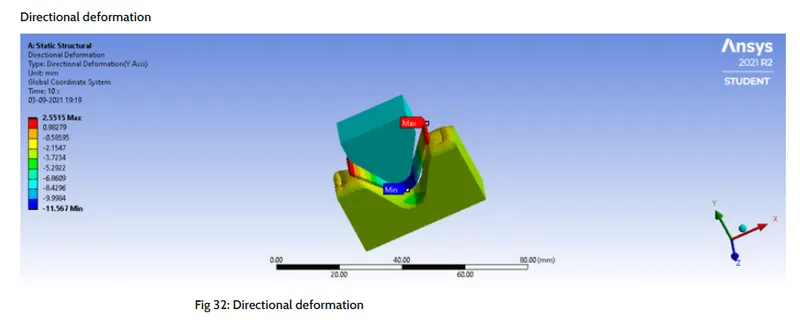
Case 3: Refine mesh to the aluminum alloy 1199 sheet and compare results with case 1.
Material Minimum equivalent von mises stress (MPa) Maximum equivalent von-mises stress (MPa) Average equivalent von-mises stress (MPa) Minimum equivalent elastic strain (mm/mm) Maximum equivalent elastic strain (mm/mm) Average equivalent elastic strain (mm/mm) Minimum directional deformation (mm) Maximum directional deformation (mm) Average directional deformation (mm)
Aluminum alloy 1199
sheet mesh (0.7 mm)
7.4707e-7 969.39 538.55 1.0883e-11 0.013655 0.0075862 -11.567 2.5515 -3.7234
Aluminum alloy 1199 Sheet Mesh (1mm) 3.6528e-8 452.22 251.23 0 0.0072942 0.0042523 -13.757 3.6361 -4.072
Thus, this proves that more refine mesh will gives us more accurate result for equivalent von misses stress, equvialent elatsic strain and
directironal deformation will be in minor effect, as this challenge evaluetd us that the factor of simulation change in the value will change the result
respectively, means that the friction coefficient or the refine mesh will have more accurate solution compare to the large value.