Week 3 Sheet metal Bending challenge
Aim of the project:
To perform the static structural analysis on the sheet metal bending process and compare the results with three different set of sheet materials which are Aluminum alloy, Copper alloy and magnesium alloy.
Compare the results for Von-mises stress, Total deformation and Equivalent elastic strain in varied material conditions.
Set Up
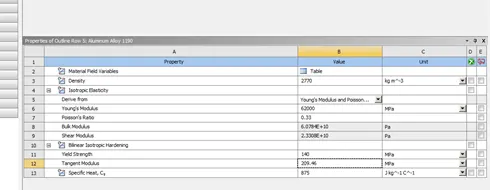
- In the Ansys workbench we chose static structural analysis and in engineering data we kept the material structural steel it is and along with that we added material Aluminum alloy 1190 with below properties.
-
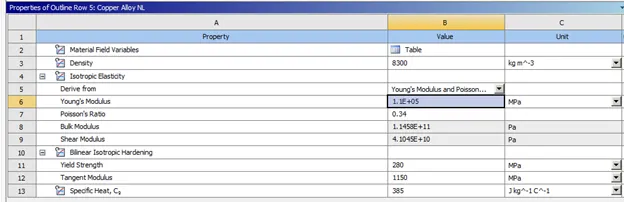
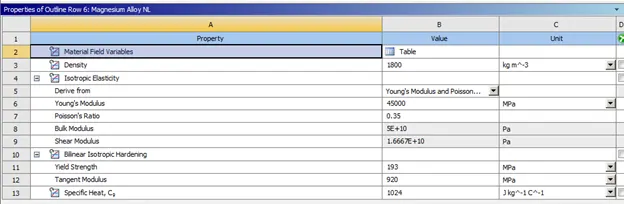
We have also added 2 more materials in Engineering data, Copper Alloy and Magnesium alloy.
-
After Importing Punch, die and sheet metal assembly model in the Geometry, We opened Mechanical module by clicking Edit to the model tab.
- We selected 2 frictional contacts and its faces between Punch - Sheet and also between Sheet - Die as shown below.
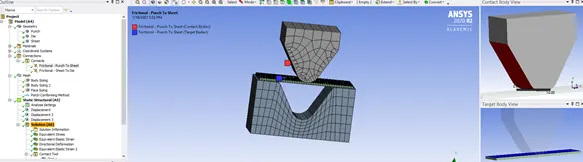

- We have adapted 3 different mesh sizing For punch and die-3mm, for sheet 1mm and for contact faces 1mm, also we set meshing method as Tetrahedrons.
- We have added 3 different Displacement boundary conditions as shown below.
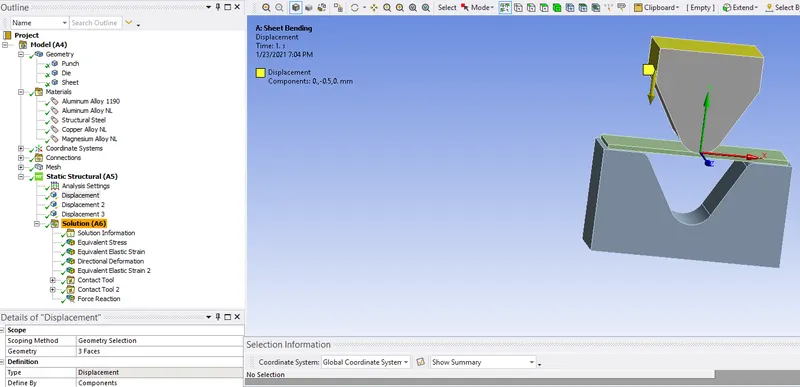
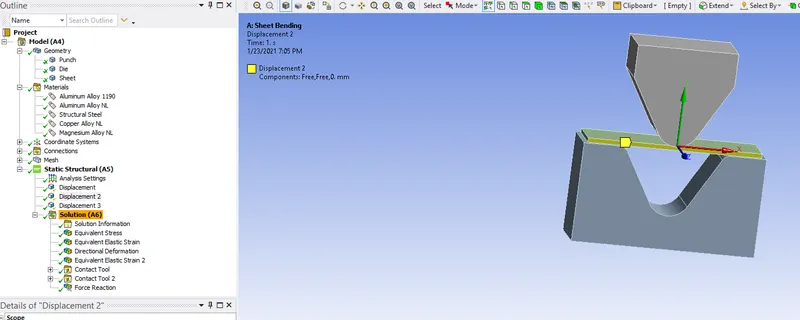
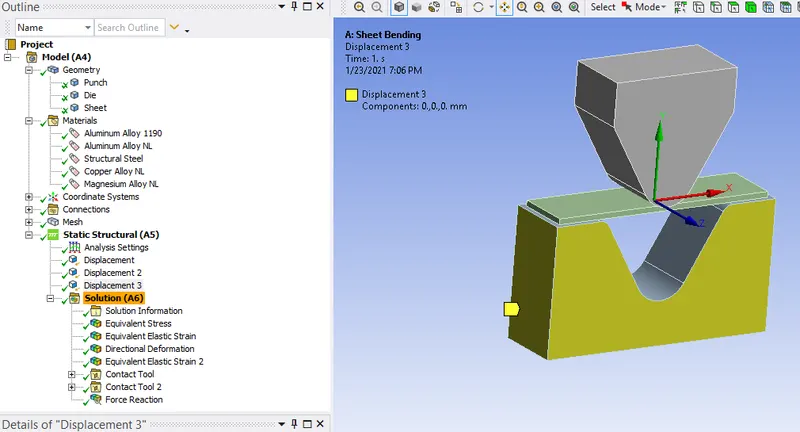
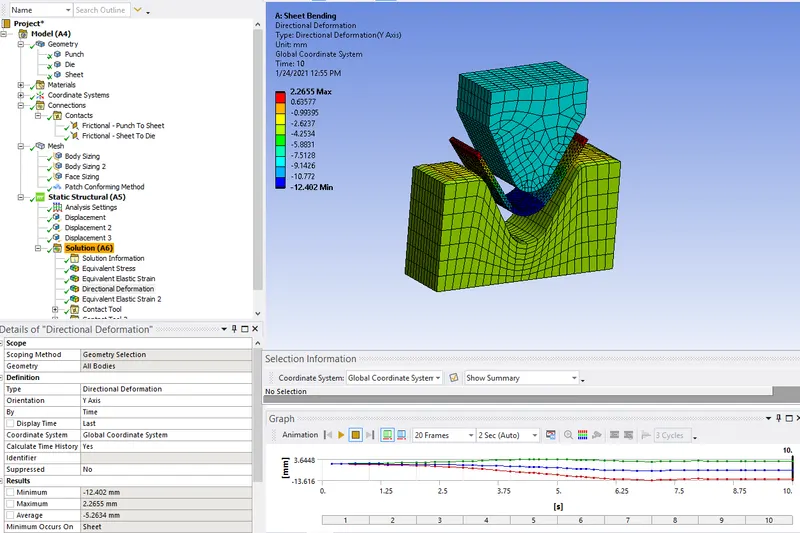
- Finally we got the solution for Von mises stress, Deformation and Equivalent strain as shown below.
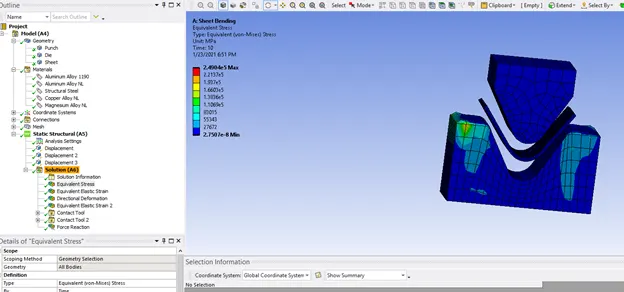
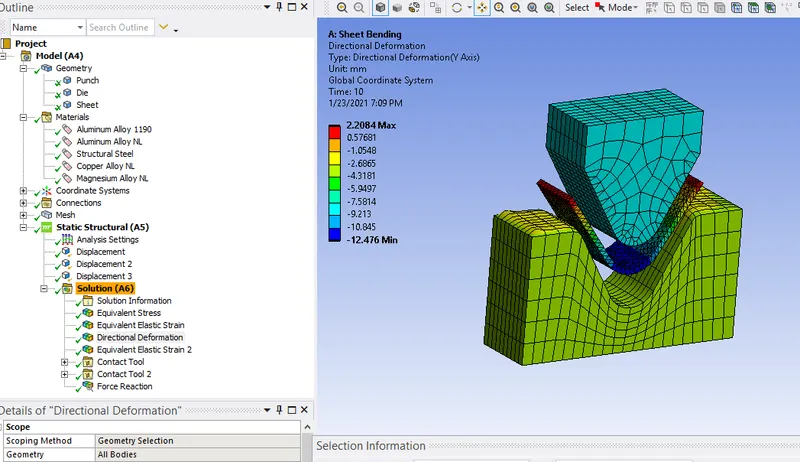
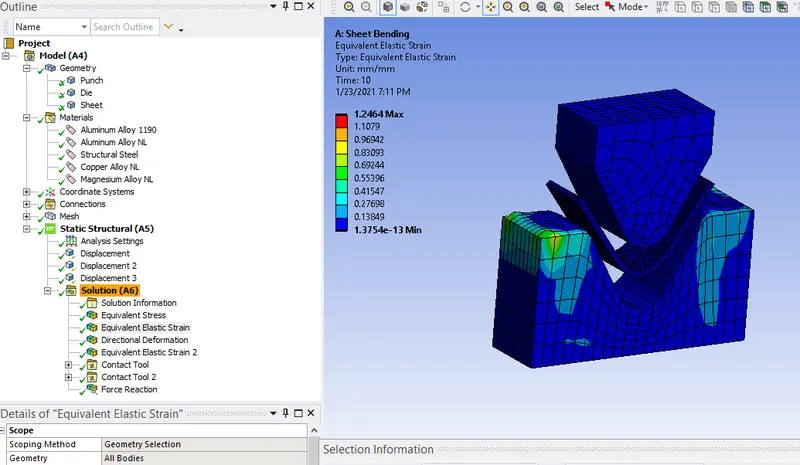
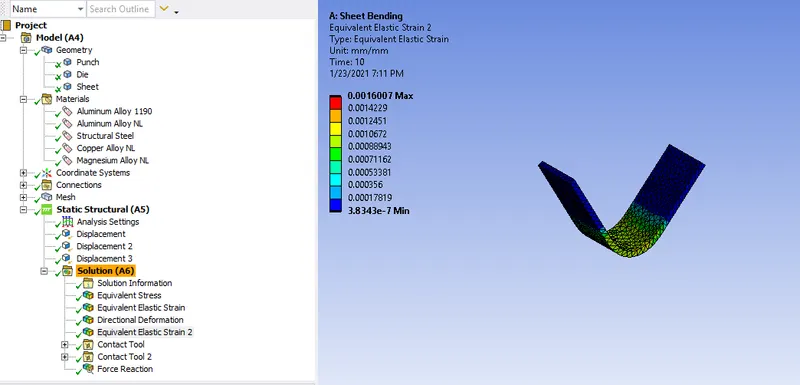
- Similarly with different set of material we got results as shown below.
Material
Von-mises Stress (Mpa)
Equivalent Strain
mm/mm
Total Deformation
mm
Aluminum Alloy 1199
Min. 2.7507e-8
Max. 2.4904e5
Min. 1.3754e-13
Max. 1.2464
Min. -12.476
Max. 2.2084
Copper Alloy NL
Min. 2.209e-11
Max. 2.128e5
Min. 7.0025e-13
Max. 1.0463
Min. -11.662
Max. 2.8053
Magnesium Alloy NL.
Min. 1.6728e-7
Max. 1.7378e5
Min. 8.3639e-13
Max. 0.86954
Min. -12.391
Max. 1.4857
In the above solution comparison chart we can see that maximum stress observed in the material Aluminium and it was less in Magnasium alloy.
Also there was very less equivalent strain and deformation observed in Magnasium alloy. So we can conclude that Magnasium alloy as strongest material among all 3 materials.
Case 2
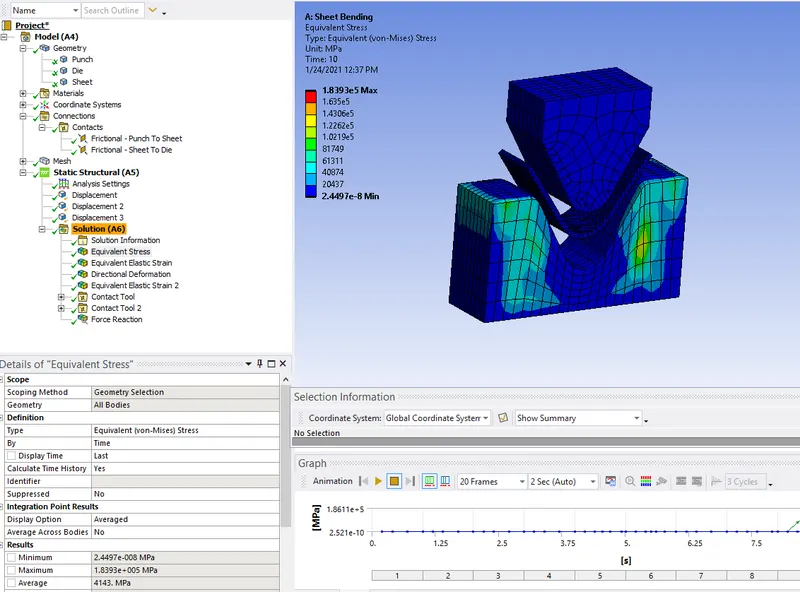
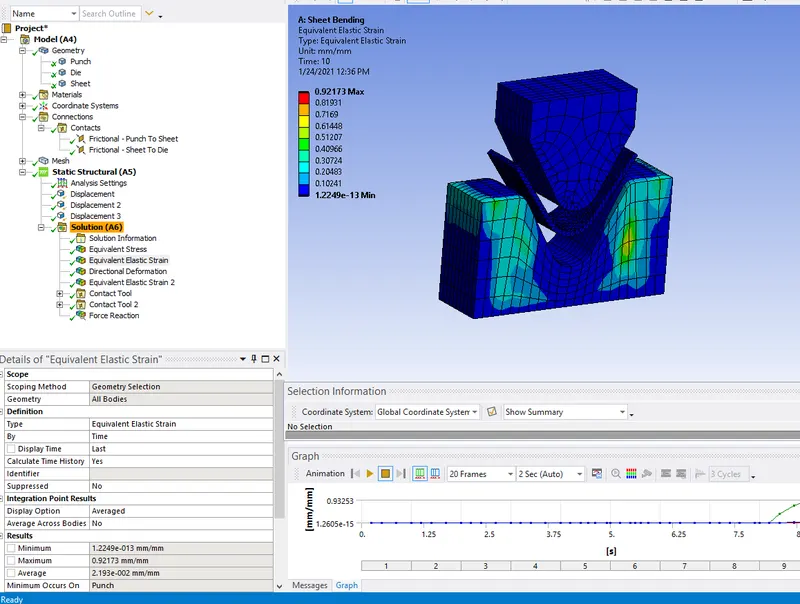
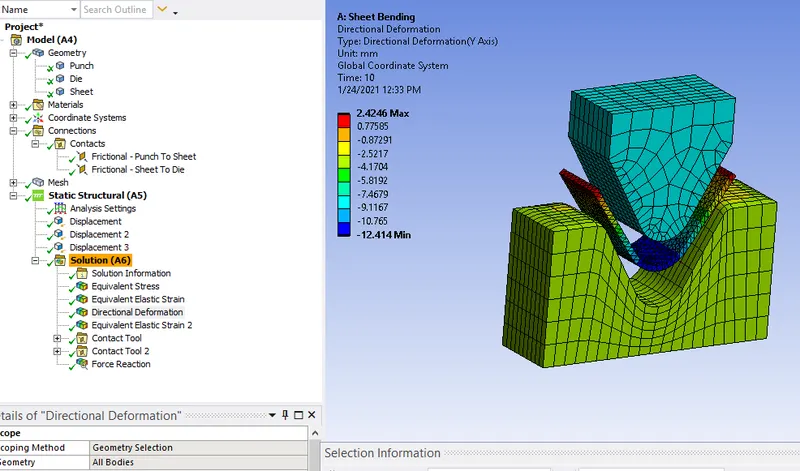
We changed the co-efficient of friction from 0.1 to 0.19 in both frictional contact punch to die and die to sheet, Below results and table shows the comparison in both the cases. In both the cases material was same which is Aluminum alloy.
|
Friction co-efficient |
Von-mises Stress (Mpa) |
Equivalent Strain mm/mm |
Total Deformation mm |
|
0.1 |
Min. 2.7507e-8 Max. 2.4904e5 |
Min. 1.3754e-13 Max. 1.2464 |
Min. -12.476 Max. 2.2084 |
|
0.19 |
Min. 2.521e-10 Max. 1.8611e5 |
Min. 1.2249e-13 Max. 0.92173 |
Min. -12.414 Max. 2.4246 |
Here we can observe that when we increased the co-efficient of friction strain and strain reduced in Alluminium alloy sheet.
Case 3
In this case we have refined the mesh and used minimum possible refined mesh in academic version.
And found below results.
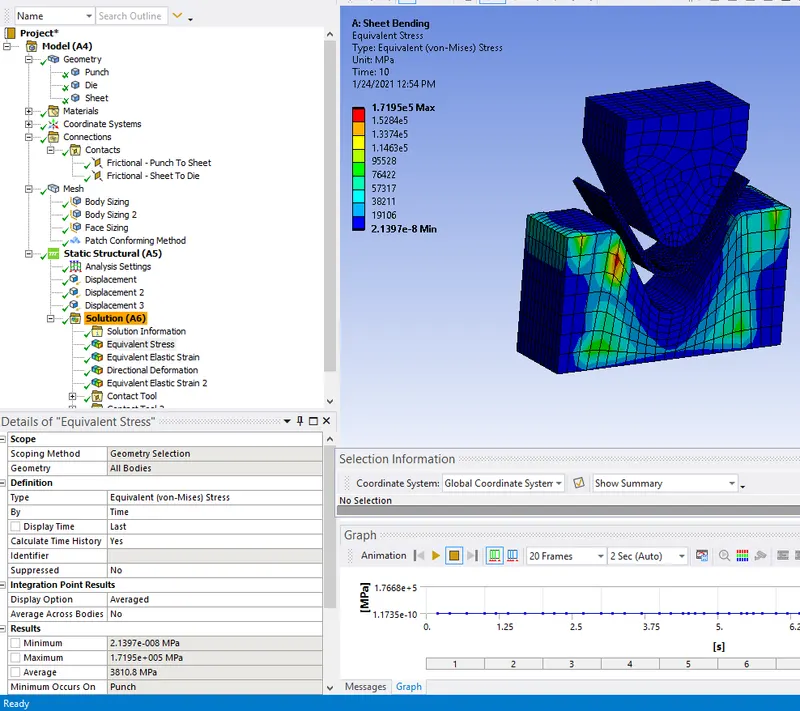
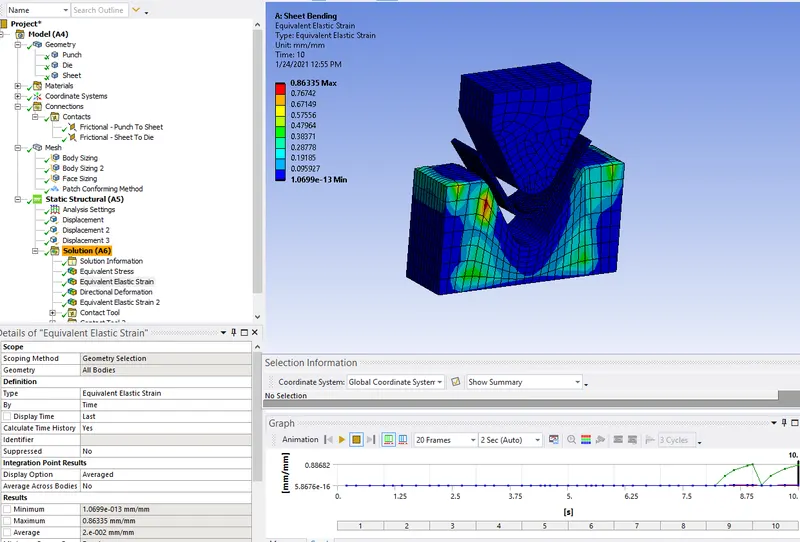
These results showed us finer mesh can improve the results. We got reduced stress, strain and deformation in case of finer mesh.