Week 3 Sheet metal Bending challenge
AIM:
To Perform the Advanced Structural Analysis on the sheet bending operation Using ANSYS WORKBENCH.
OBJECTIVE:
Analyze the punch,die and sheet setup to find out their Directional deformation, equivalent stress and Equivalent Elastic Strain under the displacement loads with Different materials compare the results. Change the frictional co-efficient of alluminium alloy and refine the mesh on the plate are different cases to study.
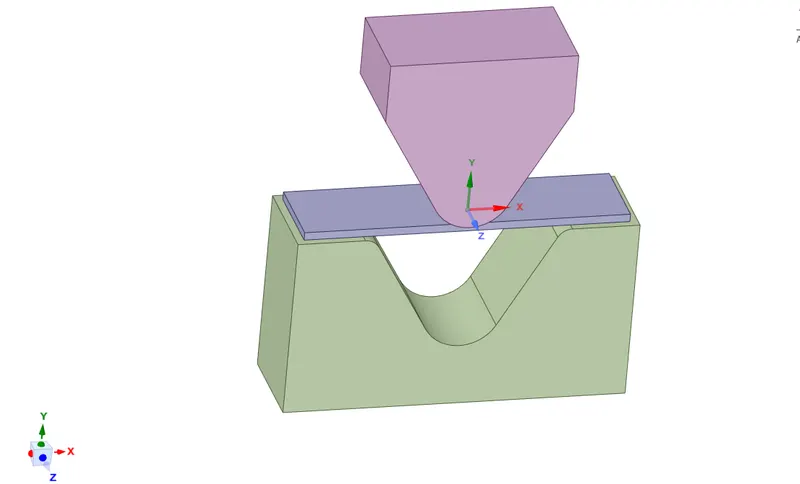
GIVEN MODEL:
*Sheet bending is a metal forming process in which a force is applied to a piece of sheet metal, causing it to bend at an angle and form the desired shape. A bending operation causes deformation along one axis, but a sequence of several different operations can be performed to create a complex part.
*This operation contains three main parts:
1. Punch:It is used to create the impact force on the sheet to transfers into particular shape.
2. Die :It is used as pattern to change the sheet into particular shape.
3.Sheet :It is nothing but workpiece, which is change into desired shape.
PROCEDURE:
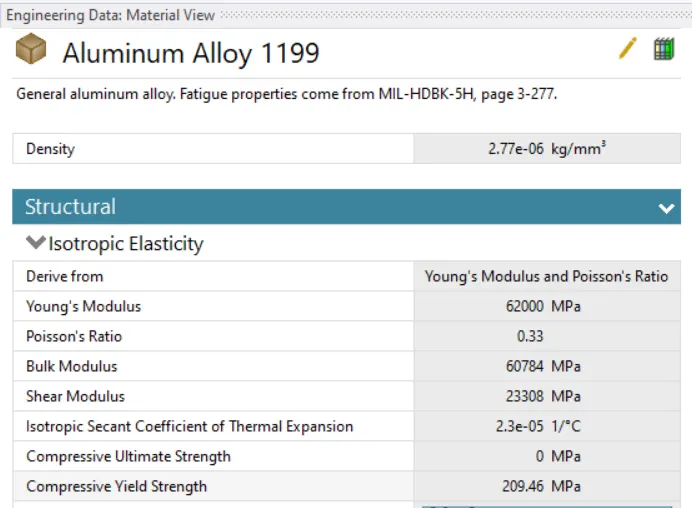
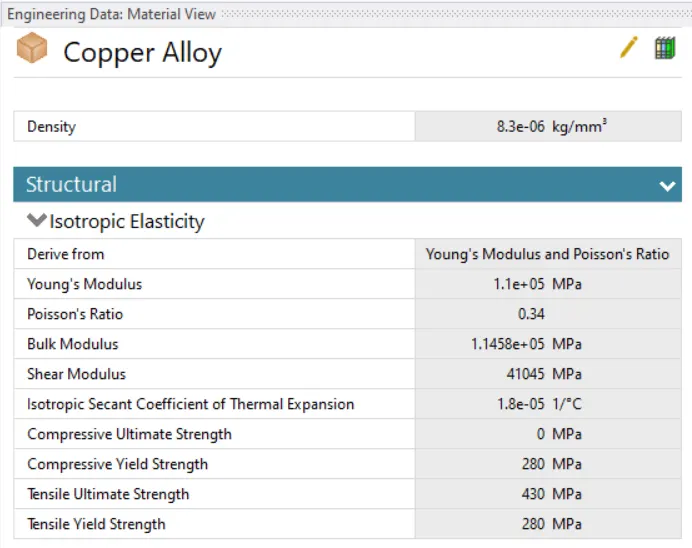
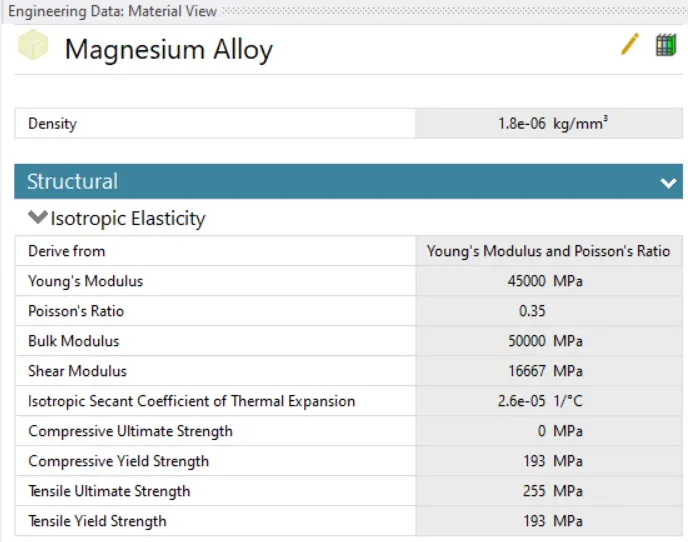
*Assign the material as alluminium alloy, Copper Alloy and Magnesium Alloy , Selecting the Engineering data >> Edit >> Engineering data sources >> General Materials >> alluminium alloy.
Alluminium Alloy 1199:
COPPER ALLOY:
Magnesium Alloy:
ALLUMINIUM ALLOY:
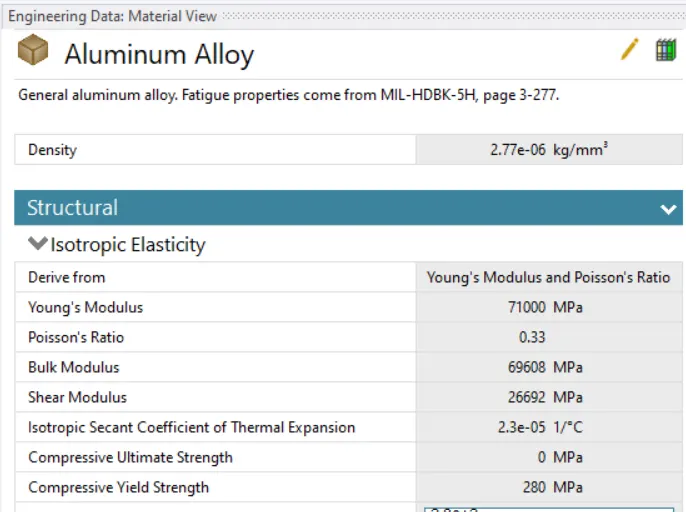
*After Assigning the material close the engineering data and open new space claim to make the required designs.
*Once geometry is imported from the space claim then open the model and eidt the geometry in Mechanical moduler.
*Assign the Contacts and targets according to the design model with contact type is Frictional, behavour is Asysmmetric, Augmente Lagrange Formulation.
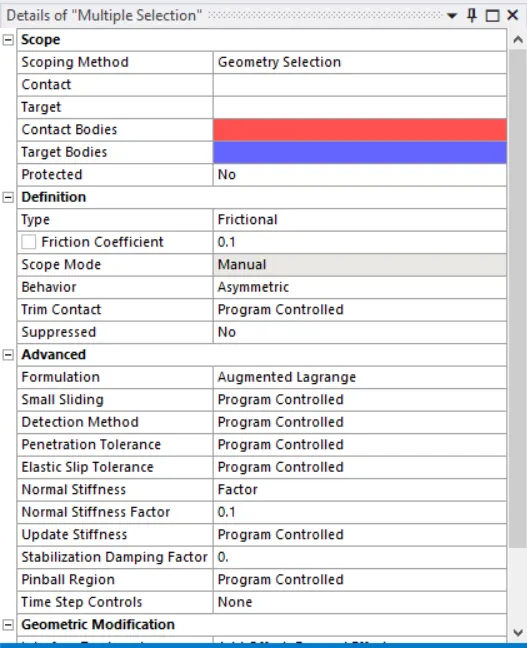
*After that Give all analysis setting in steps of time.
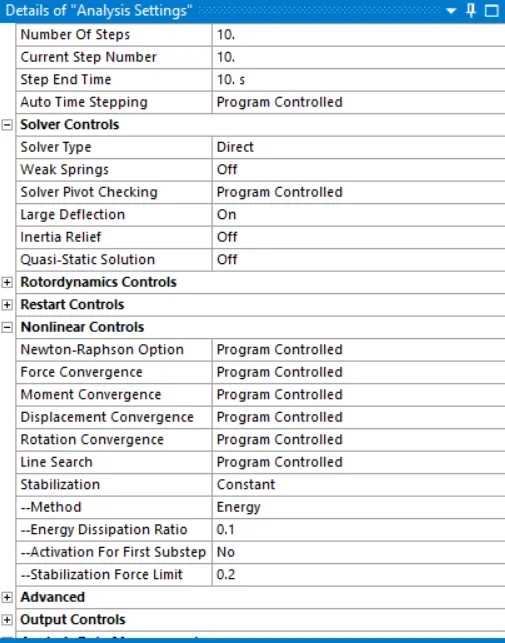
*Apply Displacement boundary condition to trace the wheel tranlation motion
CASE-1
Aluminium Alloy 1199,Copper Alloy and Magnesium Alloy . Find out the Equivalent stress, Equivalent elastic strain and Total Deformation in Y direction and compare the results for the three materials
ALUMINIUM ALLOY 1199:
EQUIVALENT VON-MISES STRESS:
MAX: 5848.5 (Mpa) and MIN:8.3572E-6 (Mpa)
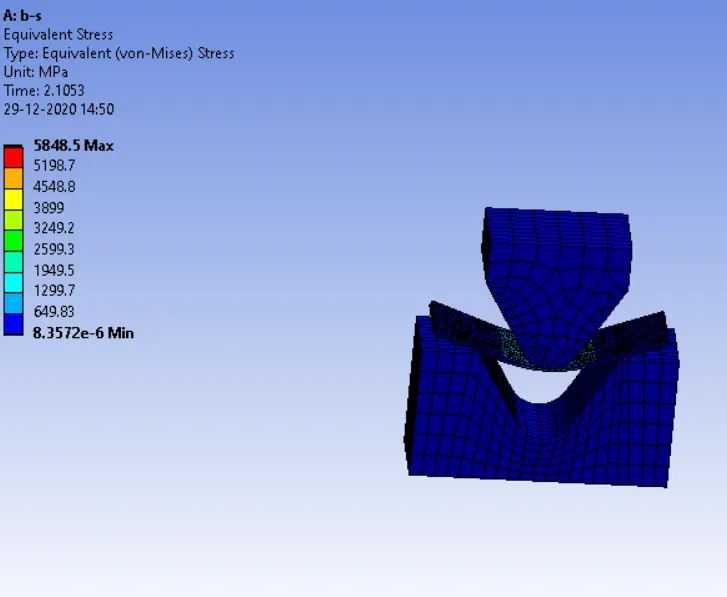
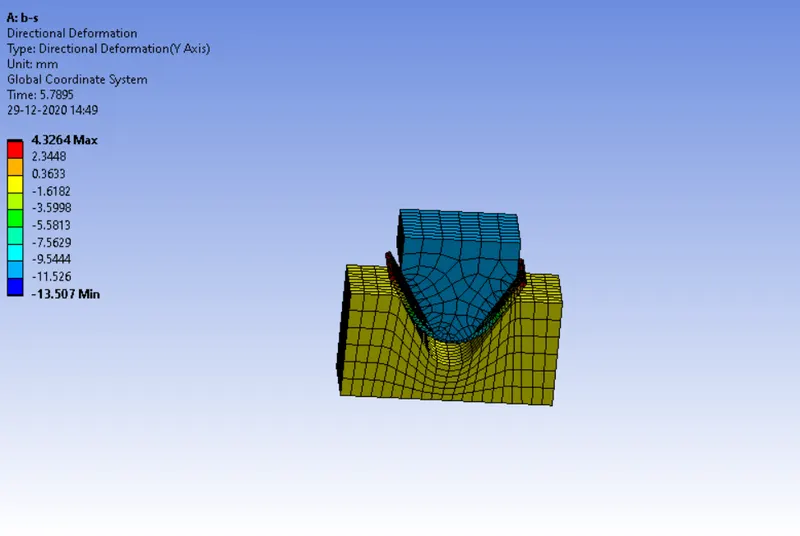
DIRECTIONAL DEFORMATION:
MAX:4.326 (mm) and MIN: -13.507 (mm)
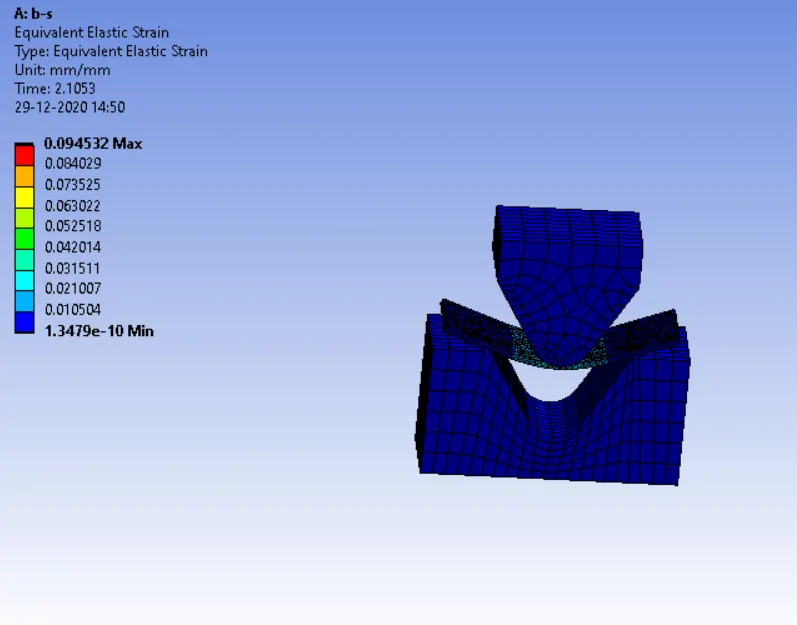
EQUIVALENT ELASTIC STRAIN:
MAX: 0.09453 and MIN:1.3479E-10
COPPER ALLOY:
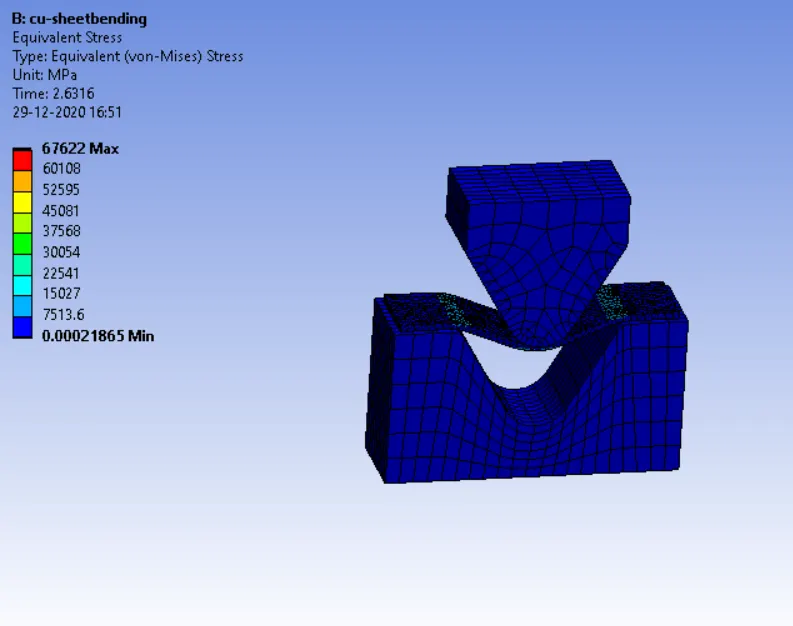
EQUIVALENT VON-MISES STRESS:
MAX: 67622 (Mpa) and MIN:21.865E-5 (Mpa)
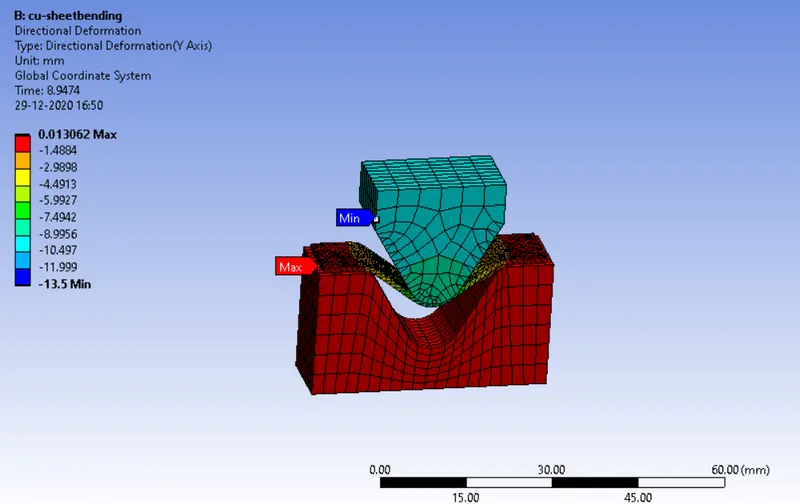
DIRECTIONAL DEFORMATION:
MAX:0.01306 (mm) and MIN: -13.5 (mm)
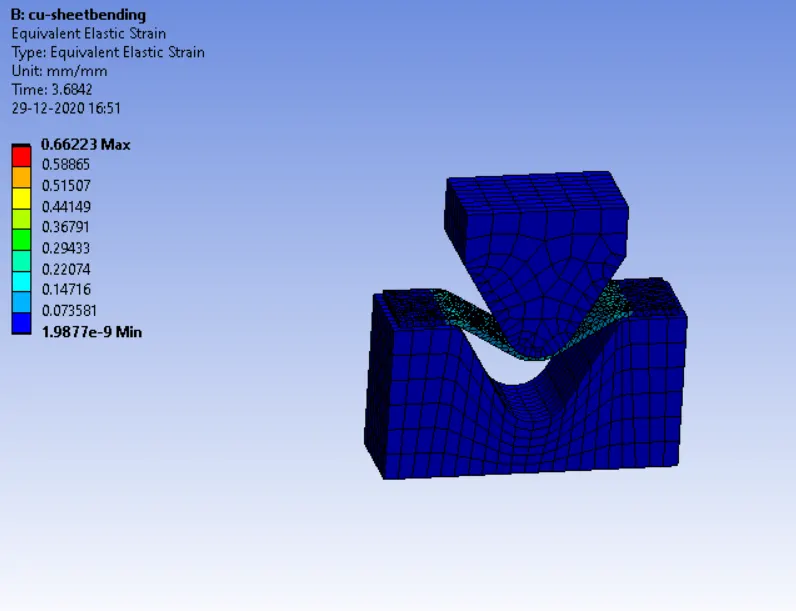
EQUIVALENT ELASTIC STRAIN:
MAX: 180 and MIN:1.63E-12
MAGNESIUM ALLOY:
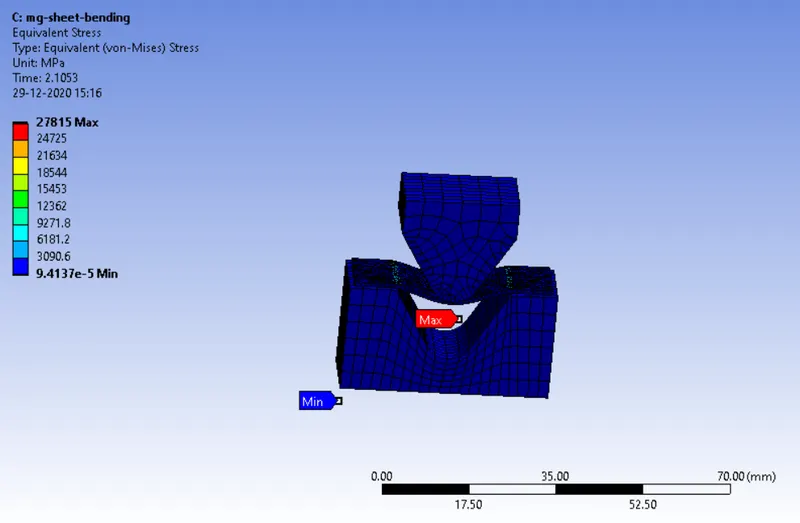
EQUIVALENT VON-MISES STRESS:
MAX: 27815 (Mpa) and MIN:9.4137E-5 (Mpa)
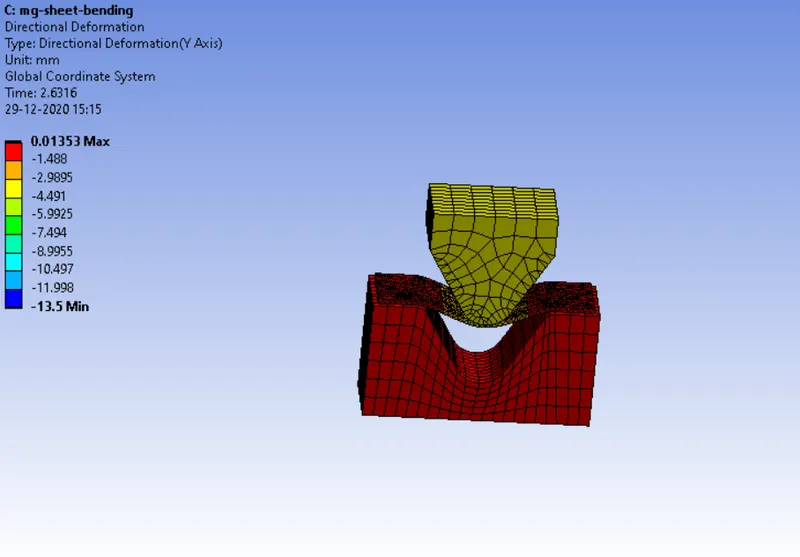
DIRECTIONAL DEFORMATION:
MAX:0.01353 (mm) and MIN: -13.5 (mm)
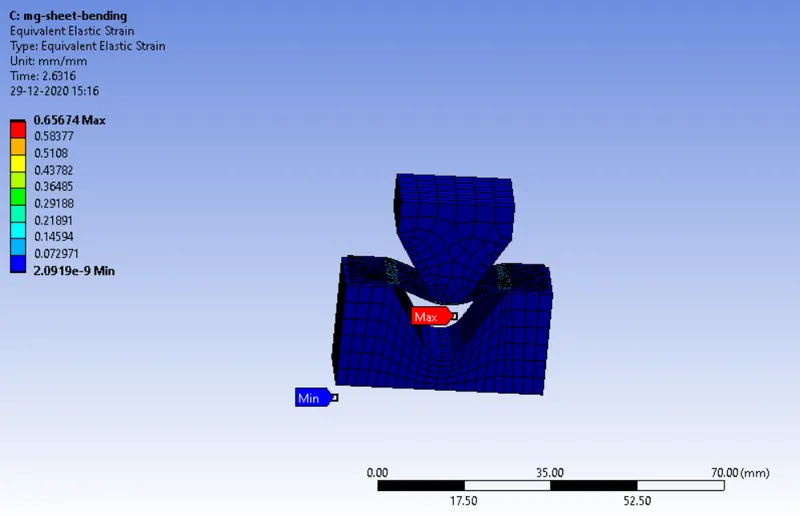
EQUIVALENT ELASTIC STRAIN:
MAX: 0.65674 and MIN:2.0919E-9
COMPARING THE RESULTS:
| SL.NO | MATERIAL |
EQUIVALENT VON-MISES STRESS (Max) |
EQUIVALENT VON-MISES STRESS (Min) |
EQUIVALENT ELASTIC STRAIN (Max) |
EQUIVALENT ELASTIC STRAIN (Min) |
DIRECTIONAL DEFORMATION (Max) |
DIRECTIONAL DEFORMATION (Min) |
| 1. | Allouminium Alloy 1199 | 5848.5 | 8.3572E-6 | 0.094532 | 1.3479E-10 | 4.326 | -13.567 |
| 2. | Copper Alloy | 67622 | 21.865E-5 | 0.66223 | 1.9877E-9 | 0.013062 | -13.5 |
| 3. | Magnesium Alloy | 27815 | 9.4137E-5 | 0.6567 | 2.0919E-9 | 0.01353 | -13.5 |
*Alluminum Alloy 1199 has less stress concentration on the sheet because it has less density than copper and magnesium.
*Stress is Directly proportional to strain we know that from hooke,s law so, Strain is also minimum in Alluminium Alloy 1199.
*Directional deformation is maximum in Alluminium Alloy 1199, moderate in magnesium alloy and minium in copper alloy due to youngs modulus.
CASE-2:
With the material as Aluminium Alloy, change the friction coefficient to 0.19 and run the analysis as mentioned in Case 1. Compare the results with that in case 1.
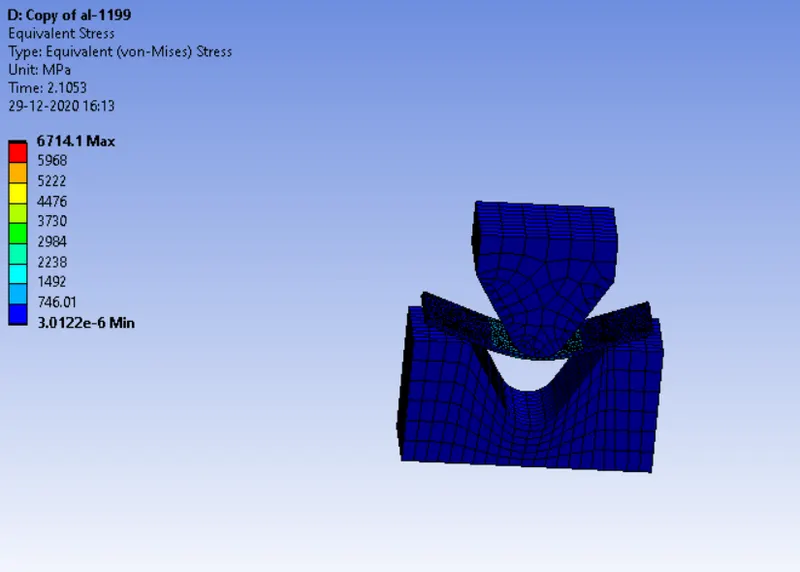
EQUIVALENT VON-MISES STRESS:
MAX: 6714.1 (Mpa) and MIN:3.0122E-6 (Mpa)
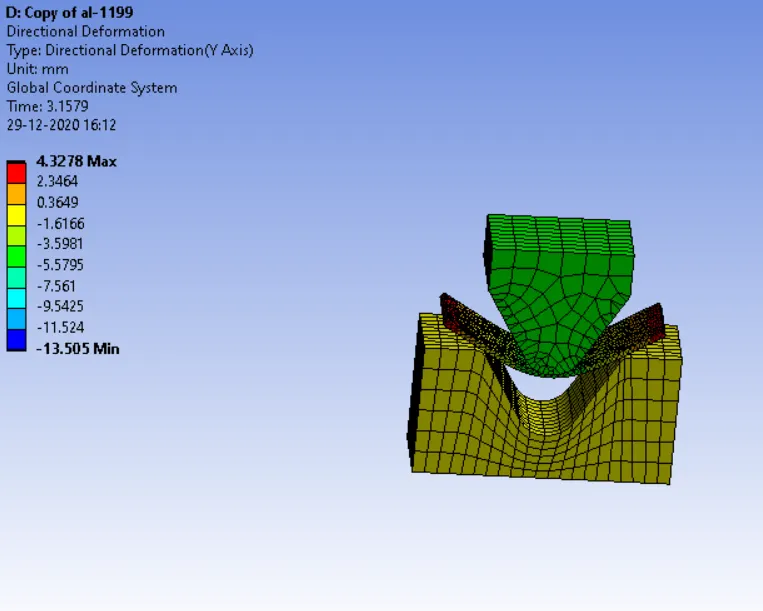
DIRECTIONAL DEFORMATION:
MAX:4.3278 (mm) and MIN: -13.505 (mm)
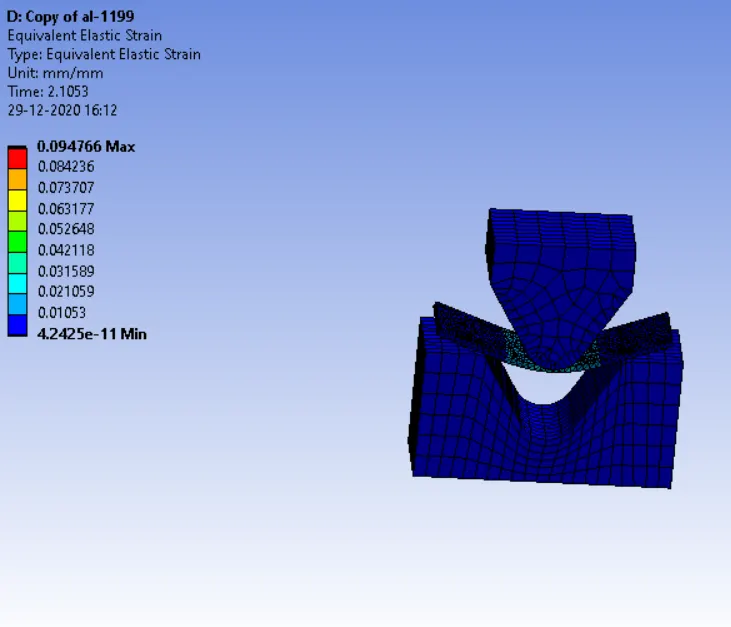
EQUIVALENT ELASTIC STRAIN:
MAX: 0.09476 and MIN:4.2425E-11
COMPARING THE RESULTS:
| SL.NO | MATERIAL |
EQUIVALENT VON-MISES STRESS (Max) |
EQUIVALENT VON-MISES STRESS (Min) |
EQUIVALENT ELASTIC STRAIN (Max) |
EQUIVALENT ELASTIC STRAIN (Min) |
DIRECTIONAL DEFORMATION (Max) |
DIRECTIONAL DEFORMATION (Min) |
| 1. | ALLUMINIUM ALLOY 1199 | 5848.5 | 8.3572E-6 | 0.094532 | 1.3479E-10 | 4.326 | -13.567 |
| 2. | ALLUMINIUM ALLOY (Nu=0.19) | 6714.1 | 3.0122E-6 | 0.094766 | 4.2425E-11 | 4.327 | -13.505 |
*Strees concentration is more in Alluminium Alloy with frictional co-efficient is 0.19 than Alluminium Alloy 1199 in Case-1.
*Directional Deformation is almost equal in both the cases.
CASE-3:
Refine the mesh on the plate such that it doesn't cross the academic limit. With Aluminium alloy as material, run the analysis as in Case 1 and compare the results.
*Element size on the plate is 0.7 (mm)
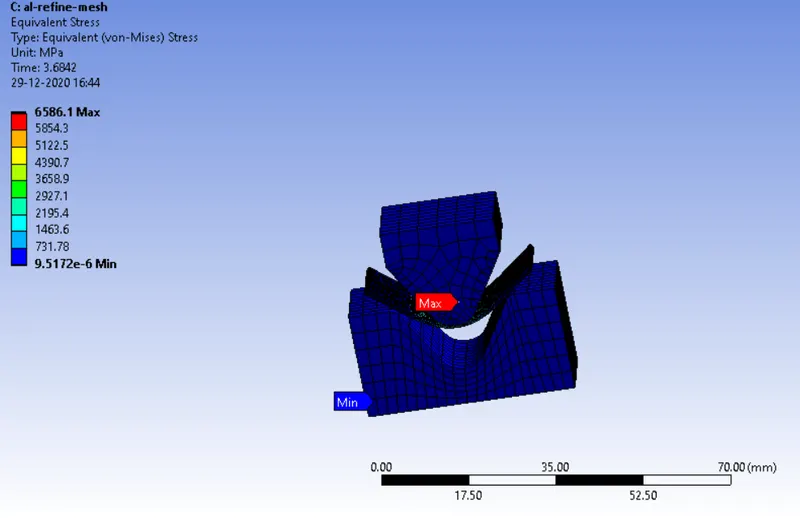
EQUIVALENT VON-MISES STRESS:
MAX: 6586.1 (Mpa) and MIN:9.5172E-6 (Mpa)
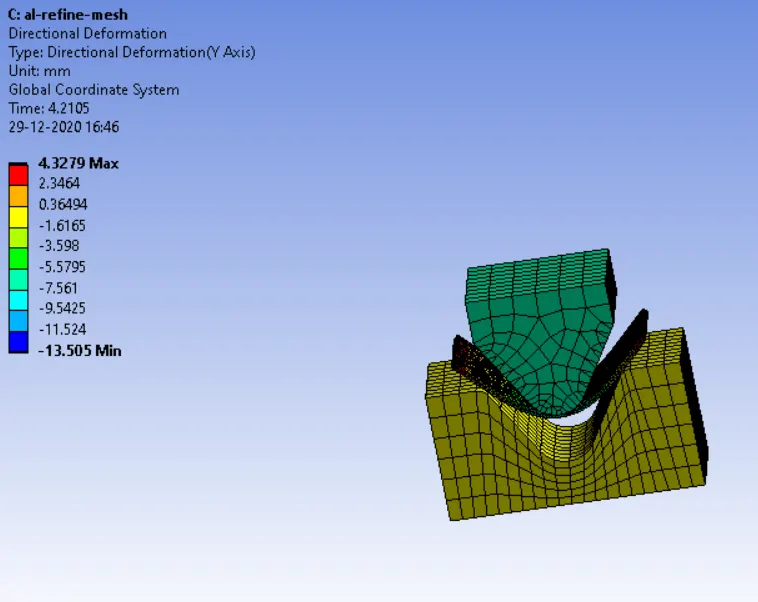
DIRECTIONAL DEFORMATION:
MAX:4.3279 (mm) and MIN: -13.505 (mm)
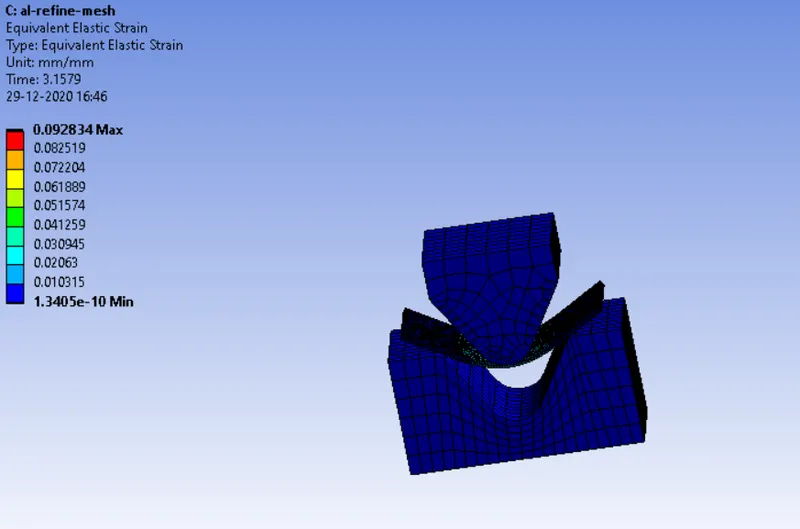
EQUIVALENT ELASTIC STRAIN:
MAX: 0.092834 and MIN:1.3405E-10
COMPARING THE RESULTS:
| SL.NO | MATERIAL |
EQUIVALENT VON-MISES STRESS (Max) |
EQUIVALENT VON-MISES STRESS (Min) |
EQUIVALENT ELASTIC STRAIN (Max) |
EQUIVALENT ELASTIC STRAIN (Min) |
DIRECTIONAL DEFORMATION (Max) |
DIRECTIONAL DEFORMATION (Min) |
| 1. |
ALLUMINIUM ALLOY 1199 (Element size is 1 (mm) |
5848.5 | 8.3572E-6 | 0.094532 | 1.3479E-10 | 4.326 | -13.567 |
| 2. | ALLUMINIUM ALLOY (Element size is 0.7 (mm) | 6586.1 | 9.5172E-6 | 0.092834 | 1.3405E-10 | 4.3279 | -13.505 |
*By Refining the mesh the results are getting more approximate than coarse mesh element size.