Week 3 Sheet metal Bending challenge
OBJECTIVE:-
To run the analysis for the sheet metal bending process for 3 different cases as described below:-
Case 1:Aluminium Alloy 1199( mentioned in the course video),Copper Alloy NL and Magnesium Alloy NL. Find out the Equivalent stress, Equivalent elastic strain and Total Deformation in Y direction and compare the results for the three materials.
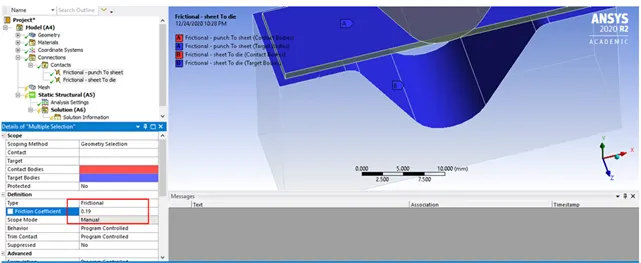
Case 2:With the material as Aluminium Alloy, change the friction coefficient to 0.19 and run the analysis as mentioned in Case 1. Compare the results with that in case 1.
Case 3: Refine the mesh on the plate such that it doesn't cross the academic limit. With Aluminium alloy as material, run the analysis as in Case 1 and compare the results.
PROCEDURE FOLLOWED:-
Create a new static structural analysis,
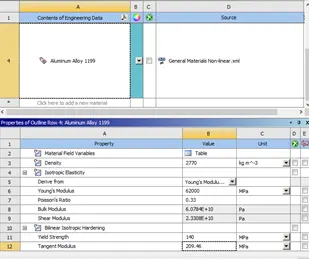
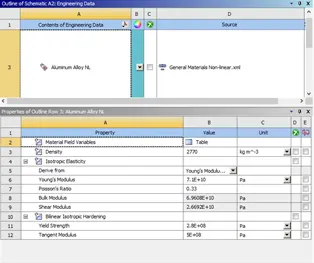
Assign a new marterial from general non-linear material section as aluminium alloy and make change to its properties.
Material aluminium alloy 1199
Young’s modulus = 62000 MPa
Yield strength = 140 MPa
Tangent modulus = 109.46 MPa
Make sure to apply the parameters in MPa.
Before doing any analysis part in mechanical workbench, we first have to check for any editing required in the geometry, for that we will be opening the model in the space-claim workbench.
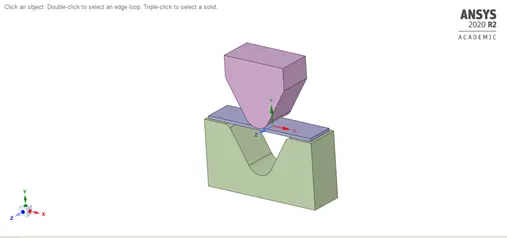
As the geometry seems to be fine, thus proceeding towards analysis part in mechanical workbench.
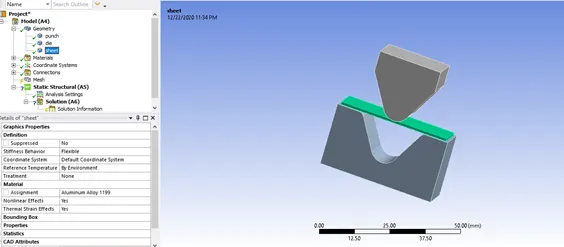
Opening the geometry in the mechanical workbench and renaming the parts according to their real name and then assigning the material to each part according to their work. Here the die and the punch will have the structural steel as the material, while the sheet will have the aluminium alloy 1199 material.
Deleting the default generated contacts and assigning the contacts manually,
Punch to sheet
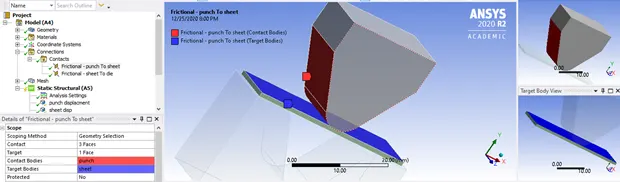
Sheet to die
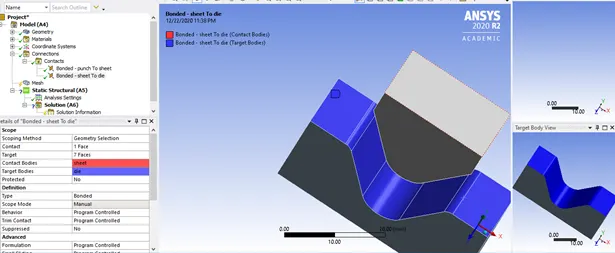
Select both contact type as frictional and assign the
frictional coefficient = 0.1
behavior = auto assymmetric
formulation = augmented lagrange
normal stiffness = factor
normal stiffness factor = 0.1
interface treatment = add offset,ramped effects.
Hence we are done defining the contacts , then we will be proceeding towards meshing part,
In meshing the die and punch body will have the 4 mm mesh,
Sheet will have the 1 mm mesh, and the face of the die and punch which will contact the sheet will also have a 1 mm mesh, thus defining all this parameters with the help of sizing option.
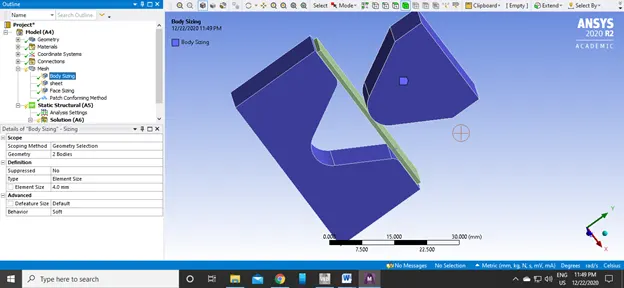
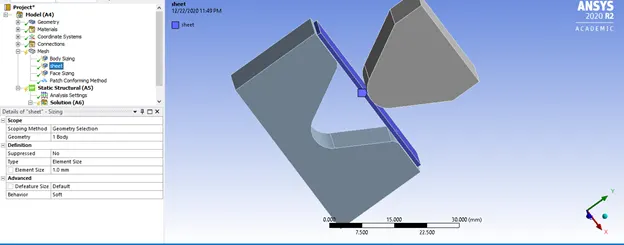
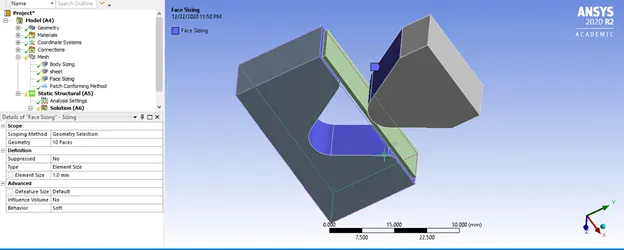
Also the method for meshing the sheet has to be defined as tetrahedron
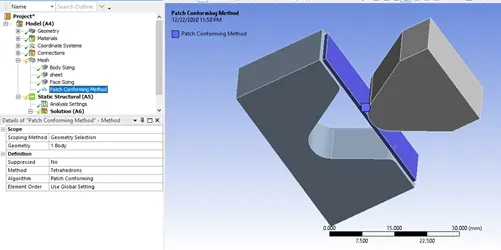
After all the meshing settings, generating the mesh
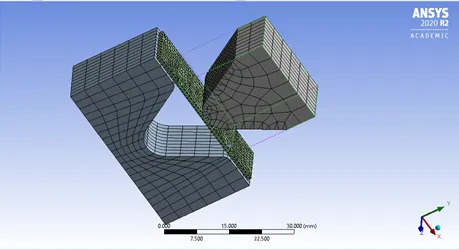
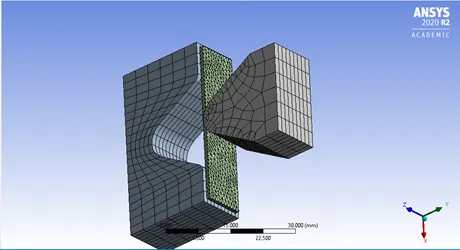
After meshing don’t forget to check for statistics, i.e. the nodes must not exceed the academic limit.
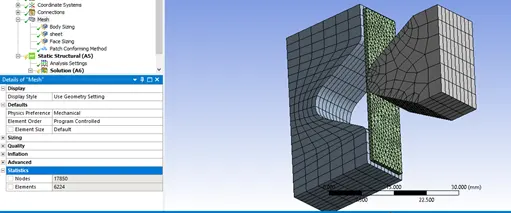
The nodes are to the limit and not exceeded the academic version limit.
Analysis setting has to be done,
Number of steps = 10
Solver type = direct
Large deflection = ON
Stabilization = constant
Energy dissipation ratio = 0.1
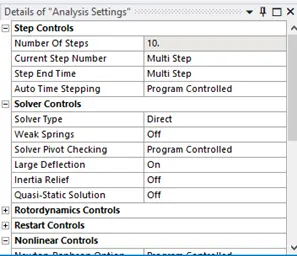
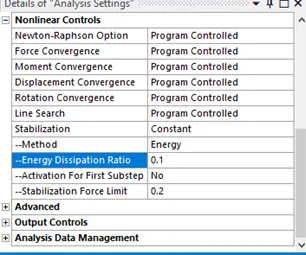
After the analysis setting has been done the Displacement values has to be set so that when the sheet is deformed the punch will move backwards, and also the die will move a little so that the sheet can be easily removed.
Displacement for punch
In x and z direction no displacements because the punch will advance in only Y-DIRECTION.
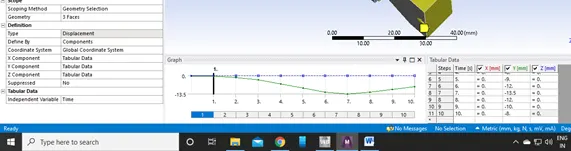
Displacement for sheet
Constraining the displacement in z-direction.
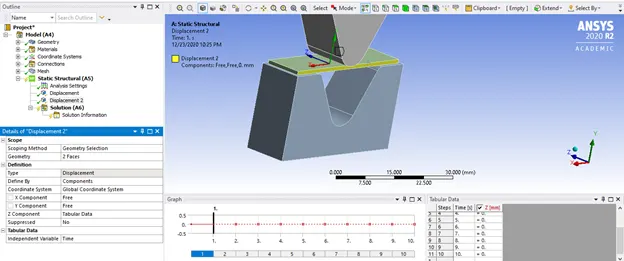
Displacement setting for punch
On the last 2 steps only the die will move, thus accordingly giving the values only in the last 2 steps, ehrn the punch has done its work and the sheet is completely deformed.
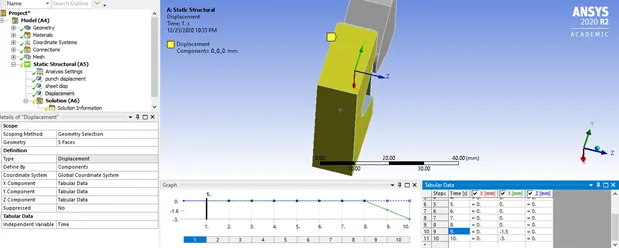
Now setting up the solution requirements
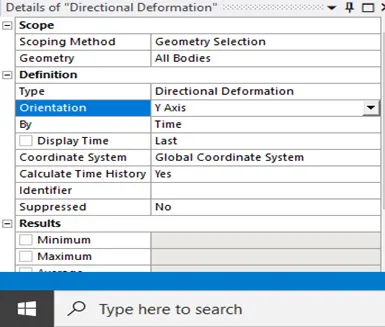
Deformation in only “y” direction. Also we need to analyze the equivalent elastic strain and also the Von-mises stress. Thus giving the solution requirement for this two also.
Solving for analysis for aluminium alloy 1199
CASE 1:-
Aluminum Alloy 1199
Directional deformation
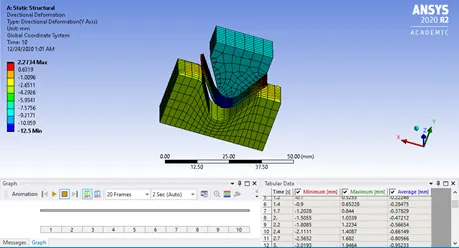
Equivalent elastic strain
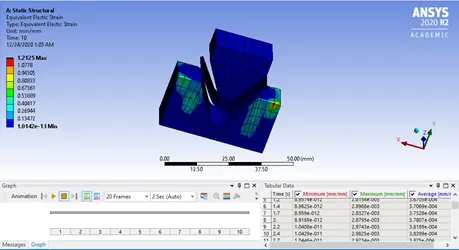
Von-mises stress
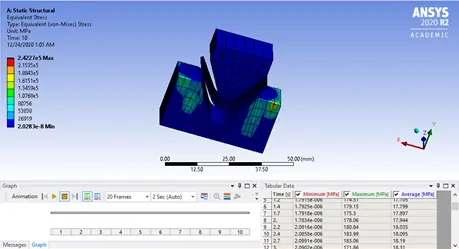
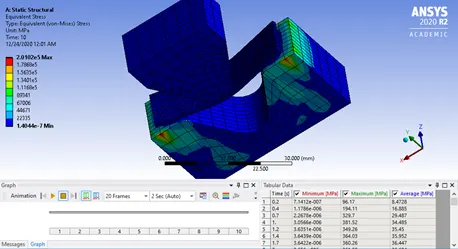
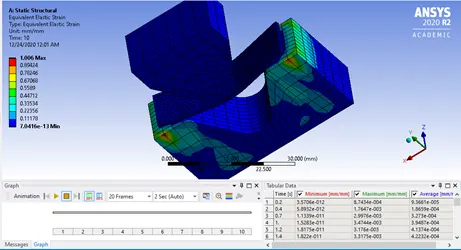
Copper Alloy
Assigning the material
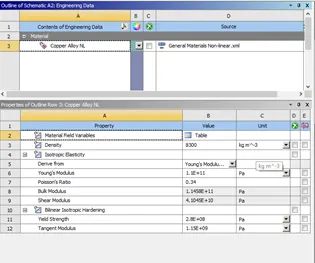
And there after following all the previous steps as done in aluminium alloy to set the settings and also apply the required paramaters, thereafter solving for analysis.
Directional deformation
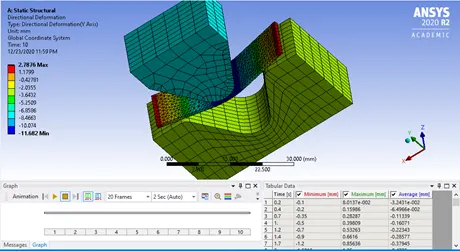
Von mises stress
Equivalent elastic strain
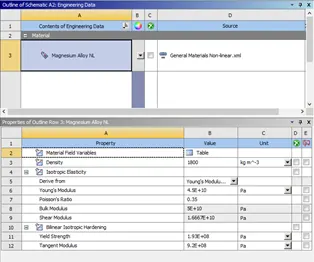
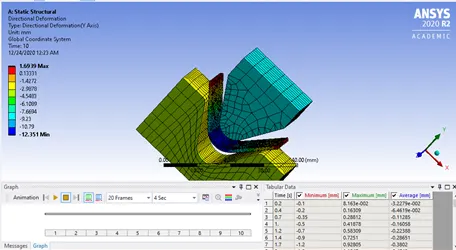
Magnesium Alloy
Material properties are set as default
Solving for analysis after the settings.
Directional deformation
Von mises stress
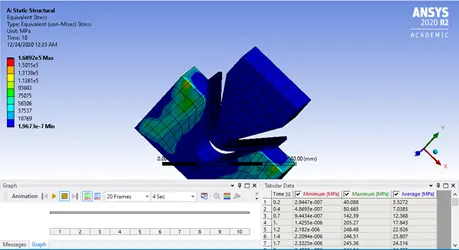
Equivalent elastic strain
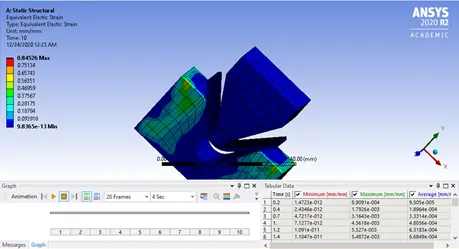
Tabulating all the maximum values for all the three alloys obtained.
|
DIRECTIONAL DEFORMATION |
VON-MISES STRESS |
EQUIVALENT ELASTIC STRAIN |
|
|
Aluminium alloy 1199 |
2.2734 |
2.4227E+5 |
1.2125 |
|
Copper alloy |
2.7876 |
2.0102E+5 |
1.006 |
|
Magnesium alloy |
1.6939 |
1.6892E+5 |
0.84256 |
CASE 2:-
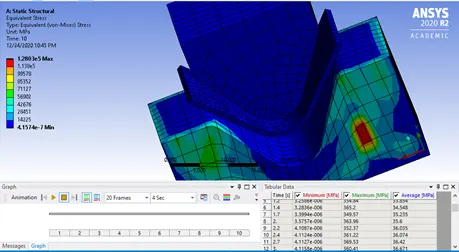
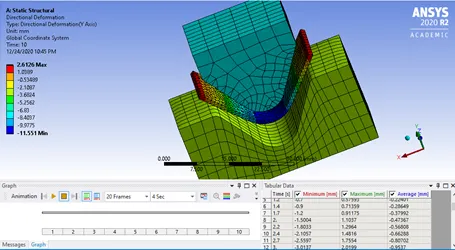
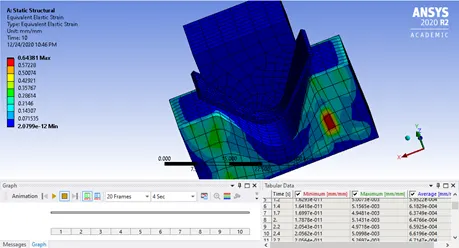
Aluminium alloy with the frictional coefficient as 0.19
Aluminium alloy with default properties.
Frictional coefficient as 0.19
Von mises stress
Directional deformation
Equivalent elastic strain
Tabulating the comparison data,
|
Directional Deformation(mm) |
Von-Mises stress(MPa) |
Equivalent elastic strain(mm) |
|
|
Aluminium alloy 1199 |
2.2734 |
2.4227E+5 |
1.2125 |
|
Aluminium alloy 0P19 |
2.6126 |
1.2803E+5 |
0.64381 |
CASE 3:-
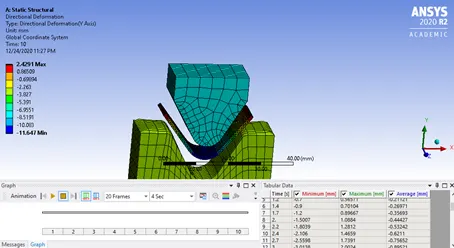
After mesh refinement and all the setting done on aluminium alloy again capturing the results.
With aluminium alloy as the alloy, and default properties,
Directional deformation
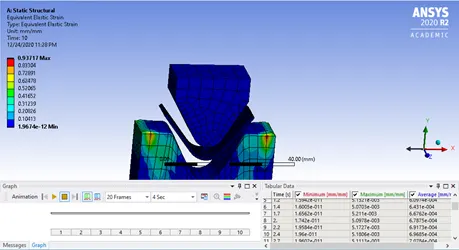
Equivalent elastic strain
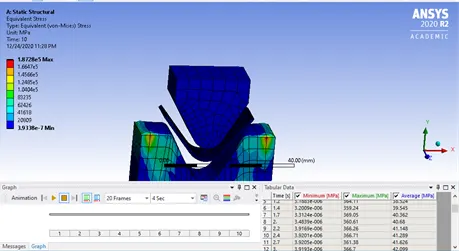
Von-mises
|
Directional Deformation(mm) |
Von-mises stress(MPa) |
Elastic strain(mm) |
|
|
Aluminium alloy 1199 |
2.2734 |
2.4227E+5 |
1.2125 |
|
Aluminium alloy 0P19 |
2.6126 |
1.2803E+5 |
0.64381 |
|
Aluminium alloy(refined mesh) |
2.4291 |
1.8728E+5 |
0.93717 |
CONCLUSION:-
For all the three case the simulation has been run and the findings are tabulated.
Case 1
|
DIRECTIONAL DEFORMATION |
VON-MISES STRESS |
EQUIVALENT ELASTIC STRAIN |
|
|
Aluminium alloy 1199 |
2.2734 |
2.4227E+5 |
1.2125 |
|
Copper alloy |
2.7876 |
2.0102E+5 |
1.006 |
|
Magnesium alloy |
1.6939 |
1.6892E+5 |
0.84256 |
On comparing above three different material analysis we get that the properties are minimum for magnesium alloy. But the maximum value differes in the rest 2 alloys, as the von-mises and the elastic strain are maximum for the Aluminium alloy 1199 and the Directional deformation is maximum for the copper alloy.
Case 2
|
Directional Deformation(mm) |
Von-Mises stress(MPa) |
Equivalent elastic strain(mm) |
|
|
Aluminium alloy 1199 |
2.2734 |
2.4227E+5 |
1.2125 |
|
Aluminium alloy 0P19 |
2.6126 |
1.2803E+5 |
0.64381 |
When compared on 2 different properties assigned for aluminium alloy the aluminium alloy 1199 has the maximum stress and elastic strain value. whereas the Directional deformation for aluminium alloy with frictional coefficient 0.19 has the greater value.
Case 3
|
Directional Deformation(mm) |
Von-mises stress(MPa) |
Elastic strain(mm) |
|
|
Aluminium alloy 1199 |
2.2734 |
2.4227E+5 |
1.2125 |
|
Aluminium alloy 0P19 |
2.6126 |
1.2803E+5 |
0.64381 |
|
Aluminium alloy(refined mesh) |
2.4291 |
1.8728E+5 |
0.93717 |
The aluminium alloy with the frictional coefficient 0.19 has the greater value for Directional deformation, on the other hand the von-mises and elastic strain values are greater for aluminium alloy 1199 with variable properties assigned as compared to default.
When selecting materials for engineering purposes, many factors must be considered. Metal alloy has unique properties that react to mechanical and chemical processes in specific ways.The mechanical properties of metal are generally determined by a number of factors, including grain size, heat treatment, atmospherics exposure, and temperature. Together, these attributes affect how a metal reacts to the forces it is exposed to in industrial processes.
Different processes affect metals in different ways. One important concept is that of stress and strain. When comparing specimens of various sizes, it is first necessary to calculate the load per unit area, also known as the normalization to the area. Stress is formulated dividing the force by the area. When conducting tension and compression tests, the area of relevance is perpendicular to the force. On the other hand, for shear or torsion tests, the area of relevance is perpendicular to the axis of rotation.Stress and strain can cause metal alloys to react in undesirable ways and must be tested carefully.
For reference the workbench files can be downloaded from:-
https://drive.google.com/file/d/1g85pCnVn1Tx1Pdq1ObLOylrsm4D5_bJk/view?usp=sharing