Week 3 Sheet metal Bending challenge
Sheet Metal Bending
To perform stress analysis on sheet metal bending operation using three different materials like Aluminium Alloy 1919, Copper Alloy NL, Magnesium Alloy NL.
Geometry File:
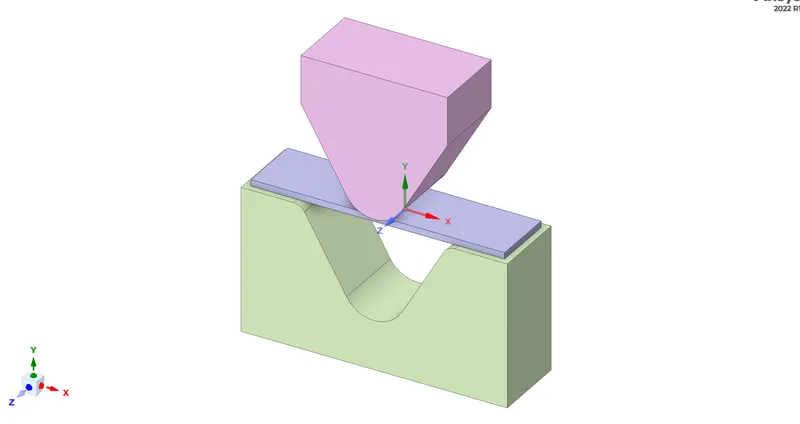
Mesh Details:
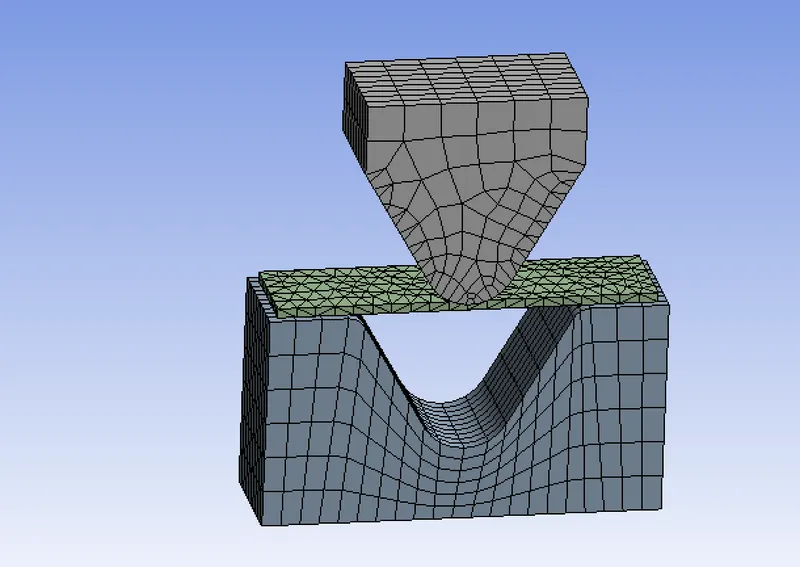
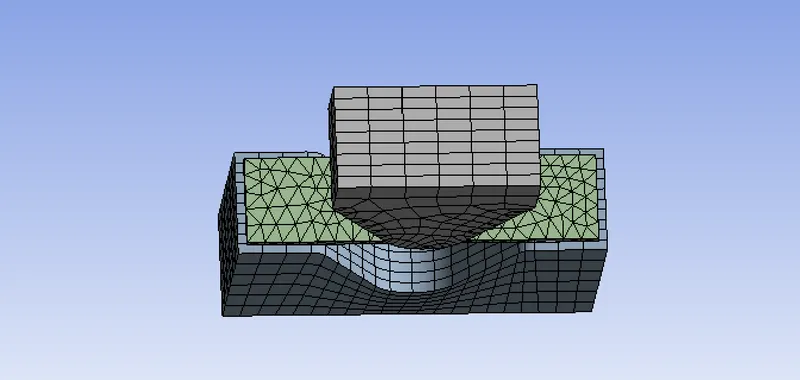
The model meshes with Ansys meshes with an element size of 4mm as we are focusing on the contact joints we separately selected face sizing and gave a different element size in order to get a finer mesh.
Hence chose,
2 mm of element size for the sheet metal
For evaluation in detail, we chose an element size of 1mm for the target bodies
As we are evaluating the sheet metal chose the tetrahedrons method.
Contacts Setup:
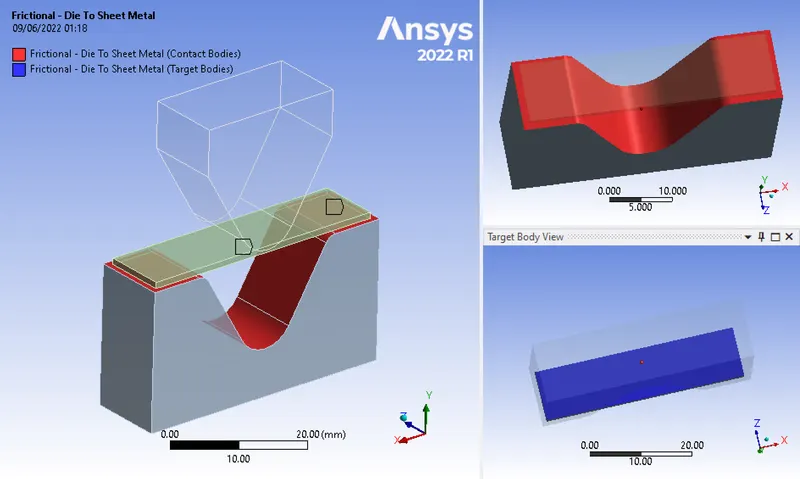
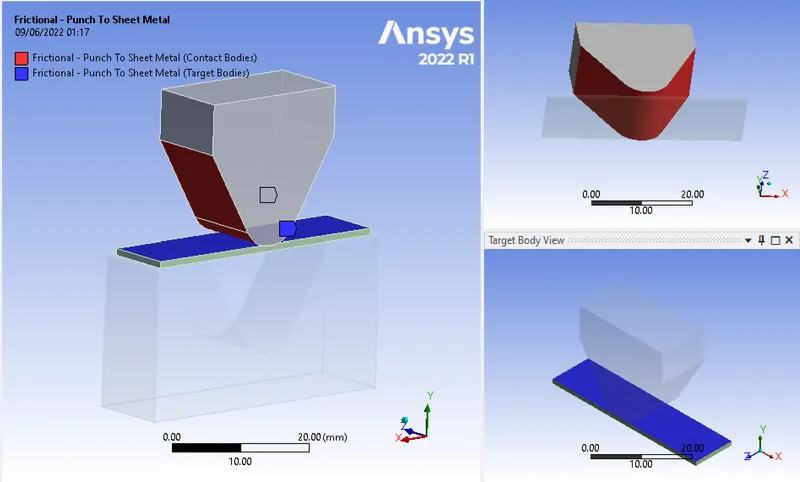
Contacts at the interface were set up between the punch and sheet and between the sheet and die with a contact type frictional and friction coefficient of 0.19 as shown in the figures below.
Analysis setup:
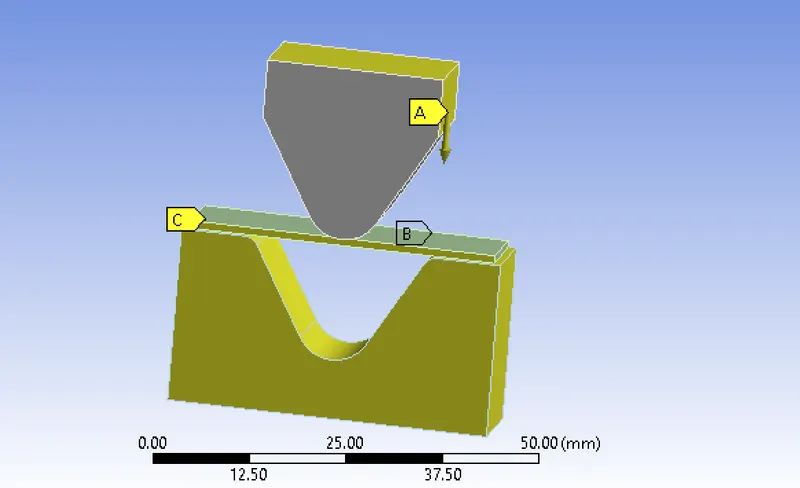
Simulation is performed in 10 steps with large deflection turned ON to account for large deformation with solver type as direct. Convergence difficulty due to unstable problems is usually the result of a large displacement for small load increments. The nonlinear stabilization technique can help in achieving convergence. we change the dissipation ratio factor to 0.1. It can be thought of as adding artificial dampers to all nodes. we then add the displacements as shown in the figure below. (A) is given displacement in the negative y-direction, (B) is given displacement of zero in the z-direction, and (C) is given zero displacements in all directions.
Simulation Results with frictional co-efficient 0.1:
The properties of the material used are:
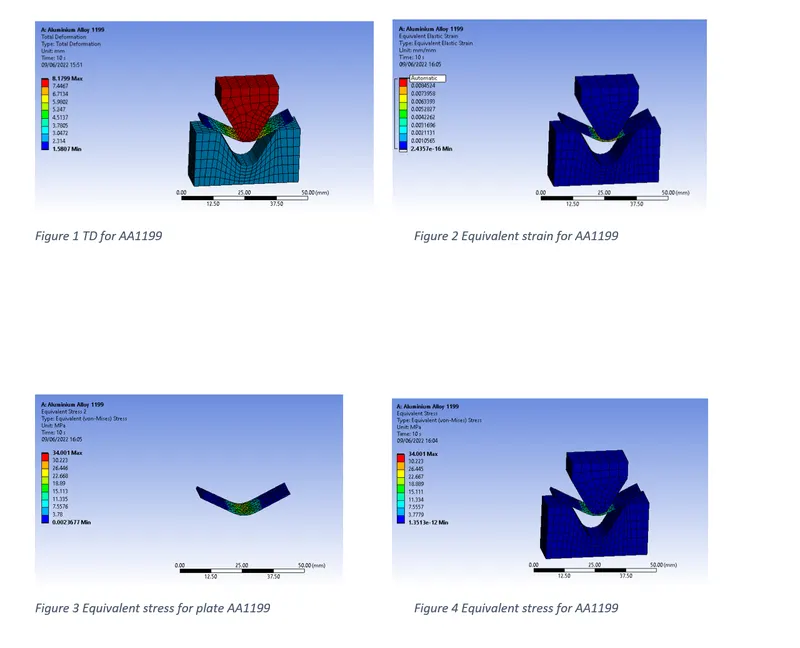
Aluminium Alloy 1919
Density 2700 kg m^-3
Youngs modulus 6200 Mpa
Poisson’s Ratio 0.33
Yield strength 140 Mpa
Tangent Modulus 289.46 Mpa
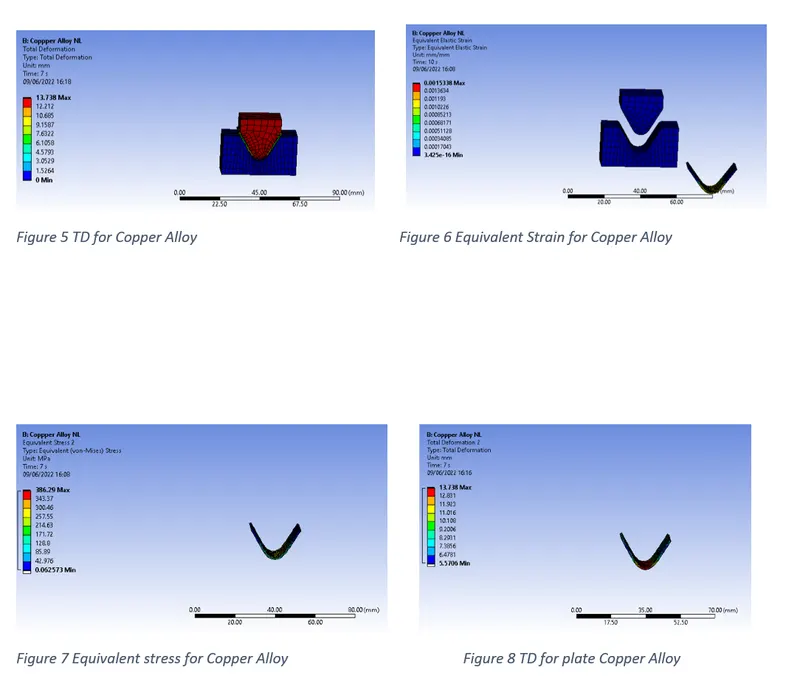
Copper Alloy NL
Density 8200 kg m^-3
Youngs modulus 1.1E+11 Pa
Poisson’s Ratio 0.34
Yield strength 2.8E+08 Pa
Tangent Modulus 1.15E+09 Pa
Magnesium Alloy NL
Density 1800 kg m^-3
Youngs modulus 4.5E+10 Pa
Poisson’s Ratio 0.35
Yield strength 1.93E+08 Pa
Tangent Modulus 9.2E+08 Pa
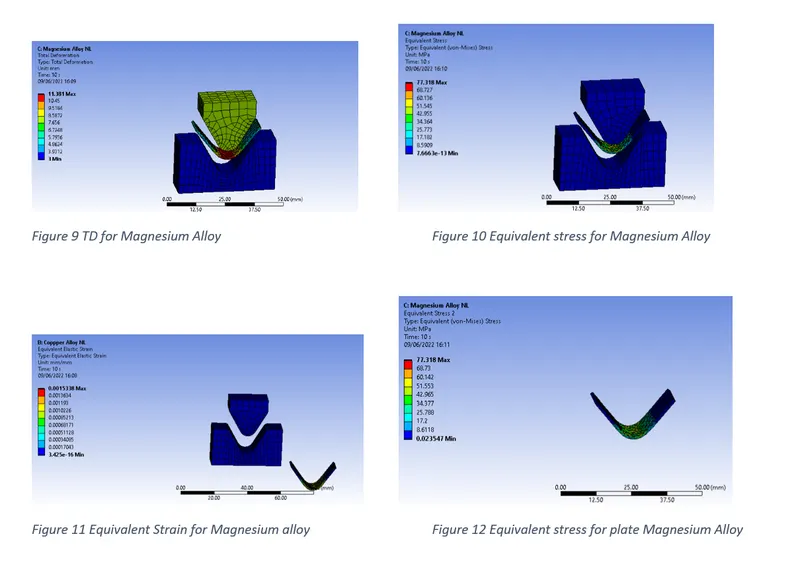
CASE 1
|
Material |
Maximum |
|||
|
Total deformation |
Equivalent stress |
Equivalent strain |
Equivalent stress on a sheet metal |
|
|
Aluminium Alloy 1199 |
8.1799 mm |
34.001 MPa |
9.5089e-003 mm |
34.001 MPa |
|
Copper Alloy NL |
13.738 mm |
386.29 MPa |
3.5518e-003 mm |
386.29 MPa |
|
Magnesium Alloy NL |
11.381 mm |
77.318 MPa |
2.5099e-003 mm |
77.318 MPa |
Simulation Results with frictional co-efficient 0.19:
The properties of the material used are:
Aluminium Alloy 1919
Density 2700 kg m^-3
Youngs modulus 6200 Mpa
Poisson’s Ratio 0.33
Yield strength 140 Mpa
Tangent Modulus 289.46 Mpa
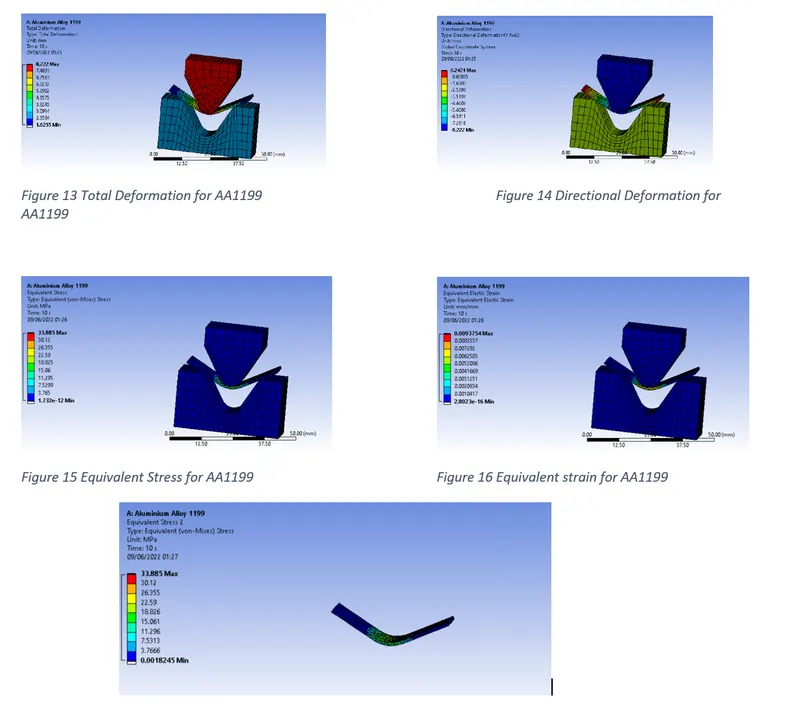
Copper Alloy NL
Density 8200 kg m^-3
Youngs modulus 1.1E+11 Pa
Poisson’s Ratio 0.34
Yield strength 2.8E+08 Pa
Tangent Modulus 1.15E+09 Pa
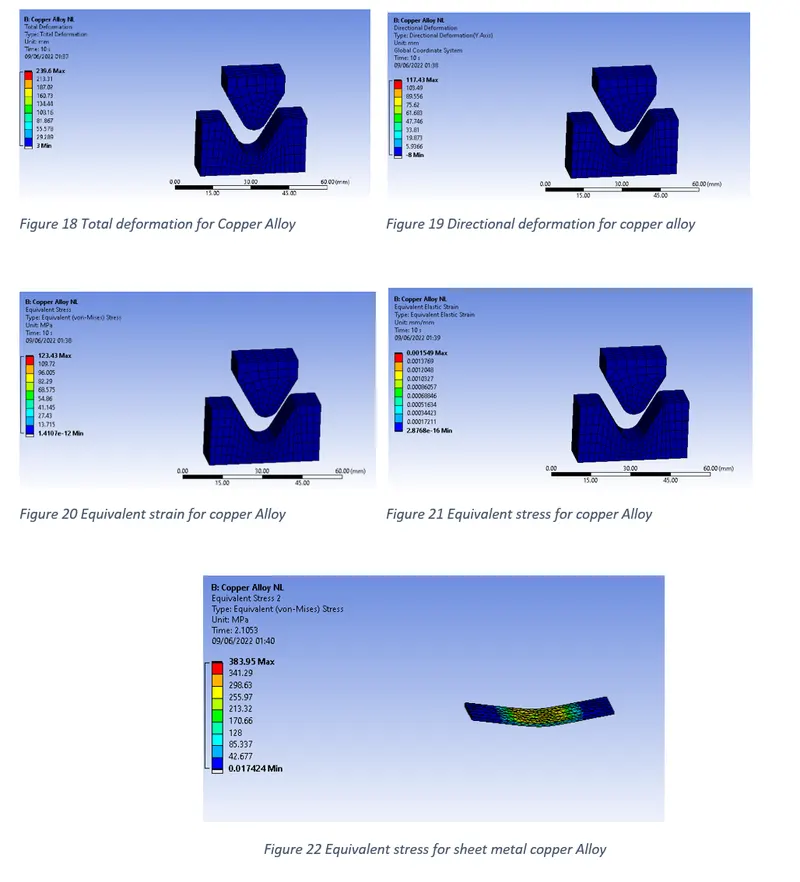
Magnesium Alloy NL
Density 1800 kg m^-3
Youngs modulus 4.5E+10 Pa
Poisson’s Ratio 0.35
Yield strength 1.93E+08 Pa
Tangent Modulus 9.2E+08 Pa
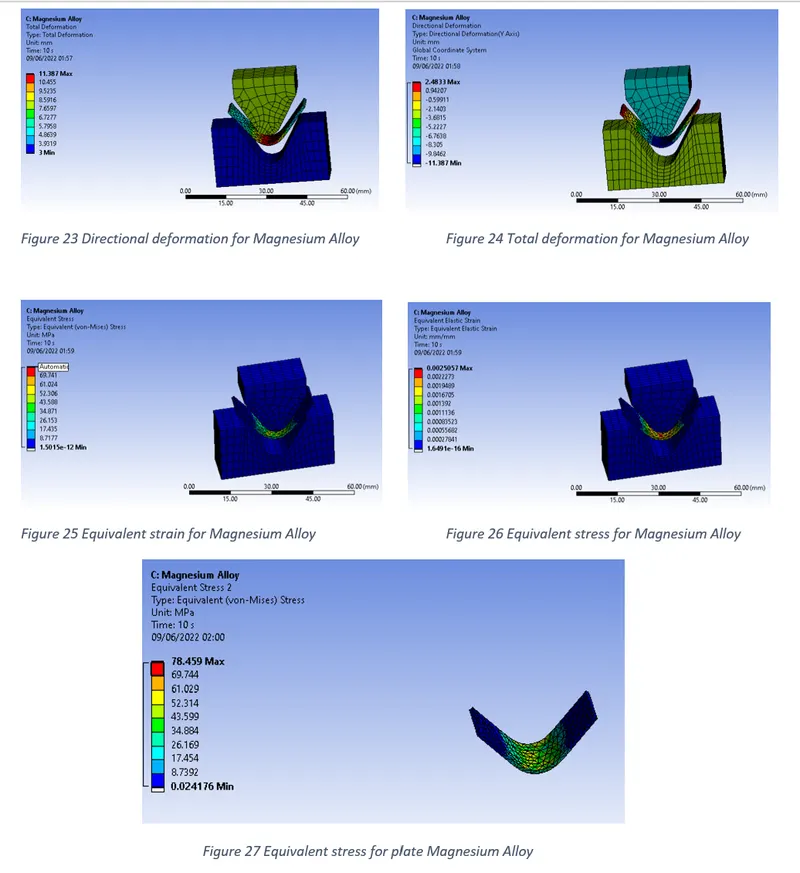
CASE 2
Comparing the result with all the materials shown below with 0.19 friction co-efficient:
|
Material |
Maximum |
|||
|
Total deformation |
Equivalent stress |
Equivalent strain |
Equivalent stress on a sheet metal |
|
|
Aluminium Alloy 1199 |
8.222 mm |
33.885 MPa |
9.3754e-003 mm |
33.885 MPa |
|
Copper Alloy NL |
239.6 mm |
123.43 MPa |
1.549e-003 mm |
123.43 MPa |
|
Magnesium Alloy NL |
11.387 mm |
78.459 MPa |
2.5057e-003 mm |
78.459 MPa |
CASE 3
Sheet with an element size of 0.9mm:
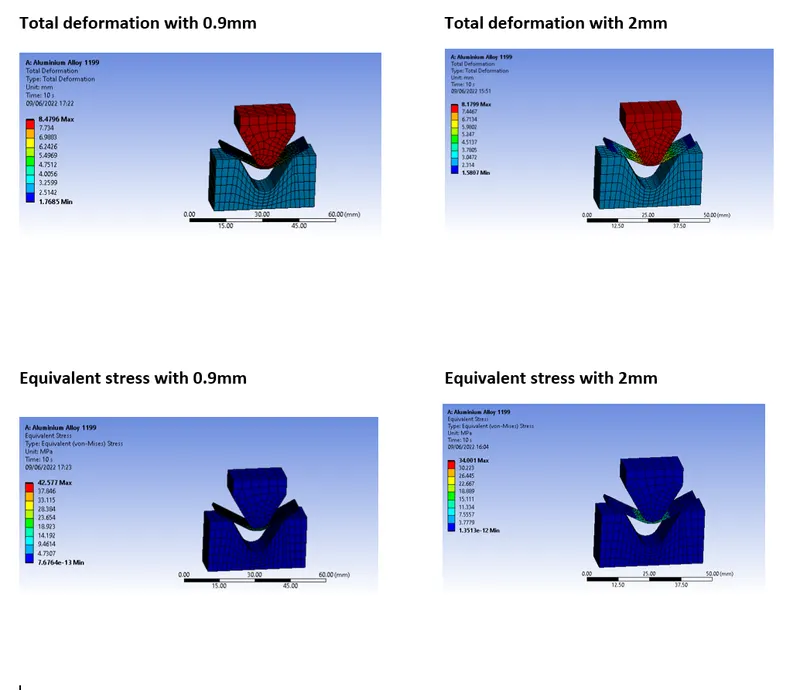
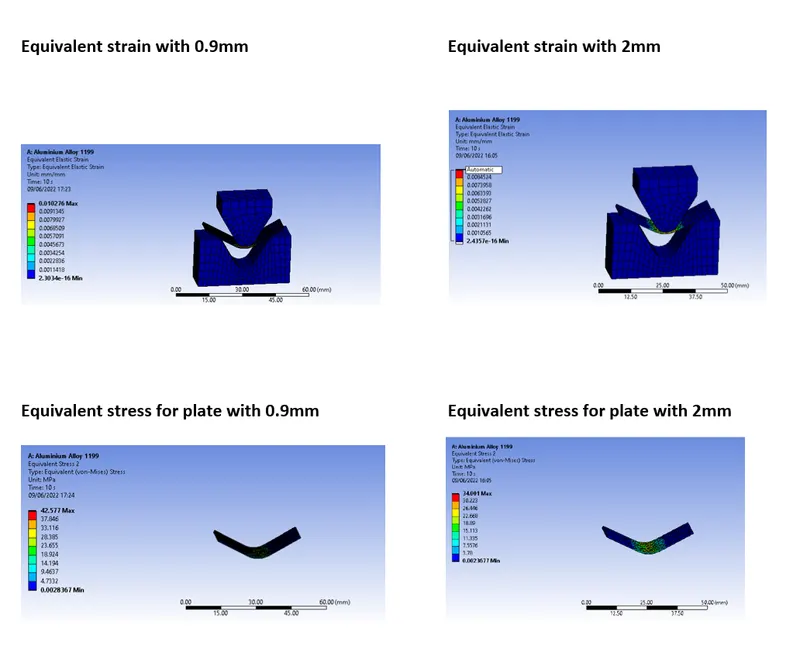
Conclusion:
Comparing case 1 and case 3 we can see that stress values depend on the element size. Refining the mesh even with a small element size there will be a better approximation in the result. Therefore it makes it necessary to use the optimized element for better accuracy.