Week 2 Bevel Gear Challenge
Grid Dependency:
A grid dependency test is performed to find out how the solution vary on the grid size by running the simulation with the refined mesh.
Finer is the mesh higher will be the accuracy of result bur that leads to additional cost and computational power.
Since the solutions are interpolated at the nodes to get an approximate result, higher will be the number of nodes and elements that leads to the additional cost and computational power.
Hence the grid dependency test helps in determining optimal mesh size keeping in mind the computational power time and cost. At some point, we will get almost the approximate results refining even though only gives us a negligible change in results but vary in computational power, time and costs.
Bevel Gear Geometry file
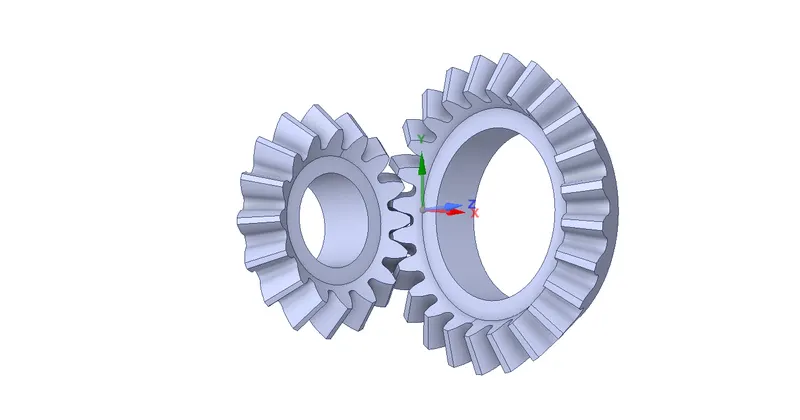
Material details
The material used in this analysis is structural steel
Young’s modulus – 211 MPa
Poisson’s Ratio – 0.3
Tensile Yield Strength – 250 MPa
Ultimate Strength – 460 MPa
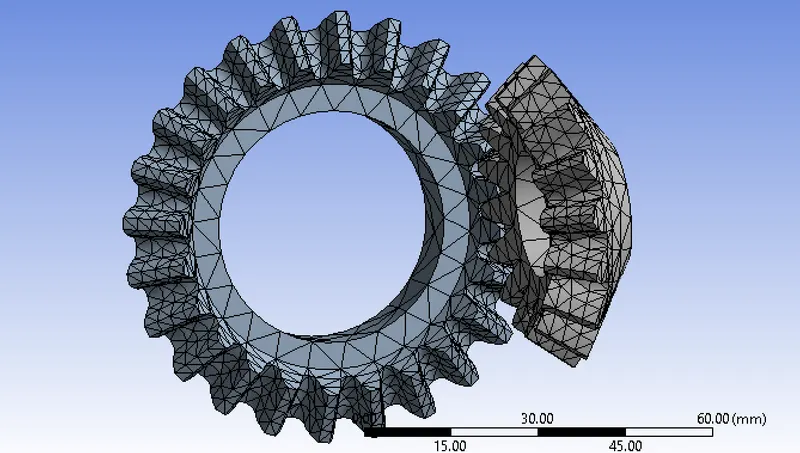
Meshing details
In this model, we used 6,5, and 4mm in refining the mesh with a different number of nodes and elements.
|
Element size (mm) |
Face sizing (mm) |
No.of nodes |
No.of elements |
|
6 |
3 |
10450 |
5271 |
|
5 |
3 |
10915 |
5546 |
|
4 |
3 |
11962 |
6141 |
Mesh Model
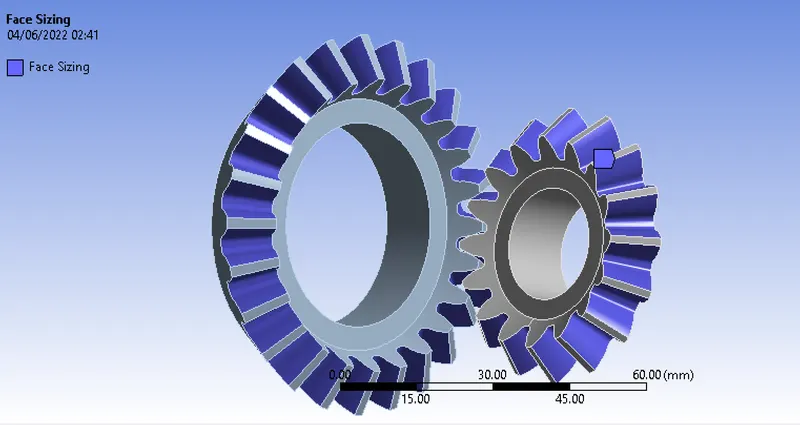
Face Sizing
In this model face sizing is done by selecting the facet joints of both the small and big gears in total there are 40 faces.
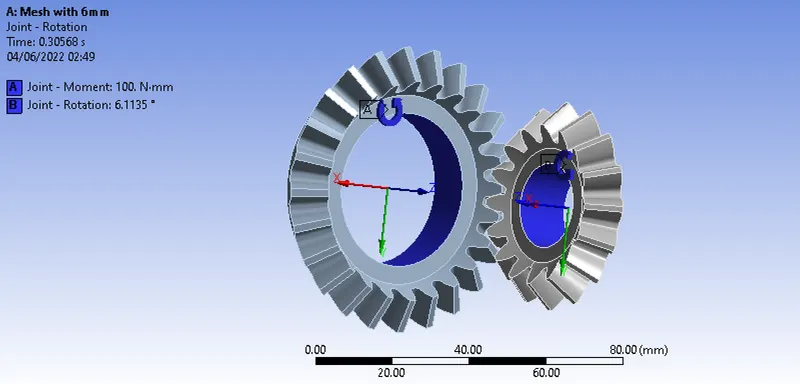
Joints Setup
In this model, revolute joints are selected as the model is time-dependent the small gear is chosen for rotation and the big gear is chosen for giving moment therefore the model is used to generate the required power.
Simulation results for different mesh sizes
Total deformation for 3 cases:
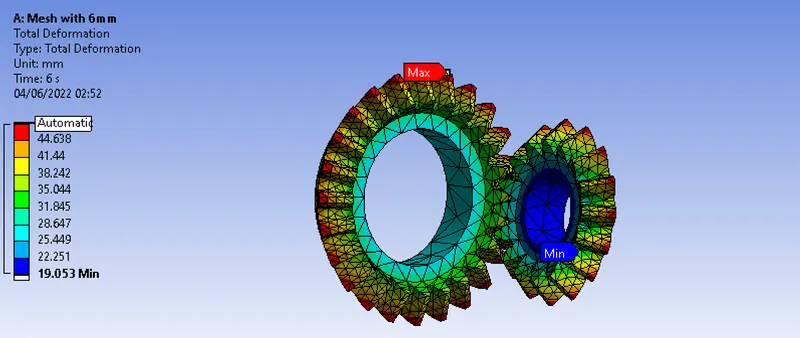
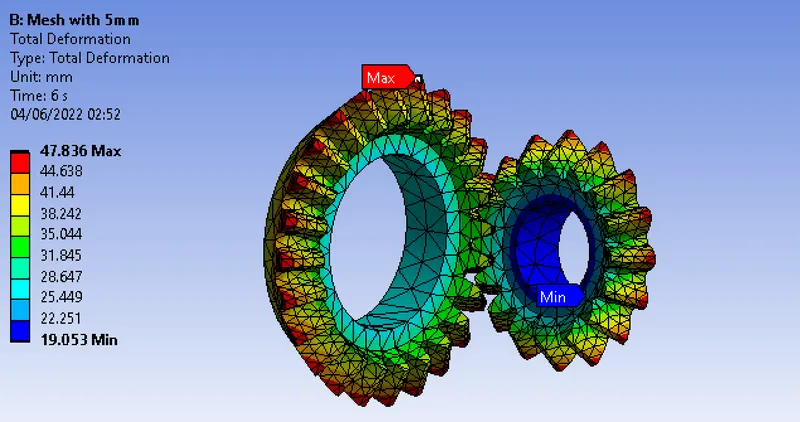
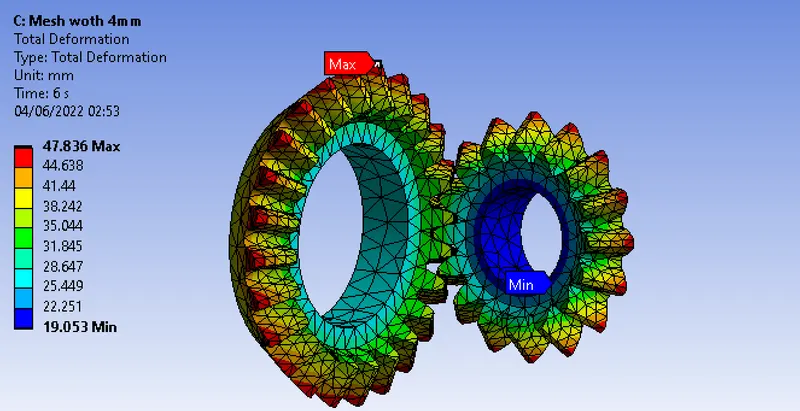
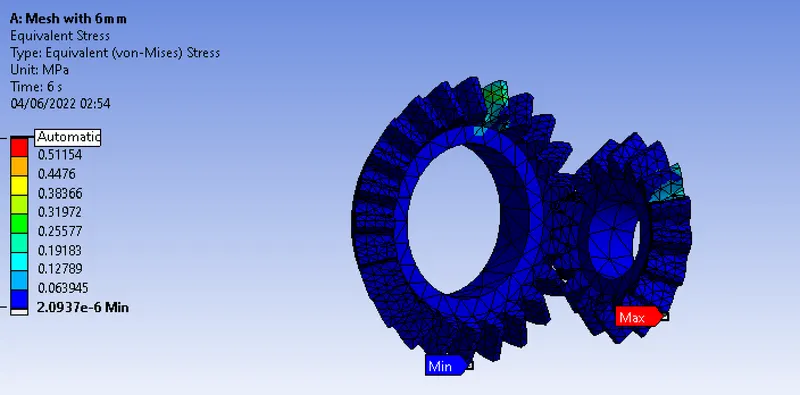
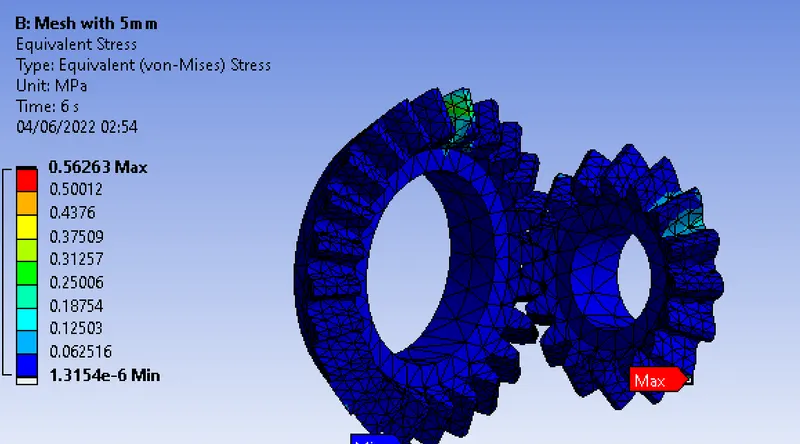
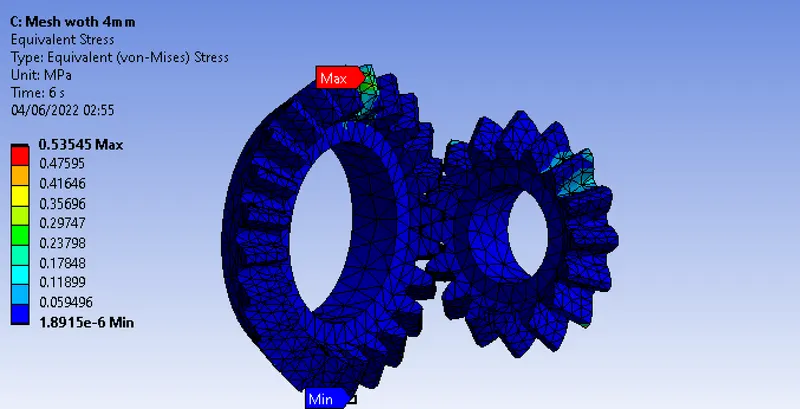
Equivalent stress for 3 cases:
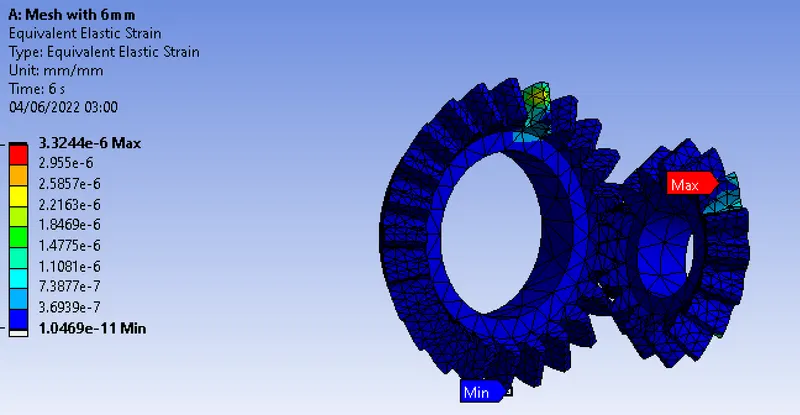
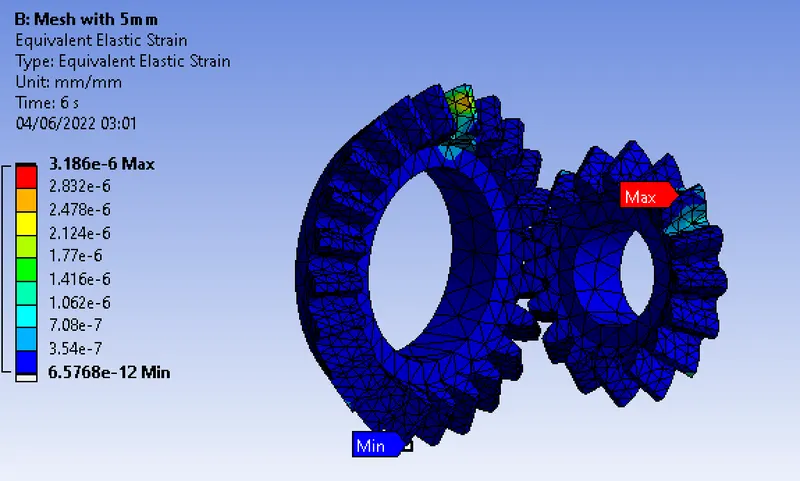
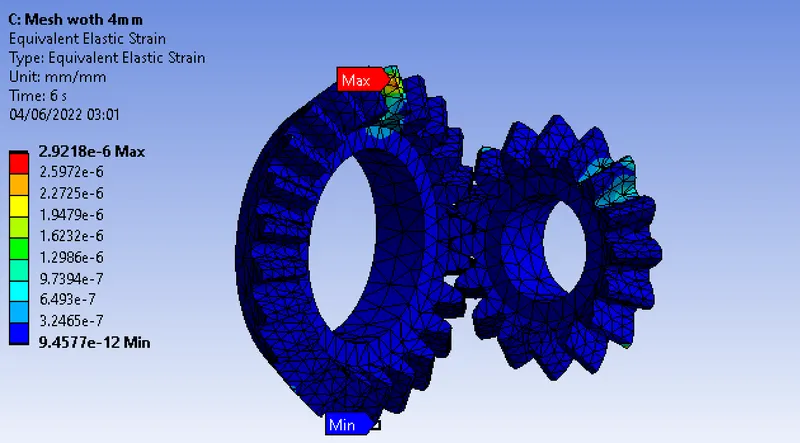
Equivalent strain for 3 cases:
Conclusion:
From the above,
we can see that the,
Total deformation is the same in all the 3 cases.
Equivalent stress and Equivalent strain have been changing as we are refining the mesh size from 6mm-5mm-4mm.
Hence, we can say that as we are refining the mesh we can see better results but you can see that there is only a negligible change in the result from refining the mesh from 5mm to 4mm. If we refine the mesh even more we can see only a slight change in the results but that results in more computational power and cost.