Week 1 Spur Gear Challenge
SPUR GEAR
CASE 1
For case 1, static structural analysis is carried out on a spur gear. The material used is cast iron and the analysis was carried out in an Ansys workbench. The spur gear is first modified in Ansys SpaceClaim software and is shown in the figure below.
The 2d geometry is then extruded within SpaceClaim to get the model to be imported into ANSYS. The extruded model is as shown in the figure below
The properties of the cast iron material used are as follows
Density 6999 kg m^-3
Isotropic secant coefficient of thermal expansion 1.196E-05C^-1
Young's modulus 8.944E+10
Bulk Modulus 6.2111E+10
Shear modulus 3.5492E+10
The model is meshed using an Ansys mesh with an element size of 1mm and a patch conforming method using default mesh was employed.
A mesh metric that identifies elements according to their quality was employed and it can be seen that the elements of the lowest quality are minimal. Most of the elements have very high quality in the range of 0.8-1.0. Hence the mesh is of acceptable quality. The meshed model is shown in the image below.
The Simulation is then run with the settings applied and the results are obtained.
CASE 2
For case 2, static structural analysis is carried out on a spur gear. The material used is cast steel and the analysis was carried out in an Ansys workbench. The spur gear is first modified in Ansys Space Claim software and is shown in the figure below.
The properties of the cast steel material used are as follows
Density 7820 kg m^-3
Youngs modulus 2.03E+11
Bulk Modulus 1.6917E+11
Shear modulus 7.8077E+10
The rotation joint is considered by selecting the phases.
CASE 3
For case 3, static structural analysis is carried out on a spur gear. The material used is cast bronze and the analysis is carried out in an Ansys workbench. The spur gear is first modified in Ansys Space Claim software and is shown in the figure below.
The properties of the cast steel material used are as follows
Density 8810 kg m^-3
Young's modulus 8E+10
Bulk Modulus 8.602E+10
Shear modulus 2.97E+10
Moment joint is considered by selecting the phases.
Rotation is applied on one gear and moment is applied on the other gear such that model the one gear rotates clockwise and the other rotates in the anti-clockwise direction. The simulation is then run and the results are obtained as below:
Results:
Total Deformation for 3 cases
Material minimum(mm) maximum(mm) average(mm)
Cast Iron 18.5 30 24.388
Cast Steel 18.5 30 24.388
Cast Bronze 18.5 30 24.388
Stress intensity for 3 cases
Material minimum(Mpa) maximum(Mpa) average(Mpa)
Cast Iron 3.5387e-004 419.54 8.928
Cast steel 1.2873e-005 431.59 8.9815
Cast Bronze 1.8006e-004 423.62 9.0395
Stess concentration for 3 cases
Material minimum(Mpa) maximum(Mpa) average(Mpa)
Cast Iron 3.2302e-004 396.33 8.3268
Cast Steel 1.2633e-005 405.45 8.3552
Cast Bronze 1.7067e-004 393.22 8.3828
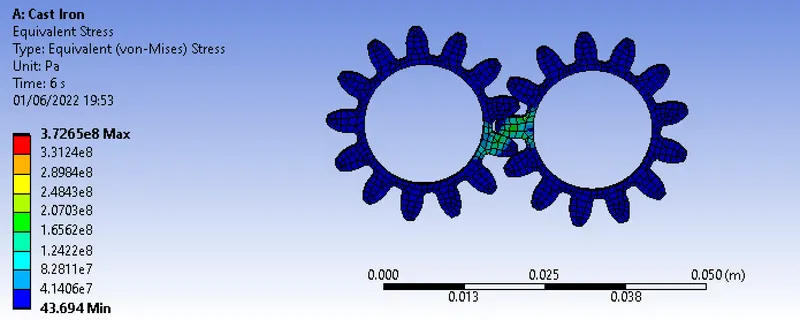
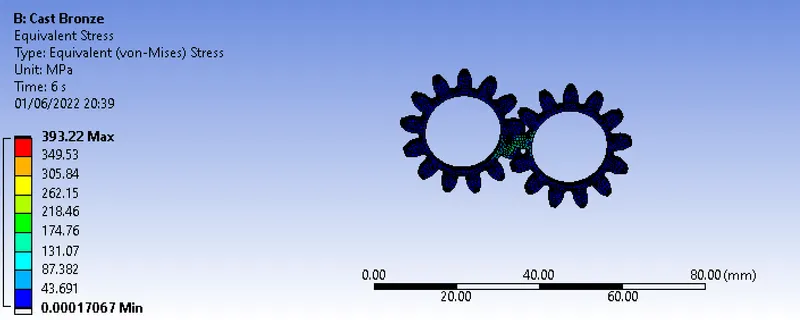
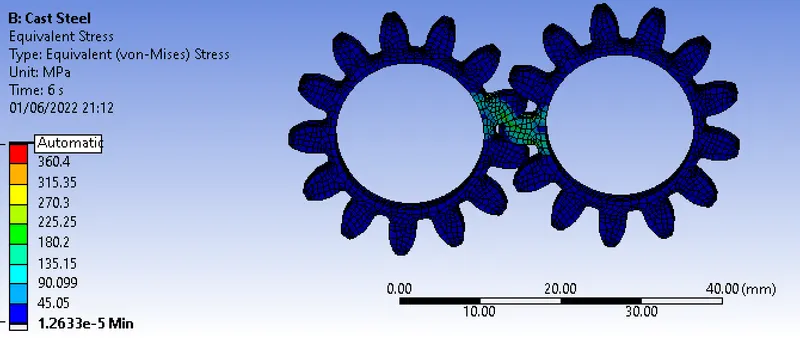
Tensile yield strength for 3 cases
Cast iron Tensile Yield Strength 79.81 MPa
Cast Bronze Tensile Yield Strength 140 MPa
Cast Steel Tensile yield strength 349 MPa
CONCLUSION
In comparison equivalent stress with 3 cases cast steel is having a higher value than the other two materials. So comparingly cast steel is recommended among the other two materials.
But if we consider the factor of safety of 3 cases the tensile yield strength of three materials is less this states that no material can withstand the maximum equivalent stress. But comparatively cast steel is more than the other two.
Hence for this particular case, I don’t recommend any of these three materials for spur gear.