Week 3 - Pitot tube
AIM: To calculate the total and static pressures and find the error in percentage for velocity to the given pitot tube model by considering the following parameters.
|
Gauge Pressure (Pa) | ||
| 240 | -2817 | ||
| 100 | 33287 | ||
| 62 | 65780 |
Introduction:
pitot tube:
A pitot tube or a pitot probe is a flow measurement appliance used to calculate the fluid flow velocity. French engineer Henri Pitot invented the pitot tube in the early 18th century. In the mid-19th century, French scientist Henry Darcy altered it to its modern form.
Types of pitot tube:

pitot-static tube:
Pitot-Static tubes, which are also called Prandtl tubes, are used on aircraft as speedometers. The actual tube on the aircraft is around 10 inches (25 centimeters) long with a 1/2-inch (1 centimeter) diameter. Several small holes are drilled around the outside of the tube and a center hole is drilled down the axis of the tube. The outside holes are connected to one side of a device called a pressure transducer. The center hole in the tube is kept separate from the outside holes and is connected to the other side of the transducer. The transducer measures the difference in pressure in the two groups of tubes by measuring the strain in a thin element using an electronic strain gauge.
The pitot-static tube is mounted on the aircraft, or in a wind tunnel, so that the center tube is always pointed in the direction of the flow and the outside holes are perpendicular to the center tube. On some airplanes, the pitot-static tube is put on a longer boom sticking out of the nose of the plane or the wing.
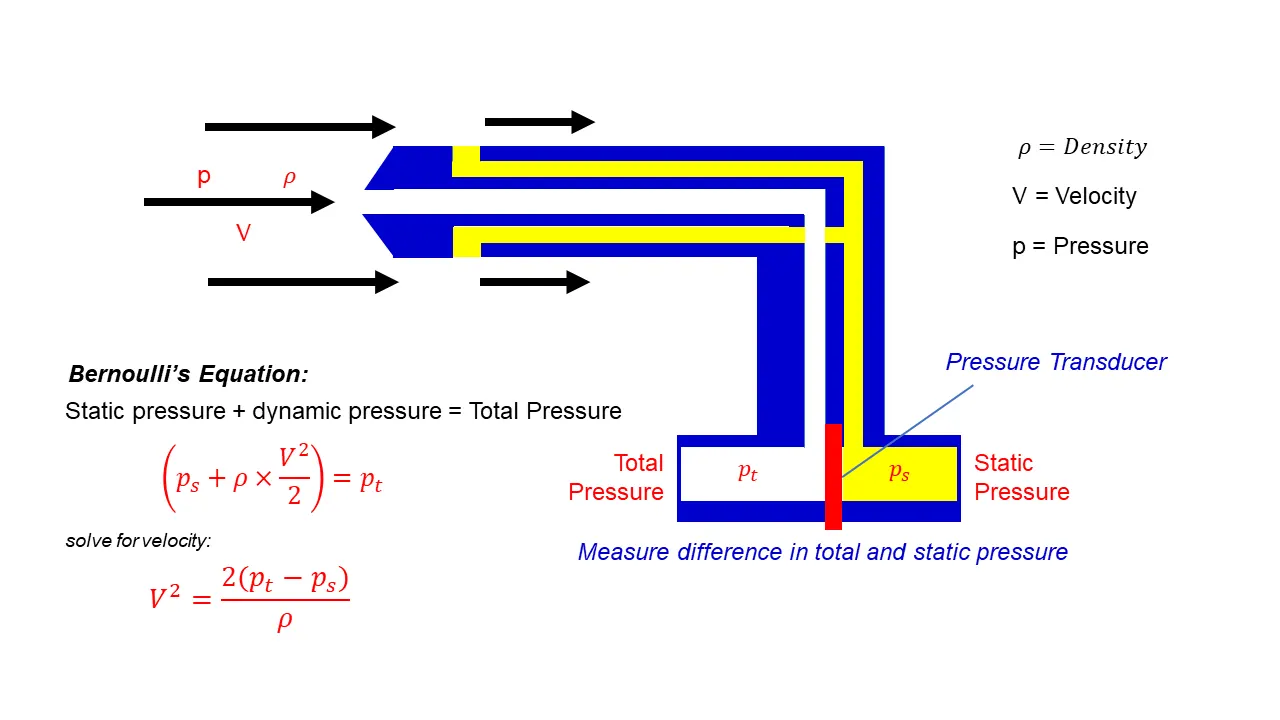
Since the outside holes are perpendicular to the direction of flow, these tubes are pressurized by the local random component of the air velocity. The pressure in these tubes is the static pressure (ps) discussed in Bernoulli’s equation. The center tube, however, is pointed in the direction of travel and is pressurized by both the random and the ordered air velocity. The pressure in this tube is the total pressure (pt) discussed in Bernoulli’s equation. The pressure transducer measures the difference in total and static pressure, which is the dynamic pressure q.
`q = pt - ps`
Solve for Velocity:
With the difference in pressures measured and knowing the local value of air density from pressure and temperature measurements, we can use Bernoulli’s equation to give us the velocity. Bernoulli’s equation states that the static pressure plus one half the density times the velocity V squared is equal to the total pressure.
`ps+0.5*rho*V^2 = pt`
Solving for V: `V^2 = 2*frac(pt-ps)(rho)`
`V = sqrt(2*frac(pt-ps)(rho))`
Procedure:
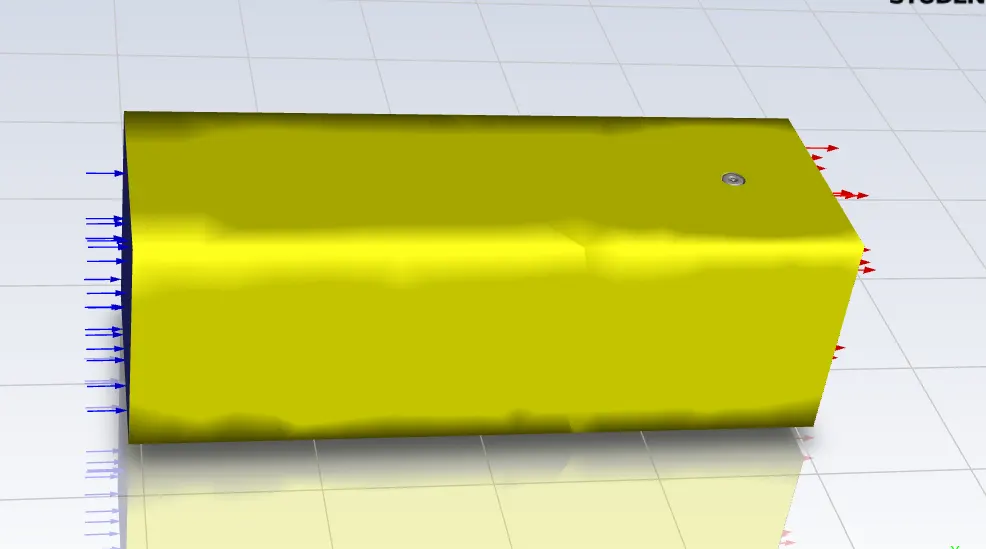
- The given pitot tube model which is enclosed with an enclosed volume and the fluid volume is extracted for both total pressure and static pressure respectively.
- Then, the geometry is meshed finely is a fine mesh size, then imported it into the solution setup.
Solution setup:
viscous model: Laminar
solver type: Pressure-based
Boundary conditions:
- inlet: velocity-inlet
- outlet: Pressure-outlet
- (static pitot tube) wall: no slip
- interior fluid and static volume: interior
- Enclosed wall: symmetry
Fluid material: air
Initialization method: Hybrid
No.of iterations: 1000
Case 1:
For velocity = 240m/sec and Gauge pressure= -2817 (pa)
Total pressure after 1000 iterations = 61650.677pa
static pressure after 1000 iterations = -2847.608pa
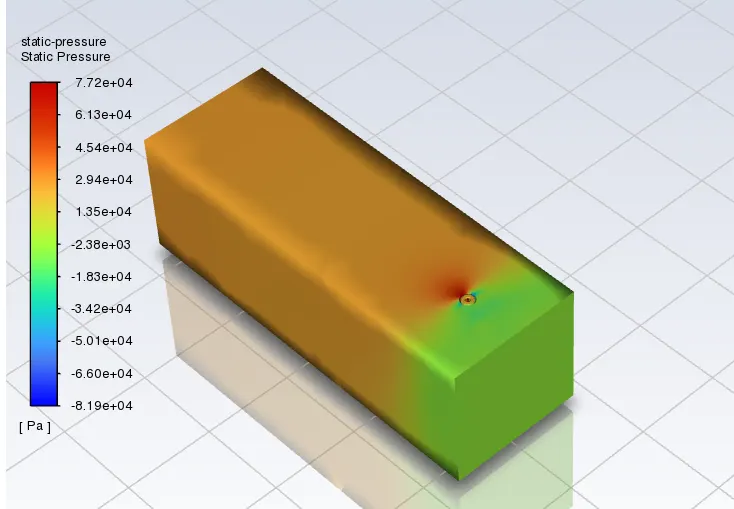
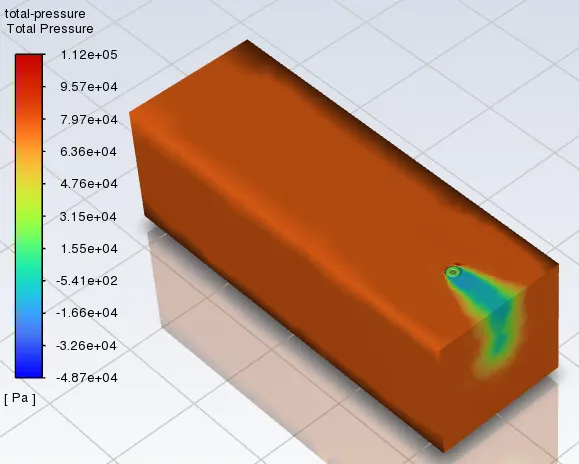
Then, by using `V = sqrt(2*frac(pt-ps)(rho))`
V= 324m/sec
Case 2:
For velocity = 100m/sec and Gauge pressure= 33287 (pa)
Total pressure after 1000 iterations = 39398.43 pa
static pressure after 1000 iterations = -134685.7pa
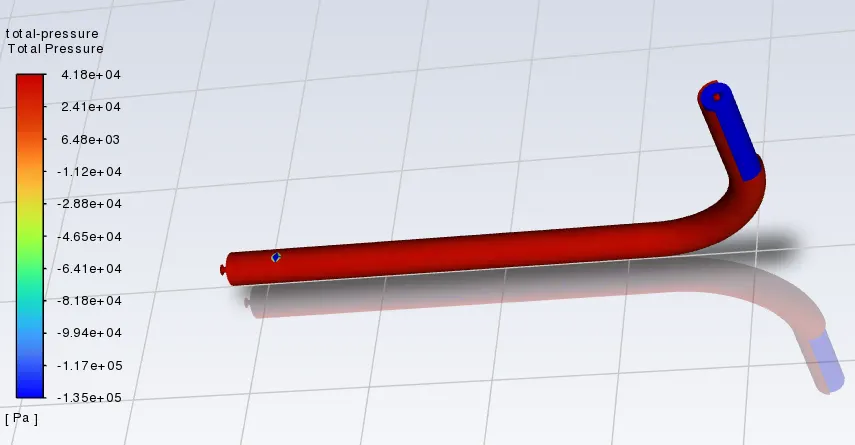
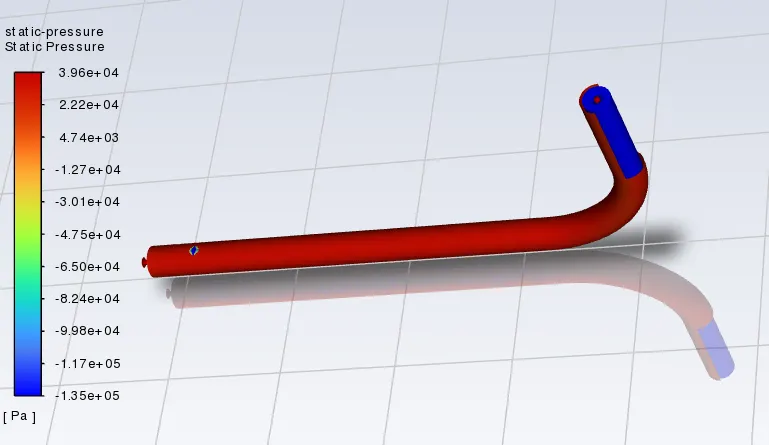
Then, the Velocity `V = sqrt(2*frac(pt-ps)(rho))` = 533.12m/sec
Case 3:
For velocity = 62m/sec and Gauge pressure= 65780 (pa)
Total pressure after 1000 iterations = 68139.896pa
static pressure after 1000 iterations = 3248.1497 pa
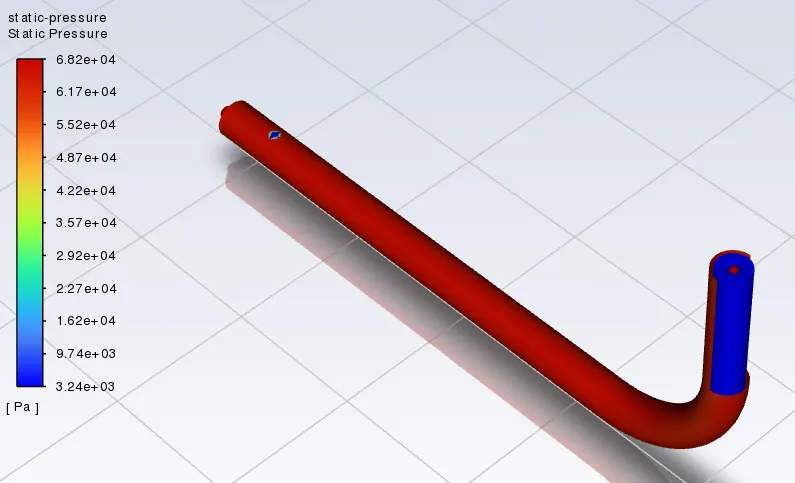
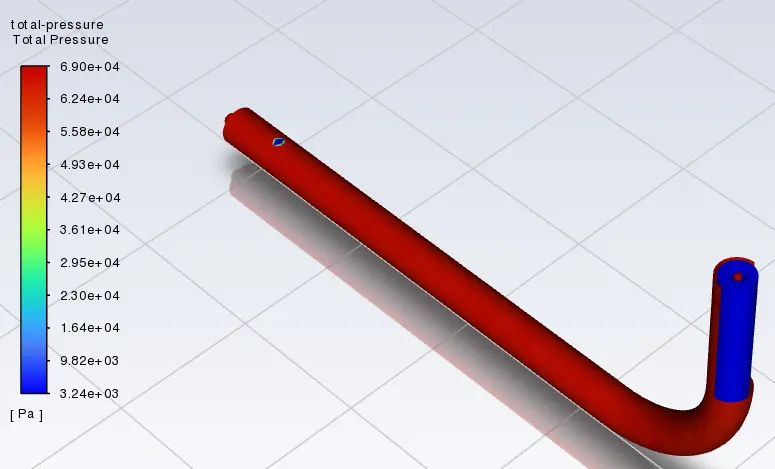
Then, the Velocity `V = sqrt(2*frac(pt-ps)(rho))` = 325.4m/sec
Percentage error for velocity :
| Given Velocity | Calculated velocity | error in % |
| 240 | 324 | 25.92 |
| 100 | 533.12 | 79.6 |
| 62 | 325.4 | 80.94 |