Flow over a backward facing step
Introduction
A backward facing step is a simple and cannonical CFD analysis problem. The idea is simple, flow is allowed to enter from an inlet, and as the cross sectional area increases, the smooth flow simply becomes turbulent. Due to the unfavorable pressure gradient formation with increase in area, there is a detachment of flow and the formation of a recirculation zone. Studying Flow seperation is important in that it leads to severe and unfavorable loss of energy.
The backward facing step could be used by many engineers to test their turbulence models and codes. Since plenty of experimental and computational data is available, verification and validation is not a big issue.
Aim
- To setup a case of flow over a backward facing step using Converge studio.
- To post process the results in paraview.
- To study the effect of changing the mesh size for the flow domain.
- To gain a qualitative understanding of flow recirculation.
Setup
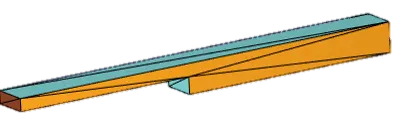
Fig. Backward facing step
In this study, a steady state solver is used, which is run for about 15,000 cycles (iterations). A steady state monitor is used to check the convergence of velocity, however it is only made to start after 5000 cycles to ensure the solution remained converged for a long time period. Air was used as the material, and to intialize the entire flow domain. The inlet boundary condition was set with a pressure of 110325 Pa and the outlet was set with a pressure of 101325 Pa. The intializaton was set using 101325 Pa so that the guess values are initially very accurate, and number of iterations to convergence is much lesser. The front and back faces (along the breadth) were set to 2D, to save computational time and only analyze results using 2D. The remainder of the geometry was set to wall, which forms the boundary for fluid flow.
Finally, to model the turbulent flow, the k-epsilon RNG flow model is used. While this is acceptable, although k-omega SST is recommended for this kind of problem, concepts such as y+ and first layer thickness were neglected in this study as the primary focus was to familiarize with the case setup in converge, and obtain a qualitative analysis of flow recirculation. Nevertheless an inflation layer thickness was defined using the fixed embedding module, however it's thickness consideration with y+ and turbulence were essentially neglected.
Any other setting was kept to the recommended default - the best choice when one is just getting started with a solver.
Converge studio offers a smooth and efficient setup interface, but seems like it's better suited used for combustion or IC engine applications in particular.
A command line was run using CYGWIN terminal to execute the simulation, and the post processing was done using PARAVIEW.
Results
Case 1: dx = dy = dz =2e-3m
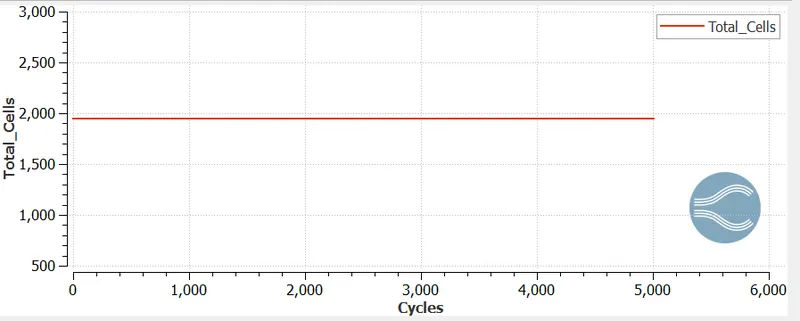
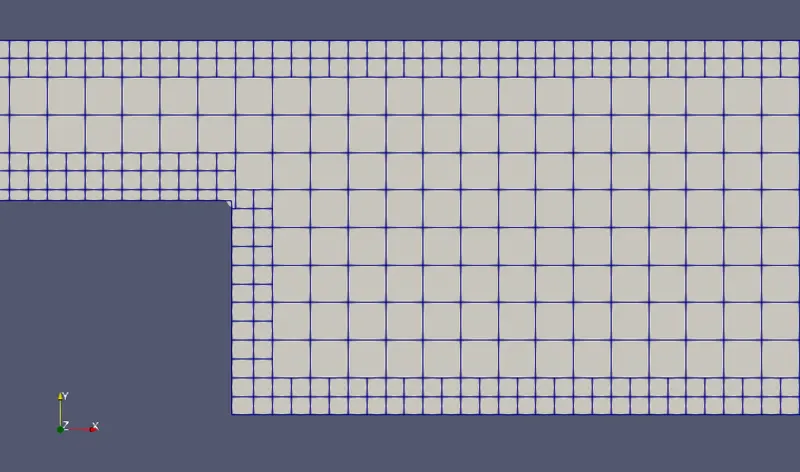
Fig. 1 Cell count and mesh.
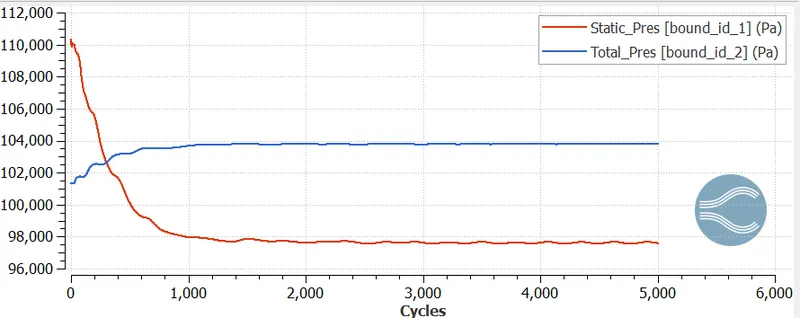
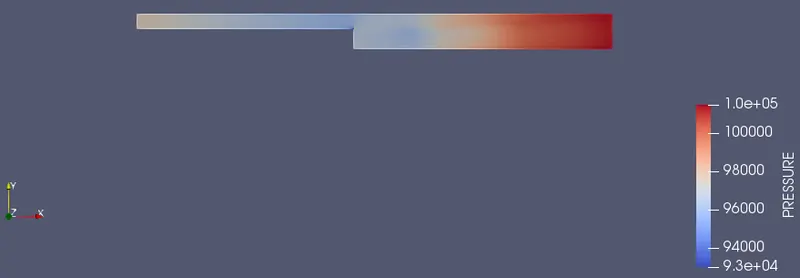
Fig. 2 Pressure convergence and contour (id-1 is inlet, id-2 is outlet).
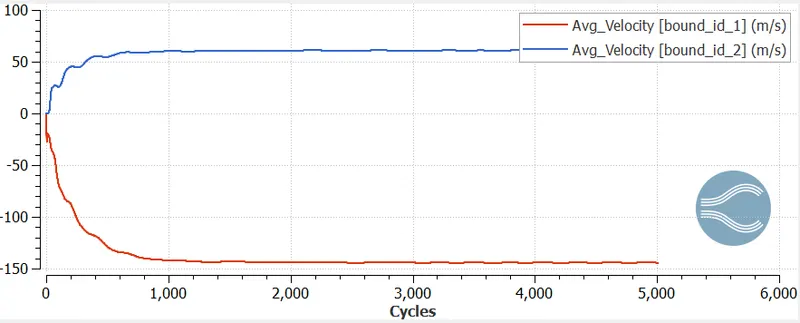
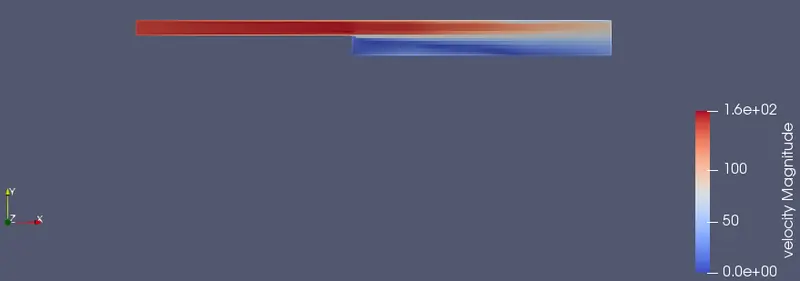
Fig. 3 Velocity convergence and contour (id-1 is inlet, id-2 is outlet).
Case 2: dx = dy = dz =1.5e-3m
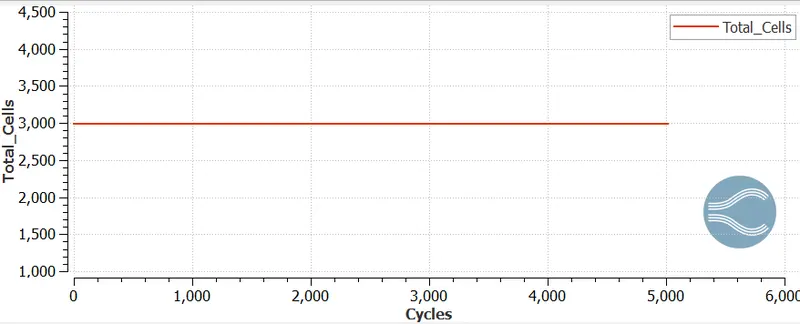
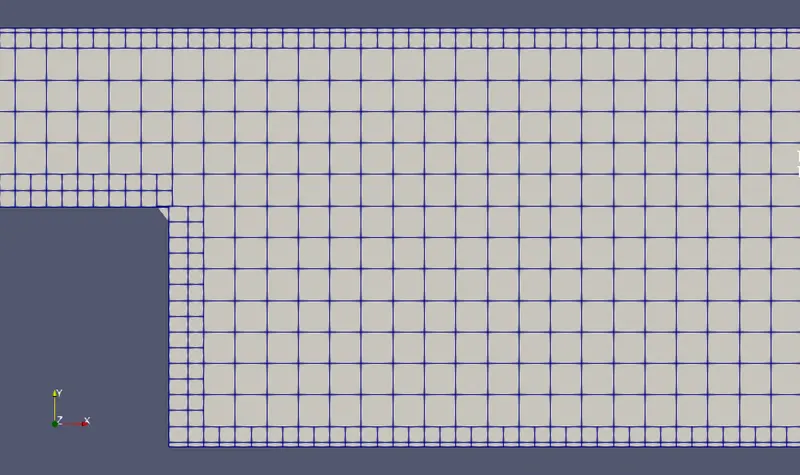
Fig. 4 Cell count and mesh.
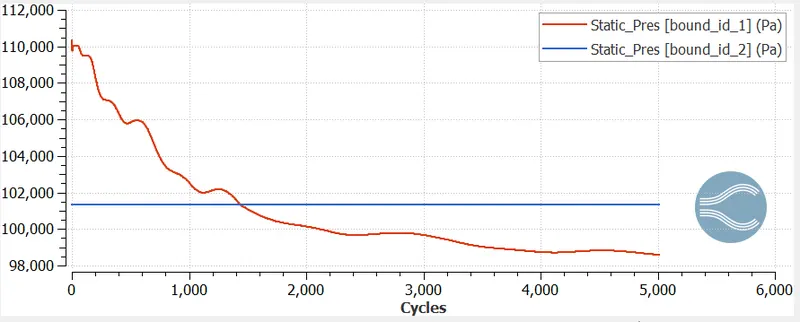
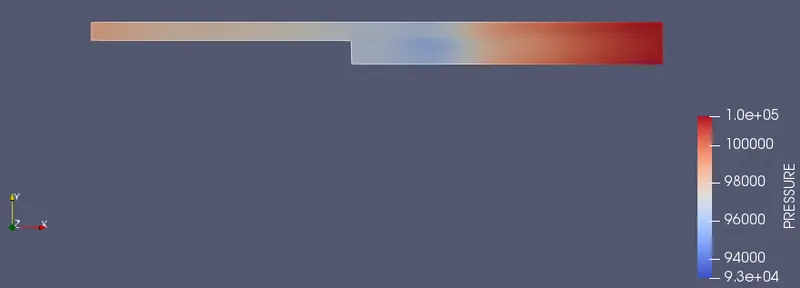
Fig. 5 Pressure convergence and contour (id-1 is inlet, id-2 is outlet).
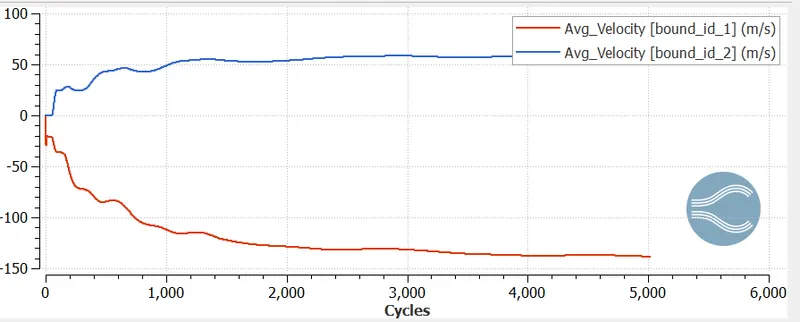
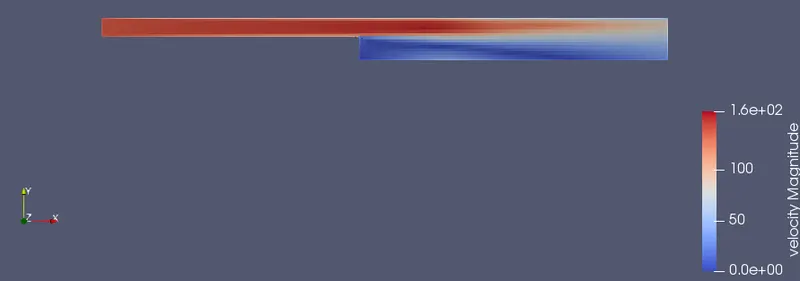
Fig. 6 Velocity convergence and contour (id-1 is inlet, id-2 is outlet).
Case 3: dx = dy = dz =1.0e-3m
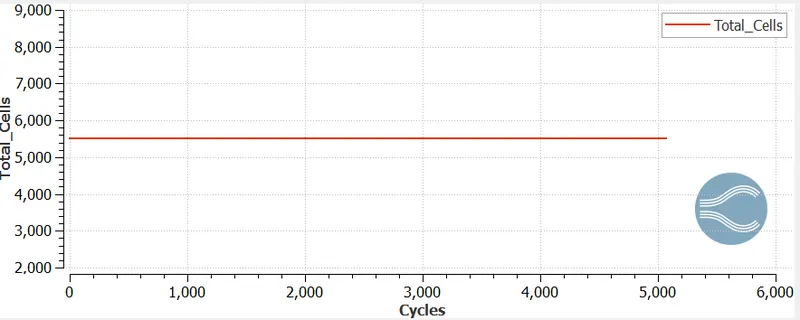
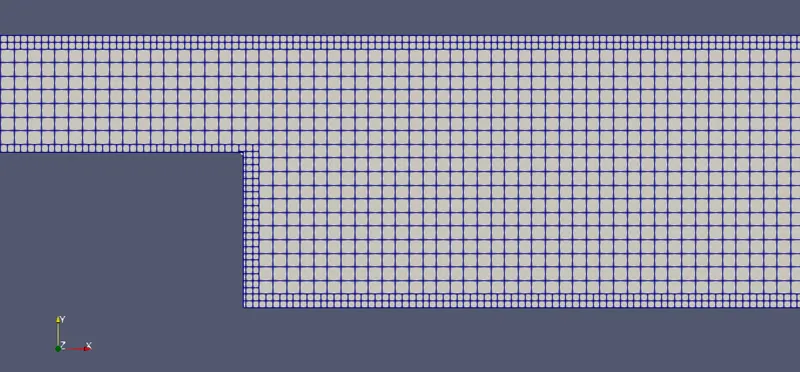
Fig. 7 Cell count and mesh.
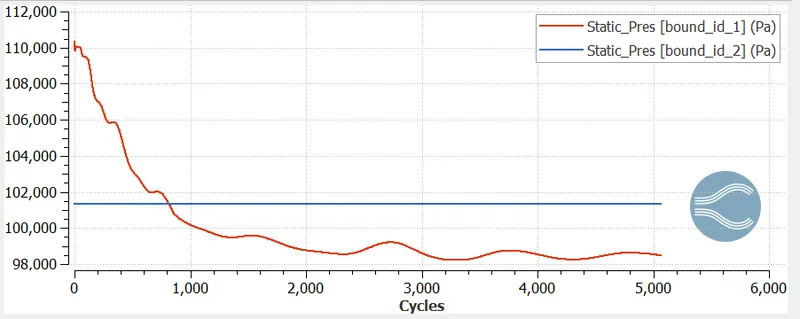
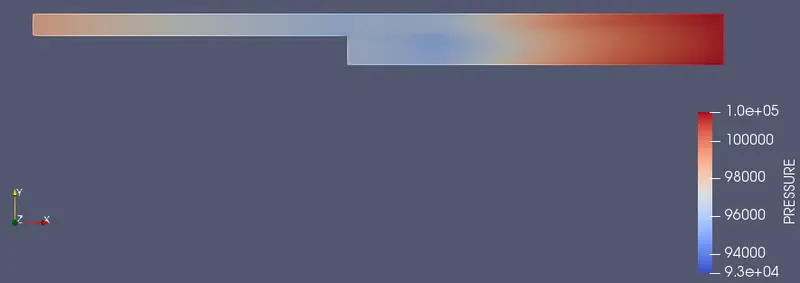
Fig. 8 Pressure convergence and contour (id-1 is inlet, id-2 is outlet).
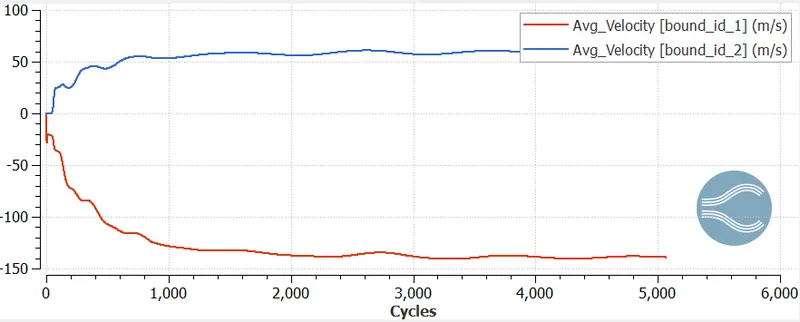
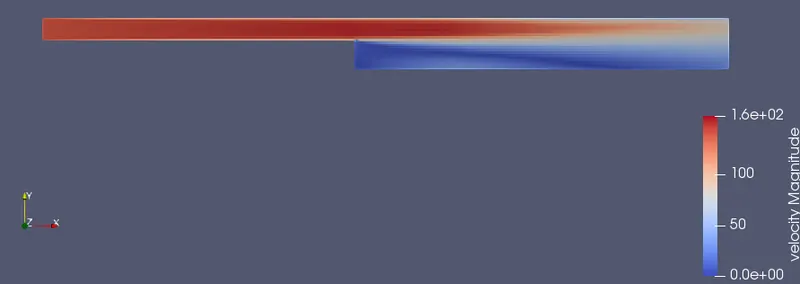
Fig. 9 Velocity convergence and contour (id-1 is inlet, id-2 is outlet).
Flow recirculation:
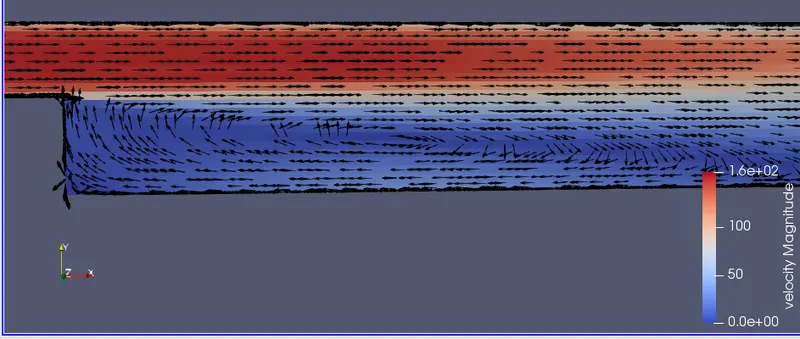
Fig. 10 Flow recirculation.
Fig. 10 shows the flow recirculation occuring in the backward facing step. As air is entering through the narrow area, its velocity is high, with low pressure. However, at the step, there exists an increase in pressure. Velocity deccelerates, and due to the unfavorable pressure gradient it faces (adverse), it seperates forming eddy like patterns before reattaching, as seen from the velocity vectors.
Conclusion
- Flow seperation is seen in the backward facing step in this study.
- Different mesh sizes are used, and all seem to converge well before the initially set target of 15,000 cycles.
- For future studies a different turbulent model can be used and also y+ can be accounted for.