Week - 3 Drop test Challenge
PHONE DROP TEST
Objective:
The objective of this project is to create a input deck from the scratch inorder to perform and analyze a free fall of a phone on conctete floor.
Procedure:
Step:1 - Selection of suitable unit system for the test
Since the mobile phone weight is measured in grams and the dimensions are measured in mm with this we can select gm, mm, ms as the unit system.
Step:2 - properties of materials
List out the properties and their values like Young's modulus, poisson's ratio, Density, Ultimate tensile strength etc. as per the selected unit system.
For the test the material of the phone is considered as plastic and floor as concrete
Step:3 - Import the model to LS DYNA interface
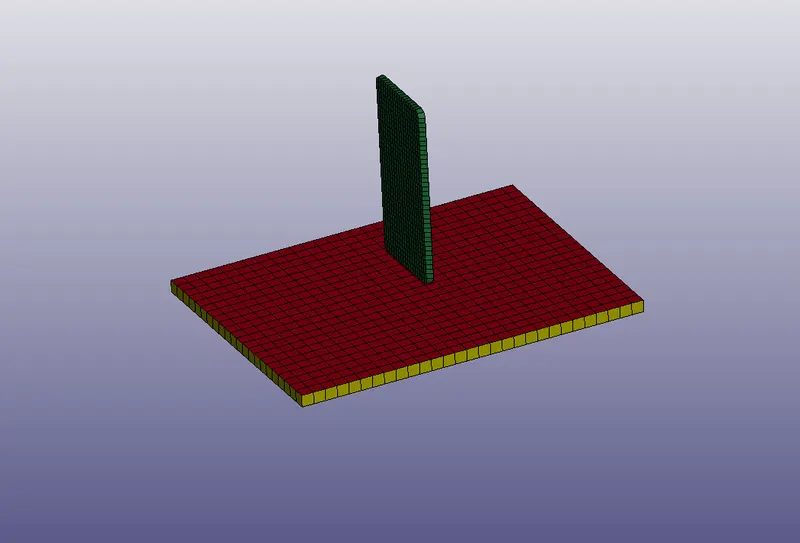
The given keyword file is opened in LS DYNA. The model has 3 parts which are 1. Phone (solid) 2. Floor (solid) and 3. Floor (Shell). Since the phone has duplictae elements that need to be isolated and deleted using the blank option. The floor is considered as shell elemenmt and the solid can be deleted. Rename the parts according to the requirement.
 o
o
Fig: Imported Model
Step:4 - Creation of Input deck using data
Section card:
The phone is considered as the solid element and floor as shell the same sections has to be created for these parts as shown in the figure below
For floor the thickness has to be assigned as 10mm ( Thickness of floor measured in solid )
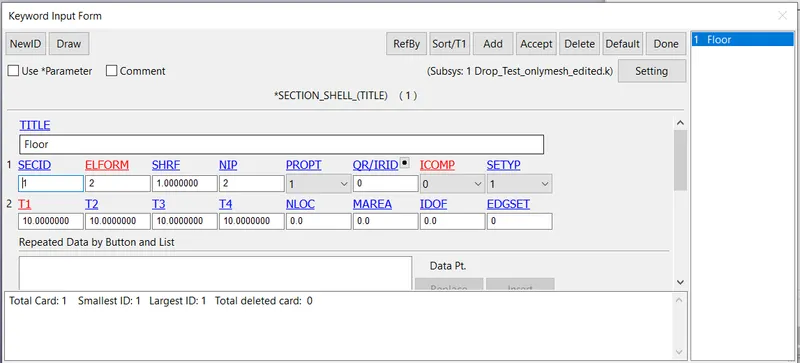
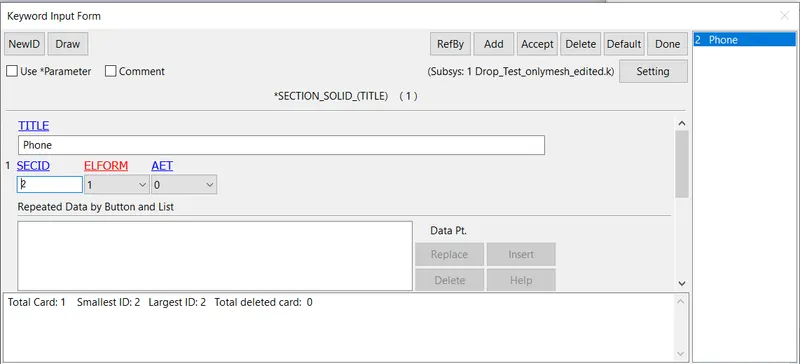
Fig: Section cards
Material card:
Before creating the material card the data of the material property has to be colllected and suitable material need to be selected,
Floor
For the Floor the material is Concrete in which MAT 20 RIGID is choosen in LS DYNA
The following properties were feeded in the material card as shown.
Density - 0.0024 gm / mm3
Youngs modulus - 14Gpa = 14000 Mpa
Poissons's ratio - 0.20
Phone
For the phone the material is Plastic elestic material which is MAT24 Piecewise linear plasticity in LS DYNA is selected
Following are the referred properties for the material
Density - 0.0078 gm / mm3
Youngs modulus - 210Gpa = 210000Mpa
Poissons's ratio - 0.26
Yield stress - 300Mpa
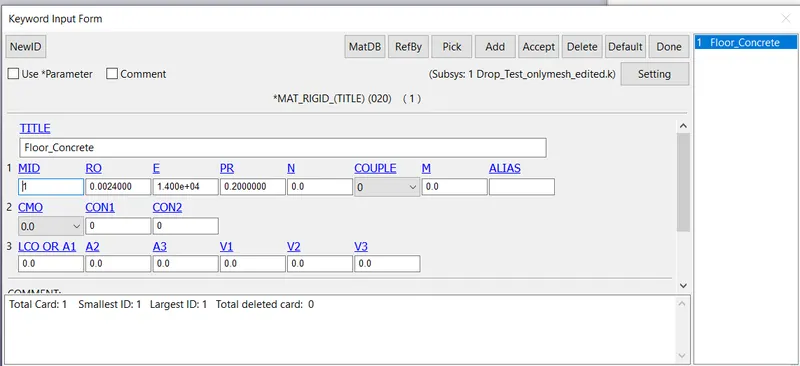
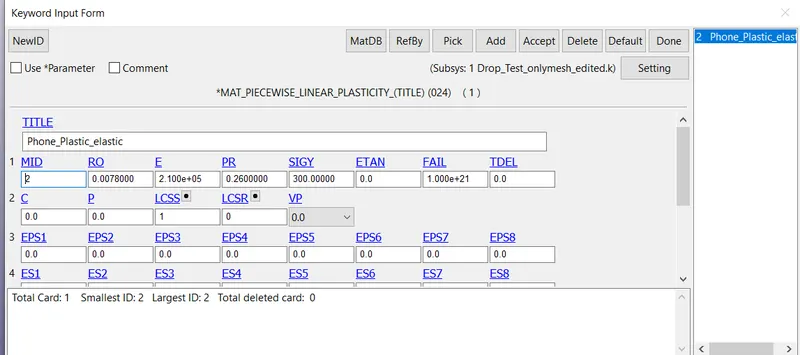
Fig: Material cards
While defining material create a curve for the material.
The created cards has to be assigned to the parts according to their ID so in the part the SECID and MATID has to be selected according to the parts which is floor and phone
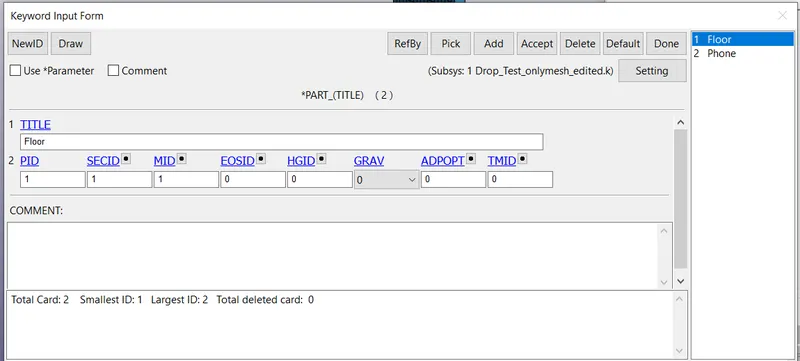
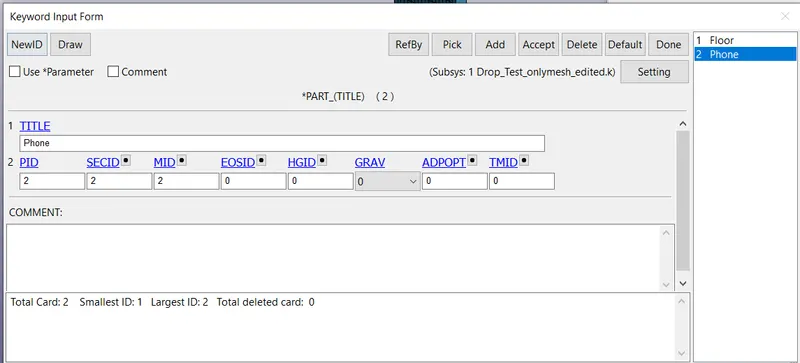
Fig: Assigning of ID's
Boundary condition:
For the drop test the floor is stationary and rigid where all the DOF of the nodes are constrained. It is created using sets by limiting all DOF in all the directions as shown.
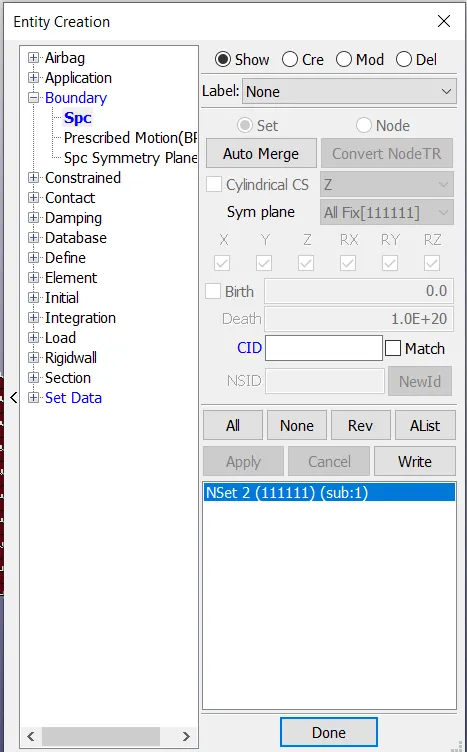
Fig: Boundary condition
Initial velocity:
Since the phone has to drop from a height while measure the distance between the phone and floor its found be 19.8mm
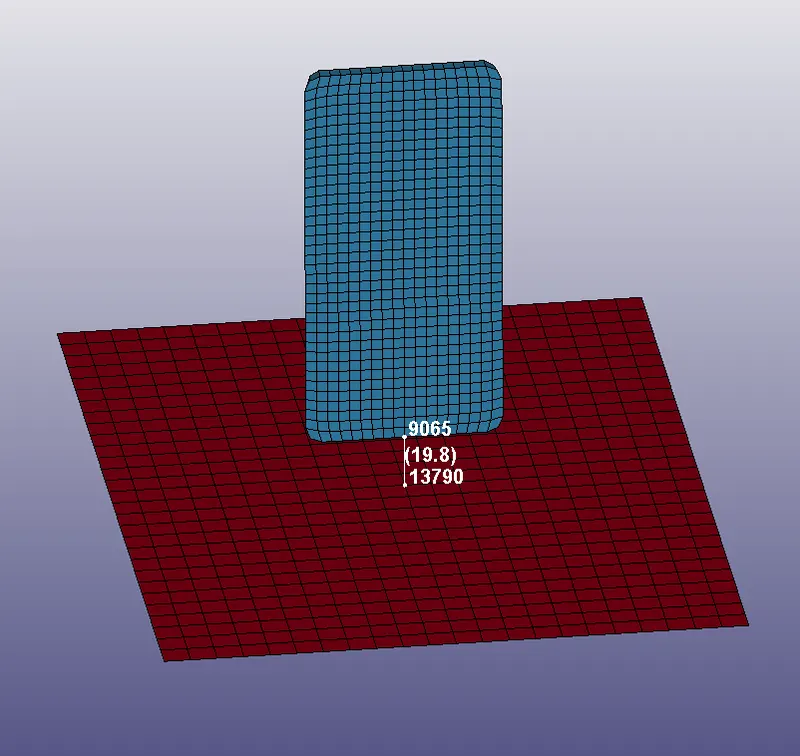
Since the case is of free fall the velocity is equal to the free fall velocity of the phone, to calculate the velocity
v = vi + gt
s = 1/2 g`t^2`
where,
v = Free fall velocity
vi = initializing velocity = 0
t = time
s = distance or height of fall
g = gravity = 9.806
19.8 X `10^-3` = 1/2 X 9.806 X `t^2`
= 0.0635 sec
= 0 + 0.0635 X 9.806 = 0.623 m/sec or 0.623 mm/m
Since the direction of fall is in Z and downwards the initial velocity of -0.623 mm/ms has to be given to the phone as shown
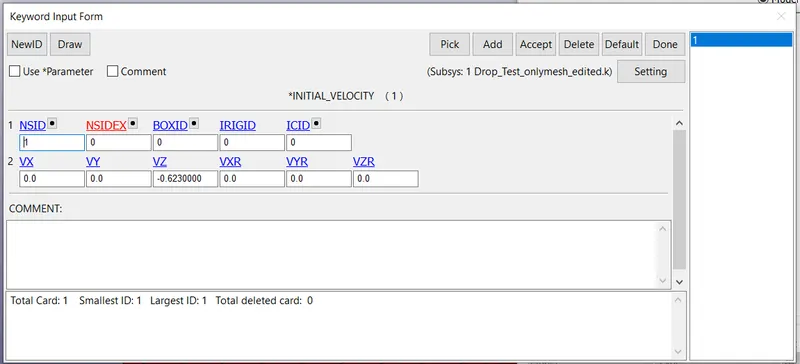
Fig: Velocity card
Contact card:
2 Types of contacts are created between phone and floor which is automatic contact between the surface of floor and phone and a self conatct for the elements of phone. While creating contacts the phone is selected as slave and floor as master.
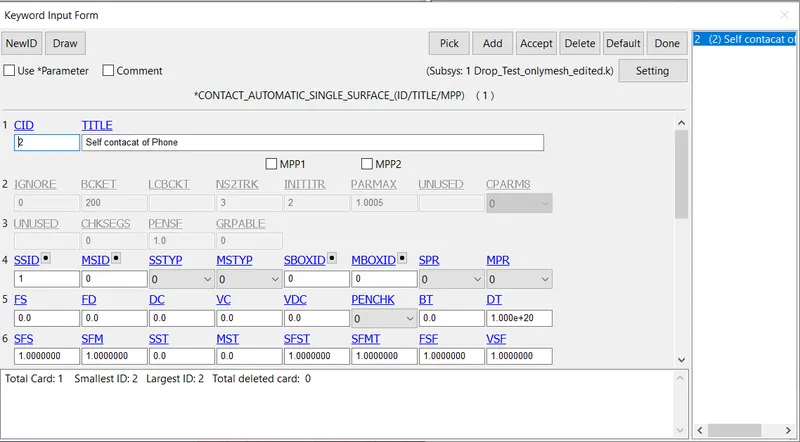
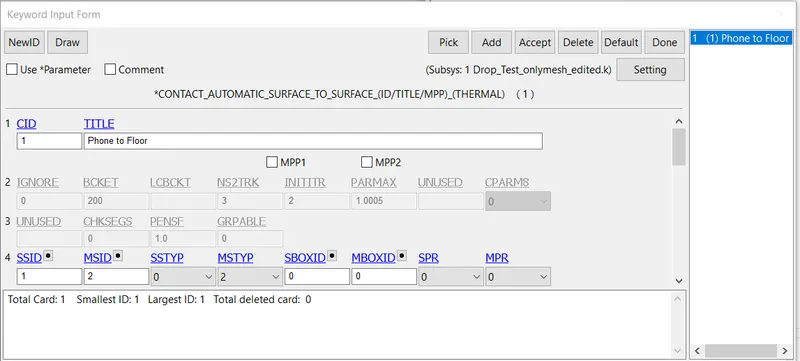
Fig: Contact card
Control card:
Control Termination
The analysis has to run to a certain period and has to be ended in order to do that the termination card is created as shown here the termination time is selected as 60ms
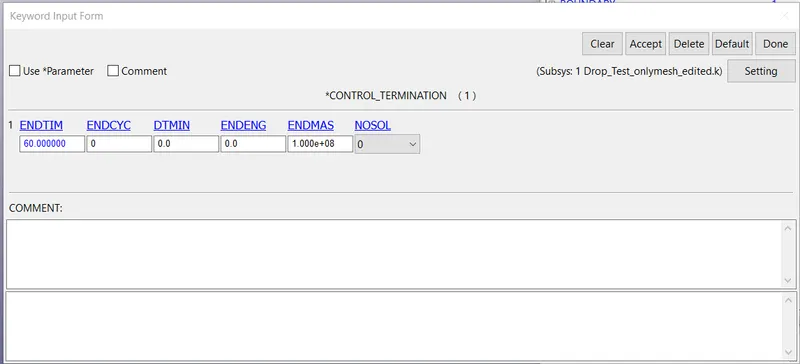
Fig: Control card
Data base card or Output card:
The required output results from the analysis is obtained by creating output card as shown. The stress and strains are obtained by Binary D3 plot and for the energies call out GLSTAT and MATSUM in ASCII option. Take DT as 0.1ms. as shown
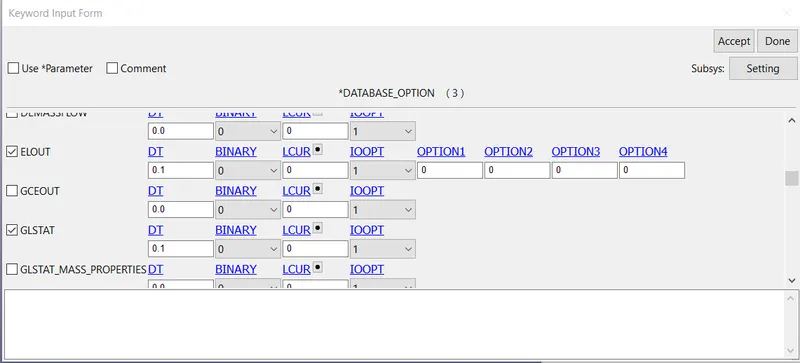
Fig: Output card
Step:4 - Model check
Once all the cards are created check for the model for any errors in the modelling if not then run the file computation as shown
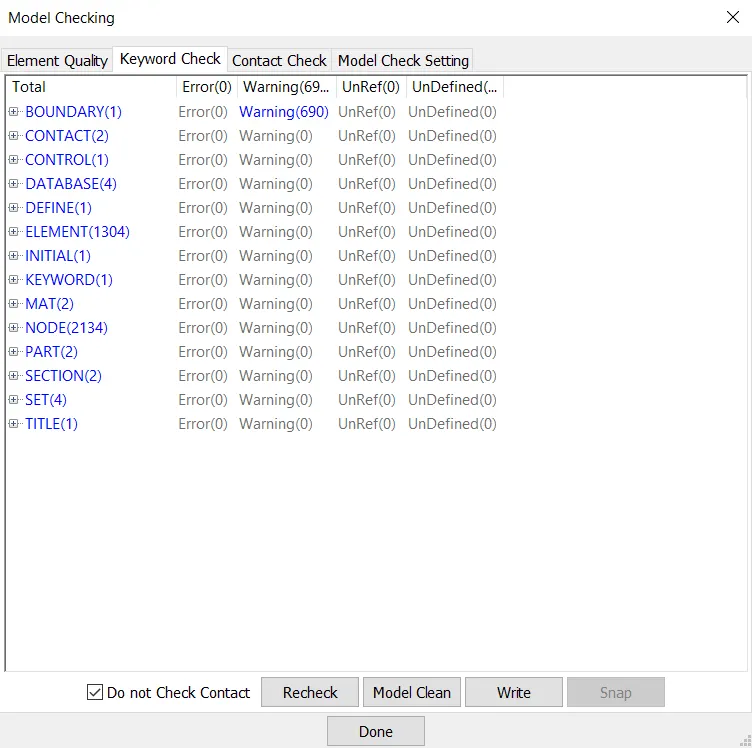
Fig: Model checking
Step:4 - Processing of model
After model check run the keyword file in LS RUN for computation with the default parameters as shown. Ensure normal termination of computation
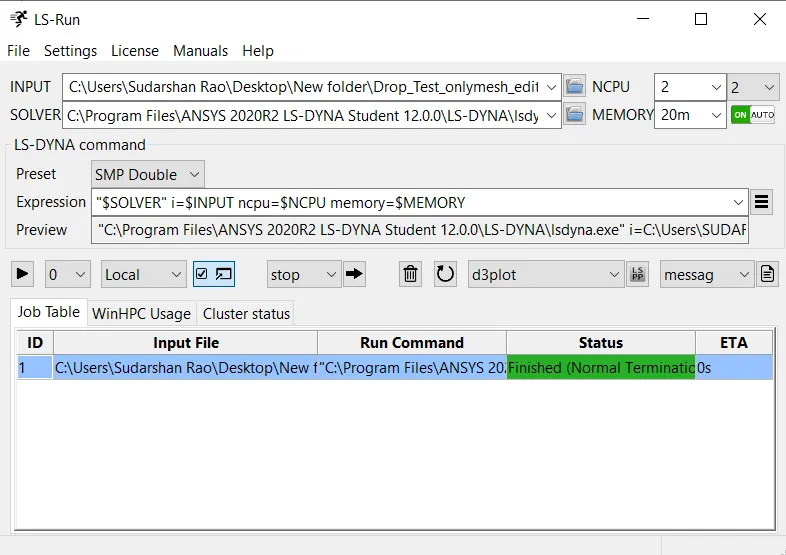
Fig: LS Run
Results:
Stress
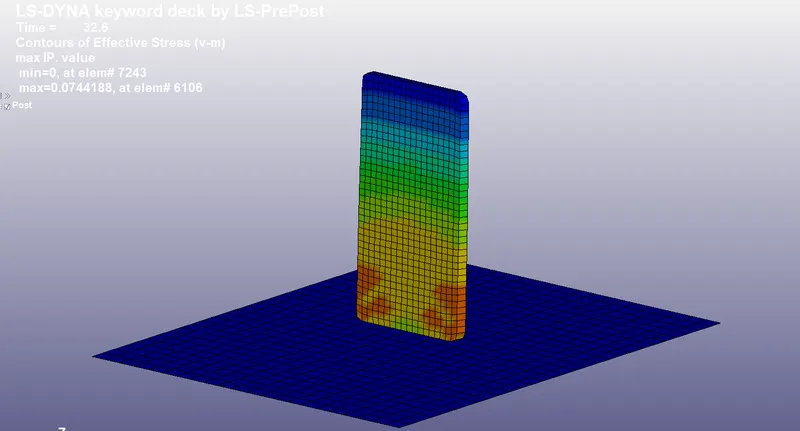
The maximum von mises stress genetated in the phone is 0.074418 Mpa at 32.6ms as shown.
Displacement:
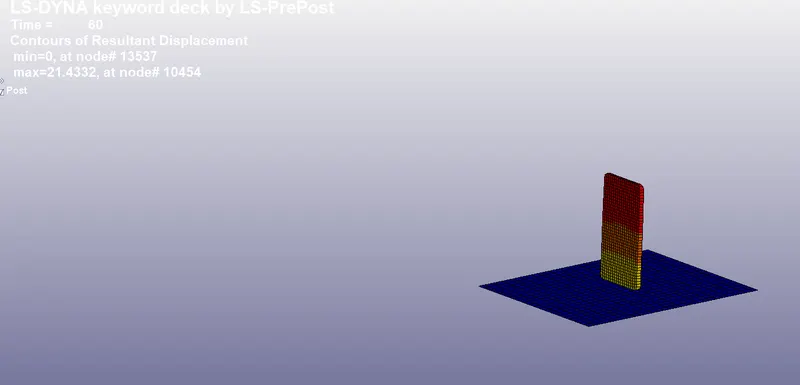
The maximum resultant dispalcement found is 21.4332mm at 60ms.
Change of Energy
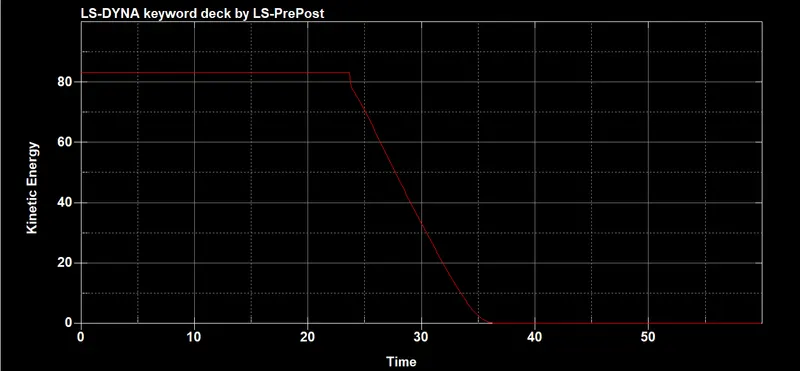
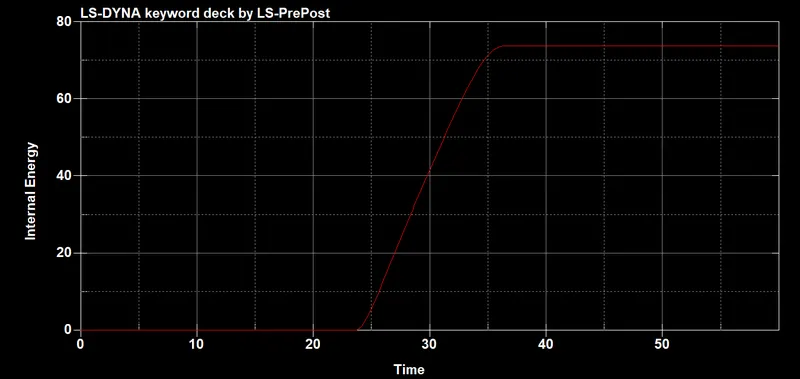
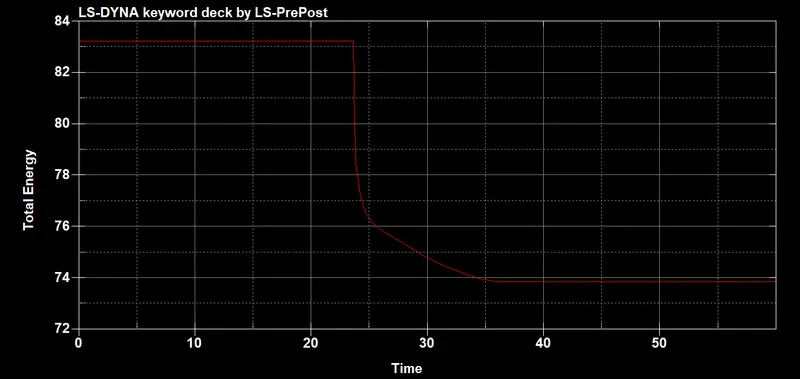
The above graphs shows the changing of the kinetic, Internal and total energy during the impact with respect to time, as we can see approximately at 24ms the kinetci energy starts decresing because of impact and internal energy increses due to the impact force.
For the given drop test model an input deck is created from the scratch and ran successfully with the desired output.
Learning outcomes:
- Creation of input deck from scratch using different cards.
- Controlling of simulation using termination card.
- Requesting the output from the simulation