Week - 3 Drop test Challenge
Objective of the challenge: To conduct a drop test of the phone modelled as a solid body which is made to hit the ground by assuming the ground to be a rigid plate.
Unit System: g-mm-ms
Assumptions:
1) Orientation of the phone to be dropped is not considered
Before starting the analysis it is important to check for duplicate nodes and duplicate elements inside the asesembly.
Keywords used for preprocessing:
There are totally 638 shell elements and 1304 solid elements which are connected by 3514 nodes
The following Keywords have been use to preprocess in the model
1) Element Formulation
*ELEMENT_SHELL: Shell element which connects the Node ID's of the plate.
*ELEMENT_SOLID: Solid Element which connrects to the Node ID's of the phone and the base solid.
*SECTION_SHELL: The section shell was used to model the plate whose thickness was taken to be 0.1mm. The element formulation was taken to be as type 2. As the plate is rigid, so default value of element formulation was considered. All other parameters in the keyword card was kept constant
*SECTION_SOLID: The cellphone body and the baseplate was modelled with Section solid. In the case of cell phone element formualtion type 2 was used to prevent hourglassing. The base plate was modelled with an element formulation of type 1 as the base plate was also rigid
2) Material of the phone, plate and the solid plate
*MAT001 Elastic: This material used for the cellphone was Alumimium whose properites was defined as density as 0.0027g/mm^3 Young Modulus as 70 x `10^4``frac{g.mm}{ms^2}`/mm^2 and poisson ratio as 0.33. Generally cellphones are made of Aluminium alloy bodies with some part used as plastics. Here we have considered entirely as aluminium
*MAT020 Rigid: The rigid material was used for the thin plate and the base plate. The material property used was steel: density as 0.00783g/mm^3 Young Modulus as 2.07 x 10^5 gmm/ms^2/mm^2 and poisson ratio as 0.3. These plates are fixed and hence the conditions have been input using centre of mass constraint (CMO) option present in the mat20 card
3) Initial velocity decided for the cellphone
*INITIAL_VELOCITY: Using this keyword the velocity of the ball was decided to be 40mm/ms. Typical drop speed included a value ranging from 18mm/ms to 25mm/ms. By using create entity A node set was created for this condition using the *SET_NODE keyword.
4) Initiallization of contact
*CONTACT_AUTOMATIC_SURFACE_TO_SURFACE: This type of contact condition was used to study the effect of phone which is the slave part over the rigid part which is the master surface. SOFT=2 that is pinball segment based contact was formulated keeping all others numerical values default
5) Control cards
Different control cards like *CONTROL_CONTACT for more contact parameter options and *CONTROL_ENERGY for all global energy considered during the analysis were considered.
Finally the *CONTROL_TERMINATION was used to set the end time of the simulation to 3ms.
6) Output generation
Different ouput files were written using *DATABASE_ASCII_option. Some of them includes GLSTAT, MATSUM, NCFORC, RCFORC, SLEOUT etc. These files are read at a time duration each of 0.01ms
The animation file was written using *DATABASE_BINARY_D3PLOT option to study the response for 0.01ms each.
The solving methodology used was Explicit Analysis Method
RESULTS
Database Ascii plots
1) GLSTAT
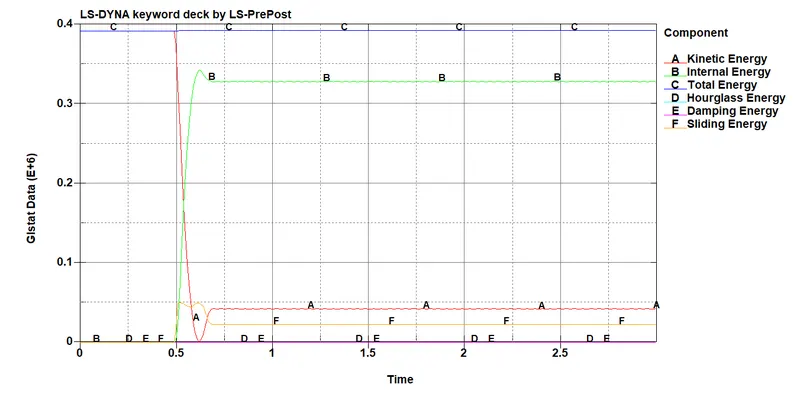
We plot the Glstat graph by calling the glstat ascii file for global energies of the system. The glstat meaures all energies with respect to time. It is observed that the Kinetic energy and Internal Energy are out of proportion along the simulation which means the Kinetic energy of the cellphone block decreases and in parallel the internal energy increases. Overall the total energy of the system remains constant at all times
2) MATSUM
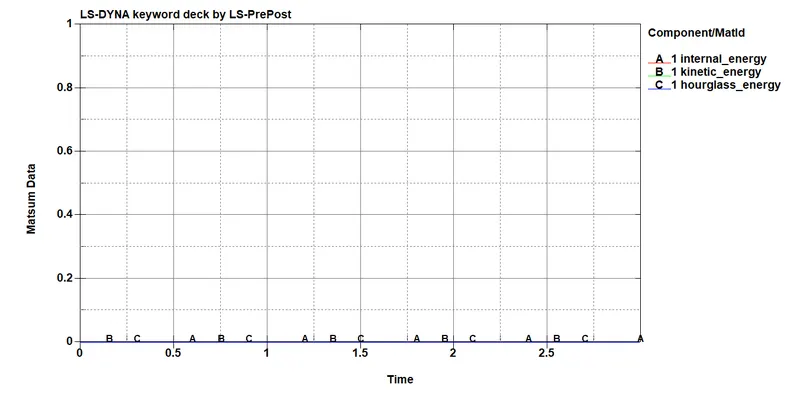
We plot the Matsum graph by calling the Matsum ascii file for calculating the different energies of the single component. Since the plate is modelled as rigid material so there is no change in energy in the form of kinetic energy poterntial energy or hourglass energy
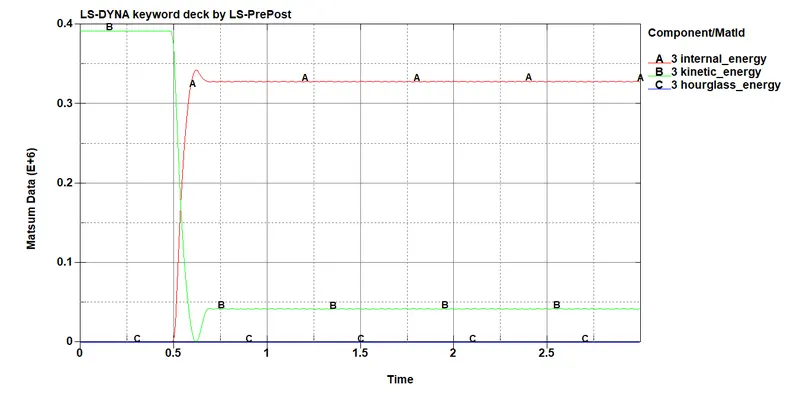
For the cellphone block the Kinetic energy internal energy and hourglass energy are studied and it is seen that the kinetic energy and internal energy are inverse in proportion with time.
3) RCFORC
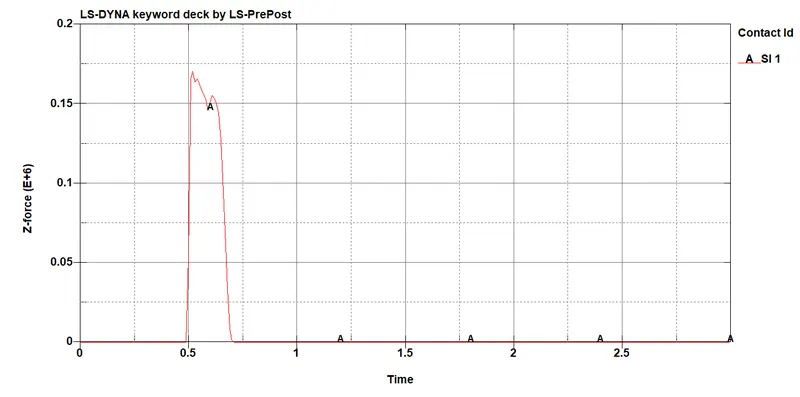
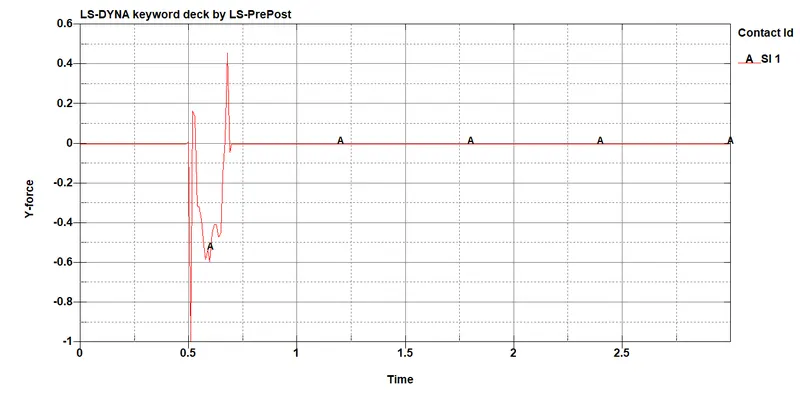
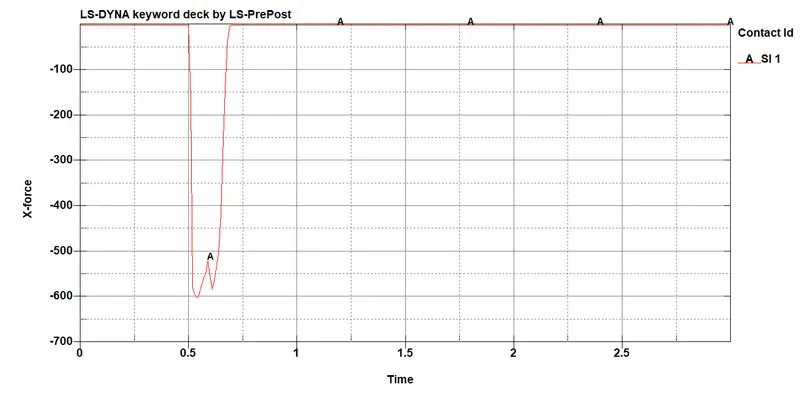
We plot the resultant contact interface forces by uploading the RCFORC ascii file. Since the cellphone block hits the rigid plate by coming in contact in the direction of z-axis it is seen that the contact interface forces are higher in the z-force as compared to x- force and y-force .
4) SLEOUT
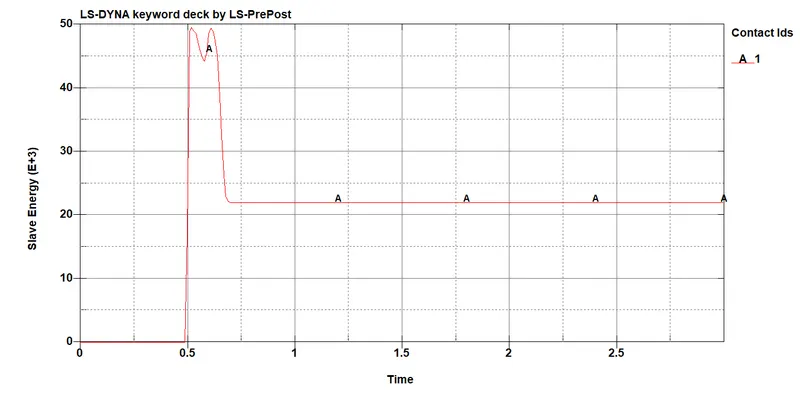
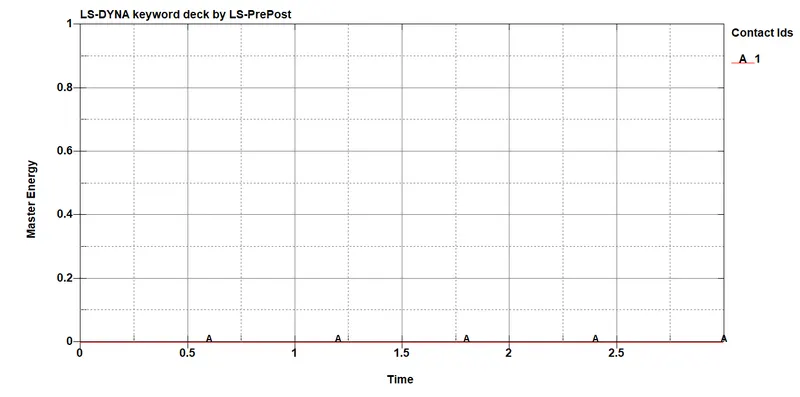
Sleout claculates the sliding interface energies of components coming in contact. We load the sleout ascii file into the ASCII list of files. The slave energy response and master energy response graphs are plotted for this ascii file.
History plot
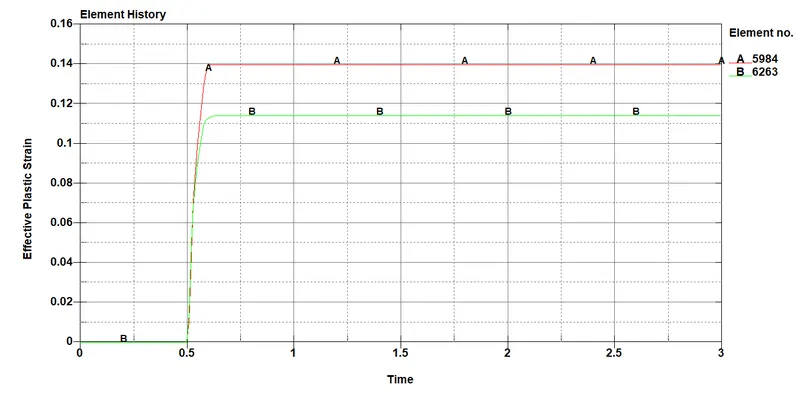
Elemental stresses and strains
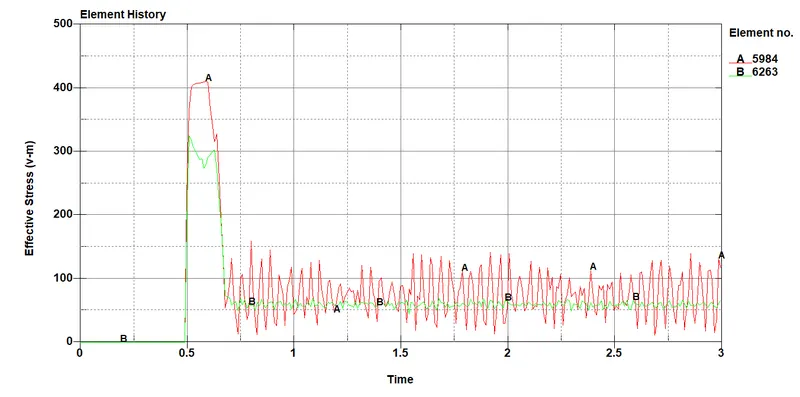
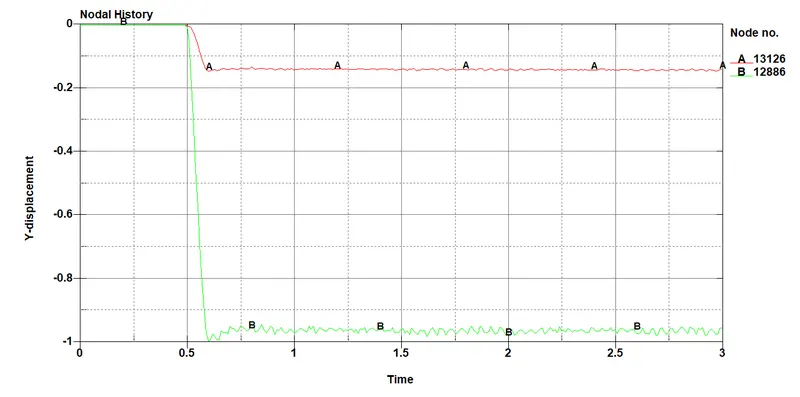
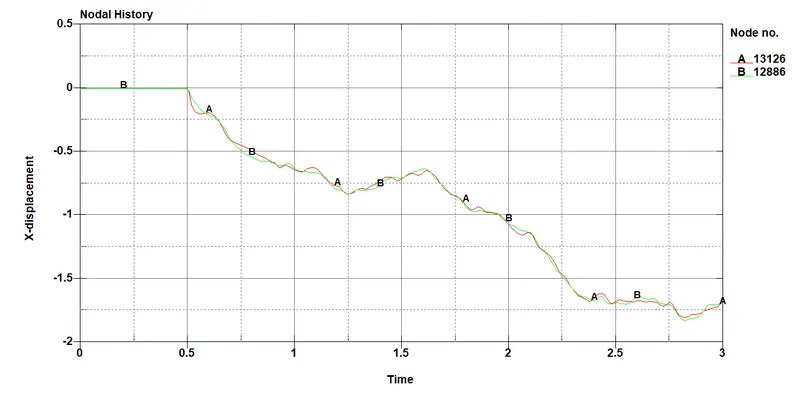
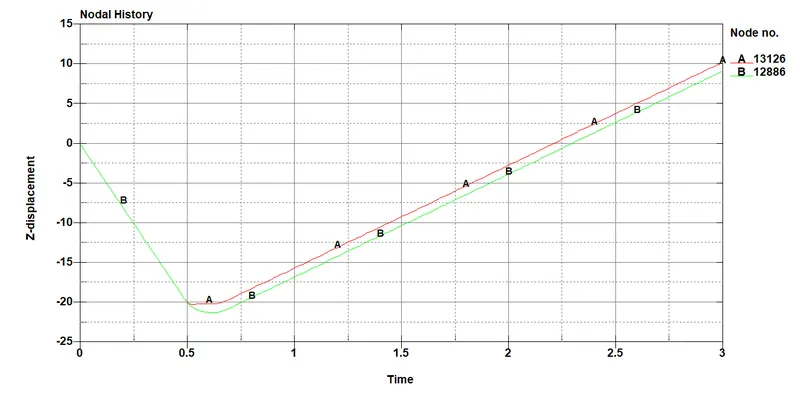
Nodal Displacements in three different coordinates