ADVISOR Tool Simulation on EV and Toyota Prius
Aims:
- To comment on the results using EV_defaults_in file in the Advisor Tool, if cargo mass is 500 kg with all other default conditions, conclude if the vehicle can travel for 45 km with FTP drive.
- To change the battery capacity in the above mentioned vehicle and to repeat the simulation.
- To perform gradeability test with PRIUS_Jpn_defaults_in file in the Advisor Tool and to compare the results in a tabular form.
Theory:
Advisor Tool: It was developed by NREL (National Renewable Energy Laboratory), which allows users to simulate the modelled vehicles in real time scenarios. It allows users to analyse the conventional, advanced, light weight, hybrid, fuel cell vehicles and heavy vehicles to be simulated in the software. It also allows users to change different parameters of the vehicles and enables the use of different fuels, motors, number of batteries, climate control systems, auxiliary systems, alternative fuels, catalytic converters, and different type of modifications that may affect vehicle efficiency, performance. and tail-pipe emissions of the vehicle.
This tool basically uses Matlab for the backend calculations to run the simulations. The vehicle models are modelled in the Simulink software and the blocks of the vehicles are scripted according to the functions of that particular vehicle. The inputs given by the user are then used for the calculations of the functioning of the vehicle. There are several drive cycles that can be used to simulate the vehicle and the efficiency, SOC usage, emissions etc that can be observed at the end of the simulation.
The default vehicle in this tool is the Parallel Hybrid vehicle which can be seen below, however, in this project we will be looking at the GM EV electric vehicle model simulations and Toyota Prius vehicle simulations.
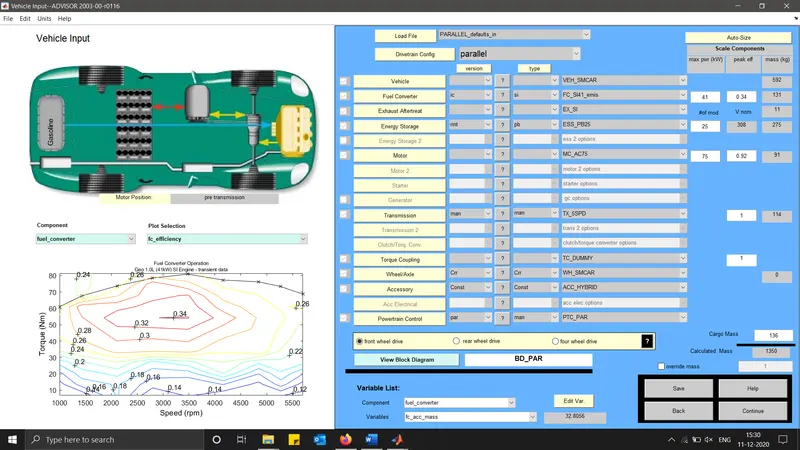
Part 1: To comment on the results using EV_defaults_in vehicle model having 500 kg cargo mass in the Advisor Tool.
The default screen of the EV model can be seen below
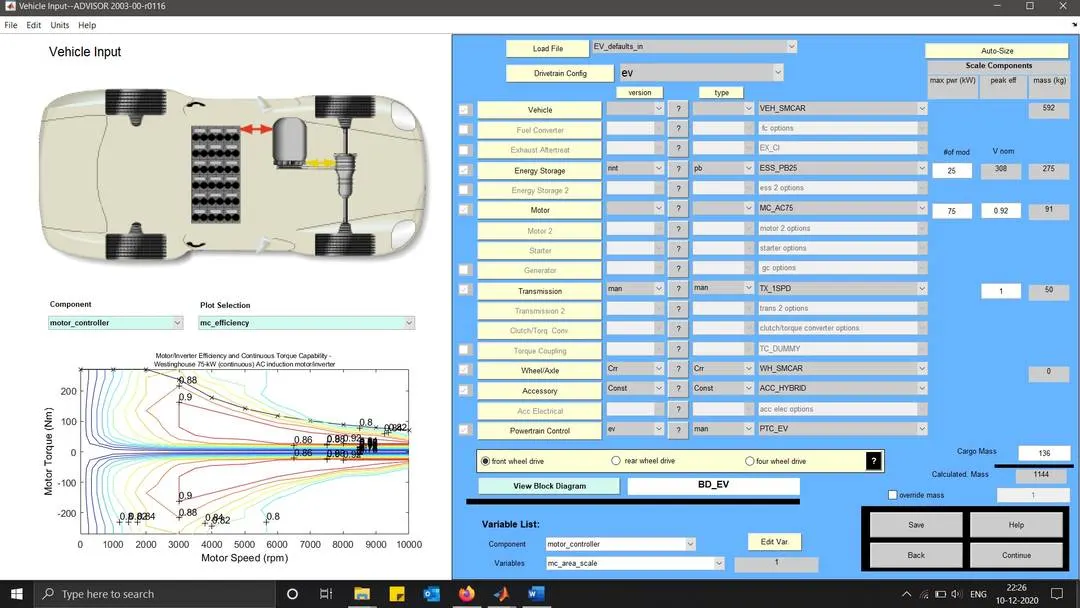
Here the cargo value was changed to 500 kg.
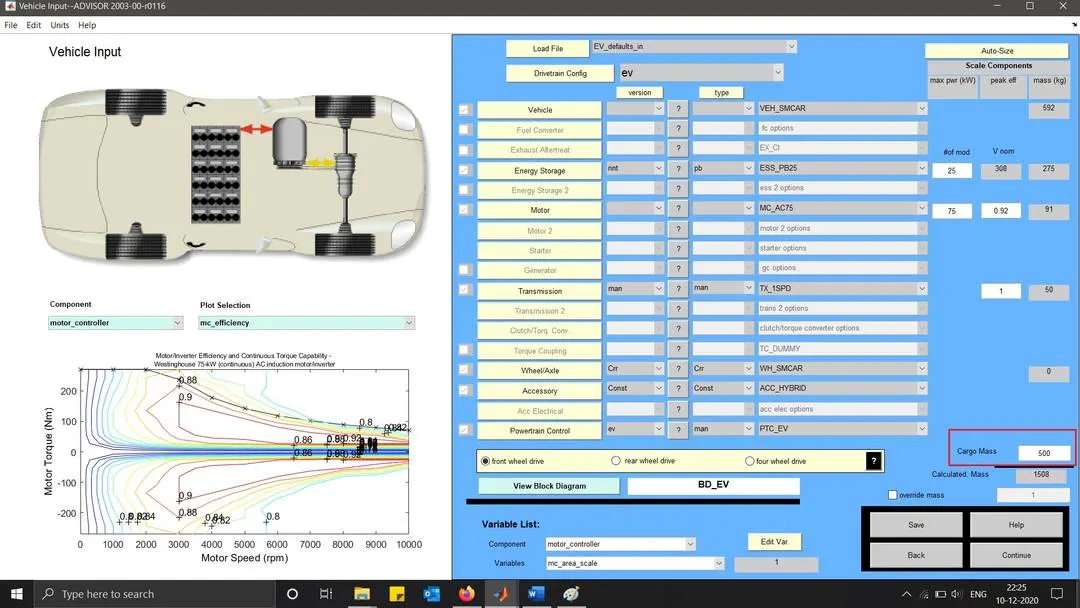
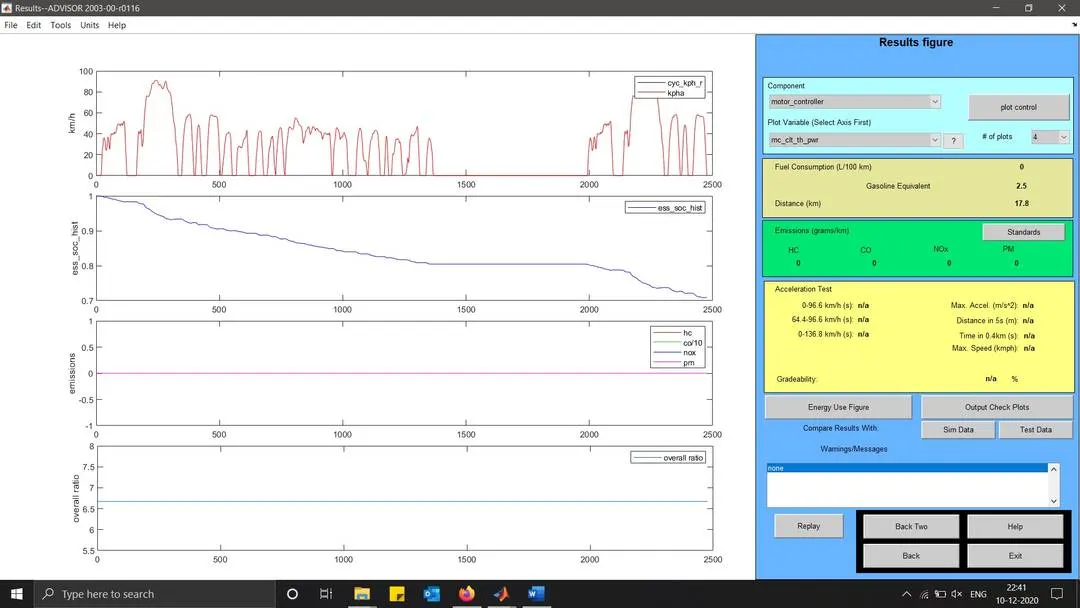
The battery was kept at a default of 25 numbers of mod. Thereafter the FTP drive cycle was selected to run for 1 number of times.
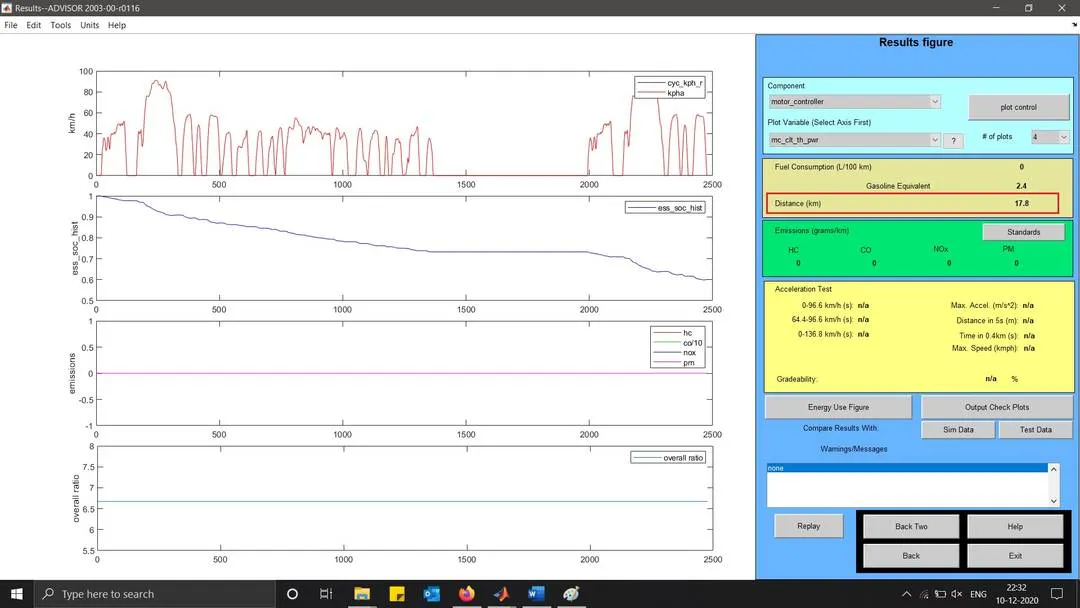
The above results were observed after running the simulation. The vehicle ran for 17.8 kilometres which can be seen below. The vehicle occupied almost 40% of the SOC.
Thereafter 2 FTP cycles were selected to run. The following results were observed after the simulation.
The vehicle ran for 35.5 kilometres and had used around 80% of SOC.
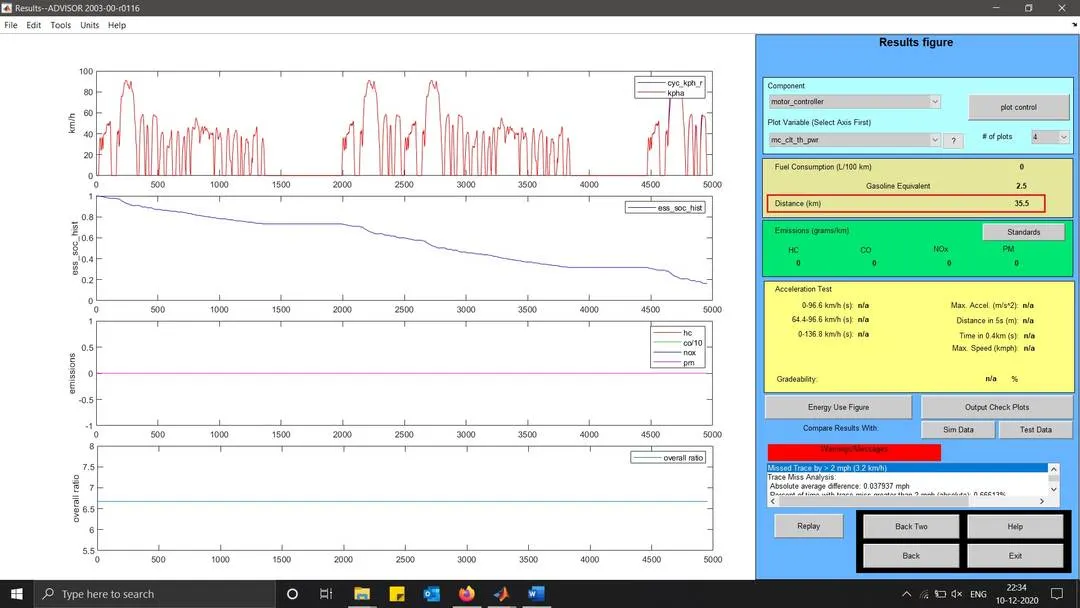
For the third simulation 3 FTP cycles were selected to be simulated. Here the vehicle ran for 41.4 kilometres where the vehicle used 100% of the SOC.
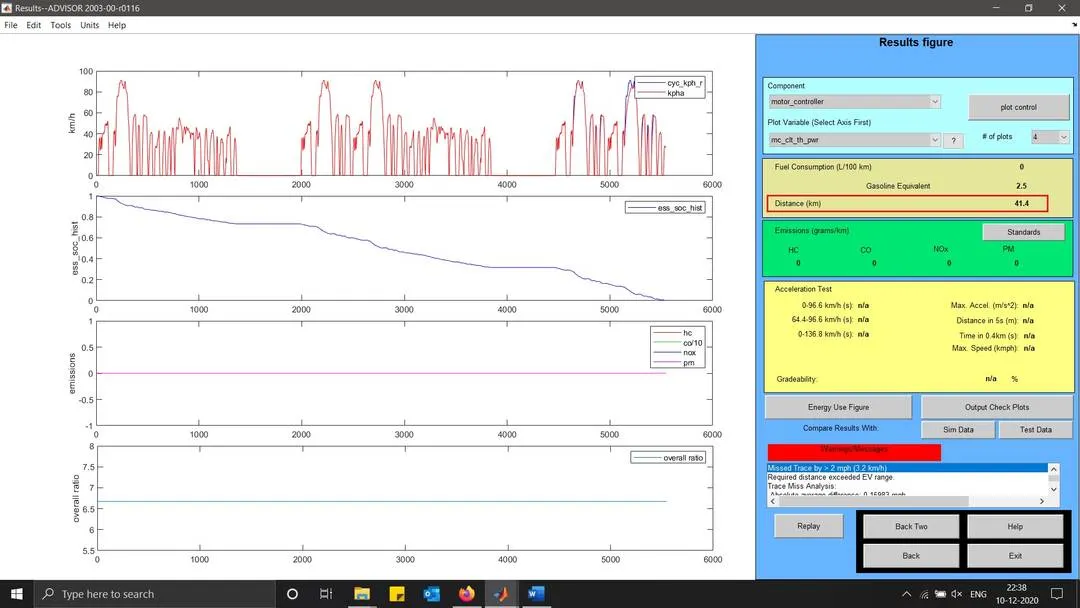
Therefore, it can be said that vehicle cannot run for 45 kilometres with 25 numbers of mod (battery packs). The results are shown below for the above simulation.
|
Number of Drive Cycles |
Distance Covered |
|
1 |
17.8 |
|
2 |
35.5 |
|
3 |
41.4 |
Part 2: To change the number of battery packs of the EV vehicle and to comment on the results, however, keeping the vehicle scenario the same as previous case.
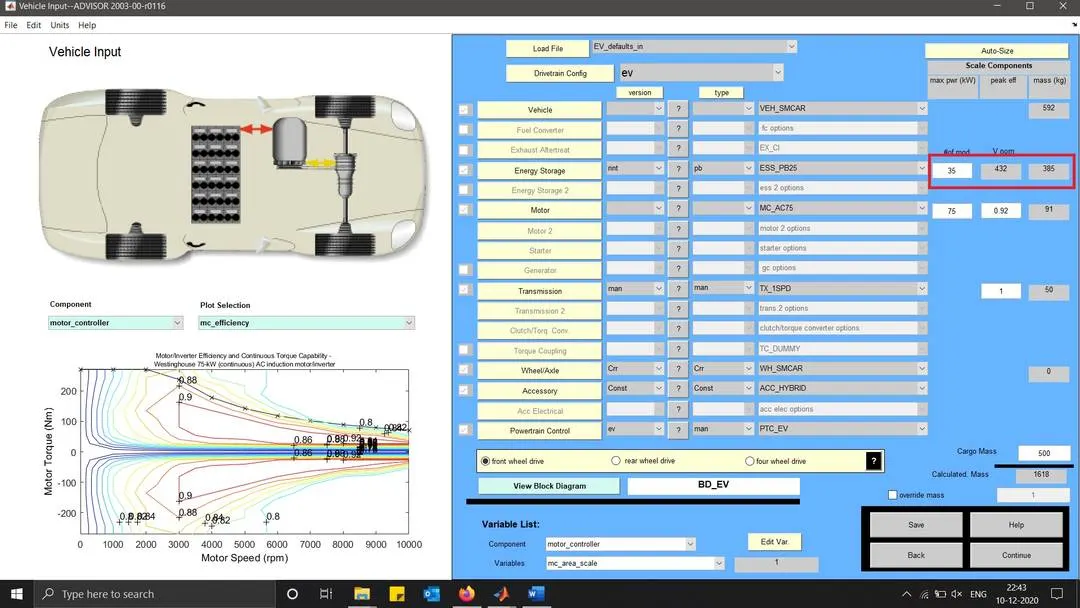
For this simulation of the EV vehicle, the cargo weight was kept at 500 kg, here we have changed the number of battery packs to 35 as shown below.
For the first simulation. 1 number of FTP cycle was selected to run for the simulation. The result for this simulation can be seen below.
The vehicle ran for 17.8 kilometres and has used up around 30% of the SOC.
As we know that the vehicle requires 3 FTP cycles to reach around 41 kilometres, therefore 3 FTP cycles were simulated for the same vehicle with 35 number of battery packs. The results can be seen below.
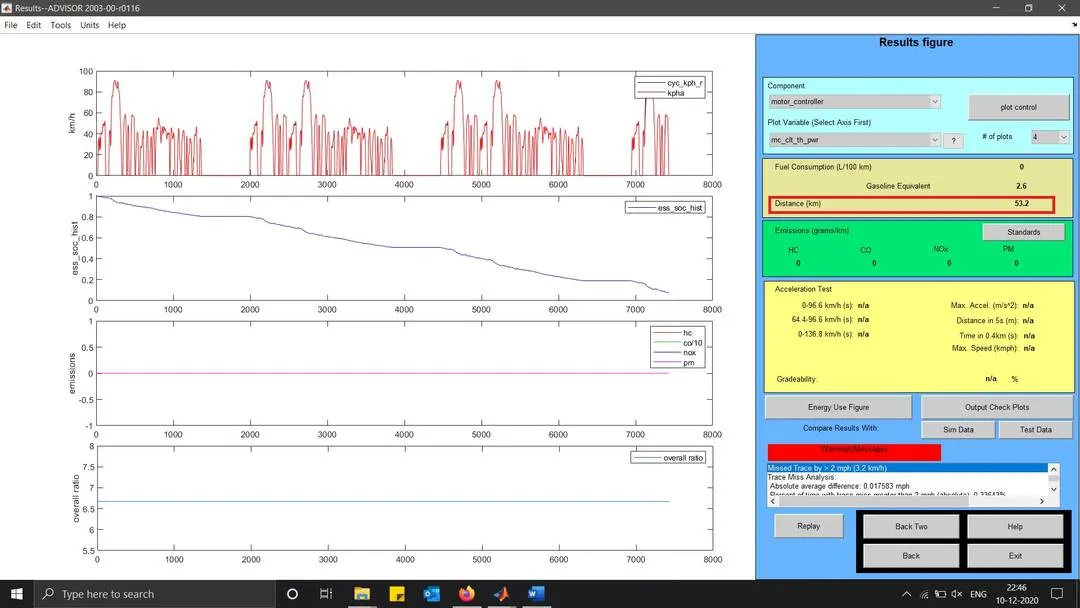
Here we can see that the vehicle consumed almost 90% of the SOC and it ran for 53.2 kilometres, hence it can be said that 35 numbers of battery packs are more than enough for this vehicle to complete 45 kilometres.
Thereafter for experimental purposes, the number of battery packs were increased to 45 and the result of 3 FTP cycles can be seen below, the vehicle ran for 53.3 kilometres and still some of the SOC was left to be used.
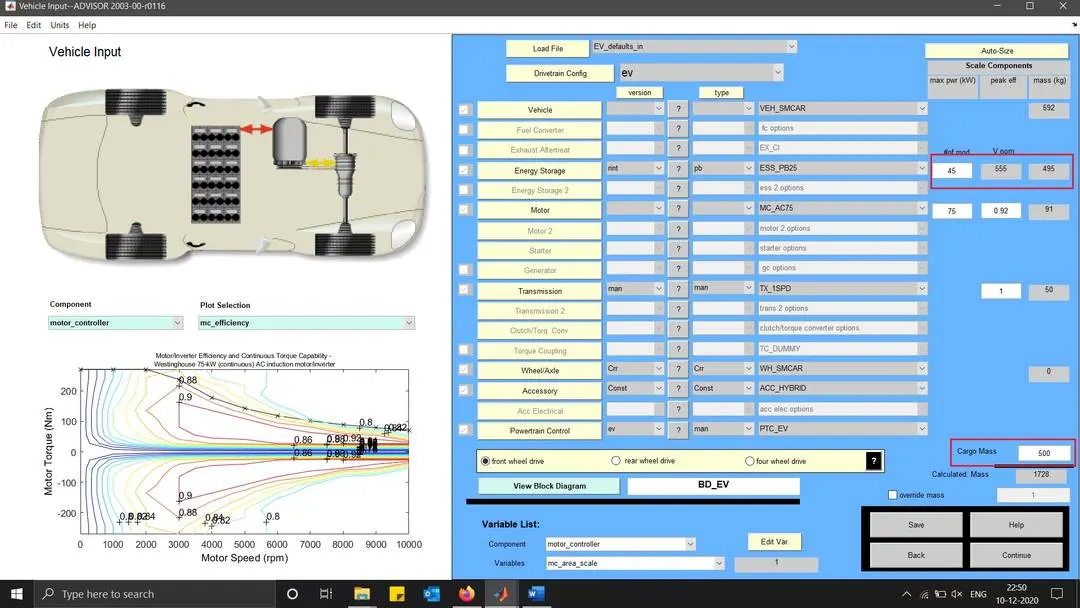
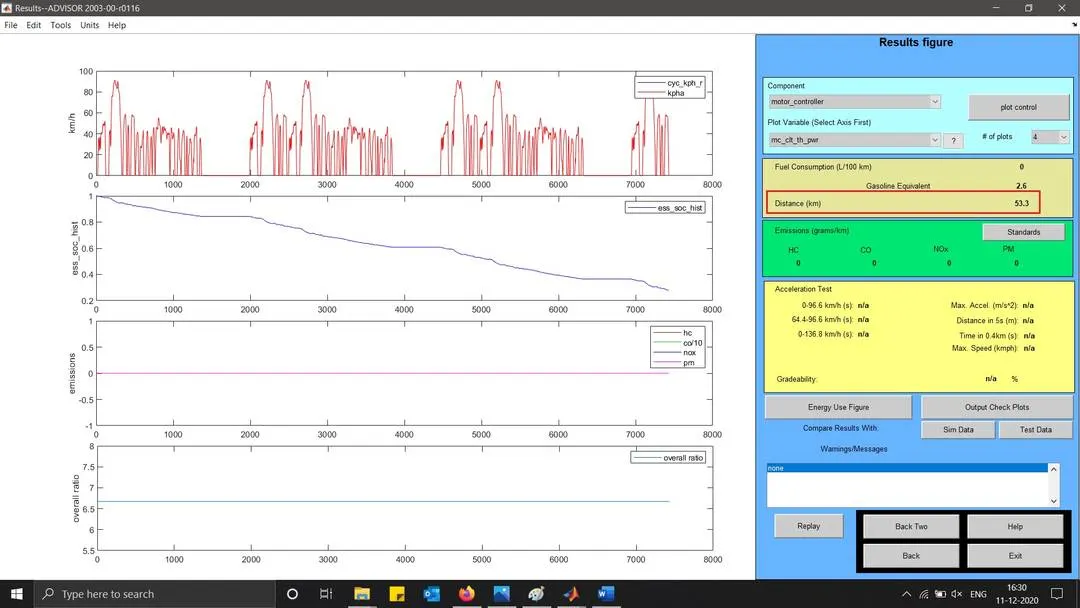
Therefore, it can be said that 35 or 45 number of battery packs are necessary for the above EV model to cover 45 kilometres in a single run.
Part 3: To simulate gradeability test with PRIUS_Jpn_defaults_in vehicle in the Advisor Tool.
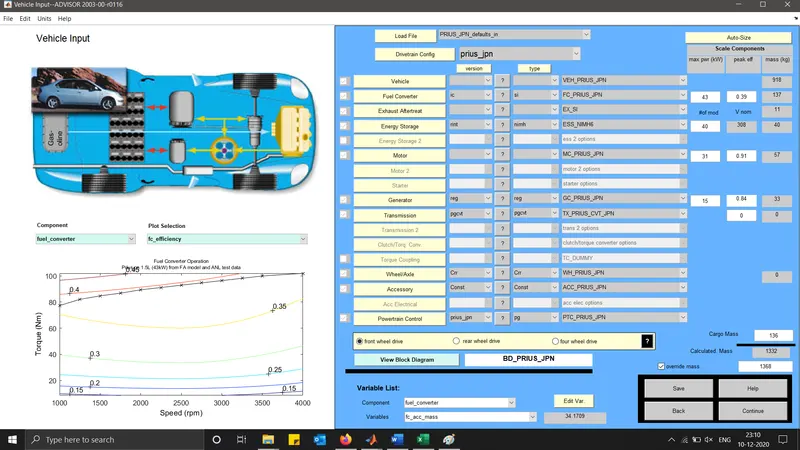
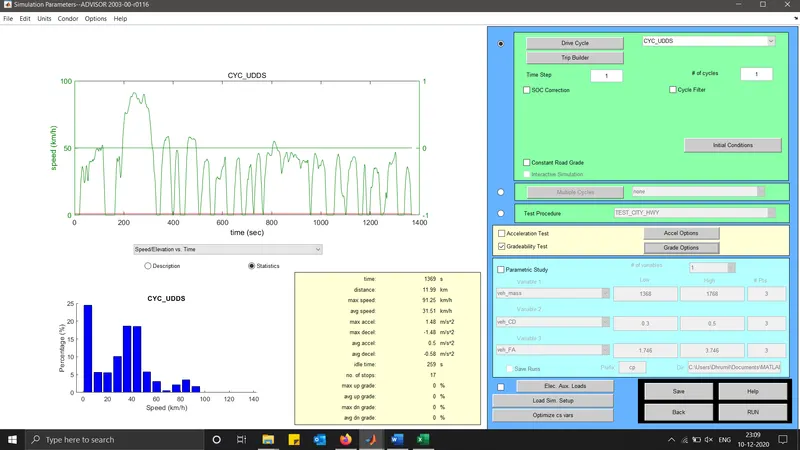
The gradeability simulation was carried out on the Prius vehicle at the default parameters of the vehicle by using the UDDS drive cycle. Here the Gradeability Test option was selected for the simulation, wherein the speed of the vehicle was varied to check the gradeability of the vehicle. Totally 12 simulations were carried out by varying the speed of the vehicle from 1 miles/hr to 55 miles/hr. The default screen of the Prius vehicle model can be seen below.
Thereafter, on the next page after clicking the Continue button. The Gradeability Test button was checked and Grade Options button was clicked to change the mph values of the vehicle to simulate at that particular speed. Therefore checking the Gradeability at the results of the vehicle.
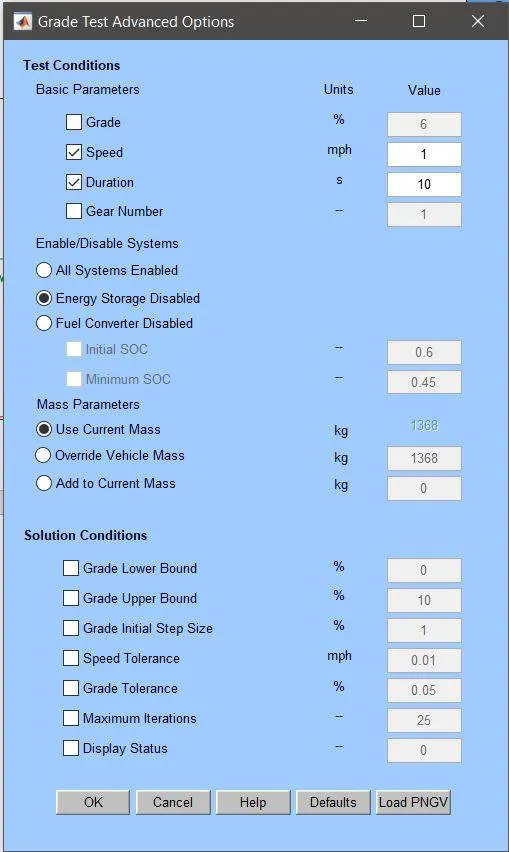
The first simulation at 1 mph was done and the results can be seen below.
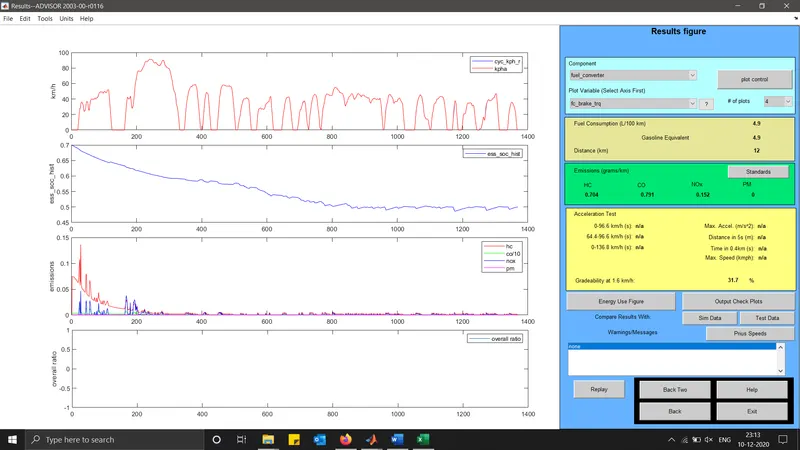
Here the vehicle achieved 31.7% gradeability.
Thereafter the simulation was carried out at 5 mph.
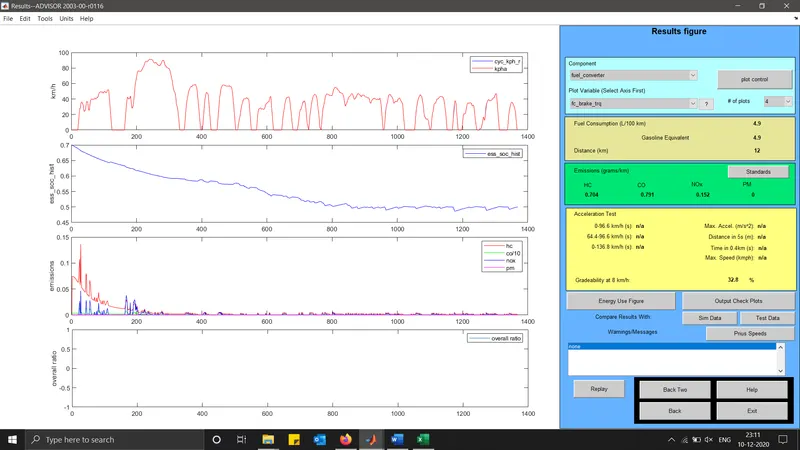
Here the vehicle achieved 32.8% gradeability.
Thereafter the simulation was carried out at 10 mph.
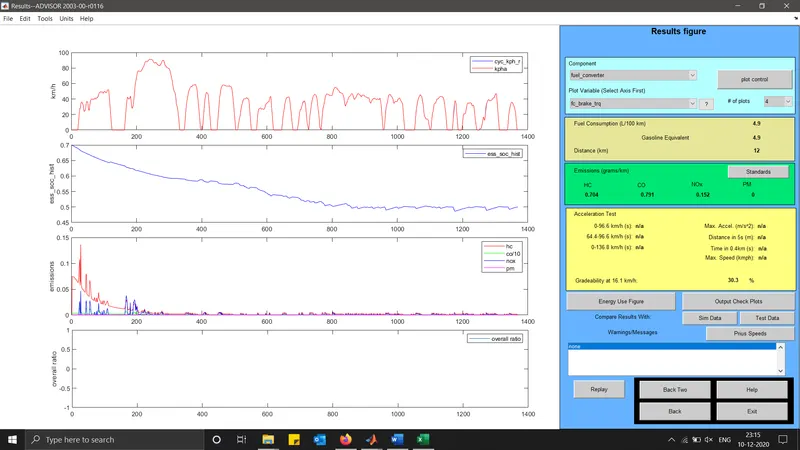
Here the vehicle achieved 30.3% gradeability.
Thereafter the simulation was carried out at 15 mph.
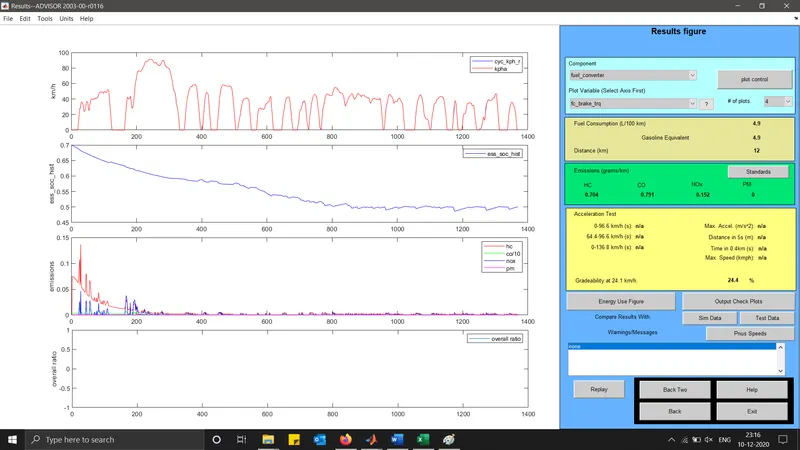
Here the vehicle achieved 24.4% gradeability.
Thereafter the simulation was carried out at 20 mph.
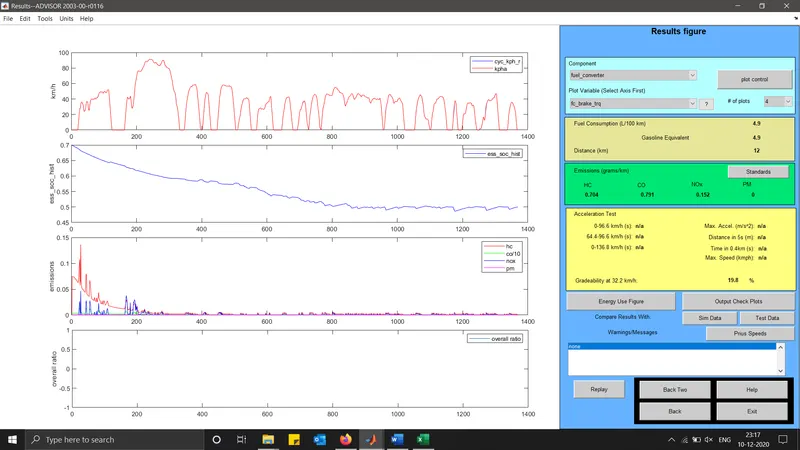
Here the vehicle achieved 19.8% gradeability.
Thereafter the simulation was carried out at 25 mph.
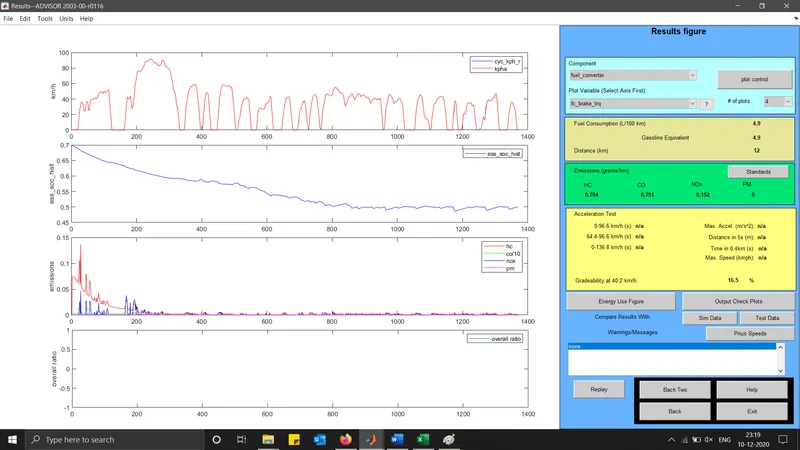
Here the vehicle achieved 16.5% gradeability.
Thereafter the simulation was carried out at 30 mph.
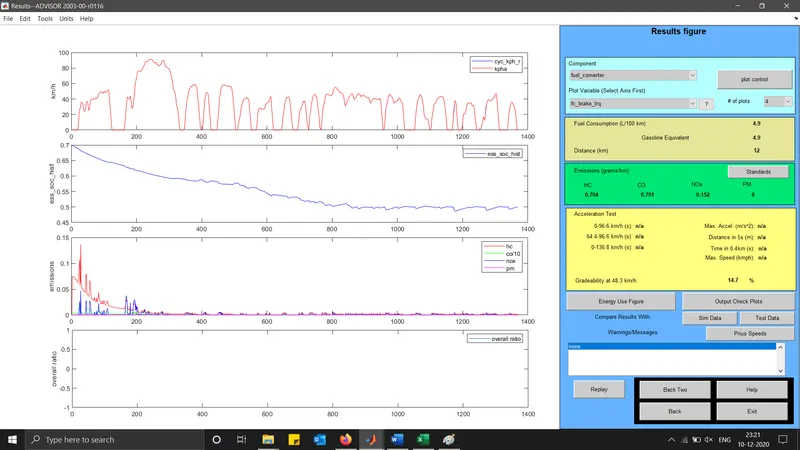
Here the vehicle achieved 14.7% gradeability.
Thereafter the simulation was carried out at 35 mph.
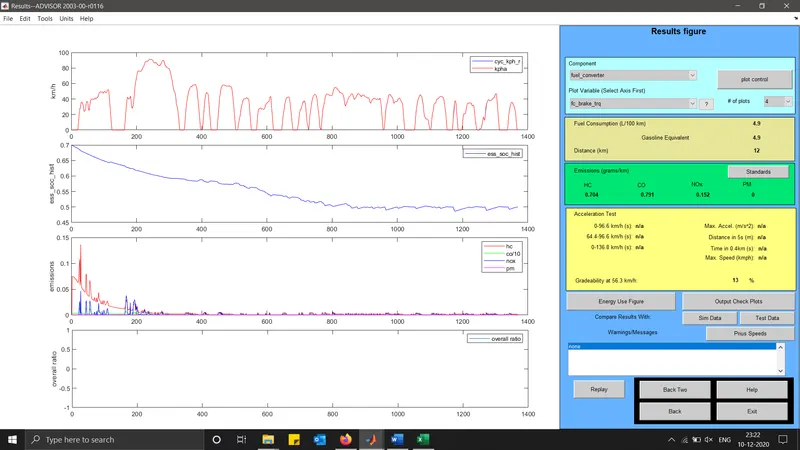
Here the vehicle achieved 13% gradeability.
Thereafter the simulation was carried out at 40 mph.
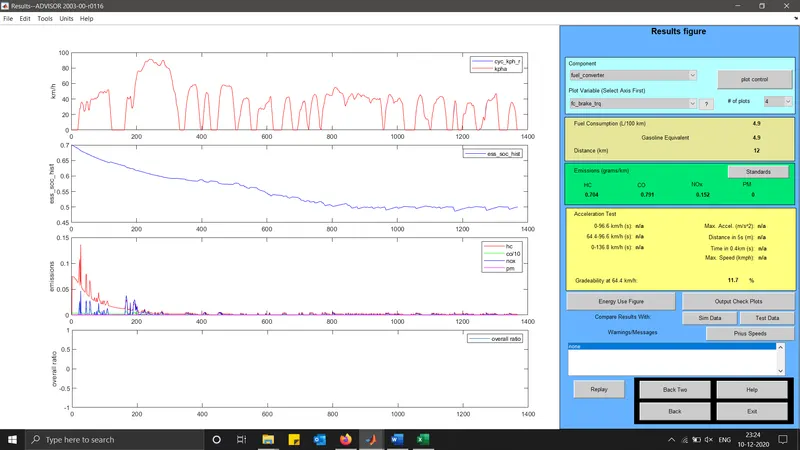
Here the vehicle achieved 11.7% gradeability.
Thereafter the simulation was carried out at 45 mph.
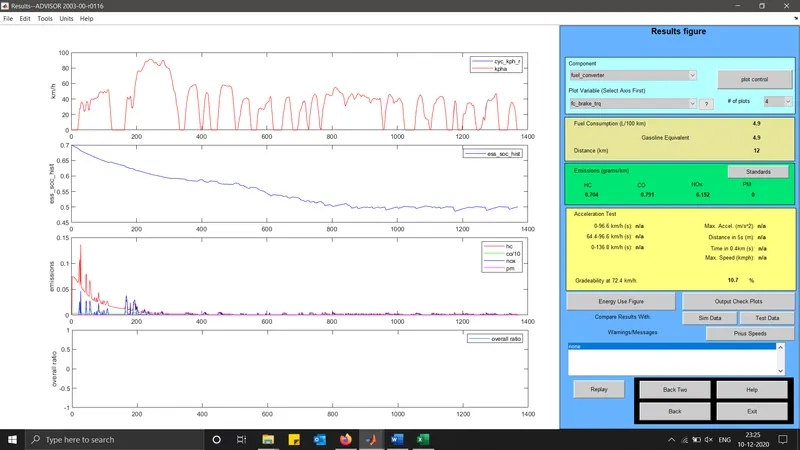
Here the vehicle achieved 10.7% gradeability.
Thereafter the simulation was carried out at 50 mph.
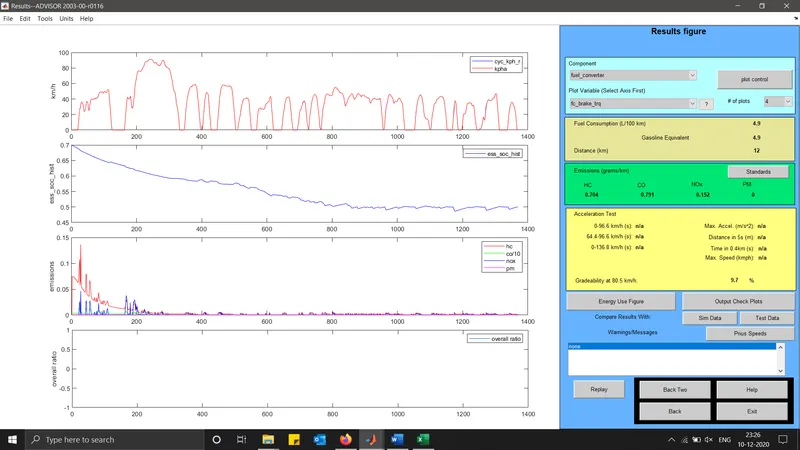
Here the vehicle achieved 9.7% gradeability.
Thereafter the simulation was carried out at 55 mph.
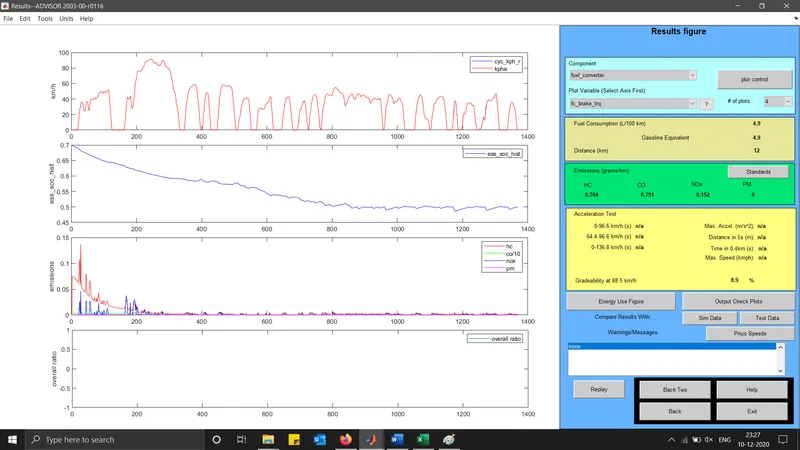
Here the vehicle achieved 8.9% gradeability.
The final results can be observed below
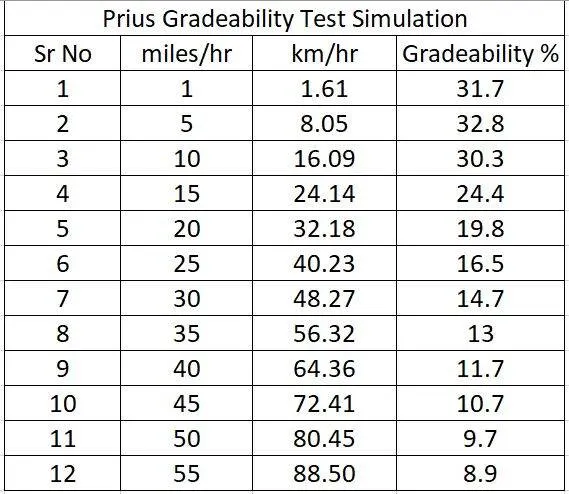
From the above results it can be said that the vehicle had the highest % of gradeability at 5 miles/hr that is at 8.05 km/hr.
Conclusions:
- The simulation was carried out on the EV model of the Advisor Tool having cargo weight of 500 kgs and it was observed that the vehicle cannot run for 45 kilometres on the default parameters having 25 number of battery packs.
- The simulation was carried out having EV vehicle with 500 kg cargo and the changed number of battery packs for 35 and 45 number of battery packs. The vehicle ran for 53.2 and 53.3 kilometres for 3 cycles of FTP drive cycle respectively. Therefore, it can be concluded that 35 and 45 number of battery packs are good to be used for the vehicle to run 45 kilometres in a single run.
- The simulation for the Prius model was carried out and it was concluded that the max gradeability was achieved at 5 mile/hr which is 32.8%.