Week-3 Challenge: ADVISOR Tool
Use ADVISOR tool and simulate the following
1. For EV_defaults_in file, if cargo mass is 500 kg with all other default conditions, can the vehicle travel for 45 km with FTP drive cycle? Conclude your observations.
2. In the above case, try changing the battery capacity and repeat the simulation.
3. Perform gradeability test with PRIUS_Jpn_defaults_in file
Compare your results in table and conclude.
ADVISOR (Advance Vehicle Simulator)
ADVISOR , NREL'S ADvanced Vehicle Simulator , is a set of model , data , and script text files for use with Matlab and Simulink . It is designed for rapid analysis of the performance and fuel economy of conventional , electric , and hybrid vehicles . ADVISOR also provides a backbone for the detailed simulation and analysis of user defined drivetrain components , a starting point of verified vehicle data and algorithms from which to take full advantage of the modeling flexibility of Simulink and analytic power of MATLAB.
1. For EV_defaults_in file, if cargo mass is 500 kg with all other default conditions, can the vehicle travel for 45 km with FTP drive cycle? Conclude your observations.
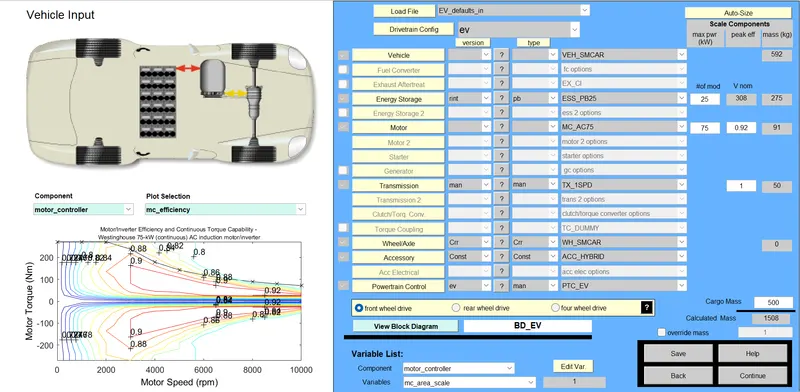
Here we are conidering a typical Electric Vehicle. Simulating EV_defaults_in file in ev drivetrain configuration with the following specifications;
- Battery or Energy storage: Lead Acid Battery with 25 modlues having a nominal voltage of 308 V and weight 275 kg
- Motor: AC induction motor with power 75kW having efficiency of 0.92 and weight 91 kg
- Trnansmission: Manual
- Drive: Front wheel drive
- Cargo mass: 500 kg
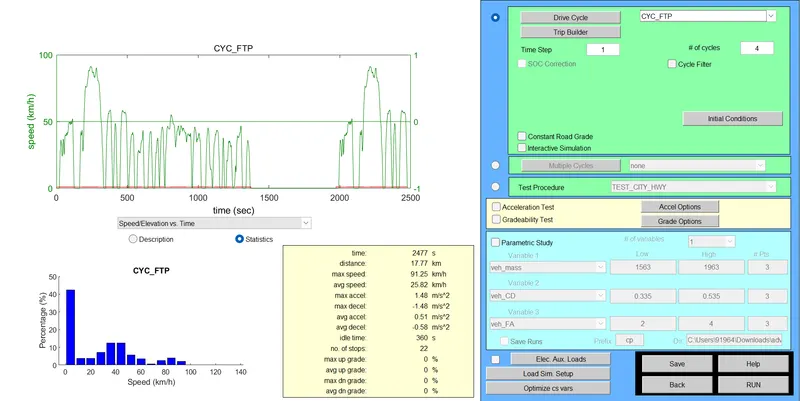
Next we are using CYC_FTP drvive cycle which has a distance of 17.77 km, average speed of 25.82 kmph and maximum speed 91.25 kmph in 2477 seconds. Inorder get a clear image about the range of vehicle we repeating the drive cycle 4 times and drain the battery completely to SOC=0%, so that vehicle travels 44.16 miles in total and find out in what distance SOC becomes 0.
Results:
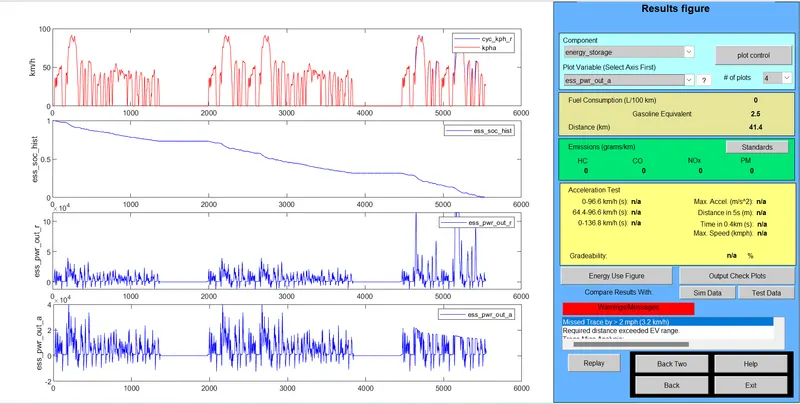
In the above figure , first plot shows the drive cycle for which vehicle has travelled , the second plot shows th SOC fail with time , the third and the fourth graph show th power output according to the throttle condition . Hence , after running the simulation , we can see that , the SOC becomes zero after aproximately 2.5 drive cycles . As shown at the right hand side , the distance travelled by vehicle is 41.4km. Which means that the range of the vehicle is 41.4 km and this vehicle can't travel for 45 km with a fully charged battery and a cargo mass of 500 kg.
2. In the above case, try changing the battery capacity and repeat the simulation.
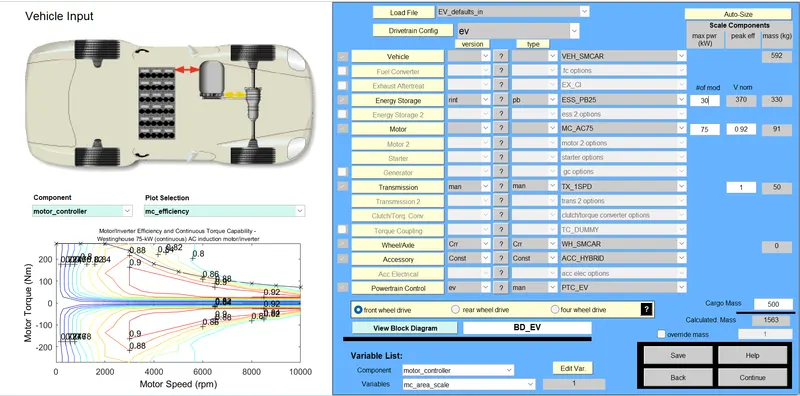
In this case we are increasing the battery module and keeping all other parameters same as the above case;
The energy storage module is increased to 30 from 25 and the corresponding nominal voltage becomes 370 V and weight of the batter is 330kg.
Results:
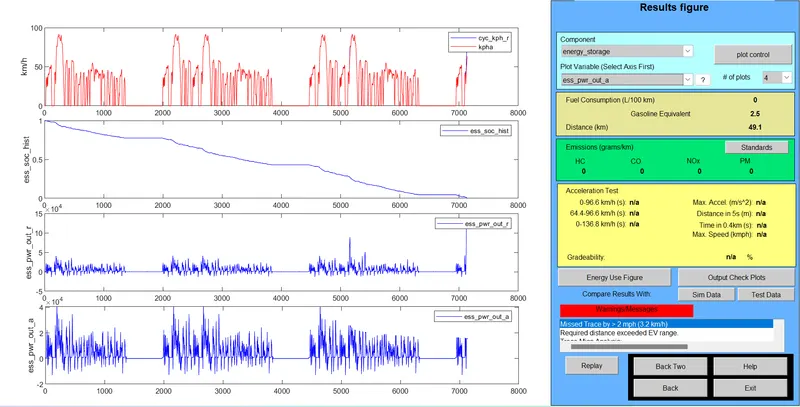
From the results it is clear that the vehicle range is increased to 49.1 km. Which means 30 module is much more sufficient to satisfy the range 45km.
3. Perform gradeability test with PRIUS_Jpn_defaults_in file. Compare your results in table and conclude.
PRIUS_Jpn_defaults_in is the model of Toyota Prius Parallel Hybrid Vehicle. It uses battery and IC engine to power the wheel. If we are going through the figure, can understand that, the differential is connected to motor and also connected with the IC engine parallely via a device called power splits. Power slit splits the power according to the demanded throttle input and keeping the engine in maximum efficiency zone, providing additional power via battery and engine during aggressive conditions, charging the battery via a generator during regenerative braking and preserving the energy efficiently.
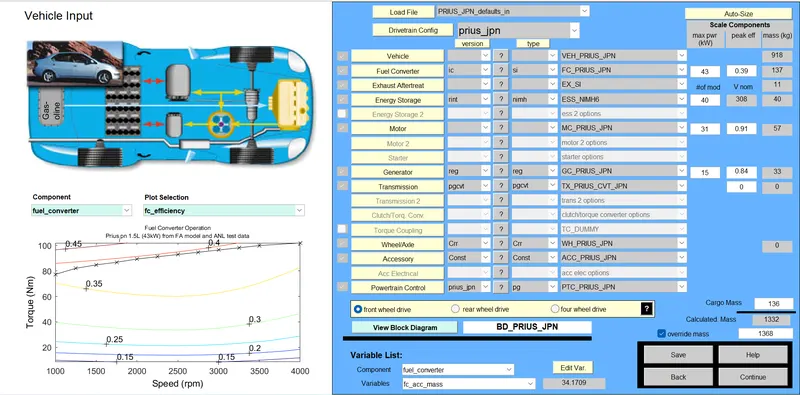
Vehicle Specifications:
- The IC engine produces maximum power of 43kW, has a a fuel convertor efficiency of 0.39 and weight 137 kg
- Energy storage/Battery is NMH (Nickel Metal Hydride) type having 40 modules producing nominal voltage of 308 V and weight is 40 kg
- Motor, Induction motor has 31 kW power and 0.91 efficiency weighing 57 kg
- Generator (regenerative) with 15 kW power and 0.84 efficiency having weight 33 kg
- CVT transmission
- Front wheel drive
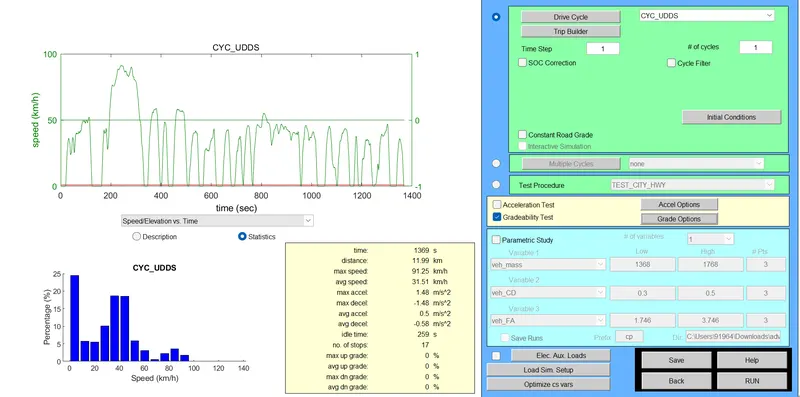
Here the Drive Cycle is CYC_UDDS having 11.99 km distance, maximum and average speed of 91.25 km/h and 31.51 km/h respevtively.
Inorder to perform gradeability test; we keep the grade value constant and changing the speed values to find out the maximum gradeability at an optimum speed simulating for 10s.
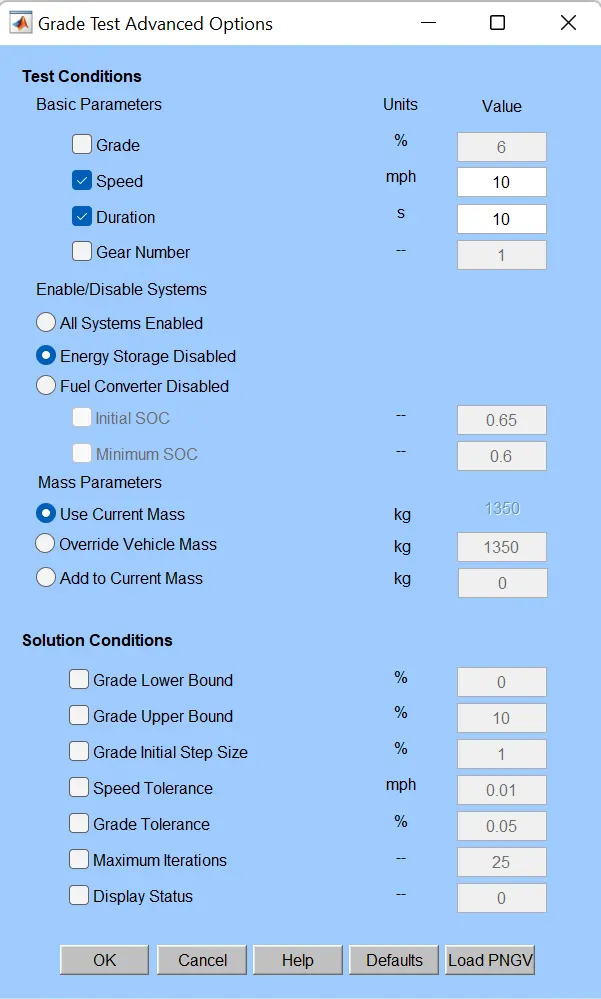
Hence the simulation is run for gradeability test.
Following are the output results:
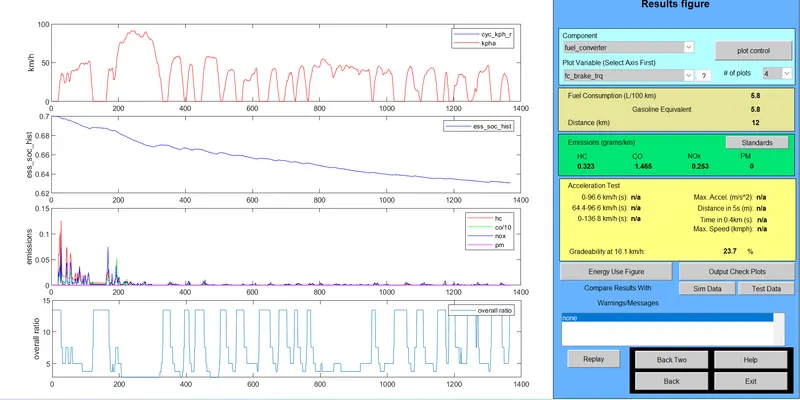
1) speed = 10 m/h = 16.1 km/h
Gradeability = 23.7%
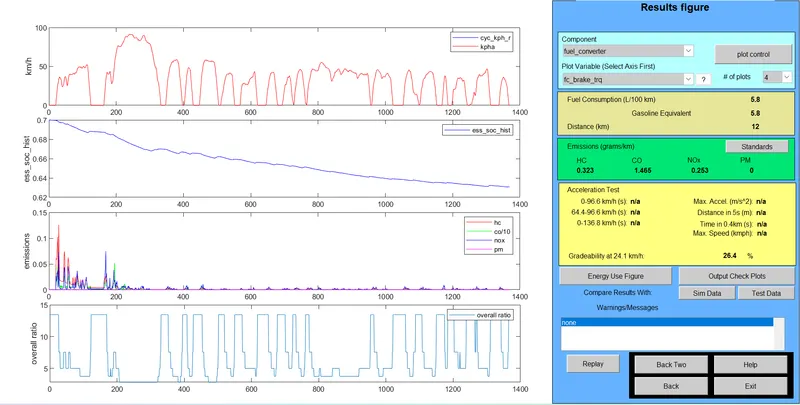
2) speed = 15 m/h = 24.1 km/h
Gradeability = 26.4%
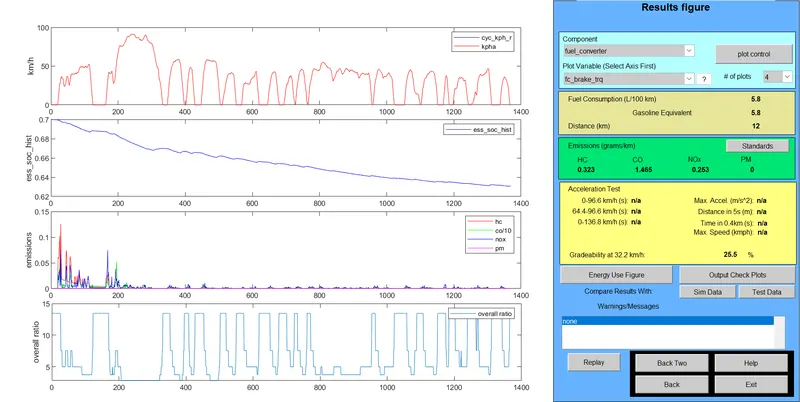
3) speed = 20 m/h = 32.2 km/h
Gradeability = 25.5%
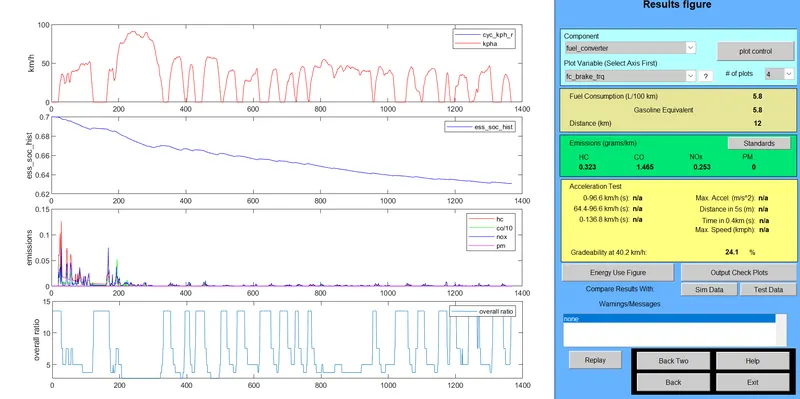
4) speed = 25 m/h = 40.2 km/h
Gradeability = 24.1%
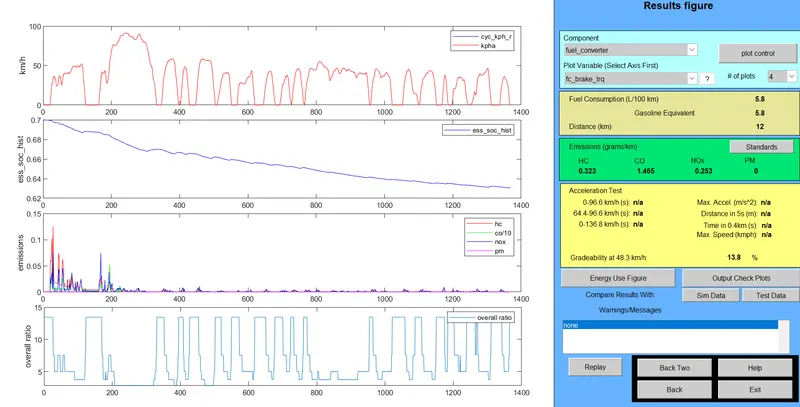
5) speed = 30 m/h = 48.3 km/h
Gradeability = 13.8%
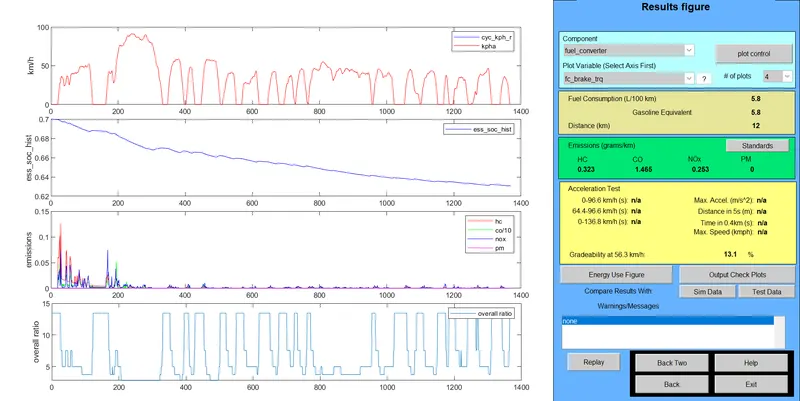
6) speed = 35 m/h = 56.3 km/h
Gradeability = 13.1%
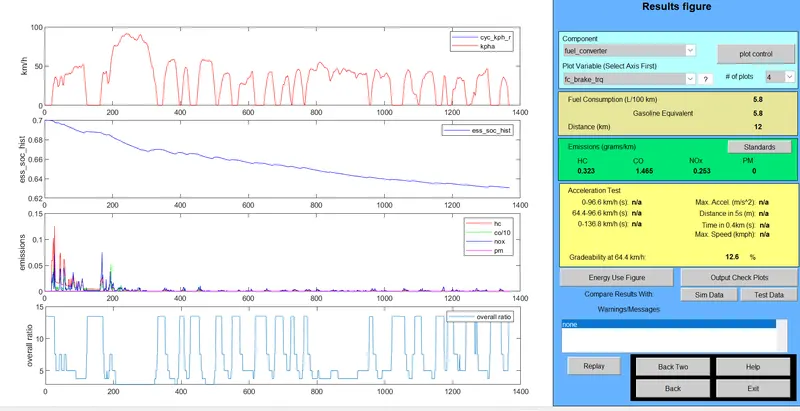
7) speed = 40 m/h = 64.4 km/h
Gradeability = 12.6%
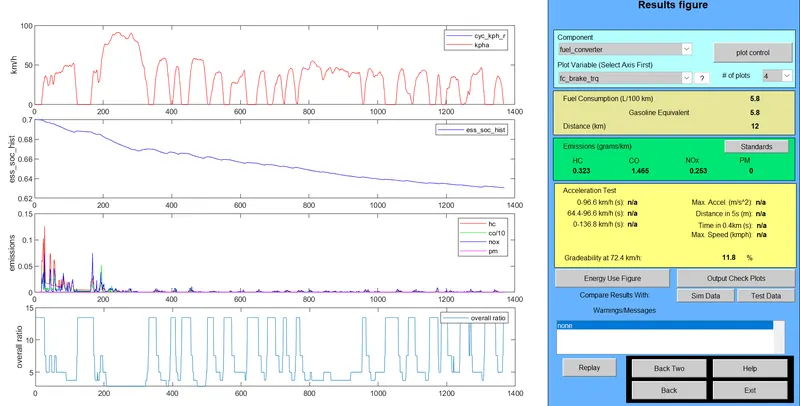
8) speed = 45 m/h = 72.4 km/h
Gradeability = 11.8%
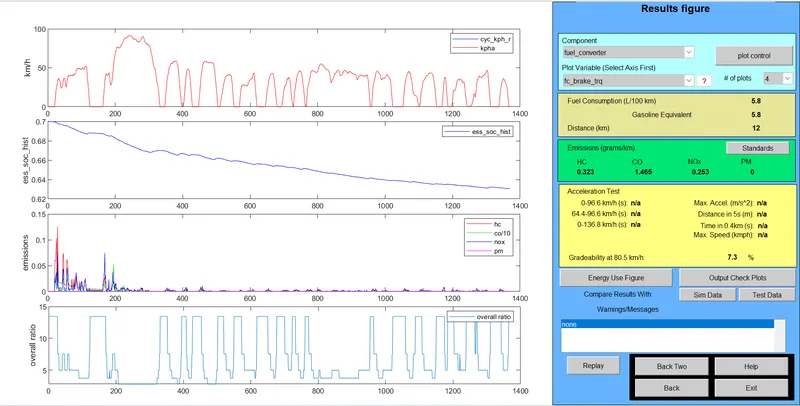
9) speed = 50 m/h = 80.5 km/h
Gradeability = 7.3%
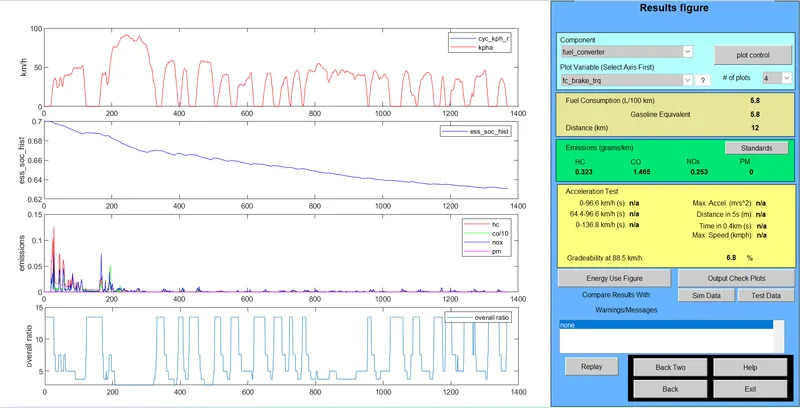
10) speed = 55 m/h = 88.5 km/h
Gradeability = 6.8%
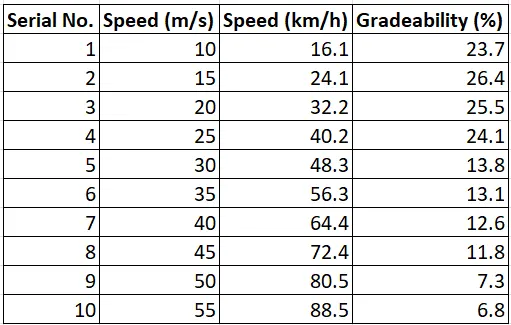
Hence, speed of 15mph to 25mph gives the highest gradeability value which makes them the optimum speeds for Prius.