Week-3 Challenge: ADVISOR Tool
Week-3 Challenge: ADVISOR Tool
QUESTIONS:
Use ADVISOR tool and simulate the following
1. For EV_defaults_in file, if cargo mass is 500 kg with all other default conditions, can the vehicle travel for 45 km with FTP drive cycle? Conclude your observations.
2. In the above case, try changing the battery capacity and repeat the simulation.
3. Perform gradeability test with PRIUS_Jpn_defaults_in file
Compare your results in table and conclude.
ANSWERS :
1. EV_defaults_in With FTP Drive cycle
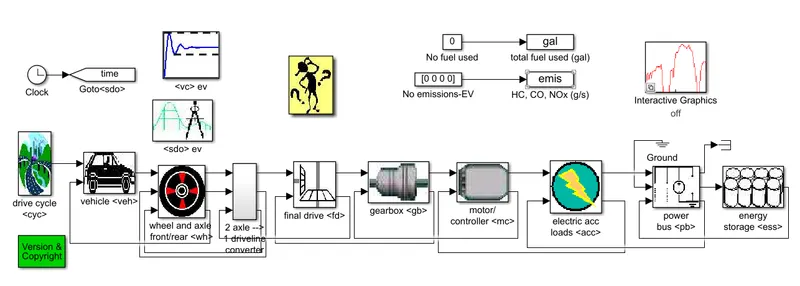
Block Diagram
Cargo Mass = 500kg
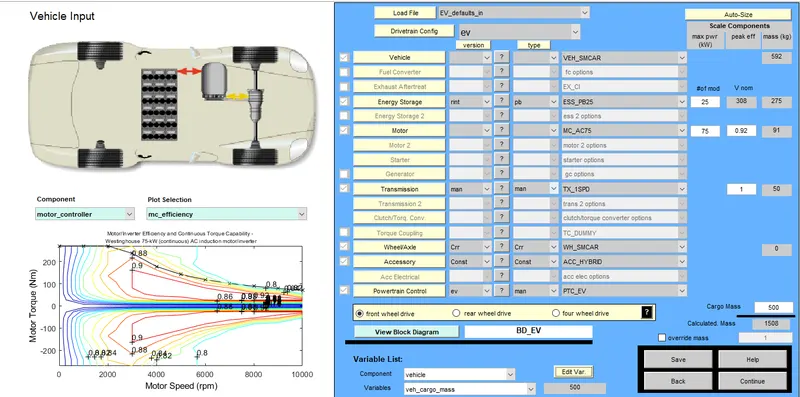
In this figure show that EV_Default_in Cargo mass value is 500 kg and other parameter is the default conditions.
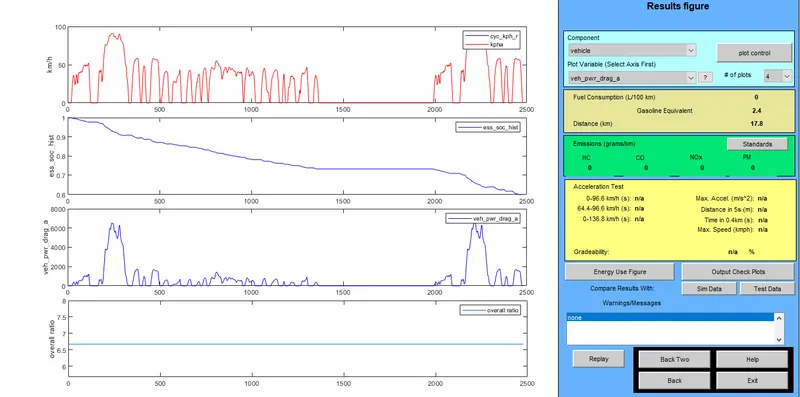
The drive cycle is different type of cycle. but in this model FTP drive cycle is used.
No.of cycles = 1. so the distance acheive by the 17.8 km.
No.of cycles = 3 or more . so the distance acheived by the 41.4 km. closely 45km
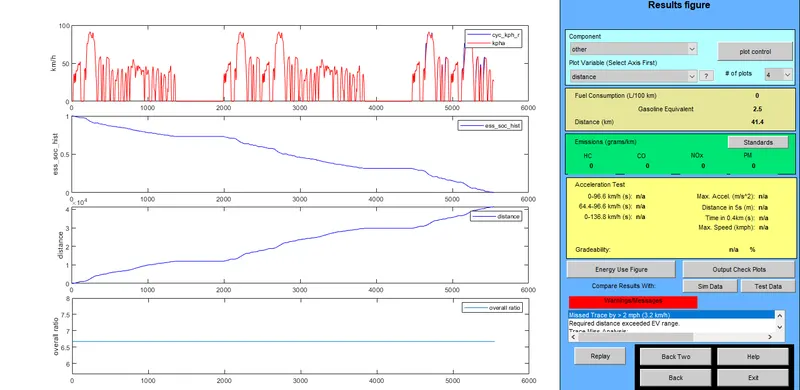
in the plot of 3 in distance is achieved by 41.4 km. at maximum speed of 91km/h. The no of cycles can be varied the distance also varied.
OUTPUT RESULTS :
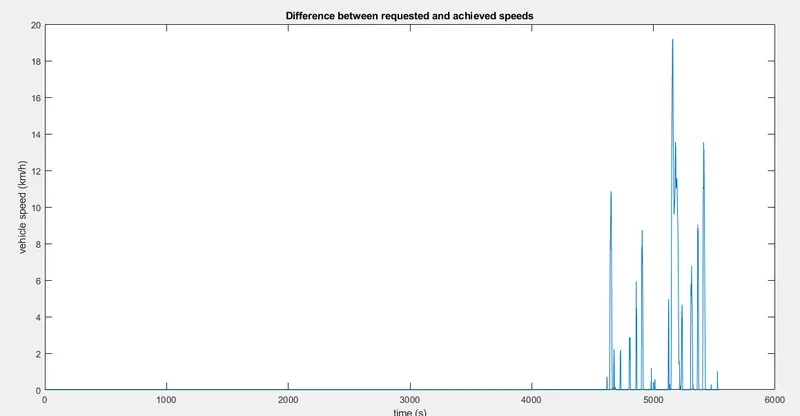
The vehicle speed achieved the 19km/h at the time 5500 sec.
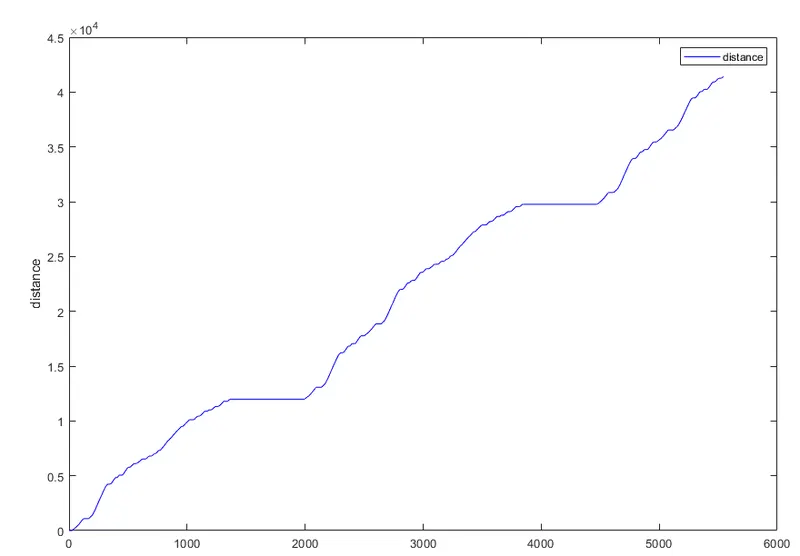
Maximum distance is 41.4km at the time of 5500sec.
2. ABOVE MODEL ADD THE ENERGY STORAGE
In this above model is used to the lithium ion battery. maximum volt is 24v and minimum volt 9v is to be changed and cell module is increase or decrease depends upon the battery current.
the cell module is 12
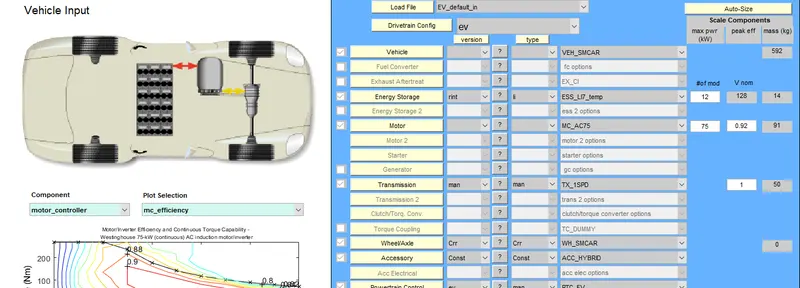
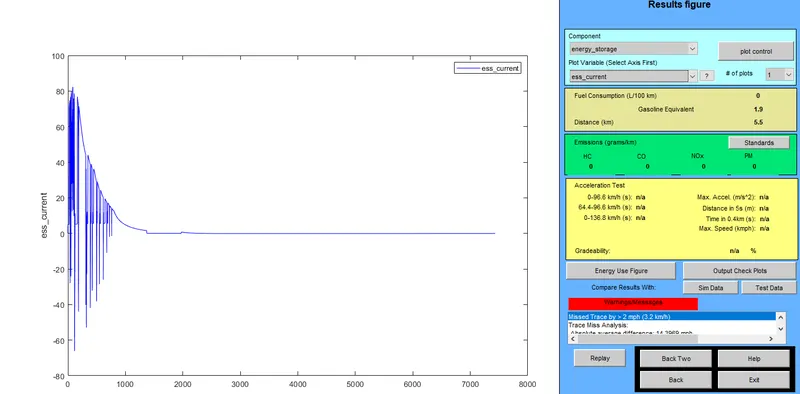
so output result is the battery current initial state is high. after the 5.5km travelled the battery current is 0.
Then change module is 36
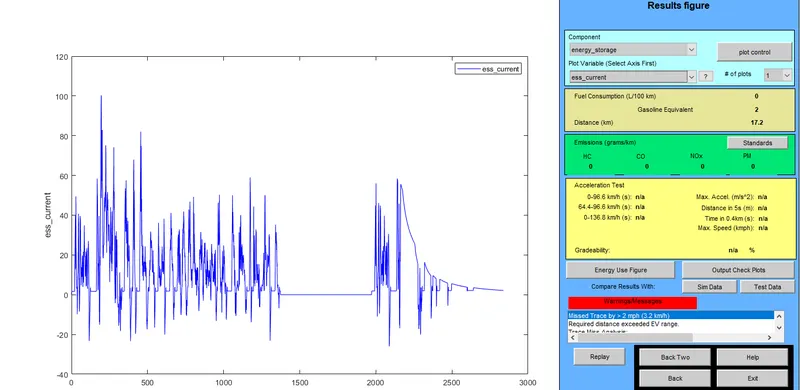
The Battery current is high 100a at the time of starting. the reached 17.2km the battery current is 0.
3. Perform gradeability test with PRIUS_Jpn_defaults_in
Block Diagram
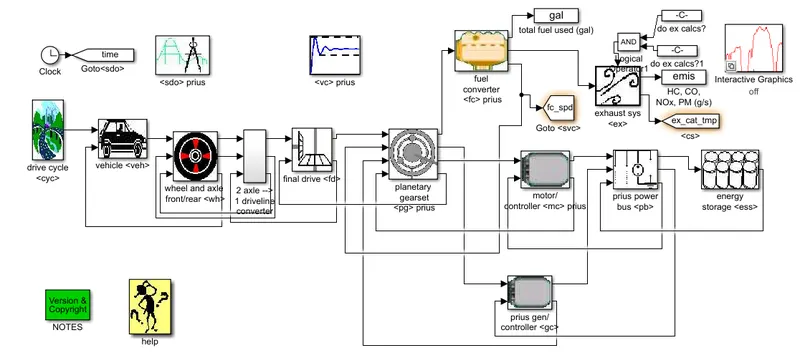
The Toyota Prius is packed with some pretty high-tech stuff, but at the heart of the Hybrid Synergy Drive (HSD) is a simple little device called the Power Split Device, or PSD. The PSD is a planetary gear set that removes the need for a traditional stepped gearbox and transmission components, and also the familiar rev-lurch-rev-lurch of acceleration in an ordinary gas powered car. It acts as a continuously variable transmission (CVT) but with a fixed gear ratio.
If you have no mathematical or mechanical understanding of hybrid technology or even regular engine components, this will help you get a feel for how the PSD allows the car to use power from an internal combustion engine (ICE), as well as 2 electric Motor/Generators (MG1 and MG2), all spinning at different and variable speeds. The PSD even allows the smaller of the two Motor/Generators, MG1, to act as a starter for the ICE, thereby eliminating another component of a traditional gasoline engine.
The model below allows you vary the speed of both the ICE, and MG2. MG2 is the larger of the 2 electric motor/generators and is also referred to as the traction motor because its speed (RPM, or revolutions per minute) has a fixed relationship to the speed of the wheels. Dragging the MG2 slider, you'll see that the speedometer changes, while changing the speed of the ICE does not directly affect speed. Once you master that concept you'll start to see how the CVT function works. The ICE can spin faster or slower, depending on how much power is needed, and with either resistance or assistance from the electric motors the car can reach the desired speed while always keeping the ICE running at the most efficient rate possible.
Rotation speeds of MG1, MG2, and ICE are inter-dependent, and the speed of MG1 will always change when you vary the speed of either of the other 2. MG1 has a maximum rate of 10,000rpm in either direction (positive or negative) with a software limit of 6500 RPM if ICE is off. Using the model below, you can see for yourself why this software limit means the ICE will always spin if you're travelling above 42mph. And in case you were curious, yes MG1 can and often does change spin directions under normal driving conditions.
ICE rotation is limited to speeds between 1000rpm and 4500rpm. It can also stop completely, but anything between 0 and 1000 will force the slider up or down. That's because the internal combustion engine can't operate effectively below that speed. The hybrid computer knows, and will stop the ICE when it decides you don't need to use any gas, and start it again when you need more power, or higher speed from MG1.
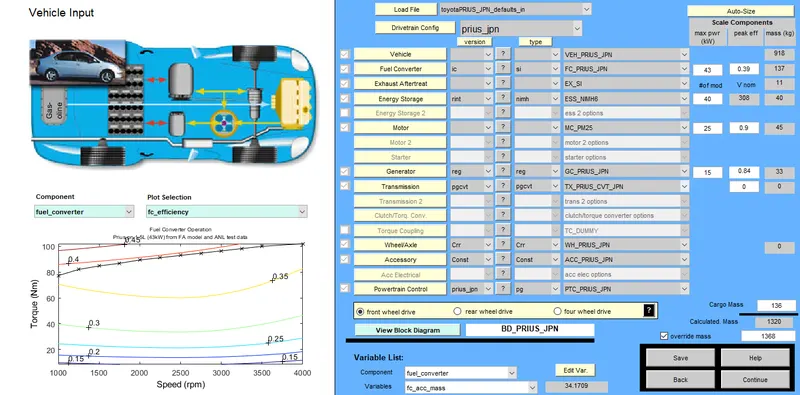
The TOYOTA PRIUS components are generator,motor,energy storage,fuel converter,exhaust and power train control.
the motor is MC_PM25 to be used. the vehicle over all mass 1320kg.
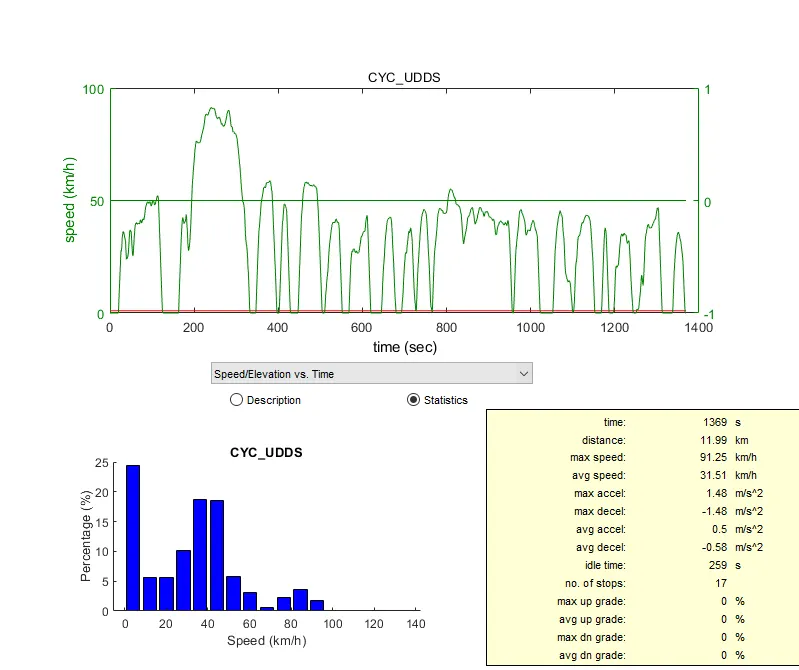
The maximum speed is the vehicle 91.25km/h at the 12km time is 1369sec with UDDS cycle.
Gradeability Test :
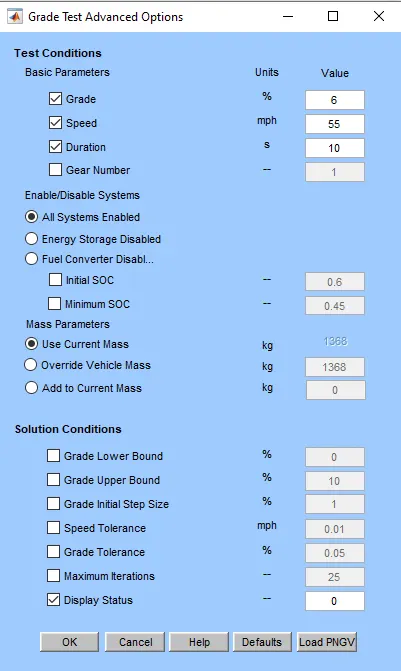
The all system are enabled. so the vehicle travelled distance changes then gradeability to changed. Maximum gradeability is 6%
OUTPUT RESULT:
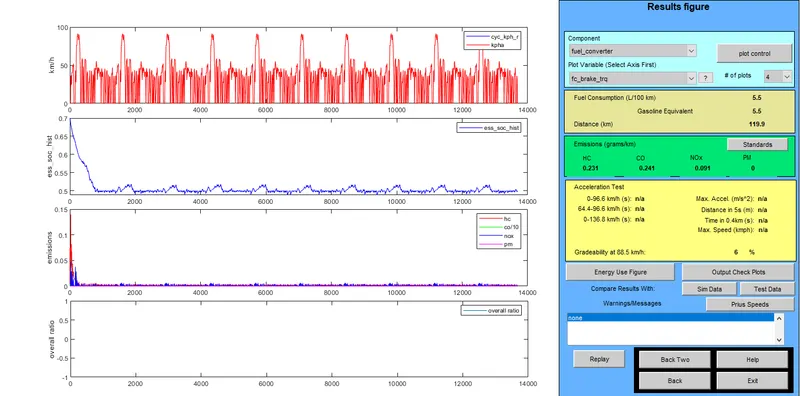
OUTPUT RESULT OF PRIUS SPEED :
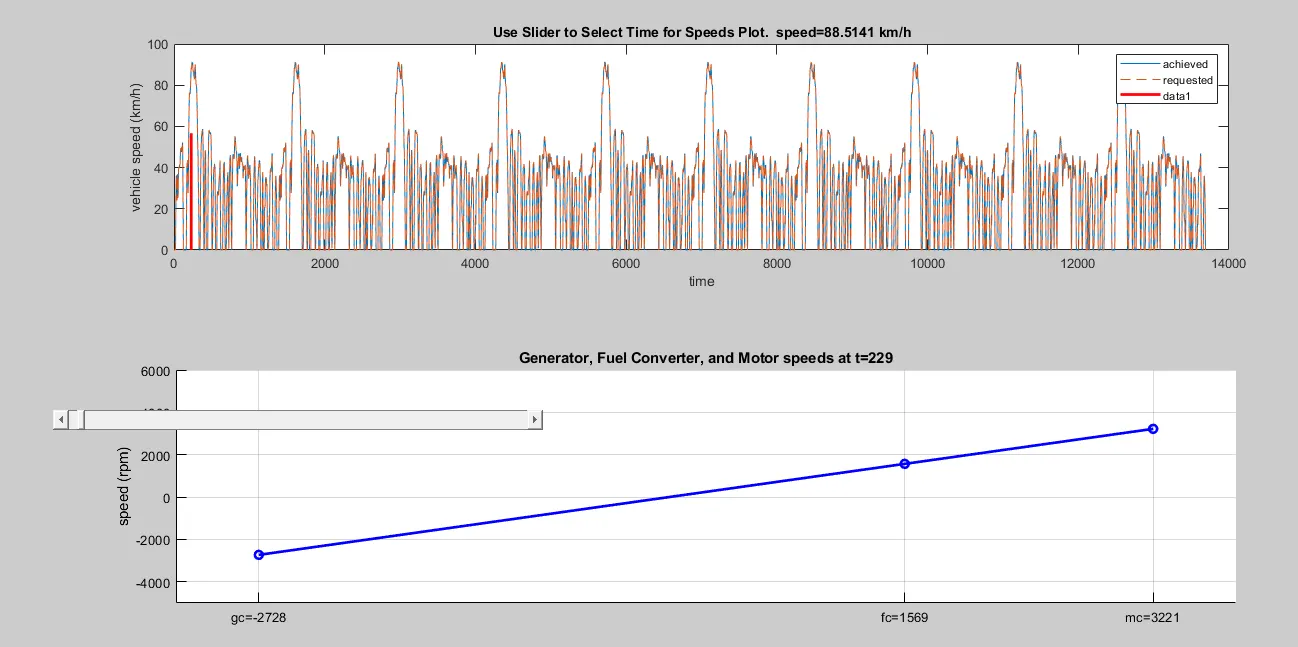
The slider gain used to the select the time then given speed. the 1st plot is vehicle speed(km/h) vs time and 2nd plot is speed(rpm) vs time.
the 2nd plot are gerator,fuel converter,and motor speeds included. the maximum speeds is the 88.5km/h. this is acheived for 229sec.the slider very useful to the given a time at the particular speed.
speed = 88.5 then gc = -2728, fc = 1569, mc = 3221.
OBSERVATIONS :
- The EV_DEFAULTS_IN FILE is distance travelled to 45km with FTP drive cycle and cargo mass and battery capacity are added.
- so, the vehicle is purely electric vehicle then efficiency of the system over all good.
- battery capacity changes due to desired the vehicle running capacity.
- They fore, EV_defaults is lithium ion battery can be used for long life purpose and system efficiency.
- The PRIUS_jpn file is the toyota vehicle.this is fuell converter, and energy storage device used for the vehicle.
- This vehicle run at the fuel converter and also battery.
- The regenrative braking used for the prius system this is the advantage of the system.
- This vehicle also run over rideing.
- this vehicle 120km distance travelled at 88.5km/h in 229 sec.