Week-3 Challenge: ADVISOR Tool
Problem Statement:
Use the ADVISOR tool and simulate the following
- For EV_defaults_in file, if cargo mass is 500 kg with all other default conditions, can the vehicle travel for 45 km with FTP drive cycle? Conclude your observations.
- In the above case, try changing the battery capacity and repeat the simulation.
- Perform gradeability test with PRIUS_Jpn_defaults_in file. Compare your results in table and conclude.
Theory:
The ADVISOR is an ADvanced VehIcle SimulatOR tool, a simulation package in MATLAB. It was developed at National Renewable Energy Laboratory to assist the Department of Energy of USA in developing technologies of the electric vehicle. It is a set of script files and models. It is used for quick analysis of vehicle performance and fuel economy of various kids of vehicles of conventional and electric kind. The tool is highly customisable and flexible; a user can select the vehicle powertrain components easily from the available files. It is used with macro statistics as input and has a backward approach in which the drive conditions are defined first and then vehicle parameters are defined. Hence it takes the drive cycle as input and simulates the vehicle condition based on that defined usage of the vehicle. The vehicle parameters such as the battery state of charge, emissions, fuel consumption, the output power of the motor or engine and so on are obtained as output. The drive cycle can be extended to include multiple cycles and a combination of various cycles as well as the Gradeability can be altered in order to best define the real-life drive conditions. The speed, time and Gradeability data are takes as input and simulation are run.
ADVISOR tool is highly beneficial to estimate the vehicle output during the design stage of the vehicle without the need for the existence of the prototype. Hence it saves the humongous expense of developing the physical vehicle, testing and then altering the powertrain architecture with the obtained performance results as a reference. The following results can be obtained using ADVISOR:
- The fuel economy of the vehicle even before the vehicle prototype is developed.
- The energy consumption during the defined drive cycle by the vehicle powertrain.
- The comparison of tailpipe emissions of different versions of fuel converter.
- Evaluation of the control strategy to optimally use the IC engine and electrical machine to meet the power and energy demands of the vehicle.
- Optimization of the gear ratio for better power output and minimum fuel consumption.
- The peak power output of the prime mover.
- The fluctuation of the efficiency of the prime mover
- The fluctuation of the state of charge of the battery
Highlighting the features of ADVISOR:
- The ADVISOR tool models are empirical in nature as the drivetrain components input-output relations are developed based on the experiments in the laboratory. This tool is quasi-static in nature and considers the data in the steady-state condition of the vehicle (such as constant torque and speed) and corrects the data to include transient effects such as the rotating inertia effects of drivetrain components.
- It has three power source models: internal combustion engine, fuel cell and energy storage system.
- It has three primary GUI screens as follows:
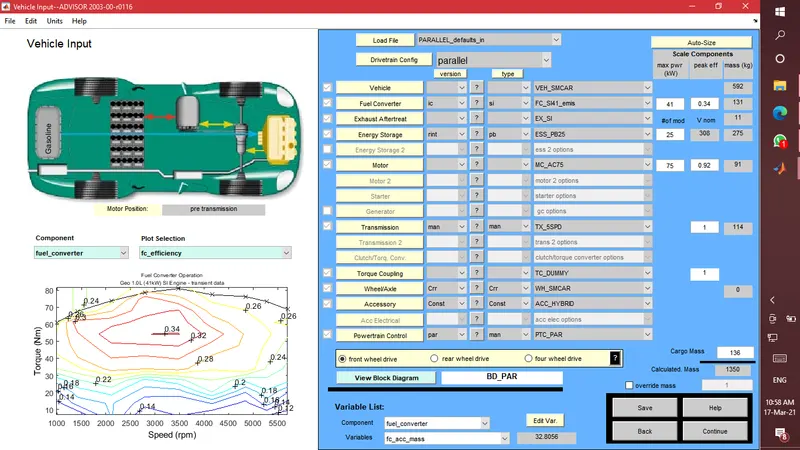
- Vehicle Input Window: Various vehicle builds are available as built-in files. When these files are loaded, the vehicle driveline configuration is displayed on the top left corner of the screen, the vehicle data is displayed on the right part of the screen and the prime mover characteristic diagram is displayed at the bottom left corner of the screen. As shown in the figure below.
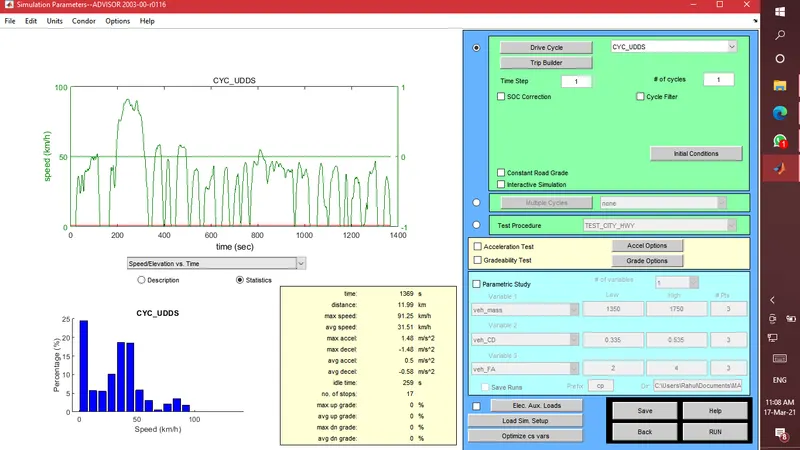
- Simulation Parameters Window: In this window, the drive cycle is defined, that is the speed of vehicle at different instances of time for a particular period with or without Gradeability of the road. The drive cycle is displayed on the top left of the screen. In the right panel, drive cycle can be built from the available standard versions or using the trip builder function. Acceleration and Gradebility test conditions can be set and parametric study can be done by varying the vehicle parameters in step.
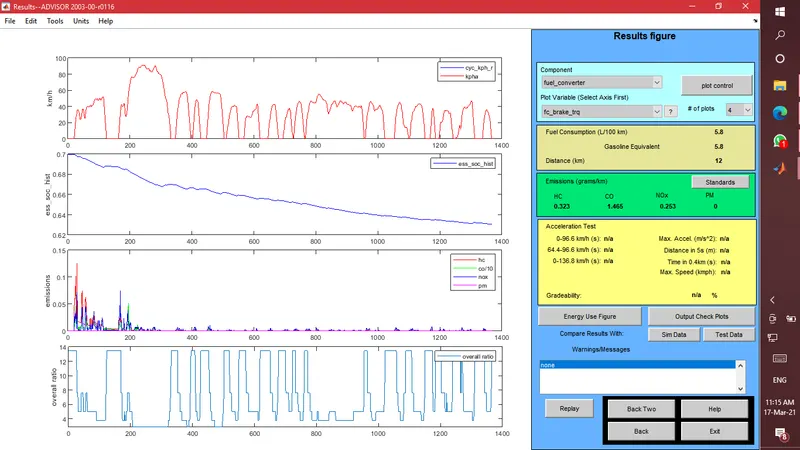
- Results Window: In this window, the vehicle performance review can be done. This review can be throughout the drive cycle or at an instantaneous point in the drive cycle. The left portion showcases the time-dependent variation of vehicle output plots and the right portion provides the summary of the overall performance of car, such as fuel economy and emissions.
- ADVISOR is a combination of backward and forward-facing approach. However, it is mostly backwards-facing analysis tool. It assumes that the vehicle has satisfied the drive cycle demands and then provided the performance requirements of the drivetrain as output. Driver behaviour is not simulated whereas the force required to accelerate the vehicle through the time step is calculated from the speed-time curve. And then the force is converted to the required torque to be delivered by the component and the linear speed of car is converted into the rotational speed required. For this combination of analysis to work best, ADVISOR makes two assumptions that
- The components work with the same efficiency regardless of the direction of the approach.
- The components downstream require less torque and power than those upstream.
- It is well suited to verify and design the control logic such as if the battery SOC is low, so the voltage and power output is low to the motor, hence turn on the engine.
The tool also has limitations and cannot be completely relied on for detailed design of the vehicle since it was originally developed as an analysis tool.
The following are the disadvantages of the tool
- As the models in the tool are quasi-static, the transients cannot be taken into account such as the physical vibrations, electric field oscillations. It cannot be used to estimate the processes with a time scale of less than a tenth second.
- It is a backward-facing vehicle simulator since it takes the required speed as input and moves through the drivetrain from the wheels to the axle to the differential to the gearbox and so on to the fuel storage. Hence it has a fixed approach and cannot change the direction of flow. Hence it is not suited for the vehicle control system design which requires a forward-facing simulator.
Simulation 1:
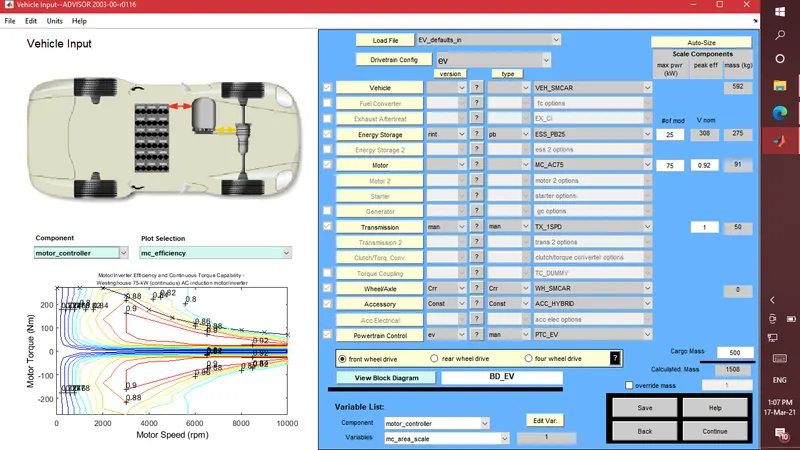
- EV_defaults_in file is loaded
- The default drivetrain configuration is ev; It is self-evident from the drivetrain schematic displayed on the left side. The vehicle only consists of battery and motor as power source and prime mover respectively. So it is a Battery Electric Vehicle. During drive mode, the energy from the battery is supplied to motor and then the kinetic energy of motor is given to final drive. During regeneration mode, the kinetic energy of the wheels is absorbed by the motor working as a generator, and then the produced electricity is fed back to the battery.
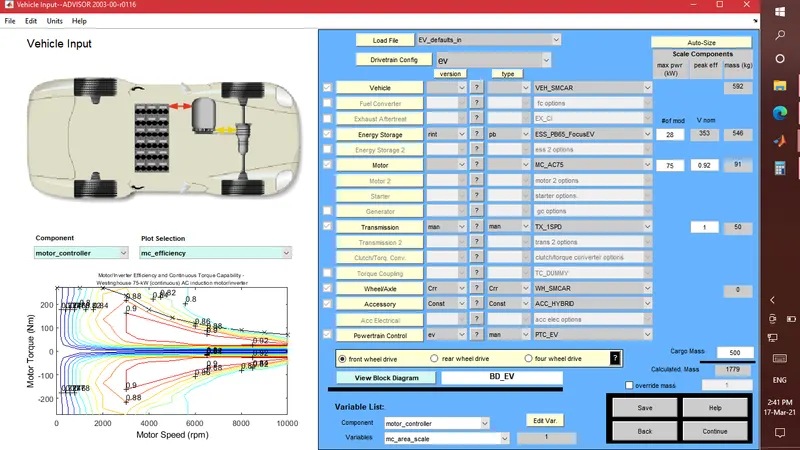
- The Energy Storage System is Rint (Internal Resistance) and battery type is pb (Lead acid battery). The battery pack contains 25 modules with nominal voltage of 308V and weight 275 kg
- The motor is Westinghouse 75 kW AC Induction motor of peak efficiency 92% and weight 91 kg
- Transmission is single-speed gearbox of 50 kg mass
- It is front-wheel driven with a cargo mass of 500 kg and Total vehicle weight of 1508 kg.
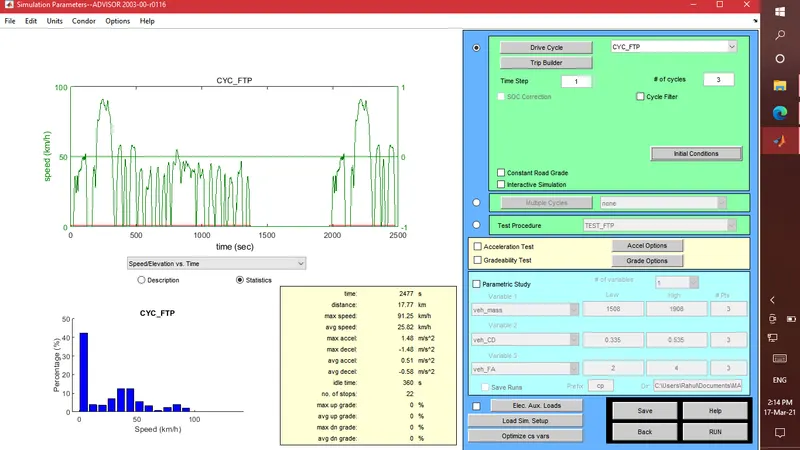
- FTP (Federal Test Procedure) drive cycle is selected which runs for time period of 2477 seconds with 91.25 km/h as max speed. The total idle time is 360 seconds which constitutes for about 40% of drive cycle time. The grade is 0%.
- The FTP drive cycle covers a distance of 17.77 km. As we want to evaluate if the vehicle can run for for 45 km, the vehicle needs to be simulated to run for at least 45 km. Hence number of drive cycles is set to 3, with total distance of 53.31 km.
- All other condition is set to default.
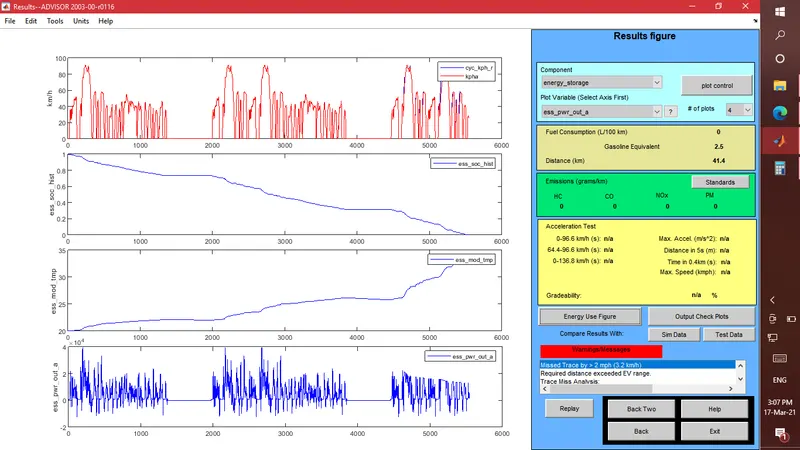
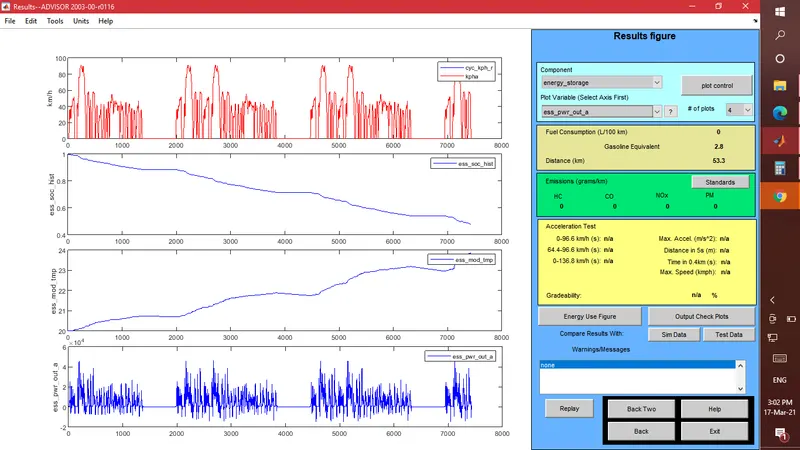
- From the results window below, it can be observed that the vehicle was able to cover a distance of 41.4 km by consuming all the charge of the battery. In the real life scenario, the battery will no be allowed to drop to 0% SOC. Battery has to maintain a minimum depth of discharge of 10-15% due to which the actual distance covered by the EV is well below 41.4 km.
- In the results plot, it can be seen that, when the EV accelerates to max speed, the batter power output is 4 kW generally. But after SOC falls below 40%, battery could only provide max power of 2 kW at peak acceleration. This shows that battery capacity is inadequate.
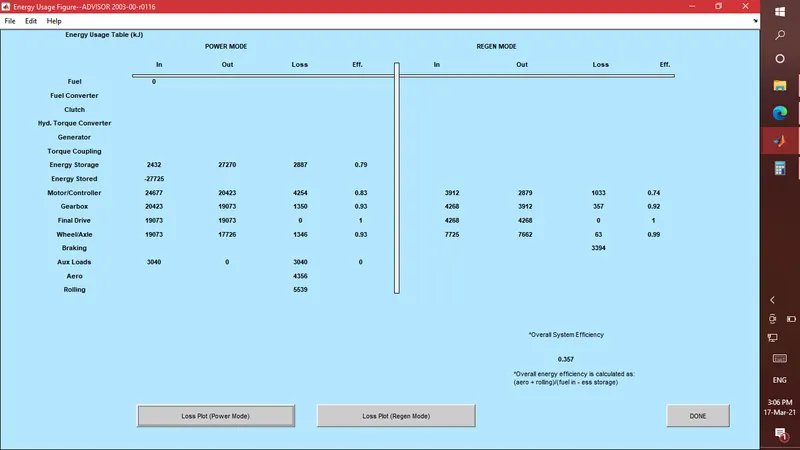
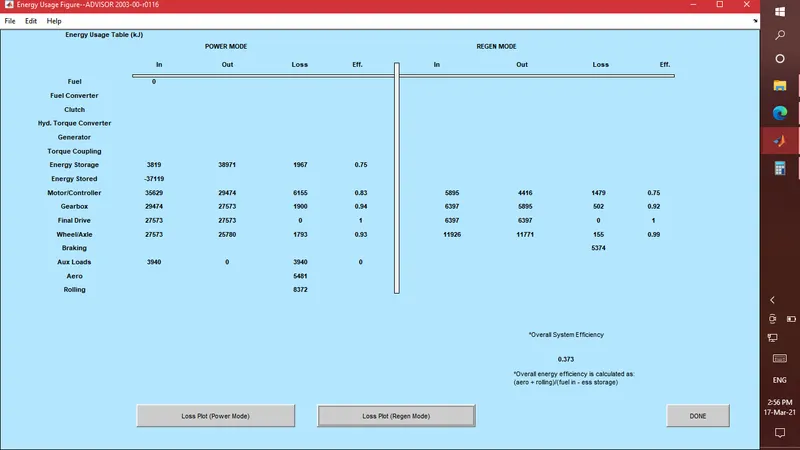
- From the energy usage table, battery energy loss is 2887 kJ, which is undesirable. Hence needs to be optimised. This battery pack: ESS_PB25 stores 27725 kJ of energy which is equivalent to 7.7 kWh. Battery capacity greater than 7.7 kWh is needed to travel 45km.
- It can be concluded that the battery size is not sufficient for this EV to travel for 45 km.
Simulation 2:
- The battery capacity is increased. Now it includes 3 extra modules of lead-acid battery, summing to 28 modules. The nominal voltage of battery has increased to 353 V and battery pack weight has increased to 548 kg. This increases the total weight of EV to 1779 kg, that is 271 kgs increment.
- The total distance covered by the EV is 53.3 km and the final SOC is at 50% at the end of the drive cycles.
- From the energy table, the battery pack capacity is 37119 kJ, that is equivalent to 10.3 kWh .
- Hence the battery capacity is adequate to cover a distance of 45 km while maintaining the depth of discharge requirement.
Simulation 3:
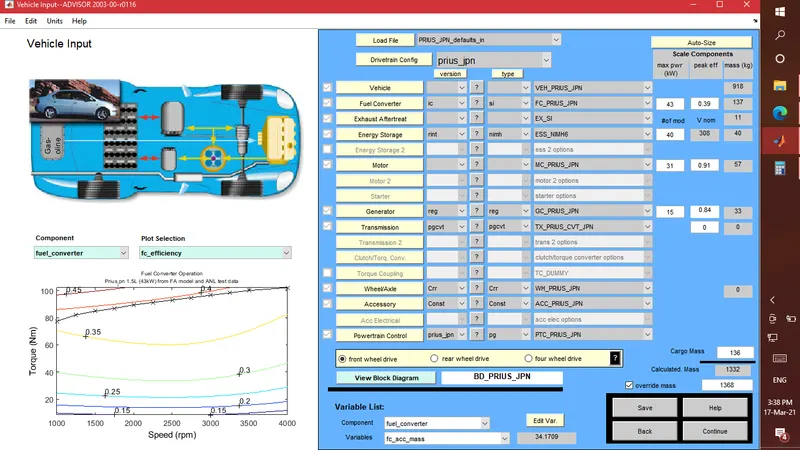
- Prius Japan model is loaded and the drivetrain configuration is set to default. The drivetrain schematic is showcased to the left from which it is evident that it is a series-parallel combination due to the presence of power split device. Gasoline tank supplies the fuel to the engine. The engine power goes through the power split device. The power split device decides if the engine power is required for traction or the power is fed to the generator which produces electricity and feeds it to the battery. The vehicle consists of a high power motor that drives the wheels during drive mode and works as a generator during regeneration mode.
- By default, the battery is made of Nickel-Metal Hydride. The pack consists of 40 modules of 308 nominal voltage.
- The motor generates the power of 31 kW and the engine develops a max power of 43 kW. The total vehicle weight is 1368 kW.
- The drive cycle selected is Urban drive system.
- The Gradeability test is selected.
- The maximum speed of the vehicle is set to 20 mph and the duration is 20s
- All systems are enabled. In this mode, the engine, as well as the motor, provide the torque to the wheels.
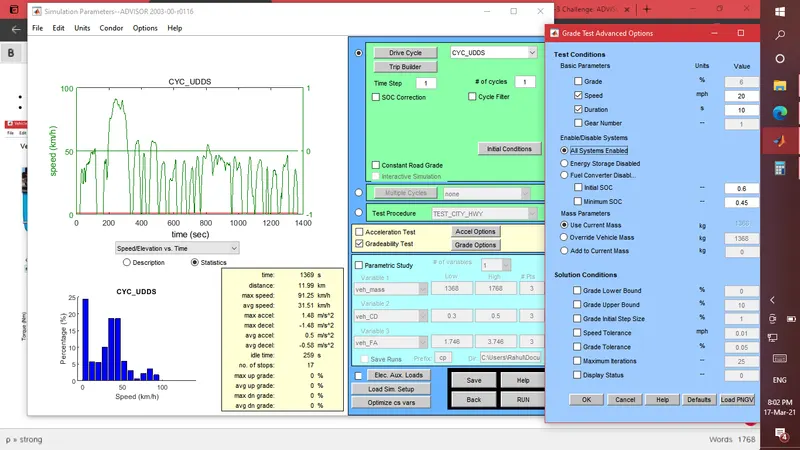
- At the given speed and duration, the maximum gradeability of the vehicle is 19.8% which is eqivalent to 11.2 degrees.
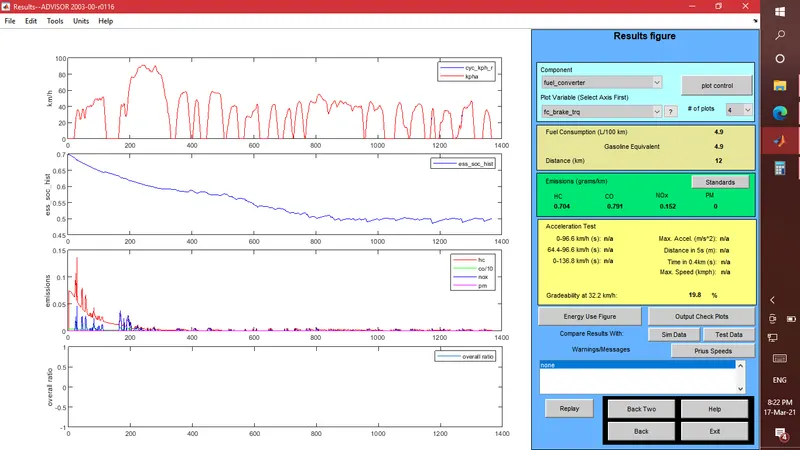
Similarly, Gradeability is obtained for different values of speed and duration of 10s as follows:
| Sl.No | Speed (mph) | Gradeability (%) | Slope angle (degrees) |
| 1 | 20 | 19.8 | 11.2 |
| 2 | 25 | 16.5 | 9.3 |
| 3 | 30 | 14.7 | 8.3 |
| 4 | 35 | 13 | 7.4 |
| 5 | 40 | 11.7 | 6.6 |
| 6 | 45 | 10.7 | 6.1 |
| 7 | 50 | 9.7 | 5.5 |
| 8 | 55 | 8.9 | 5 |
It is observed that as the speed of the vehicle increases on the grade, the Gradeability of the vehicle decreases.
Reference: