Week-3 Challenge: ADVISOR Tool
ADVISOR TOOL
Aim:
- To find weather the file EV_defaults_in files with 500kg cargo weight and FTP drive cycle can travel a distance of 45km range and conclude the observation.
- To repeat the simulation by using the above setup by changing the battery capacity.
- To perform gradeability test with PIRUS_jpn_defaults_in files and conclude the details.
ADVISOR Tool:
ADVISOR, NREL's Advanced Vehicle Simulator, was first developed & designed as an analysis tool to assist the U.S. Department of Energy (DOE) in November 1994. It was designed to analyze vehicle powertrains, focusing on power flows among the components. When it is used to follow a driving cycle, such as the Federal Urban Driving Schedule, its main outputs are fuel use and tailpipe emissions. It can also be used to simulate the vehicle in a maximum effort acceleration, where outputs are 0-60 mph time or 40-60 mph time.
the new ADVISOR 2.0 is theGUI, which was written by NREL in the latest MATLAB® /Simulink® environment. ADVISOR provides straightforward access to many powerful analysis functions through its easy-to-use GUI. The following descriptions of the three main GUI pages explain the wide array of features that are available for configuring a vehicle, conducting a simulation, and analyzing the results.
1: EV_default_in with 500kg cargo weight using FTP drive cycle:
the file setup EV_default_in is an pure electric model which runs with 25 mods of battery cells of 308V. the initial mass of the vehicle is 1308kg. by default it is having MC_AC75 motor which is having the motor efficiency of 92%
- for this model and additional total cargo mass of 500kg is added and the drive cycle of the model is changed to FTP_drive cycle. the figure below is the EV_default_in with its predefined values.
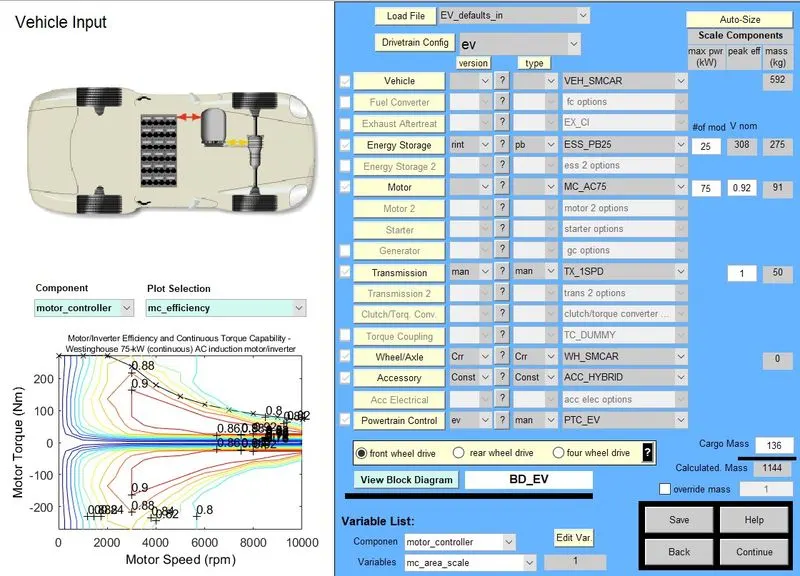
fig(1):default window of EV_defaults_in with its predefined values
- Now the total cargo mass of 500kg is arranged for the model.
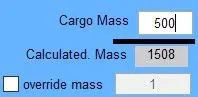
fig(2): Cargo mass is added in this block.
- The drive cycle data which is predefined (CYC_UDDS) is being changed to FTP drive cycle using the drive cycle tab.
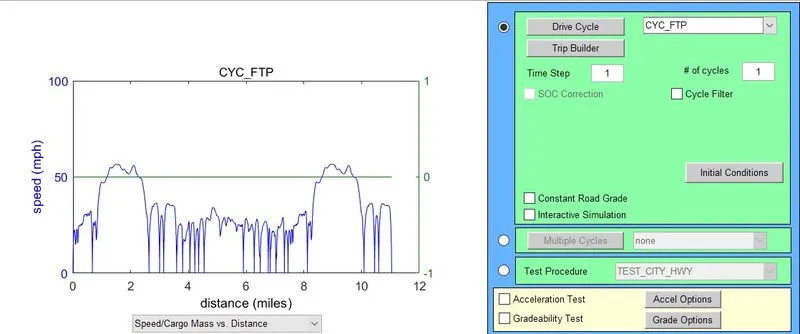
fig(3): FTP drive cycle with 1 cycle.
- Now, by mainatining other parameters as default. the model is simulated and the range is calculated. the approximate range of the above model is observed to be 17.8km with 60% state of charge.
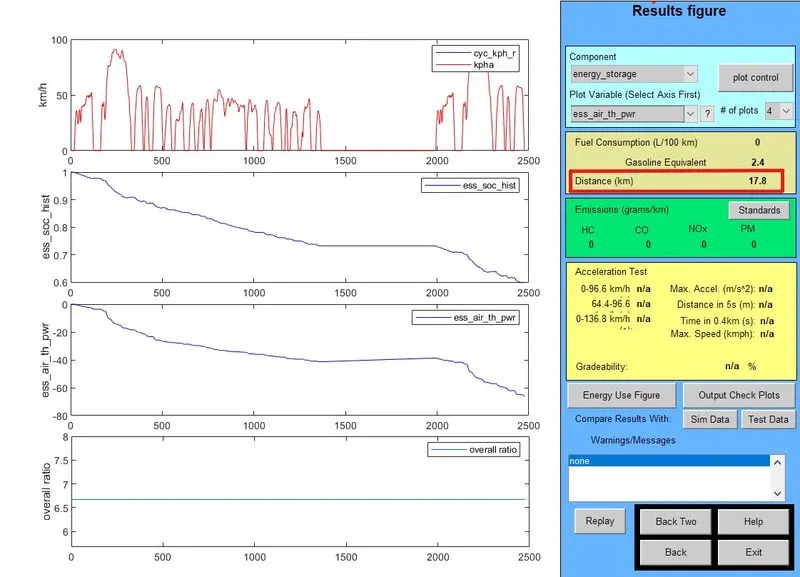
fig(4): distance range of vehicle with soc.
- By increasing the no. of drive cycles till the soc is reduced we can check the total range. therefore the range of the vehicle with the given specifications is obtained to be 41.4km with state of charge 0 for three FTP drive cycles.
Therefore, For EV_defaults_in file with cargo mass is 500 kg with all other default conditions cannot travel for 45 km with FTP drive cycle.
2: By changing the battery capacity of the vehicle in the above case and repeating the simulation:
With the above set of parameters and setup, the battery capacity has been changed from 25mods to 100 mods of 1233V and the total mass is observed to be 2333kg.

fig(2.1): Change in capacity of the battery.
For one single FTP drive cycle, the disance covered is 17.8km with SOC of 87% and for 3 drive cycle the SOC is around 66% and for complete concumption of battery the vehicle is able to travle around 136.2km of range for 8 FTP drive cycles.
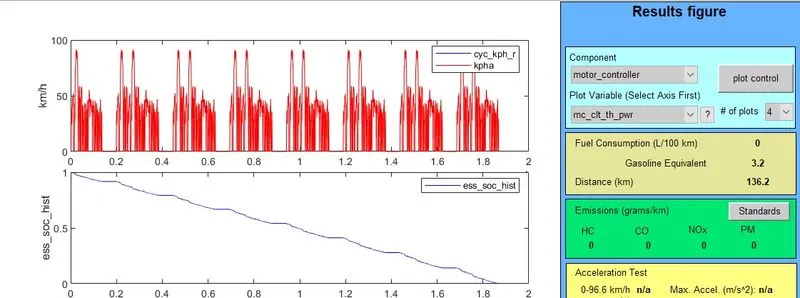
fig(2.2): distance range for 8 FTP drive cycles.
3:Performing gradeability test with PRIUS_Jpn_defaults_in file:
The PIRUS_Jpn_defaults_in file setup contains the Toyota Pirus model. this is a hybrid vehicle works both on gasoline and electric battries. the main speciality of this model is its gear system. it has a planetary gear set. This gear set consists of total three type of gears,
- The sungear that sists in the center(Central gear).
- Planet gears.
- The ring gear(Outer gear).
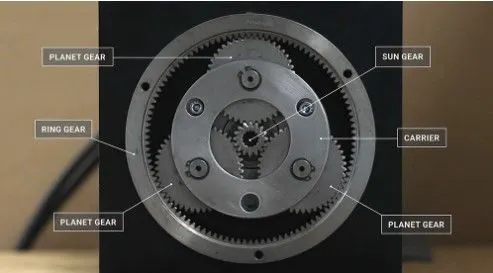
Fig(3.1): planetary gearset.
Operation: The load from the sun gear is distributed to several planetary gears which can either be used to drive an outer ring or a shaft or spindle. The central sun gear takes a high-speed, low-torque input. It drives several rotating external gears which increases the torque.
The simple design is a highly efficient and effective way of transferring power from a motor to an output. Approximately 97% of the energy input is delivered as an output.
the follwing picture shows the simulink blocksets for a planetary gearset in Pirus model.
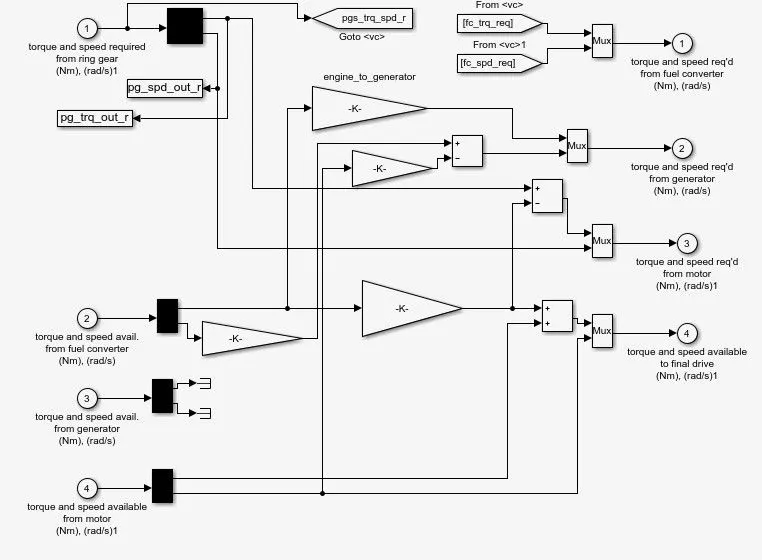
To perform the gradeability test in this model the model is selected and in the next step, On the middle of right side of the the window there is an option for Greadablity test. by turning on this we can arrange the settings using grade options.
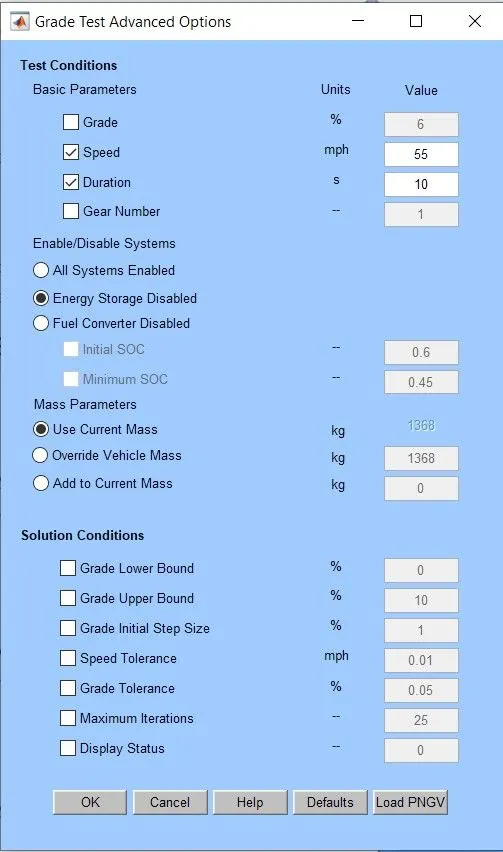
Fig(3.3): grade options.
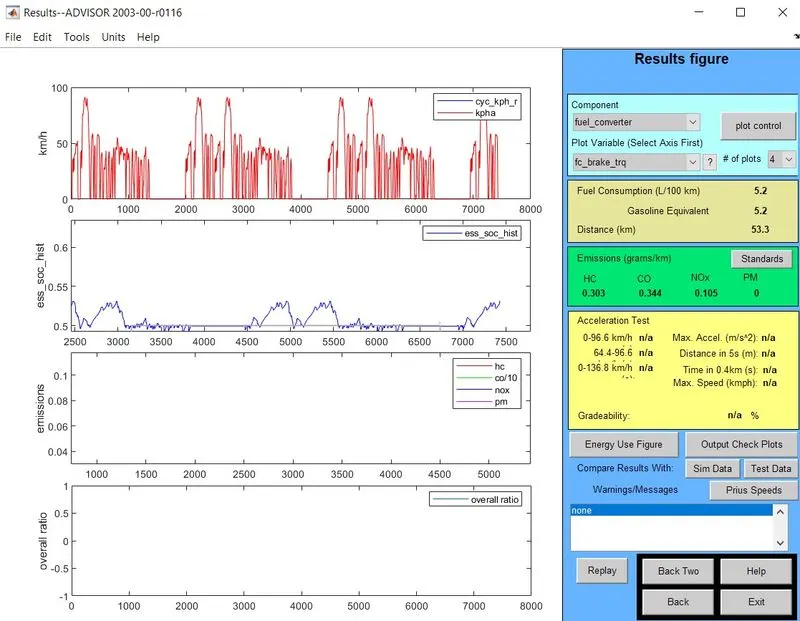
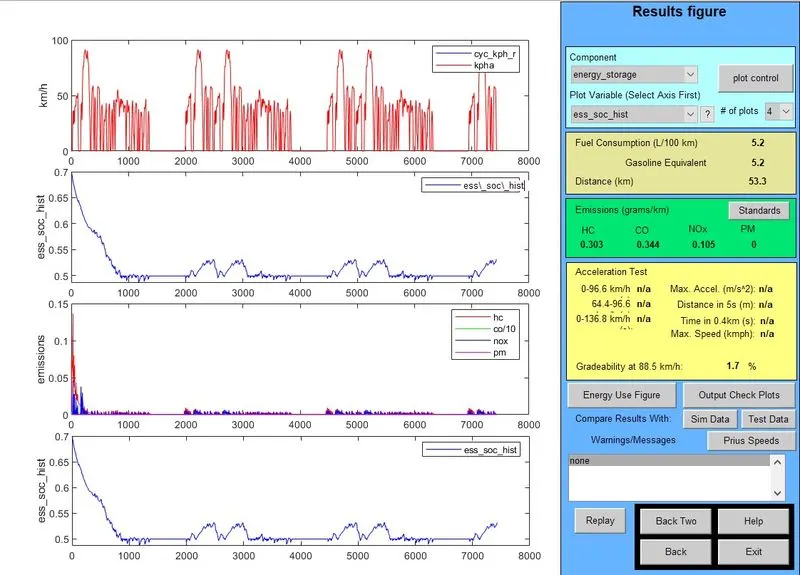
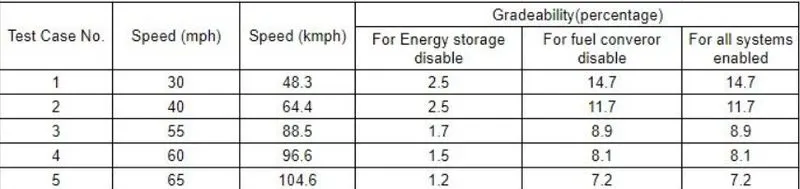
these options can be altered as per the requirement, the following figures show us performance of the vehicle with and without the gradedability test. as this model is hybrid, the all system enabled option is to be choosen.
Observation:
1: As the weight increases the performance of the vehicle decreases.
2: As the battery capacity increases. the vehicle can run for more distance but the load and power consumption by accessories alter the range of the vehicle.
3: the greadabilty test with different speeds with all 3 options in grade options is performed.