Week 3 - Adiabatic Flame Temperature calculation
AIM:
1. To study the effect of equivalence ratio with the Adiabatic Flame Temperature in constant volume chamber. Fuel used is Methane (CH4). Compare the results obtained with the ones obtained using the cantera approach.
2. Calculating AFT of CH4 with heat loss of 0.35 in constant prsessure chamber.
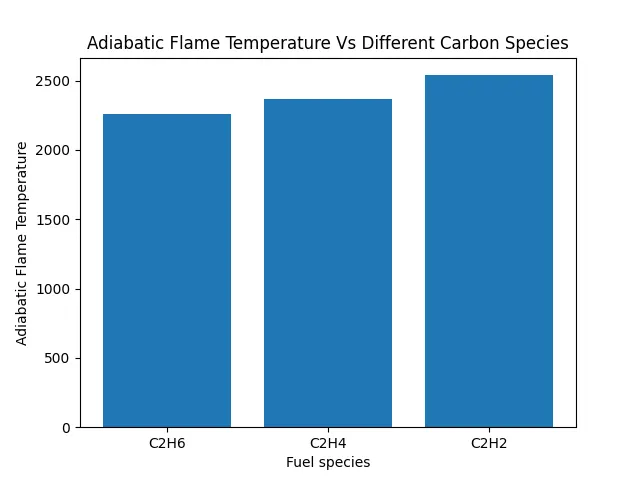
3. Plotting the effect of the number of carbon atoms on the final temperature for which the heat loss is to be considered as 0.
4. Studying, for a general alkane, the effect of the number of carbon atoms(from 1 to 3) on final temperature; assuming no heat loss.
Theory:
Adiabatic Flame Temperature (AFT):
- The temperature that the combustion products theoretically reach if no energy is lost to the outside environment.
- The temperature that results from the complete combustion process that occurs without any work, heat transfer or changes in kinetic energy.
- For an assumed temperature, if Enthalpy of products id equal to the Enthalpy of reactants, then this temperature is called as the Adiabatic Flame Temperature.
- There are 2 kinds of Adiabatic Flame Temperature: a) Constant Pressure Combustion b) Constant Volume Combustion
Equivalence Ratio (`phi`):
- The ratio between fuel to air mixture for the given fuel to its Fuel to air ratio at stoichiometric composition.
- If `phi`< 1, the mixture is considered as lean mixture. This means that the quantity of air as compared to the fuel in the actual mixture is more. These mixtures tend to produce extra by-products like O2`
- Similarly, if `phi` > 1, the mixture is said to be rich mixture. This means that the quantity of fuel as compared to the air in the actual mixture is more. These mixtures tend to produce extra by-products like CO.
- And finally, if Equivalence Ratio (`phi`) = 1, it is a stoichiometric mixture.
Generalized Format for Methane combustion with varied fuel-air ratio is given below,
For hydrocarbons, the generalized format for combustion reaction when `phi` = 1 is as follows,
CxHy + [x+(y/4)][O2 + 3.76N2] = xCO2 + (y/4)H2O + 3.76[x+(y/4)]N2
Similarly, for methane as the fuel, the generalized format for Rich and Lean mixtures is given by,
For Rich Mixtures,
CH4 + (2/`phi`)(O2 + 3.76N2) = [(4/`phi`)-3]CO2 + 2H2O + [4-(4/`phi`)]CO + (7.52/`phi`)N2
And for Lean Mixtures,
CH4 + (2/`phi`)[O2 + 3.76N2] = CO2 + 2H2O +[(2/`phi`)-2]O2 + (7.52/`phi`)N2
Lower Heating Value (LHV):
- It is also known as net calorific value. LHV of a fuel is defined as total energy released when a substance undergoes complete combustion in the presence of oxygen and under STP conditions.
- Here, we use this to formulate heat loss from the combustion of CH4 in Constant Pressure Chamber
Heat Loss (H_loss):
- In practical cases, during combustion, not all the heat produced is utilized. Some of the heat is lost in the form of heat loss.
- This heat loss affects the performance of the overall system in the form of efficiency.
- Heat loss is calculated as follows,
stoichiometric reaction is given by,
CH4 + 2[O2 + 3.76N2] = CO2 + 2H2O + 7.52N2
Here,
H.V = H(CH4)+2H(O2)-H(CO2)-2H(H2O)
Above, the reactants are at STP conditions. Also, since the enthalpy of N2 gets cancelled, it is not mentioned. We can also formulate it as,
H.V. = x * LHV
where, x => Heat loss Factor
and LHV => Lower Heating Value.
In case of constant volume chamber, internal energy equilization method is applied. In this, the internal energies of the products and reactants are equal.
The result for effect of equivalence ratio on the AFT of methane (CH4) is shown in the diagram below:
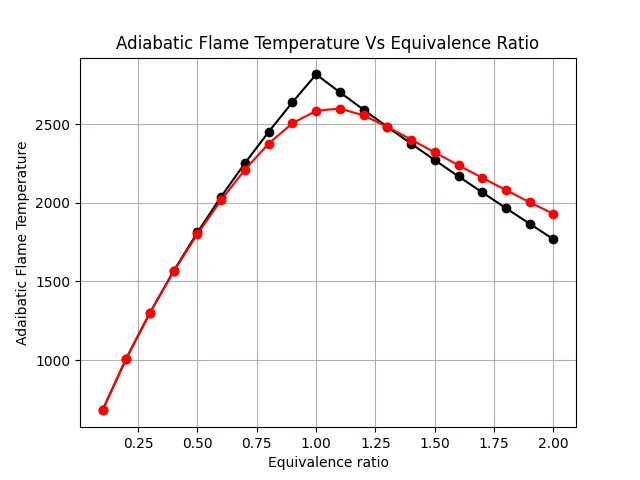
CONCLUSION: From this we can confirm that the results obtained using cantera module are more accurate when compared to the results obtained without using cantera.
The link for the code for effect of Equivalence Ratio on the Adiabatic Flame Temperature in a constant volume chamber is given below:
https://drive.google.com/file/d/1vMnDmaXDrvPp-vATVcn7HYNkCiA39vCS/view?usp=sharing
The result for calculation of AFT for CH4 with heat loss of 0.35 in constant prsessure chamber is provided below:
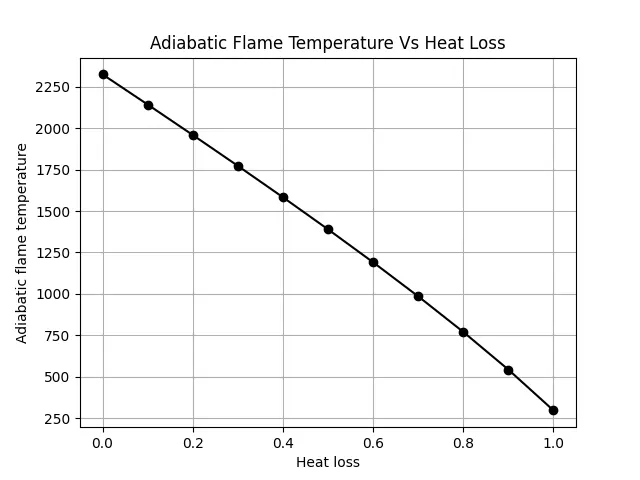
CONCLUSION: From the above graph, it is visible that, with increase in heat loss from the system, final temperature obtained goes on decreasing. Also it is common knowlegde that in order to be as efficient as possible, the system should have minimum losses.
The link for the code for above problem is provided below:
https://drive.google.com/file/d/1RYIzdD0q75-fxetUTF5oyKq4d7FhOrOA/view?usp=sharing
The result of the effect of the number of carbon atoms on the final temperature for which the heat loss is to be considered zero is shown below in a graphical representation:
The link for the code for the above problem is provided below:
https://drive.google.com/file/d/1yu9BhRn5XGyU2dbBCcLsaOsRcKWNn5Cl/view?usp=sharing
The result for the effect of the number of carbon atoms(from 1 to 3) on final temperature; assuming no heat loss is shown below:
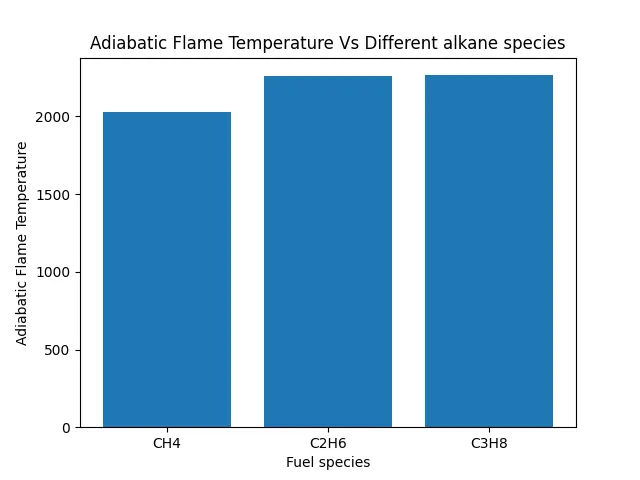
CONCLUSION: From the above obtained result, we can conclude that with increase in number of carbon atoms in an alkane higher is the AFT.
The link for the code for the above problem statement is provided below:
https://drive.google.com/file/d/18nEiyM5pnAMPBypQm3oj8JxF5AomMeF8/view?usp=sharing