Week 5.2 - Literature review: ODE Stability
AIM:
To write a literature review on ODE Stability and answer the given important question concerning ODE stability.
THEORY:
As disucssed in the video lecture, the two ways to numerically solve an ODE system: Explicit and Implicits Integration scheme (also called Backward Difference Scheme). These methods are approaches used in numerical analysis for obtaining approximations to the solutions pf time-dependent ordinary or partial differential equations, as is required in computer simulations and physical processes. In an Explicit Scheme, a direct computation of the dependent variables are made in terms of the known values. But in case of Implicit Euler integration (Implicit Scheme)/ Backward Difference scheme, a dependent variable is defined by coupled set of equations, and for this an iterative technique is used to obtain the solution.
At times the implicit codes may seem lenghtier and time consuming, but this scheme when compared to explicit scheme, is more probably preferred as in case of explicit scheme, if the value for time-step (incremental change in time for which the governing equations are being solved) is wrongly selected, the system may become and blow up. To avoid such blow ups, backward difference scheme as its results are stable and more accurate.
Now in this assignment, we are supposed to explain:
- When does an ODE system become unstable?
- How stability affects the engineering simulations?
- And whether stability conditions be derived, for all types of problems?
These questions are answers below with necessary results and graphs.
RESULTS:
ODE systems tend to become unstable when Explicit Integration Scheme is employed and time-step taken is not suitable (larger time steps are not suitable for this integration scheme). This is more aptly shown by the results of the python code whose link is provided below.
https://drive.google.com/file/d/1YJjlbDlv62IuwUfKNYV1vIJFKUU_Mrma/view?usp=sharing
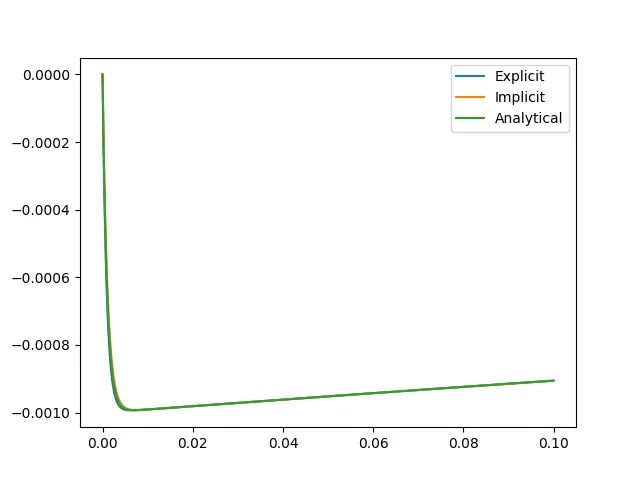
When dt = 1.9e-4
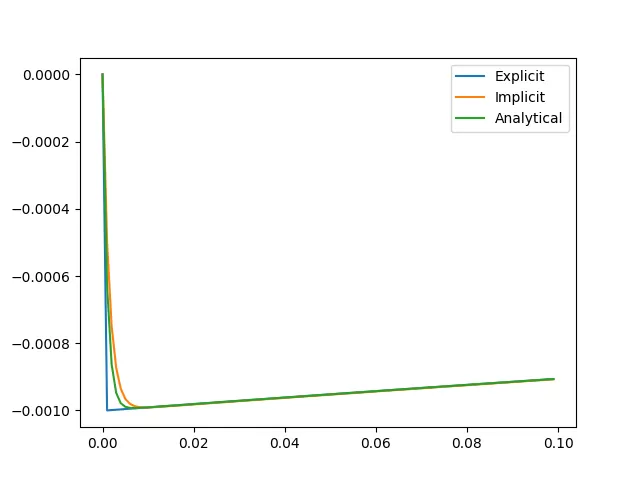
when dt = 10e-4,
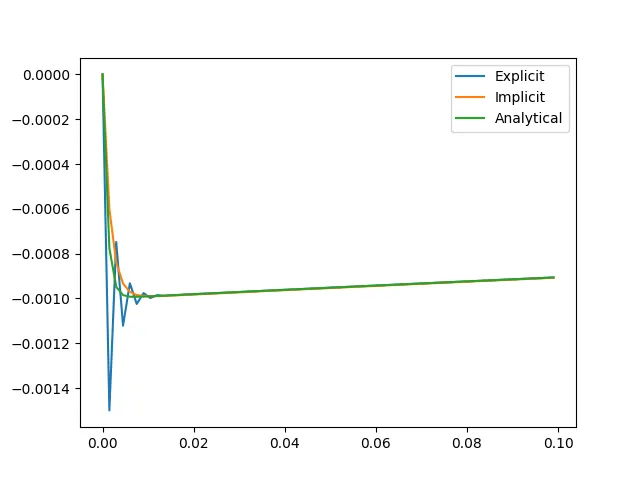
when dt=15e-4,
and when dt=19e-4,
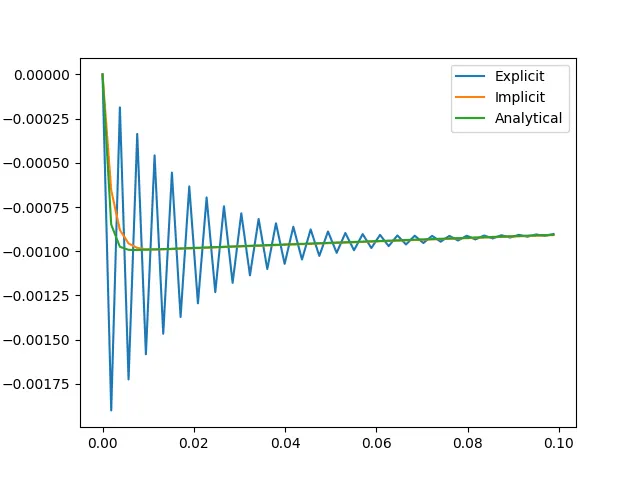
As we can see from the above python results that, as the time step (dt) increases, the solution for Explicit Integration Scheme keeps getting more and more unstable. After a certain value, the system explodes. Thus, the considered ODE system becomes unstable in case of Explicit Integration Scheme for higher values of the time step.
- Now, for the effect of stability on engineering simulations, it is essential that the scheme we choose, should yield stable results unconditionally. Since we cannot always compute analytical solution for an ODE system, we can either choose between Implicit and Explicit Euler Integration Scheme. As it has been established above that, only implicit scheme stays unconditionally stable, it is preferred over explicit scheme. Now, if in an engineering simulation, an unstable result is derived, it either become impossible to make sense of the results or it the results obtained may lead to an flawed understanding or prediction of problem at hand. This may cost us in multiple ways: time, effort, resources and most importantly money.
- And in as for the case of applicability of stability conditions on the types of problems, it can be said that it is possible in a general sense.But it also depends on the ODE system under consideration. So far in the assignment, we have been studying the effects and results of a single order ODE system. For higher order ODE systems, the stability conditions may vary and the computations may become more complex. Long answer short, YES, stability conditions may be derived for any type of problems.