Week 4.2 - Combustion Efficiency Calculation after Preheating
AIM:
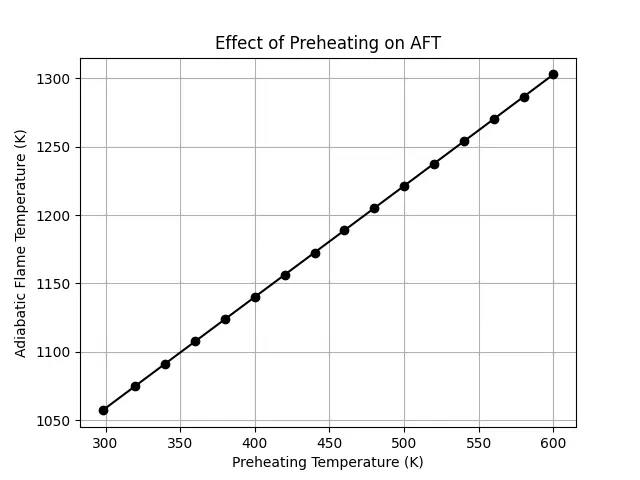
- Studying the effect of preheating on AFT. Writing a code to study thid effect by altering the preheating temperature within the range 298K to 600K.
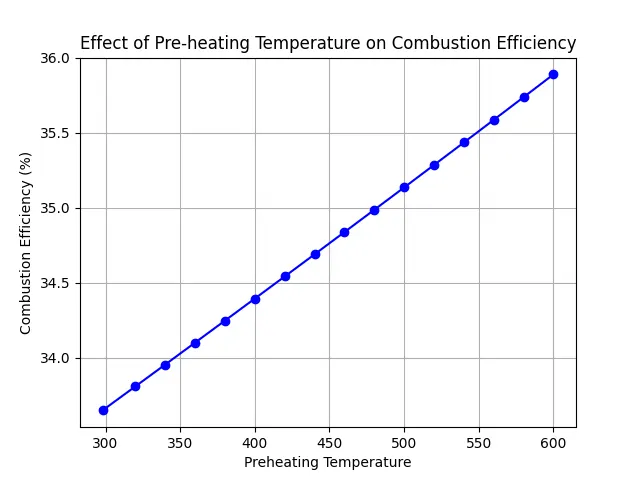
- Plot the effect of pre-heating temperature combustion efficiency.
INTRODUCTION:
In this assignment we are going to study the effect of preheating in the AFT and combustion efficiency. For this, a program to calculate AFT suitable as per our requirement. We will use the cantera library as it is more accurate than the manual calculation using just python method. We will also see the effect of these changes on the overall combustion system.
THEORY:
Recuperator:-
A recuperator is a special purpose counter-flow energy recovery heat exchanger positioned within the supply and exhaust air streams of air handling system, or in the exhaust gases in the industrial process, in order to recover the waste heat. Generally, the are used to extract heat from the exhaust and used it to preheat air entering the combustion system. In this way they use the waste energy to heat the air, offsetting some of the fuel, and thereby improves the energy efficiency of the system as a whole.
Combustion Efficiency:-
Combustion Efficiency is the calculation/measurement, in percentage, of how well your equipment is burning a specific fuel. Complete combustion efficiency (100%) would extract all the energy available in the fuel. However, 100% combustion efficiency is not realistically achievable.
Any combustion system that we design should be made keeping in mind to achieve maximum possible combustion efficiency. This is especially necessary as we are approaching conventional energy crisis at a really fast pace. Thus it is important to study the importance, engineering principles reagarding the combustion efficiency.
Formula for Combustion Efficiency is given as:
`eta_(combustion)` = `Q_(out)/(LHV)`
where, LHV => Lower heating
and `Q_(out)` => Useful Heat
Now, as for the question of fuel saving, yes, we can conclusively say that fuel is saved as the due to preheating the combustion efficiency is increased meaning that the work output produced for the same amount of fuel is more when compared to the initial conditions before preheating.
Also, the assumption of furnace exit temperature is wrong as there are several other factors which are not accounted for in the calculations. These factors may alter this exit temperature and thus ultimately the combustion efficiency.
CODE:
Program 1 (Preheating Temperature Vs Adiabatic Flame Temperature):
https://drive.google.com/file/d/16eP0IEO0bjN1099MJze-3fISe92U3DJC/view?usp=sharing
Program 2 (Preheating Temperature Vs Combustion Efficiency):
https://drive.google.com/file/d/15hOSIdRnWMK9YPEDwhep3k_txdzP6q-7/view?usp=sharing
CODING APPROACH:
Program I.
For this program, we need to calculate AFT for different preheating temperature. Also, for this program we assume stoichiometric combustion of methane.
Step 1.) Import all the necessary libraries and create a gas object of Solution class. After this, create 2 other objects of Quantity class which will inherit the properties of gas object.
Step 2.) Write a for loop of range of length (temp) under which the oxidizer object along with the calculation of AFT will be written.
Step 3.) Plot a chart for different values of AFT obtained for different values of preheating; Plot Preheating Temperature Vs Adiabatic Flame temperature graph.
Program II.
Here, in this program, we need to calculate combustion efficiency (`eta_(combustion)`) for different preheating temperature. For this we'll have to formulate an appropriate logic in which the calculation that are to be done again and again in an iterating fashion are placed in a loop which will execute itself for the required number of times.
Step 1.) First we will import the necessary libraries and after this create an gas object of solutions class.
Step 2.) Now we will create 2 objects of Quantity class with gas as parameter i.e. this object will inherit the properties of gas object; 'Fuel' and 'Exhaust'.
Step 3.) Here, as the values for 'Oxidizer' object will vary with preheating temperature, we will have write this object in a for loop having a range of lenth of preheating temperature list. Along this, we will also write the formula for calculating the useful heat under this loop as well.
Step 4.) After all this, using matplotlib library, plot a chart for Preheating temperature Vs Combustion Efficiency.
RESULTS:
Conclusion:-
From the above obtained graph, it is safe to assume that the Adiabatic Flame Temperature (AFT) increases with the increase in the preheating temperature.
Conclusion:-
From the above obtained result, we can conclude that increase in preheating temperature results in increased combustion efficiency. The graph obtained shows us that, as we increase the preheating temperature, the combustion efficiency goes on increasing as well.