Week 3 - Adiabatic Flame Temperature calculation
Problem 1:
To calculate adiabatic flame temperature for methane combustion in a constant volume system for different equivalence ratios.
Adiabatic Flame Temperature (AFT): The temperature of combustion products that is obtained after combustion of fuel assuming no heat is lost to surroundings is Adiabatic Flame Temperature. AFT is used for knowing the maximum possible temperature that could be reached in the cylinder. There are two types of AFTs depending on how the process is completed.
Constant pressure AFT obtained when the system undergoes combustion at constant pressure - In this process, the absolute enthalpy of reactants equals to the absolute enthalpy of products (which are at AFT)
Constant volume AFT obtained when the system undergoes combustion at constant volume:
There are two methods to obtain the AFT.
Method I:
Absolute Internal energy of reactants equals the absolute internal energy of products.
`U_r = U_r` where U is internal energy, r - reactants and p - products`
and from the relation H = U + PV (H - enthalpy, P - Pressure, V - Volume)
Differentiating, dH = dU + d(PV)
dH = dU + PdV + VdP
For a constant volume process, dV = 0
Therefore, dH = dU + VdP --> (1)
dU = dH - VdP
`(H - VP)_r = (H - VP)_p`
`(H_r - H_p) - V*(P_r - P_p) = 0` --> (2)
From ideal gas equation, PV = nRT where n is no. of moles, R is universal Gas constant and T is temperature
For constant volume, `V*(P_r - P_p) = R*(n_r*T_r - n_p*T_p)` --> (2`
Substituting eq.(2) in eq. (1),
`H_r - H_p) - R*(n_r*T_r - n_p*T_p) = 0 --> (3`
Temperature T_p is the AFT.
Enthalpies of reactants and products are obtained from NASA polynomial equations.
Eq. (3) is a non linear equation and is solved using Newton Rhapson Method to get AFT.
The above procedure is done for three different equivalence ratios 0.8, 1, 1.666.
0.8 is lean mixture in which the no. of moles of air is more than required for complete combustion.
1 is stiochiometric mixture in which the no. of moles of air is in exact sufficient amount for complete combustion.
1.666 is rich mixture in which there is less amount of air due to which fuel is not burnt completely.
Method II:
As the system is adiabatic and constant volume, the amount of heat energy released during the combustion process only increases the internal energy of the system. Work done by the system will be zero and no heat is lost to the surroundings.
Heat released = change in internal energy of the system --> (4)
Heat released (q) = mass of fuel * calorific value (CV)
CV of methane is 55 MJ.
Weight of one mole of methane = 16/1000 kg.
Heat released for one mole complete combusiton of methane = (16/1000) * (55e6) = 880000 J/mole.
Internal energy = `c_v * T` where `c_v` is specific heat at constant volume.
change of internal energy = c_v * (T_p - T_r) = U_p - U_r --> (5)
and `c_p - c_v = R` -->> (6)
From NASA polynomial data,
`c_p = (a1 + a2*T + a3*T^2 + a4*T^3 + a5 *T^4)*R`
From above equation, c_p value is obtained and using eq. (6), c_v value is obtained.
c_v value is substituted in eq. (5) which gives internal energy change.
Then, eq. (4) becomes
q - (c_v*(T_p - T_r)) = 0
q - (U_p - U_r) = 0 --> (7)
Eq. (7) is a non linear equation and is solved using Newton Rhapson method to get AFT.
For lean and stoichiometric mixtures, the entire fuel is burnt completely, so the total heat energy of 880 kJ is released and raises the internal energy.
But for rich mixture, some part of fuel remains unburnt and only some percentage of total heat is released during combustion. For a equivalence ratio of 1.666, 40% less air is available compared to stiochiometric mixture. Assuming linear relationship between amount of oxygen and amount of unburnt fuel, only 60% of fuel will be burnt which releases 60% of total heat energy (0.60 * 880) i.e., eq. (7) for equivalence ratio of 1.666 will be
(0.60*q) - (U_p - U_r) = 0
General Equation for methane combustion for stiochiometric and lean mixtures:
`CH_4 + (2/phi)*(O_2+3.76*N_2) = CO_2 + 2H_2O + (2/phi -2)*O_2 + (7.52/phi)*N_2` --> (8)
where phi is equivalence ratio.
when `phi` = 1, mixture is stiochiometric.
`phi` < 1, mixture is lean
`phi` > 1, mixture is rich
For a rich mixture of `phi` = 1.666, methane combustion reaction will be
`CH_4 + 1.2(O2 + 3.76N2) = 0.5CO2 + 0.9H20 + 0.5CO + 1.1H2 + 4.512N2`
In order to obtain AFT for the above equivalence ratios of combustion of methane, codes in python are written to solve eqs. (3) and (7). Also, cantera module is used to validate the results obtained by eqs. (3) and (7).
Results:
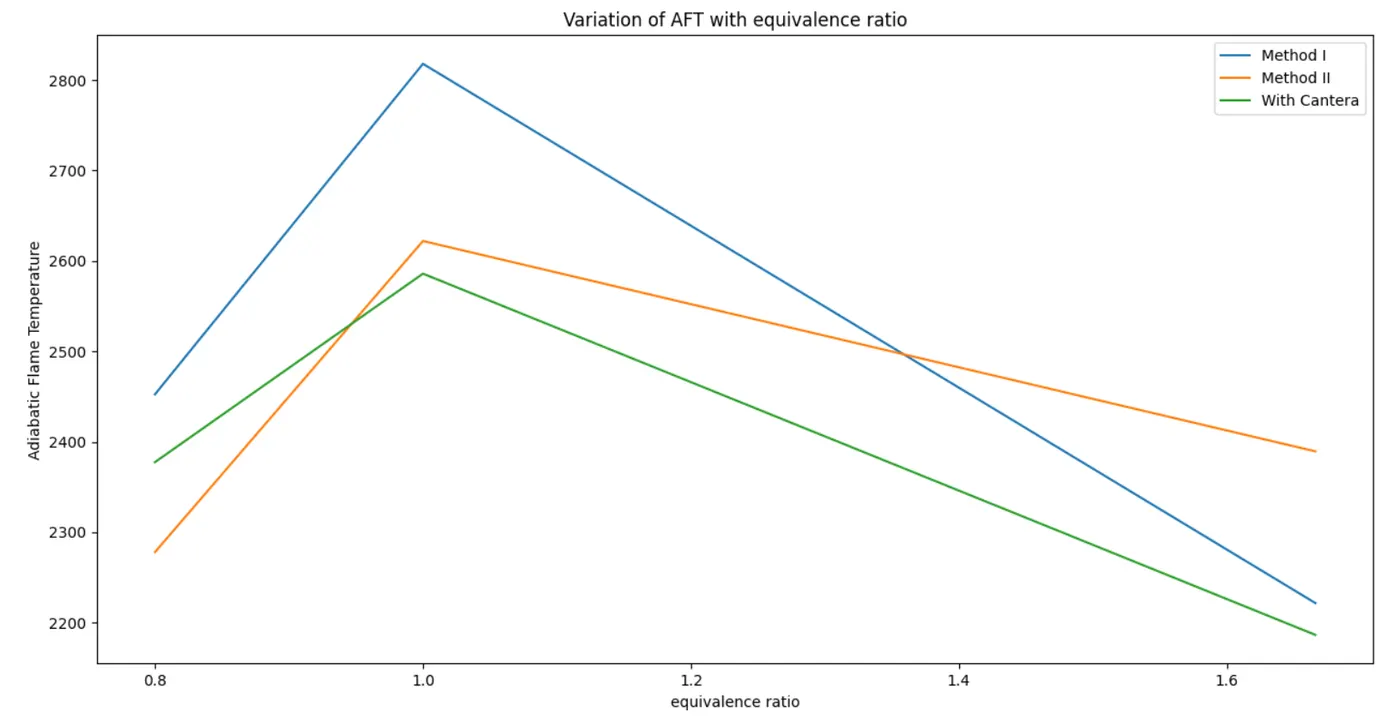
AFTs obtained with Method I , Method II and Cantera are
| `phi`= 0.8 | `phi`= 1.0 | `phi`= 1.666 | |
| Method I | 2452.459 | 2817.831 | 2221.713 |
| Method II | 2278.01 | 2621.966 | 2389.453 |
| Cantera | 2377.513 | 2585.878 |
2186.546 |
A graph is plotted to show the variation of AFT with equivalence ratio for Method I, Method II and with cantera.
Conclusions:
From the above plots, it is observed that AFT increases with increase in equivalence ratio upto 1. When `phi`is greater than 1, AFT is decreasing.
Also, it is observed that AFTs obtained with cantera are low compared to AFTs obtained with Method I. Method IIs AFTs are lower than that of Cantera only upto equivalence ratios less than 0.95.
The reason Cantera predicts lesser values is because it uses a principle called minimization of Gibbs Free energy.
From first law of TD, dQ - dW = dU
dU + dW - dQ = 0 --> (9)
From second law of TD, dS >= dQ/T
dQ <= TdS
When dQ = TdS, eq. (9) becomes dU + dW - TdS = 0
When dQ < TdS, eq. (9) becomes dU + dW - TdS < 0
The terms dU + dW - TdS is change in Gibbs free energy (dG).
Therefore, dG <= 0
All chemical reactions takes place until the change in Gibbs free energy is zero. dG will be equal to zero only at the minimum value of Gibbs free energy function. This function will be minimum at a certain equilibrium composition of combustion products. So, the Cantera evaluates in a way that a particular composition of combustion products at which the gibbs free energy becomes minumum.
The composition of combusiton products in methods I and II may not be in such a way that gibbs free energy becomes minimum. That is why the AFTs of both the methods are not equal to that of cantera.
Also, there are many species of combustion products that cantera considers whereas there are only 4-5 combustion products in methods I and II. Heat released during combsution will be absorbed by every one of those species whereas heat released in methods I and II will be absorbed by far less no. of species. This is the reason the AFTs are lesser in cantera.
Problem 2:
Constant Pressure reactor with Heat Loss:
1. Methane combustion with maximum possible heat loss factor of 0.35:
In this case, AFT should be calculated during the stiochiometric combsution of methane with a maximum possible heat loss factor of 0.35.
Maximum possible heat will be released/ lost is when the reactants and products are at STP conditions.
That is after the combustion, if the products are brought down to STP conditions (or the initial conditions of reactants), total amount of heat released which includes heat relased during combustion and heat removed from combusiton products to attain STP is maximum possible heat loss.
This is obtained by the difference in enthalpy values of reactants and products at STP.
Max. heat lost , dH = `(H_p - H_r)_(STP)` where H_r = enthalpy of reactants at STP
H_p = enthalpy of products at STP
AFT should be found out for methane combustion with (0.35 * dH) loss.
In constant pressure process, enthalpy of reactants equals the enthalpy of products.
If there is no heat loss, H_r = H_p
With a max. heat loss factor of 0.35,
H_r = H_p - (0.35*dH)
H_r - H_p + (0.35 * dH) = 0 --> (10)
H_r is the enthlapy of reactants at STP
H_p is the enthalpy of products at AFT.
Eq. (10) is a non linear equation and is solved by Newton Rhapson method.
A code is written in Python to solve the above eq. (10) and the AFT obtained is
AFT = 1678.411 K
2. Calculating AFT for stiochiometric combustion of 2 carbon atom Hydrocarbons with heat loss factor of 0.35:
In this, AFTs should be calculated for alkanes, alkenes and alkynes having 2 carbon atoms.
Alkanes = `C_nH_(2n+2)`
Alkenes = `C_nH_(2n)`
Alkynes = `C_nH_(2n-2)`
where n is no. of carbo atoms.
When n = 2,
Alkane obtained is Ethane `C_2H_6`
Alkene obtained is Ethene `C_2H_4`
Alkyne obtained is Ethyne `C_2H_2`
General formula for stoichiometric combustion of any hydrocarbon is
`C_aH_b + (a+b/4)(O_2 + 3.76N_2) = aCO_2 + (b/2)H_2O + (a+b/4)*3.76N_2` -->(11)
Ethane combustion
`C_2H_6 + 3.5*(O_2 + 3.76N_2) = 2CO_2 + 3H_2O + 3.5*3.76N_2`
Ethene combustion
`C_2H_4 + 3*(O_2 + 3.76N_2) = 2CO_2 + 2H_2O + 3*3.76N_2`
Ethyne combustion
`C_2H_2 + 2.5*(O_2 + 3.76N_2) = 2CO_2 + H_2O + 2.5*3.76N_2`
Same concept used in previous problem is adopted i.e, Max. heat loss of each of the hydrocarbon is obtained by calculating their enthalpies of reactants and products at STP. Then, the enthalpies of reactants at STP and that of combustion products which would be at AFT are calculated with a heat loss factor of 0.35 using eq. (10)
Code in Python is written to calculate AFTs for Ethane, Ethene and Ethyne.
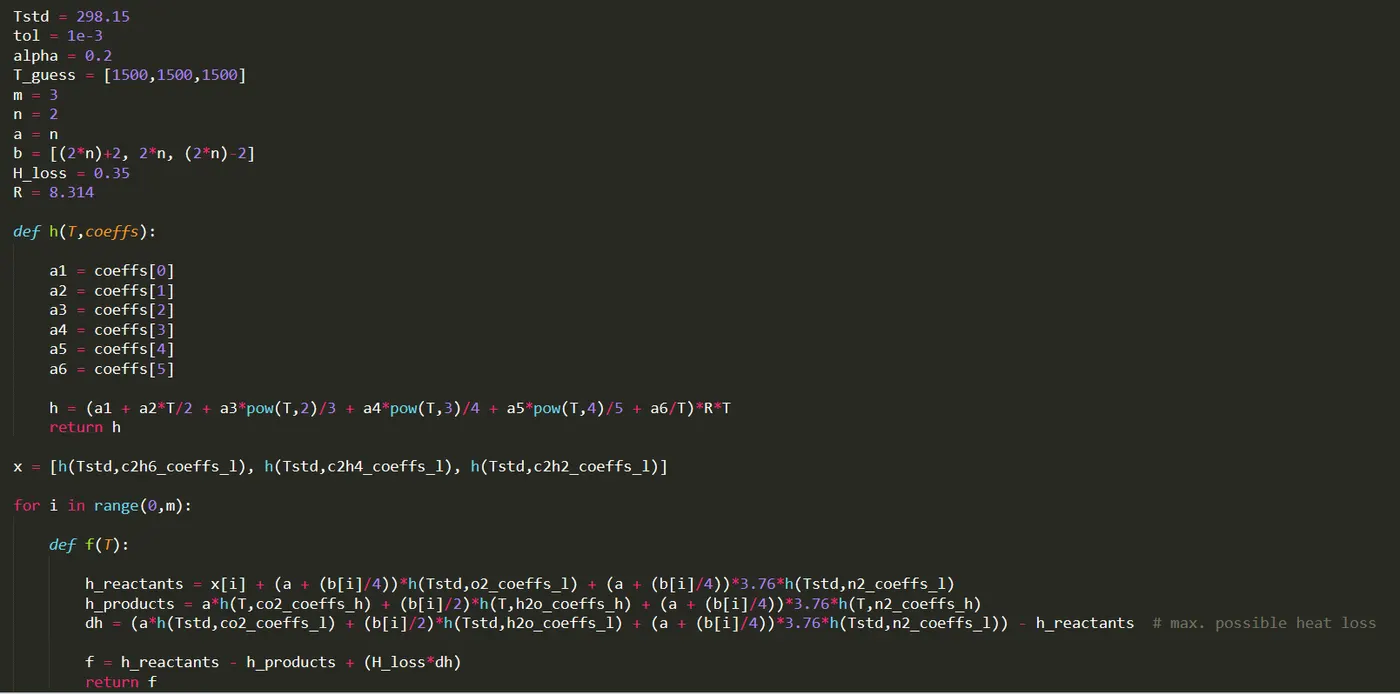
No. of carbon atoms is given as 'a'.
As the no. of carbon atoms remain same, value of hydrogen atoms changes with alkane, alkene and alkyne.
Array 'b' is assigned to hydrogen atoms, first element representing no. of hydrogen atoms in alkane, second in alkene and third for alkyne.
Function for calculating enthalpy is written.
General equation for hydrocarbon combustion eq. (11) is written in a for loop. The for loop is iterated three times, each time for a different hydrocarbon. The no. of moles of reactants and products are changed for each iteration depending on values in 'b' array.
The enthalpies for each hydrocarbon at STP is put in an array 'x' and is iterated each time inside for loop. Values of max heat loss and the non linear equation is iterated each time. The equations are then solved using Newton Rhapson method.
values of AFT for each hydrocarbon is
| Ethane | Ethene | Ethyne | |
| AFT | 1714.036 | 1837.150 |
2065.506 |
A graph is plotted to show the trend
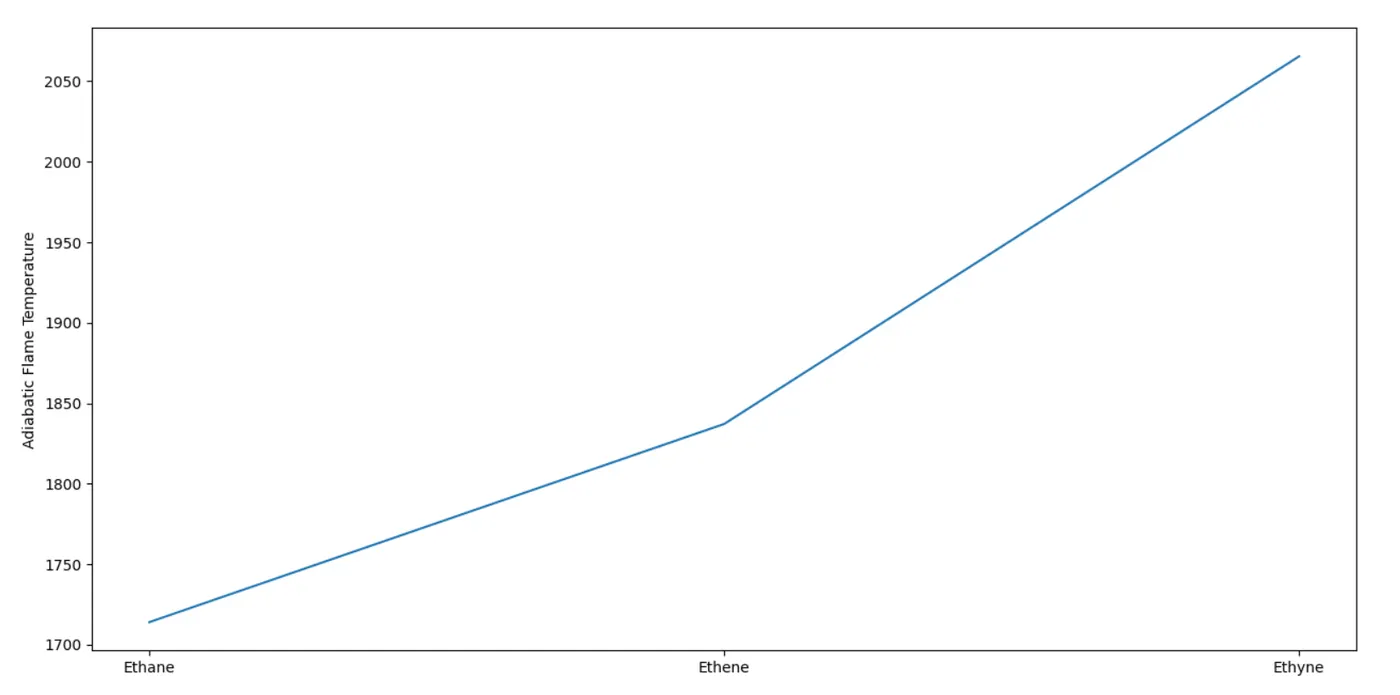
It is observed that AFT for Ethane > Ethene > Ethyne.
This is because the AFT depends on the temperature of combustion products. The combustion products for all the three hydrocarbons are carbondioxide, water vapour and nitrogen.
No. of moles of carbondioxide are same for each of the hydrocarbons. But the no. of moles of water vapour and nitrogen differ.
For Ethane, 3 moles of water vapour is present. 2 moles for ethene and 1 mole for ethyne. The c_p value (specific heat at constant pressure) for water vapour(triatomic molecule) is large (approx. 55kJ/kmol-K) i.e., amount of heat required to raise the temperature of water vapour is high. So, for 3 moles of water, it takes a lot of heat to raise its temperature compared to 2 moles for ethene and 1 mole for ethyne. The temperature of 1 mole of water can be increased easily compared to 2 and 3 moles. So, the temperature of ethyne is increased with amount of heat less than what is required for ethene and ethane.
Similarly, no. of nitrogen moles for ethane is 3.5, 3 for ethene and 2.5 for ethyne. c_p value for a diatomic molecule is also high. 3.5 moles of nitrigen requires more amount of heat to rasie its temperature compared to 3 and 2.5 moles.
In whole, Heat required to raise the temperature of Ethyne is less than Ethene and heat required to raise the temp. of Ethene is less than Ethane. That is why the AFT of Ethane > Ethene > Ethyne.
3. Effect of no. of carbon atoms on AFT with no heat loss:
The no. of carbon atoms considered are 1,2,3 for alkane hydrocarbons.
1 carbon atom - `CH_4` - methane
2 carbon atoms - `C_2H_6` - ethane
3 carbon atoms - `C_3H_8` - Propane
General formula for combustion of hydrocarbon is given by eq. (11) and code in python is written for eq. (11) to obtain AFT.
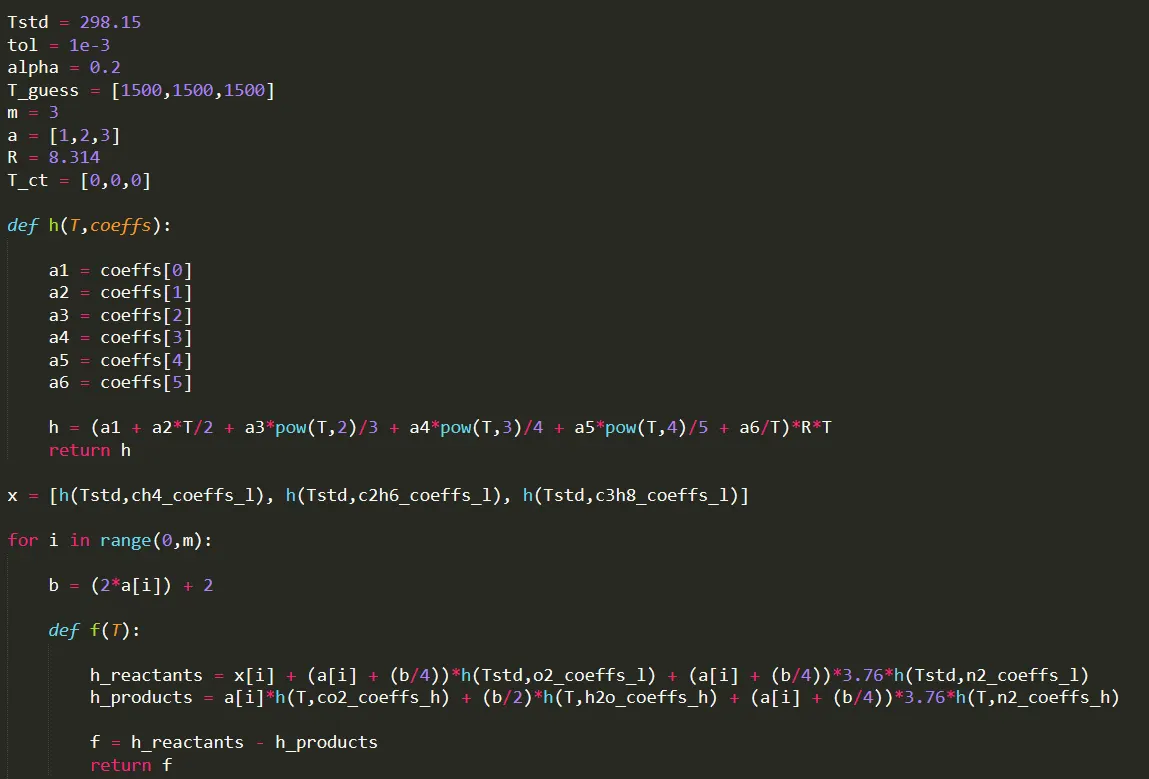
Similar methodology used for previous problem is adopted. In this, value of 'a' and also 'b' iterates inside for loop. Enthalpies for methane, ethane and propane at STP conditions are calculated and put in array 'x' . As there is no heat loss, enthapy of reactants equals the entahpy of products and a non linear equation is obtained which is solved by newton rhapson method.
AFTs are also obtained using cantera module and compared.
| Methane | Ethane | Propane | |
| Without Cantera | 2325.598 | 2379.849 | 2392.097 |
| With Cantera | 2224.617 | 2258.737 | 2265.701 |
A graph is plotted as below
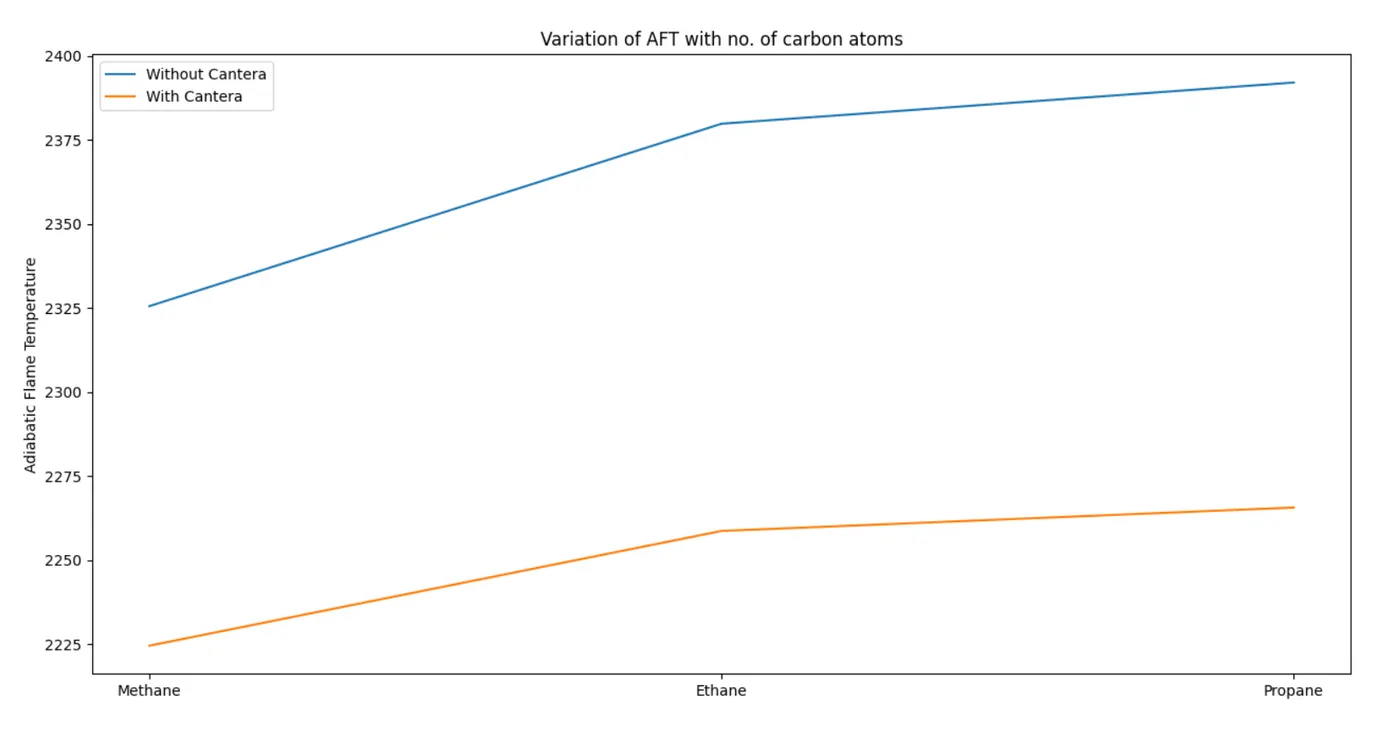
It is observed that as the no. of carbon atoms increase, AFT is increasing. This is because the calorific value of propane > ethane > methane i.e amount of heat released during the combustion of propane > ethane > methane. Due to this, temperature of combustion products (AFT) for propane > ethane > methane.
Also, AFTs obtained by cantera are lesser as seen in the first problem. This is due to the cantera using the principle of minimization of Gibbs free energy.
Google drive link for codes:
https://drive.google.com/drive/folders/1CaEpDiPAYybsnQ5m97MCS53XTPFUlrQo