Week 3.5 - Deriving 4th order approximation of a 2nd order derivative using Taylor Table method
AIM
To derive the fourth order approxiamtion of second order derivative using central difference, skewed right side difference and skewed left side difference.
Central difference method
The order of accuracy P = Number of nodes in the stencil N - order of derivative Q + 1
P=N-Q+1
N=P+Q-1=4+2-1=5
We have 5 point in the stencil
Assume dx is the distance between nodes in the stencil
We assume the expression as
`(del^2f)/(delx^2) = af(x-2dx)+bf(x-dx)+cf(x)+df(x+dx)+ef(x+2dx)`
Taylor series expansion of each term is given by
`af(x-2dx) = af(x) - a(f'(x)*(2dx))/(1!)+a(f''(x)(2dx)^2)/(2!)+a(f'''(x)(2dx)^3)/(3!)+a(f''''(x)(2dx)^4)/(4!)-...`
`bf(x-dx)=bf(x)-b(f'(x)(x))/(1!)+b*(f''(x)(dx)^2)/(2!)-b*(f'''(x)(dx)^3)/(3!)+b*(f''''(x)(dx^4))/(4!)-...`
cf(x)=cf(x)
`df(x+dx)=df(x)+d*(f'(x)(dx))/(1!)+d*(f''(x)(dx)^2)/(2!)+d(f'''(x)(dx)^3)/(3!)+d*(f''''(x)(dx)^4)/(4!)+...`
`ef(x+2dx)=ef(x)+e*(f'(x)(dx))/(1!)+e*(f''(x)(dx)^2)/(2!)+e*(f'''(x)(dx)^3)/(3!)+e(f''''(x)(dx)^4)/(4!)+...`
Writing the taylor table
| f(x) | f'(x)dx | `f''(x)(dx)^2` | `f'''(x)(dx)^3` | `f''''(x)(dx)^4` | |
| af(x-2dx) | a | -2a | (4/2)a | (-8/6)a | (16/24)a |
| bf(x-dx) | b | -b | b/2 | (-1/6)b | (1/24)b |
| cf(x) | c | 0 | 0 | 0 | 0 |
| df(x+dx) | d | d | d/2 | (1/6)d | (1/24)d |
| ef(x+2dx) | e | 2e | (4/2)e | (8/6)e | (16/24)e |
| Sum | 0 | 0 | 1 | 0 | 0 |
Solving the matrix using inversion gives
a=-0.0833
b=1.3333
c=-2.5000
d=1.3333
e=-0.0833
With truncation error of order of 4
`f''(x)(dx^2)=af(x-2dx)+bf(x-dx)+cf(x)+df(x+dx)+ef(x+2dx)`
`f''(x) = (-0.0833f(x-2dx)+1.3333f(x-dx)-2.5f(x)+1.3333f(x+dx)-0.0833f(x+2dx))/(dx^2)`
Skewed Right sided difference
The order of accuracy P = Number of nodes in the stencil N - order of derivative Q
4=N-2
N=4+2=6
we have 6 nodes
consider 6 equidistant points with dx as the distance between them.
The points from left to right are named respectively f(x), f(x+dx), f(x+2dx), f(x+3dx), f(x+4dx), f(x+5dx).
We assume the expression as
`(del^2f)/(delx^2) = gf(x)+hf(x+dx)+if(x+2dx)+jf(x+3dx)+kf(x+4dx)+lf(x+5dx)`
Where g,h,i,j,k,l are constants of approximation
Taylor series expansion of each term is given by
`gf(x)=gf(x)`
`hf(x+dx)=hf(x)+h*(f'(x)(dx))/(1!)+h*(f''(x)(dx)^2)/(2!)+h*(f'''(x)(dx)^3)/(3!)+h*(f''''(x)(dx)^4)/(4!)+h*(f'''''(x)(dx)^5)/(5!)+...`
`if(x+2dx)=if(x)+i*(f'(x)(2dx))/(1!)+i*(f''(x)(2x)^2)/(2!)+i*(f'''(x)(2dx)^3)/(3!)+i*(f''''(x)(2dx)^4)/(4!)+i*(f'''''(x)(2dx)^5)/(5!)+...`
`jf(x+3dx)=jf(x)+j*(f'(x)(3dx))/(1!)+j*(f''(x)(3dx)^2)/(2!)+j*(f'''(x)(3dx)^3)/(3!)+j*(f''''(x)(3dx)^4)/(4!)+j*(f'''''(x)(3dx)^5)/(5!)+...`
`kf(x+4dx)=kf(x)+k*(f'(x)(4dx))/(1!)+k*(f''(x)(4dx)^2)/(2!)+k(f'''(x)(4dx)^3)/(3!)+k*(f''''(x)(4dx)^4)/(4!)+k*(f'''''(x)(4dx)^5)/(5!)+...`
`lf(x+5dx)=lf(x)+l*(f'(x)(5dx))/(1!)+l*(f''(x)(5dx)^2)/(2!)+l*(f'''(x)(5dx)^3)/(3!)+l*(f''''(x)(5dx)^4)/(4!)+l*(f'''''(x)(5dx)^5)/(5!)+...`
Writing the taylor table
| f(x) | f'(x)dx | `f''(x(dx)^2` | `f'''(x)(dx)^3` | `f''''(x)(dx)^4` | `f'''''(x)(dx)^5` | |
| gf(x) | g | 0 | 0 | 0 | 0 | 0 |
| hf(x+dx) | h | h | (1/2)h | (1/6)h | (1/24)h | (1/120) |
| if(x+2dx) | i | 2i | (4/2)i | (8/6)i | (2/3)i | (4/15)i |
| jf(x+3dx) | j | 3j | (9/2)j | (9/2)j | (27/8)j | (81/40)j |
| kf(x+4dx) | k | 4k | 8k | (32/2)k | (32/3)k | (128/15)k |
| lf(x+5dx) | l | 5l | (25/2)l | (125/6)l | (625/24)l | (625/24)l |
| sum | 0 | 0 | 1 | 0 | 0 | 0 |
Solving for g,h,i,j,k,l using matrix inversion gives
g=3.7500
h=-12.8333
i=17.8333
j=-13.0000
k=5.0833
l=-0.8333
With truncation error of order of 4
`f''(x)(dx^2)=gf(x)+hf(x+dx)+if(x+2dx)+jf(x+3dx)+kf(x+4dx)+lf(x+5dx)`
`f''(x) = (3.75*f(x)-12.833f(x+dx)+17.8333*f(x+2dx)-13.0000f(x+3dx)+5.0833*f(x+4dx)-0.8333*f(x+5dx))/(dx^2)`
Skewed Left sided difference
The order of accuracy P = Number of nodes in the stencil N - order of derivative Q
4=N-2
N=4+2=6
we have 6 nodes
consider 6 equidistant points with dx as the distance between them.
The points from left to right are named respectively f(x-5dx), f(x-4dx), f(x-3dx), f(x-2dx), f(x-dx), f(x).
We assume the expression as
`(del^2f)/(delx^2) = rf(x-5dx)+sf(x-4dx)+tf(x-3dx)+uf(x-2dx)+vf(x-dx)+wf(x)`
Where r,s,t,u,v,w are constants of approximation
Taylor series expansion of each term is given by
`rf(x-5dx)=rf(x)-r*(f'(x)(5dx))/(1!)+r*(f''(x)(5dx)^2)/(2!)-r*(f'''(x)(5dx)^3)/(3!)+r*(f''''(x)(5dx)^4)/(4!)-r*(f'''''(x)(5dx)^5)/(5!)+...`
`s.f(x-4dx)=s.f(x)-s*(f'(x)(4dx))/(1!)+s*(f''(x)(4dx)^2)/(2!)-s*(f'''(x)(4dx)^3)/(3!)+s*(f''''(x)(4dx)^4)/(4!)-s*(f'''''(x)(4dx)^5)/(5!)+...`
`tf(x-3dx)=tf(x)-t*(f'(x)(3dx))/(1!)+t*(f''(x)(3dx)^2)/(2!)-t*(f'''(x)(3dx)^3)/(3!)+t*(f''''(x)(3dx)^4)/(4!)-t*(f'''''(x)(3dx)^5)/(5!)+...`
`uf(x-2dx)=uf(x)-u*(f'(x)(2dx))/(1!)+u*(f''(x)(2x)^2)/(2!)-u*(f'''(x)(2dx)^3)/(3!)+u*(f''''(x)(2dx)^4)/(4!)-u*(f'''''(x)(2dx)^5)/(5!)+...`
`vf(x-dx)=vf(x)-v*(f'(x)(dx))/(1!)+v*(f''(x)(dx)^2)/(2!)-v*(f'''(x)(dx)^3)/(3!)+v*(f''''(x)(dx)^4)/(4!)-v*(f'''''(x)(dx)^5)/(5!)+...`
`wf(x)=wf(x)`
Writing the taylor table
| f(x) | f'(x)dx | `f''(x(dx)^2` | `f'''(x)(dx)^3` | `f''''(x)(dx)^4` | `f'''''(x)(dx)^5` | |
| rf(x-5dx) | r | -5r | (25/2) | (-125/6)r | (625/24)r | (-625/24)r |
| sf(x-4dx) | s | -4s | 8s | (-32/3)s | (32/3)s | (-128/15)s |
| tf(x-3dx) | t | -3t | (9/2)t | (-9/2)t | (27/8)t | (-81/40)t |
| uf(x-2dx) | u | -2u | (4/2)u | (-8/6)u | (2/3)u | (-4/15)u |
| vf(x-dx) | v | -1v | (1/2)v | (-1/6)v | (1/24)v | (-1/120)v |
| wf(x) | w | 0 | 0 | 0 | 0 | 0 |
| sum | 0 | 0 | 1 | 0 | 0 | 0 |
Solving for r,s,t,u,v,w using matrix inversion gives
r=-0.8333
s=5.0833
t=-13.0000
u=17.8333
v=-12.8333
w=3.7500
With truncation error of order of 4
`f''(x)(dx^2)=rf(x-5dx)+sf(x-4dx)+tf(x-3dx)+uf(x-2dx)+vf(x-dx)+wf(x)`
`f''(x) = (-0.8333*f(x-5dx)+5.0833f(x-4dx)-13.0000*f(x-3dx)+17.8333*f(x-2dx)-12.8333*f(x-dx)+3.7500*f(x))/(dx^2)`
The given function `cos(x).e^(x)` needs to be evaluated at second order derivative using the exact differential and the 3 types of approxiamtion.
MATLAB Code
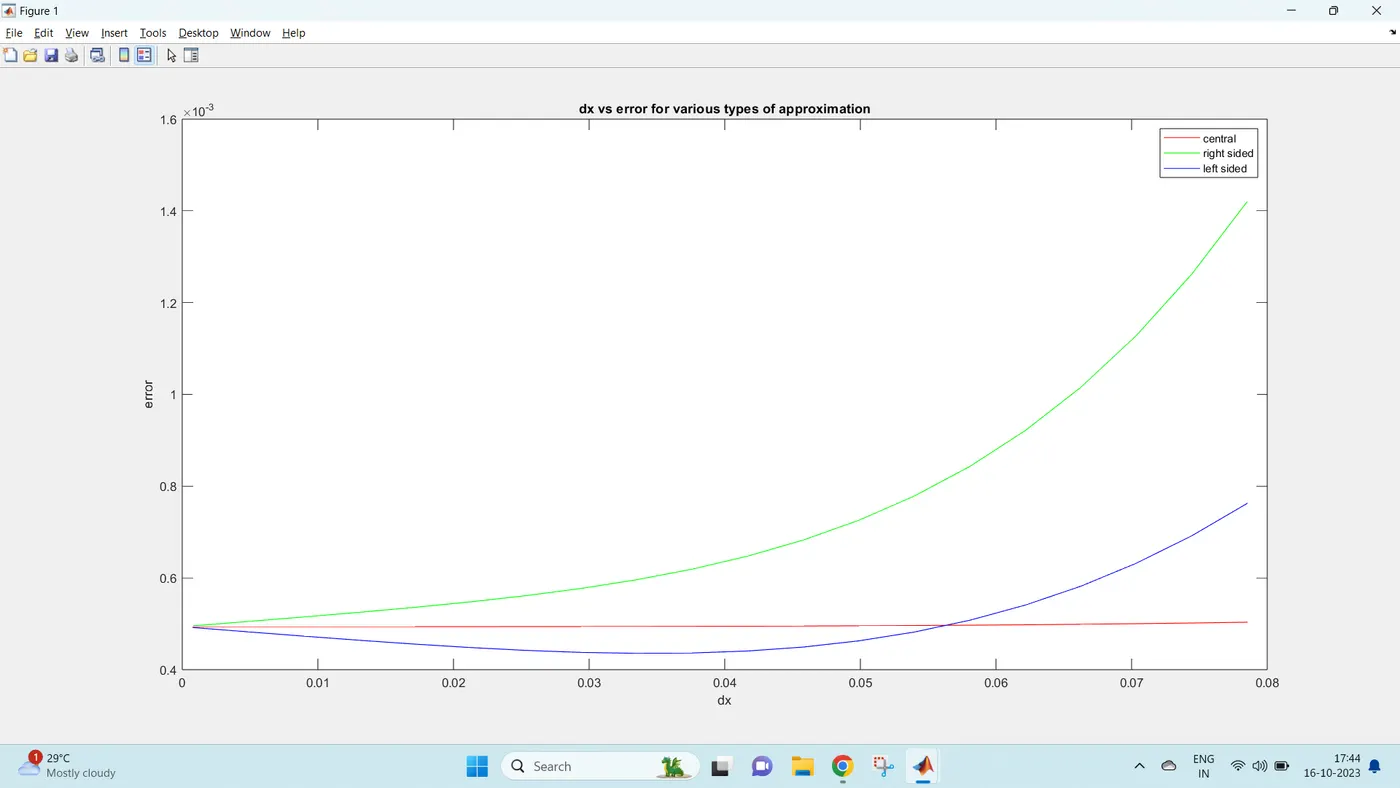
WHY A SKEWED SCHEME IS USEFUL:
The system which doesn’t contain sufficient information on both side of the point of interest. In such cases we cannot use central differencing scheme so skewed scheme is useful in such cases.
WHAT CAN A SKEWED SCHEME DO THAT A CD SCHEME CANNOT DO:
CDS cannot not be employed at the boundary nodes due to unavailability of right and left nodes at the same time. In such cases the skewed differencing scheme is use