Week 2 Session 7
Q. Compare the different architectures of HEV. Discuss the pro's and con's.
----> HEV stands for Hybrid Electric Vehicle. Different architectures of HEV are Series, Parallel & Sereis-Parallel.
1. Sereis HEV
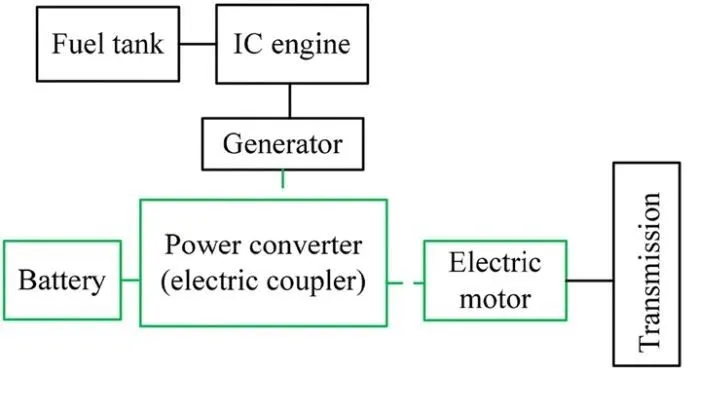 |
- It has 2 energy source components in sereis to drive the transmission i.e. Motor and ICE.
- In Battery Mode : Energy flow is from Battery --> Power Converter --> Motor --> Transmission.
- In ICE Mode : Energy flow is from Fuel tank --> ICE --> Generator --> Power Converter --> Motor --> Transmission.
- Only Electric Motor is connected with the transmission.
-
Advantages :
- ICE can be operated in optimal narrow region, hence better efficiency.
- As motor directly drives the transmission, no need of multi-gear transmission box.
Disadvantages :
- Involves dual energy conversion i.e. from mechanical to electrical and from electrical to mechanical again, thus offers low overall efficiency .
- Space and weight constraints as a extra generator is required, thus increases cost as well.
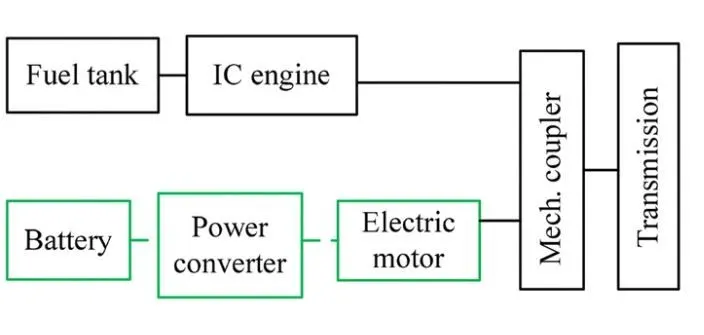 |
- It has 2 energy source components in parallel to each other i.e. Motor and ICE.
- Motor and ICE are coupled to transmission via a coupler like DCT (Dual Clutch Transmission).
- In Battery mode : Energy flow is from Battery --> Power Converter --> Electric Motor --> Coupler --> Transmission.
- In ICE mode : Energy flow is from Fuel Tank --> ICE engine --> Coupler --> Transmission.
- In Hybrid mode : Energy is balanced between ICE and Motor.
-
Advantages :
- No energy conversion involved, hence more overall efficiency.
- Compact design due to absence of generator.
- Reduction in size of traction motor due to less vehicle weight.
-
Disadvantages :
- ICE cannot be just operated in narrow optimal range.
- Complex operation due to DCT and coupler.
3. Series - Parallel HEV
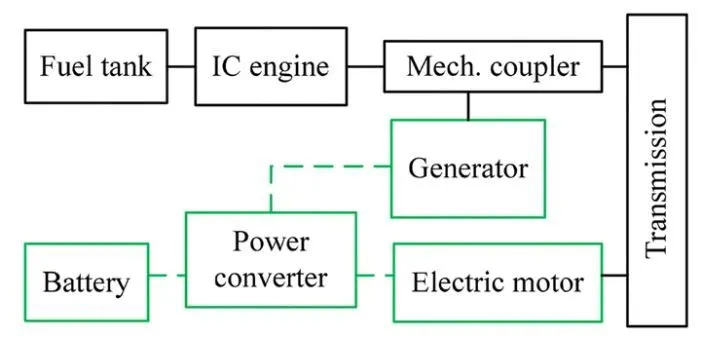 |
- It is a combination of both Series HEV and Parallel HEV architecture.
- Both Motor and ICE are connected individually to the transmission.
- The engine can both drive the vehicle directly (as in parallel HEV) and be effectively disconnected, with only the motor providing power (as in series HEV).
- Battery can also be charged from the ICE extra power via a generator.
-
Advantages :
- With fuel-only and electric-only options, the engine operates at near optimum efficiency.
- At lower speed it operates with motor and at high speed it operates with ICE, thus minimising the loss at high speed in series HEV.
-
Disadvantages : - High cost as it requires a generator and a larger battery pack.