Railwheel and Track
Aim:
To perform a static structural analysis on the Rail wheel and Track setup.
Objective:
Case 1: Multiply the bearing load by 5 times and compare the results with the load of 100000 N (As done in week 2 video). Compare the Total Deformation, Equivalent stress and the life under both the loads
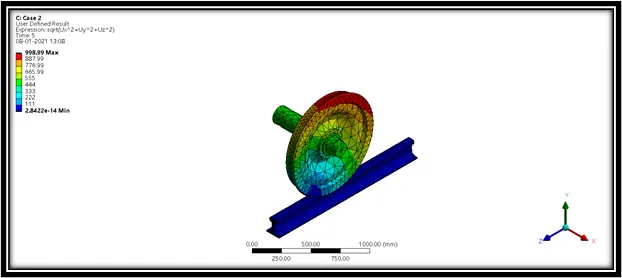
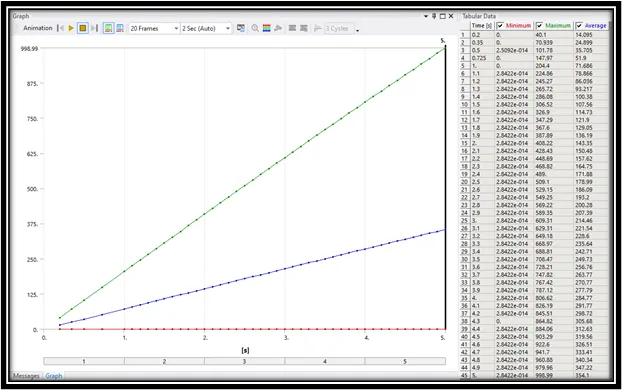
Case 2: Implement a User defined result and calculate the Total Deformation from this result and check if it is the same as that obtained by the inbuilt result by ANSYS-WORKBENCH for a load of 100000 N.
Procedure:
Geometry Model:
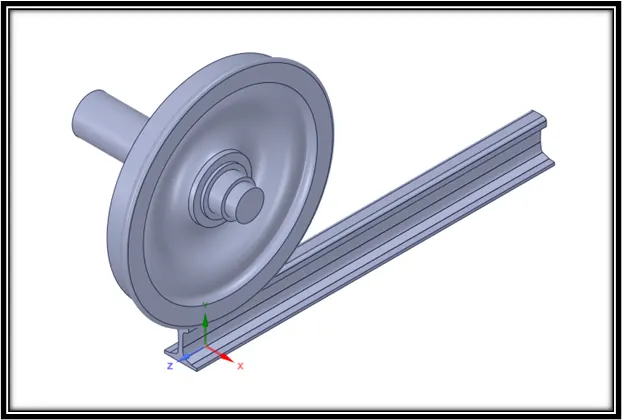
Boundary Conditions:
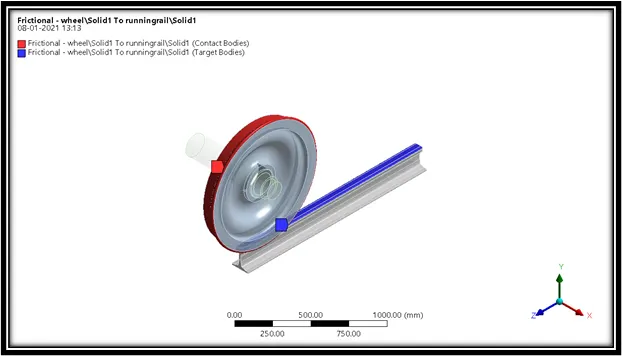
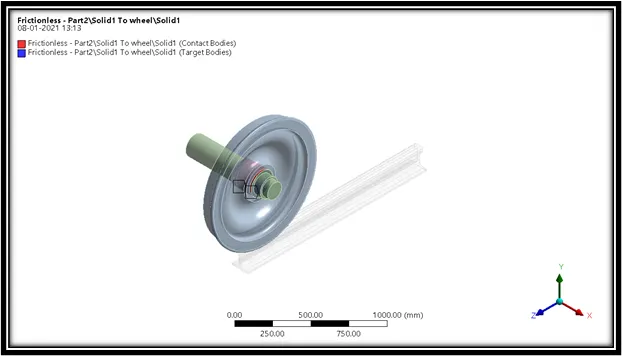
There are 2 contact connections which must be provided for this model. The first connection is between the running rail and the wheel and the other connection is between solid and the wheel.
The first connection between the running rail and the wheel is given frictional type of contact as shown in the image below by selecting the required areas for the motion to take place in that direction.
The other connection which is between the solid and wheel will have a frictionless type of contact as shown in the image below by selecting the required areas for the motion to take place in that direction.
The next step in the connections is to providing the joint types.
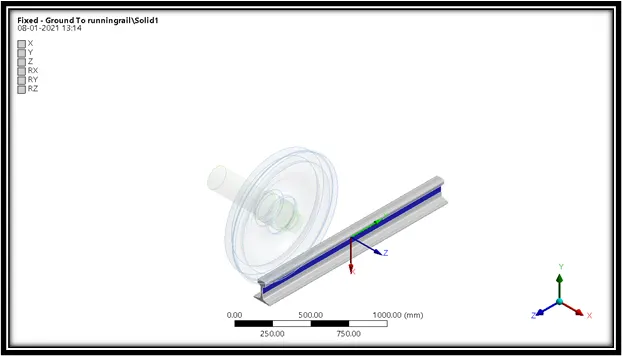
The first joint type is the fixed one where the running rail is to be fixed to the ground as shown in the image below.
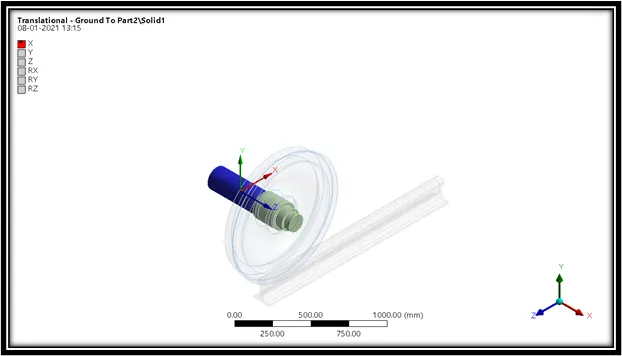
The next type of joint is the translational type which will be used to provide a certain amount of force on the solid to make the wheel move on the running rail and the translational movement will be followed in the X direction as shown in the image below.
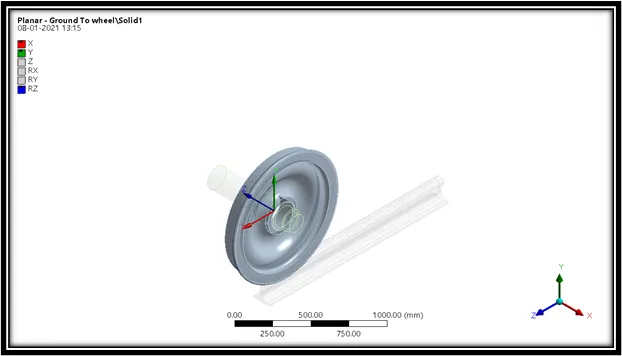
The last type of joint will be a planar type which will be given to the wheel. This will help the wheel to move in the X and Y direction correspondingly moving the Z direction.
Next, we will provide the analysis settings for the required settings with a total simulation of 5 seconds.
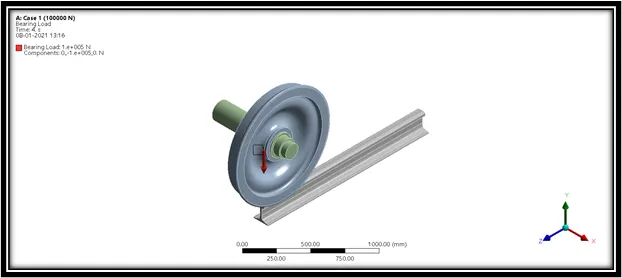
Now, we will be providing the boundary conditions for the model. The first condition is to provide a bearing load on the contact region of solid and the wheel with a force of 100000 N in values of tabular data and it will be varied based on the cases given.
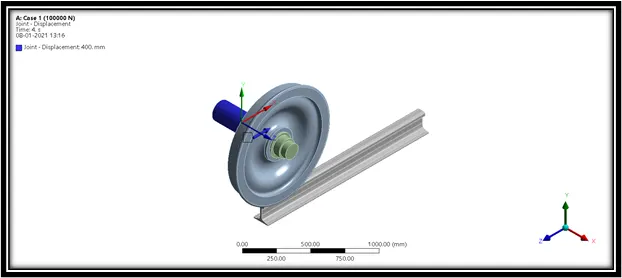
The next boundary condition is to give displacement values in a tabular data form with a value of 400 mm on the whole solid part as shown in the image below.
Simulation Results:
Case 1:
100000 N:
Total Deformation:
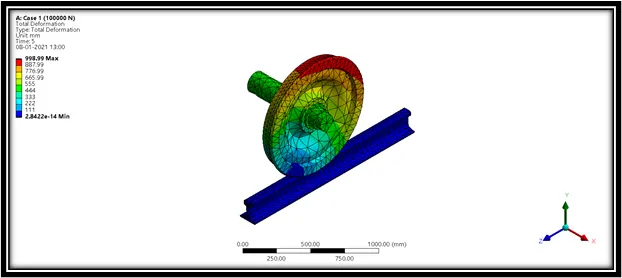
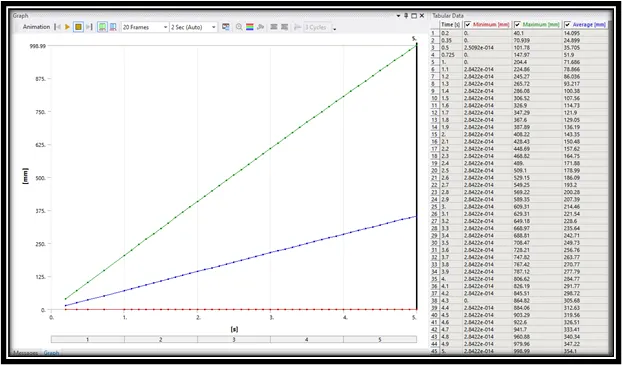
Simulation Video - https://drive.google.com/file/d/13IVxahL9innaoBvoXx0fCTy4DLkOPkt_/view?usp=sharing
Equivalent Stress:
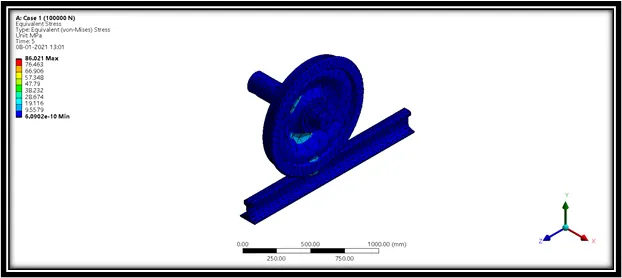
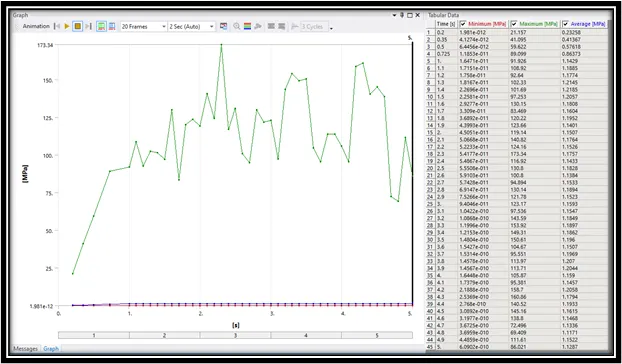
Simulation Video - https://drive.google.com/file/d/1PQkSitIQjLqGsqUWDEQQemHXUCHzL7kN/view?usp=sharing
Life:
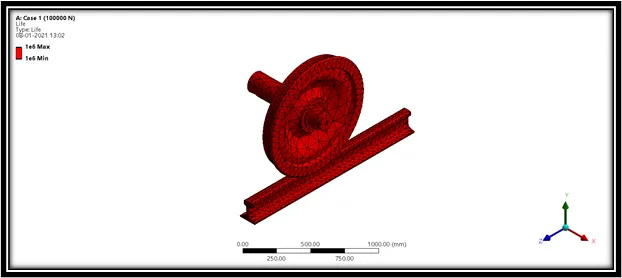
Simulation Video - https://drive.google.com/file/d/1tXMwiEDnal3Jjfp281KWQyO8_muatLNO/view?usp=sharing
500000 N:
Total Deformation:
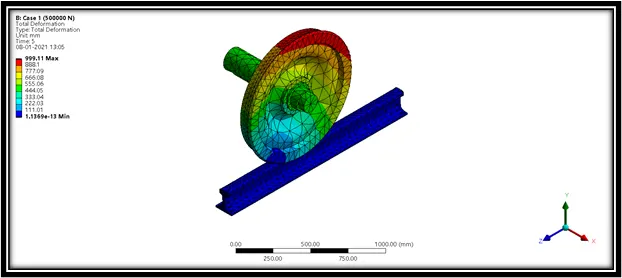
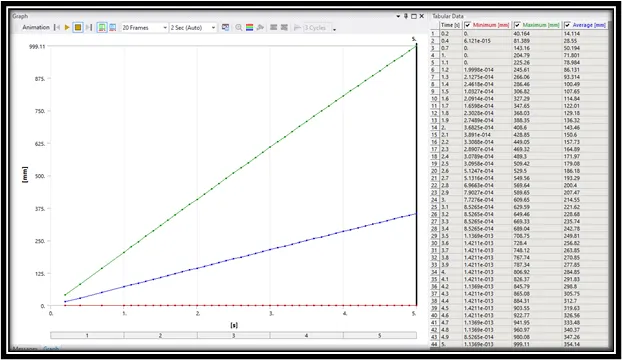
Simulation Video - https://drive.google.com/file/d/1M_l_t-XlEp6YdZI4jx8gUhRfezL_G9Nz/view?usp=sharing
Equivalent Stress:
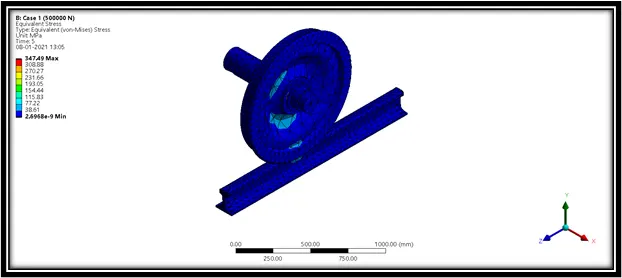
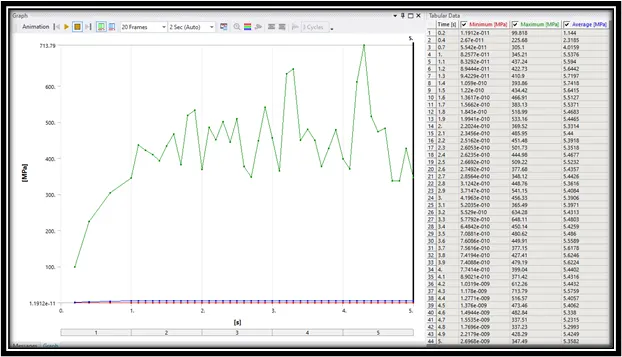
Simulation Video - https://drive.google.com/file/d/1zzliEqUK5hau3AAJJE8gBVPYzj4N7Npv/view?usp=sharing
Life:
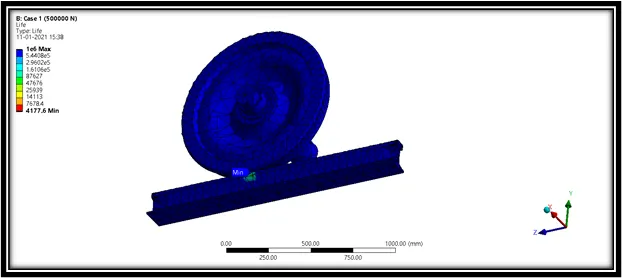
Simulation Video - https://drive.google.com/file/d/1PYoLqtLyaiAol2DzfgaBxQ7BuVedsTXF/view?usp=sharing
Case 2:
Comparison:
Case 1:
|
Bearing Load |
Total Deformation (mm) |
Max. Equivalent Stress (MPa) |
Life |
|
100000 N |
998.99 |
173.34 |
100000 |
|
500000 N |
999.11 |
713.79 |
4177.6 - 100000 |
We can see that the total deformation has a very slight variation when the bearing load is varied. The equivalent stress gets varied by 4.1 times when the bearing load is varied by 5 times. The life of is the important factor which is to be noted because the when there is 100000 N of bearing load the life doesn’t have a change in the number of the cycles, but the bearing load is 500000 N then life at a certain point in the model is reduced abruptly to 4177.6 cycles to the maximum life cycle, which means that the crack or failure will start from that region after 4177.6 cycles.
Case 2:
The values for both the user defined results and the inbuilt results by ANSYS for a load of 100000 N used to calculate the Total Deformation is the same.