Week 2 - Flow over a Cylinder.
Week 2 - Flow over a Cylinder.
Aim: Simulating a flow over a cylinder and study the affects of flow parameters on the simulation results.
- The challenge at hand is divided into 2 challenges:
- For Reynolds NumberRe=100, simulate the flow using steady and unsteady/transient solver independently and compare the results.
- Using a steady solver solve simulate the flow over the cylinder with varying Reynolds Number.
Theory: When a blunt body is placed in flow field the flow is seperated from considerable portion of the body. i.e: the flow will not be in contact for the entire length of body along the flow direction. Over a certain value of Reynolds number (Re), the flow in the wake region is characterised by formation of unsteady vortices in alternating pattern. Such a phenomenon is called Kármán vortex street.
The Karman Effect is also visible on a symmetrical body like - a cylinder, which is very non-intuitive as we presume that a laminar uniform flow over a symmetric body should give a symmetric flow in the wake region. But, such is not the case. The phenomenon shall be verified through simulation and the reasons shall be made clear in the conclusion section of this challenge.
Objective:-
Simulate the flow over a cylinder and explain the phenomenon of Karman vortex street.
PART-I
- Simulate the flow with the steady and unsteady case and calculate the Strouhal Number for Re= 100.
PART-II
- Calculate the coefficient of drag and lift over a cylinder by setting the Reynolds number to 10,100,1000,10000 & 100000. (Run with steady solver)
- Discuss the effect of Reynolds number on the coefficient of drag. [ Results should be validated with any standard literature and error should be within 5 %]
Simulation Setup:
We a first setup the geometry for our case. We are using cylinder one side of a face for the 2D analysis.
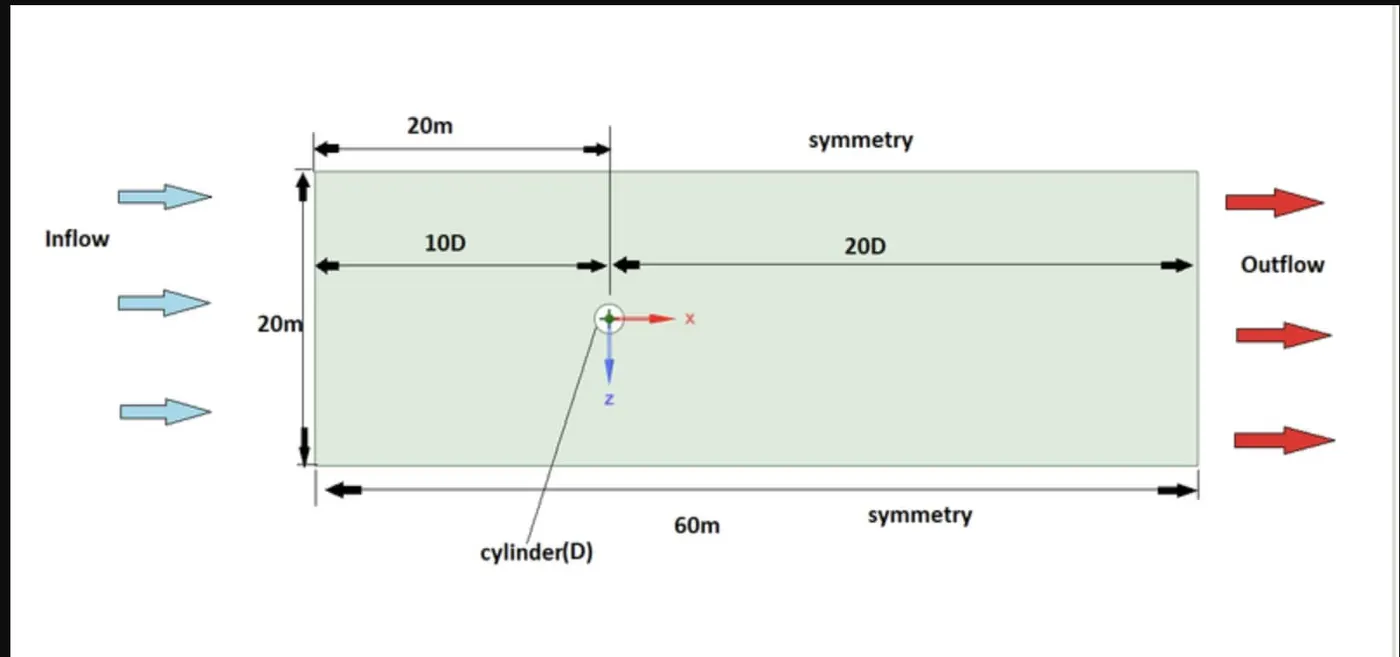
Meshing:-
For the meshing we are using the triangular mesh because:-
Element Sizing:-
For the element size we choose the size of 0.1 M because as the element size decreases,the accuracy and simulation are more smoothe. But the solving equation are increases as the number of element increase that will cause the longer simulation runtime.
Sizing Method:-
We need to make a smooth surface of the gemontary on top of which we are trying to simulate the flow. This method insure that the meshing will be applied on the circular shape will be equivalent to the boundary of that cylinder. This will help to meshing around the circular object more precious.
Inflation Layer:-
It is helps us to generate the body fitting maeh. This is used to ensure that the surface over the body will be smoothe. We can added multiple layer for additional smoothing. We can also adjust the distance between each layer according to our need.
Physics behind the simulation:-
For this particular type of a problem, we need to understand the reynold number,strouhal number,lift,drag and vortex shedding.
Reynold Number:- The Reynolds number (Re) is a dimensionless quantity used in fluid mechanics to predict the type of flow a fluid will exhibit, whether it will be laminar, turbulent, or in transition. It is defined as the ratio of inertial forces to viscous forces and helps understand how fluid momentum interacts with the internal friction in the system.
Strouhal number:- The Strouhal number (St) is a dimensionless number that describes the frequency of vortex shedding from a bluff body, such as a cylinder, in relation to the flow conditions. It is defined by:
Coefficient of drag:-The coefficient of drag is a dimensionless number that quantifies the resistance or drag force experienced by an object as it moves through a fluid (like air or water). It depends on the shape, surface roughness, and flow conditions around the object. Engineers use this coefficient to measure how streamlined or resistant a body is to fluid flow.
Coefficient of lift:- The coefficient of lift is a dimensionless number that quantifies the lift force generated by a lifting surface (such as a wing or an airfoil) relative to the dynamic pressure of the fluid flowing over it. It is a key parameter in aerodynamics and is used to analyze the performance of wings and other aerodynamic surfaces.
Results:-
Case-I:- Simulate the flow with the steady and unsteady case and calculate the Strouhal Number for Re= 100.
1] Steady State:-In the state we are using the steady state solver. For Re=100, we have density is 1 kg/m3,Velocity is 1 m/s and cylinder diameter is 2m Based on that we are using the dynamic viscosity of 0. 02 kg/m-s. We are controlling the Re number by changing the dynamic viscosity.
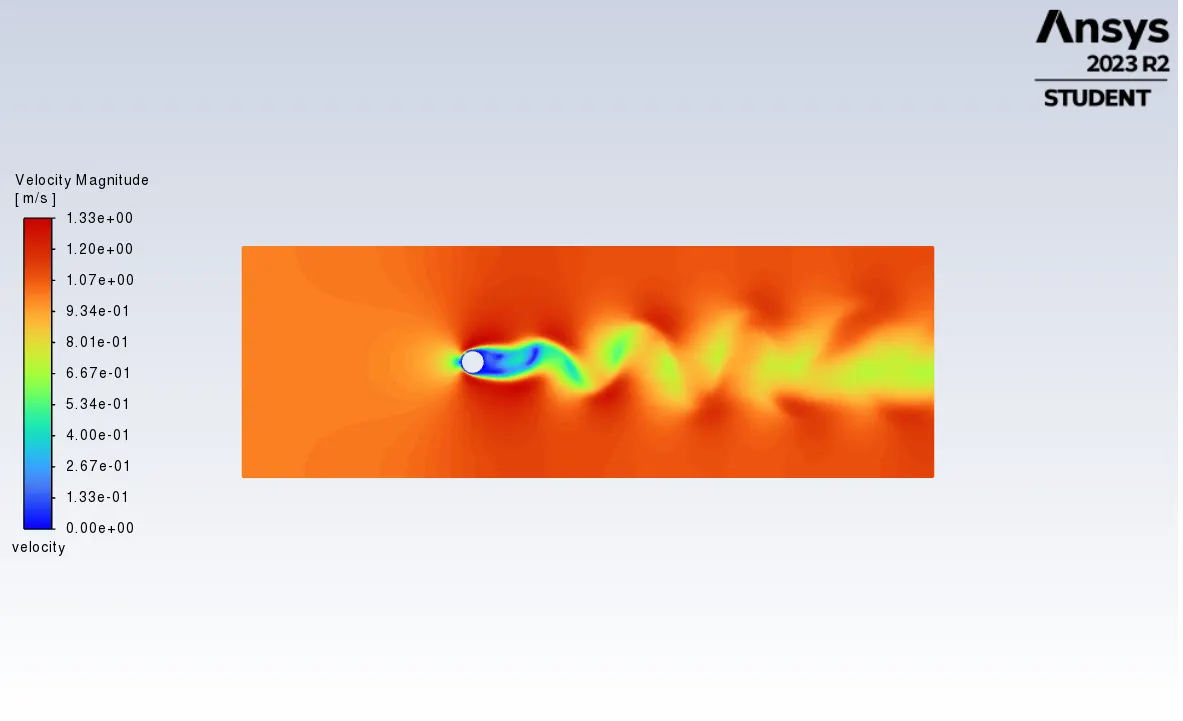
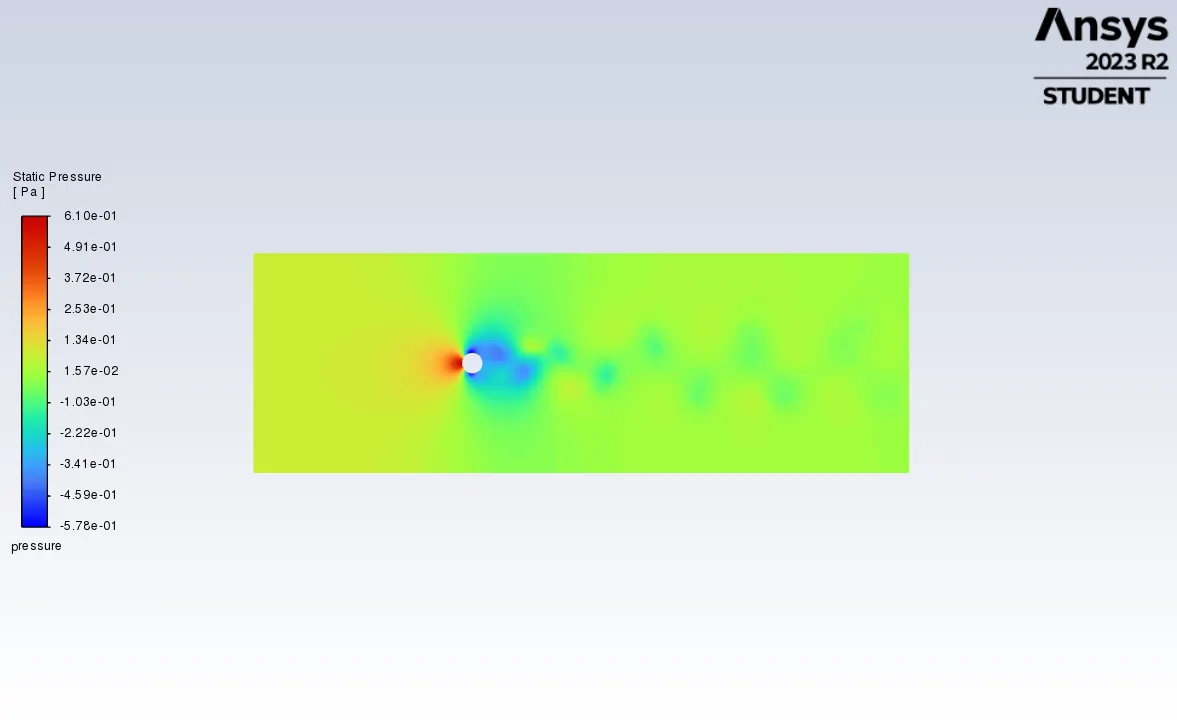
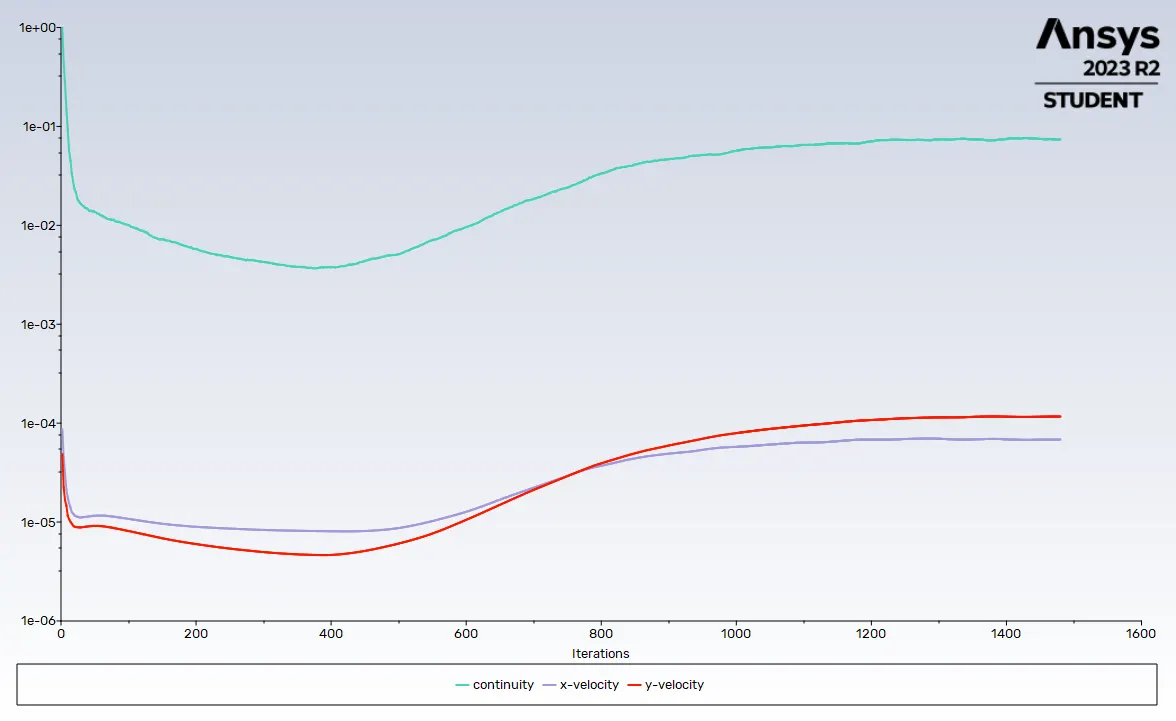
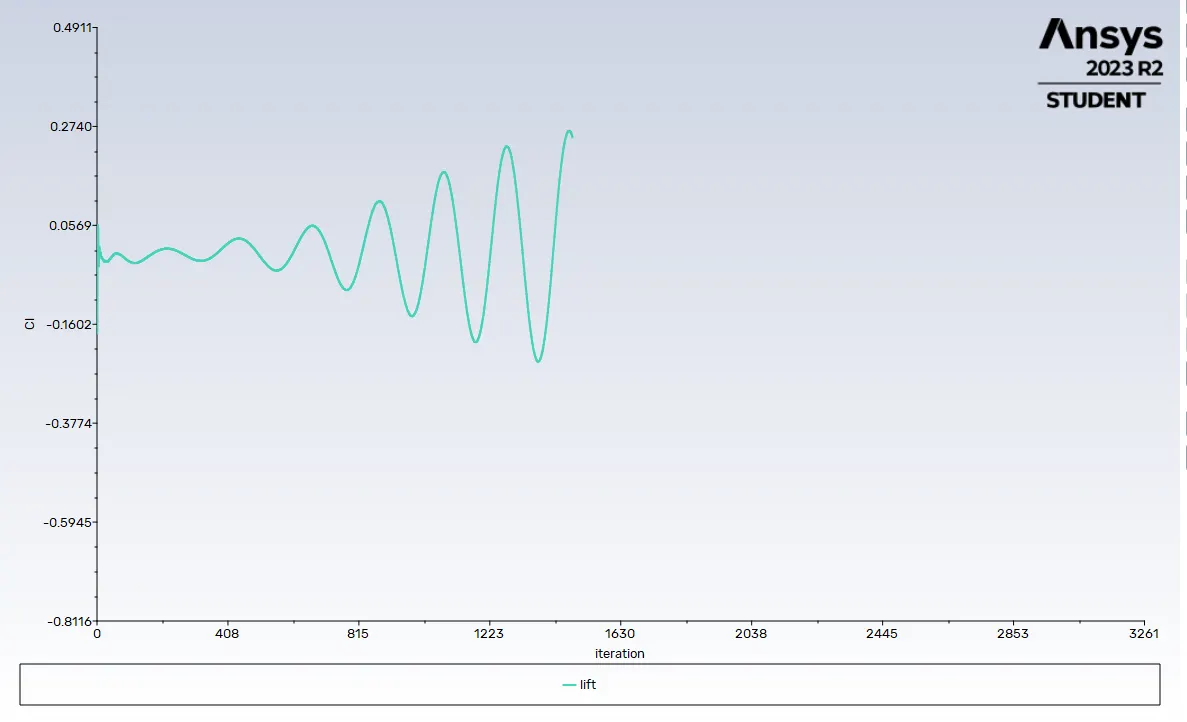
From above we can see that the we have achieved the von karman vortex street at Re=100 and dynamic viscosity= 0.02.
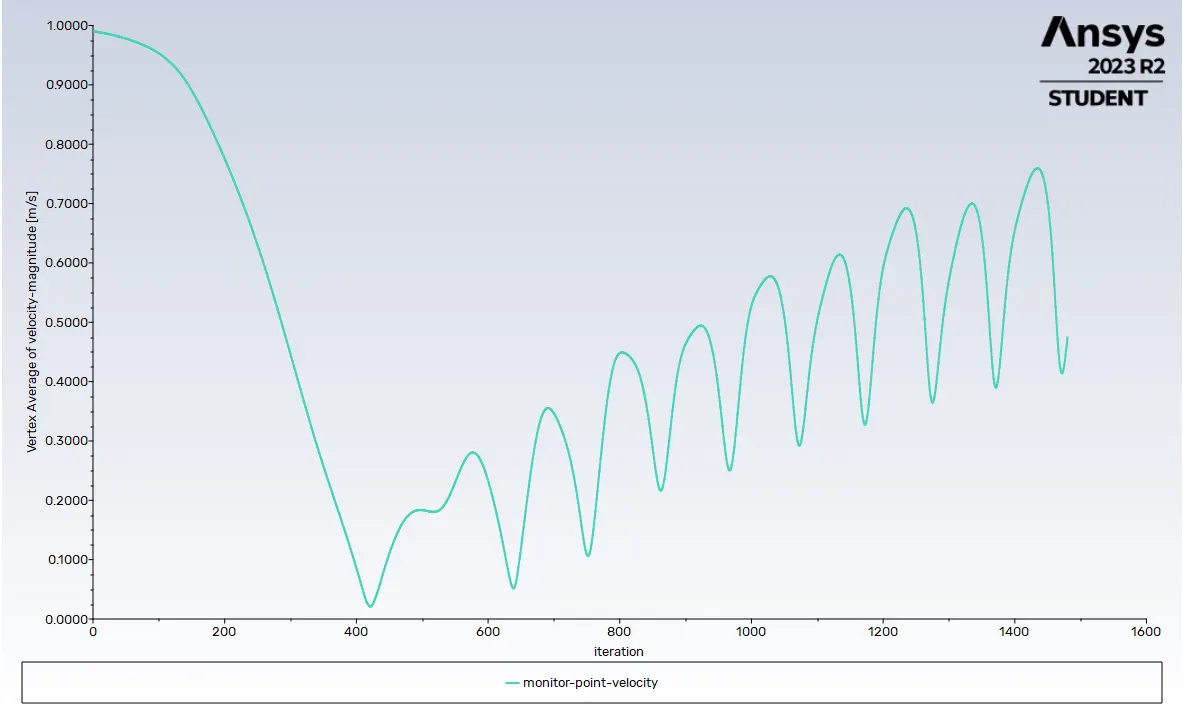
Strouhal number: To know the accuracy of the simulation we need to find the strouhal number. To do that we need to find out frequency of lift. We have plotted the frequency curve of the lift.
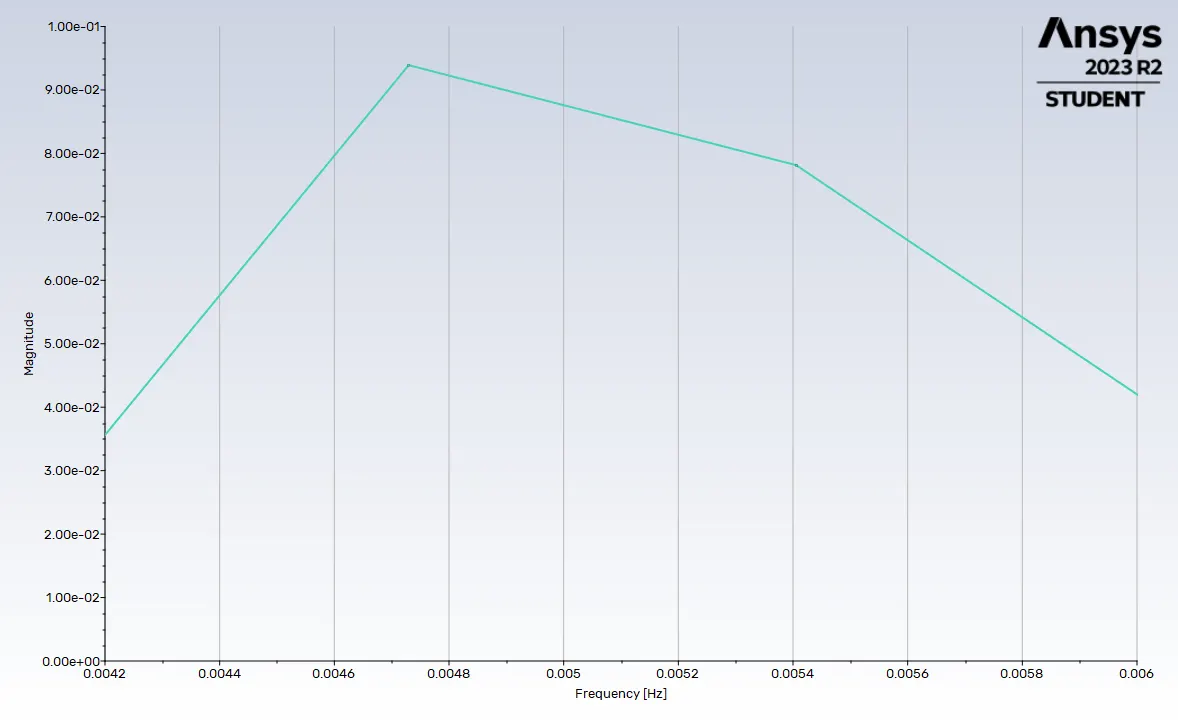
From above graphe we can know the frequency at which the lift is oscillating. In this case the frequency is 0.00466. Now place these value in strouhal number equation we will get a strouhal number.
The Strouhal number (St) is approximately 0.2.
For flow over a cylinder at a Reynolds number (Re) of 100, the typical Strouhal number (St) is indeed around 0.2 to 0.22. So based on that we can conclude that our simulation has achieved low number of the von karman vortex shedding.
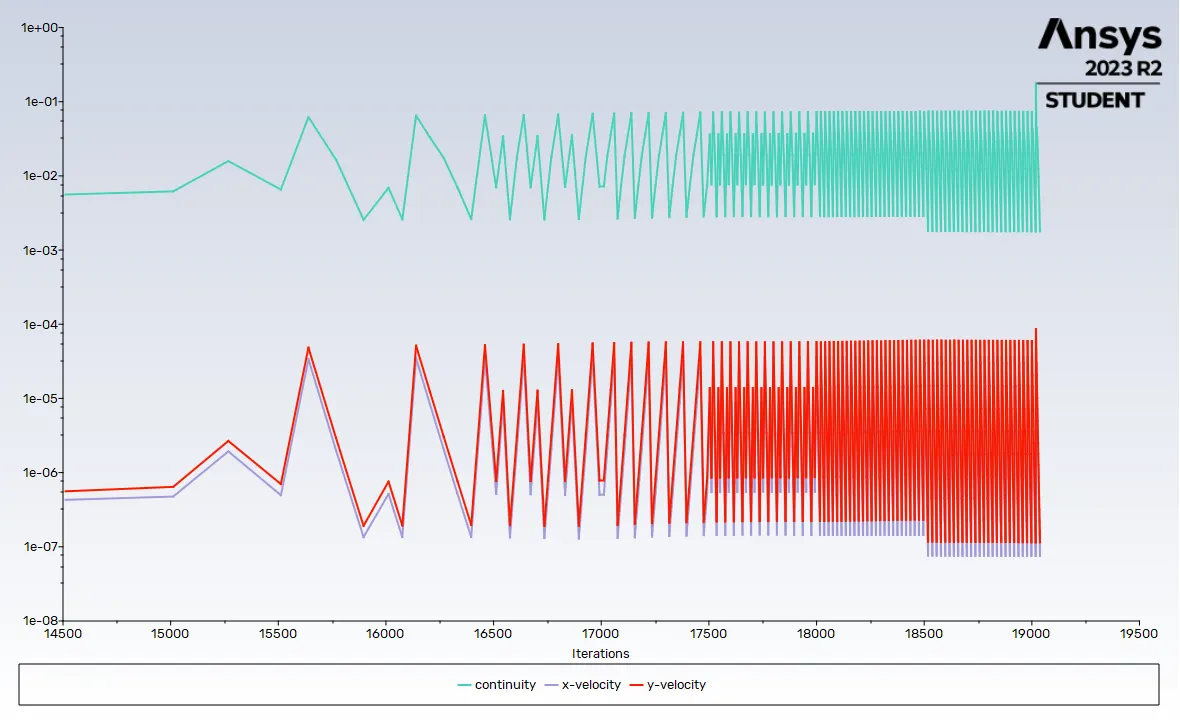
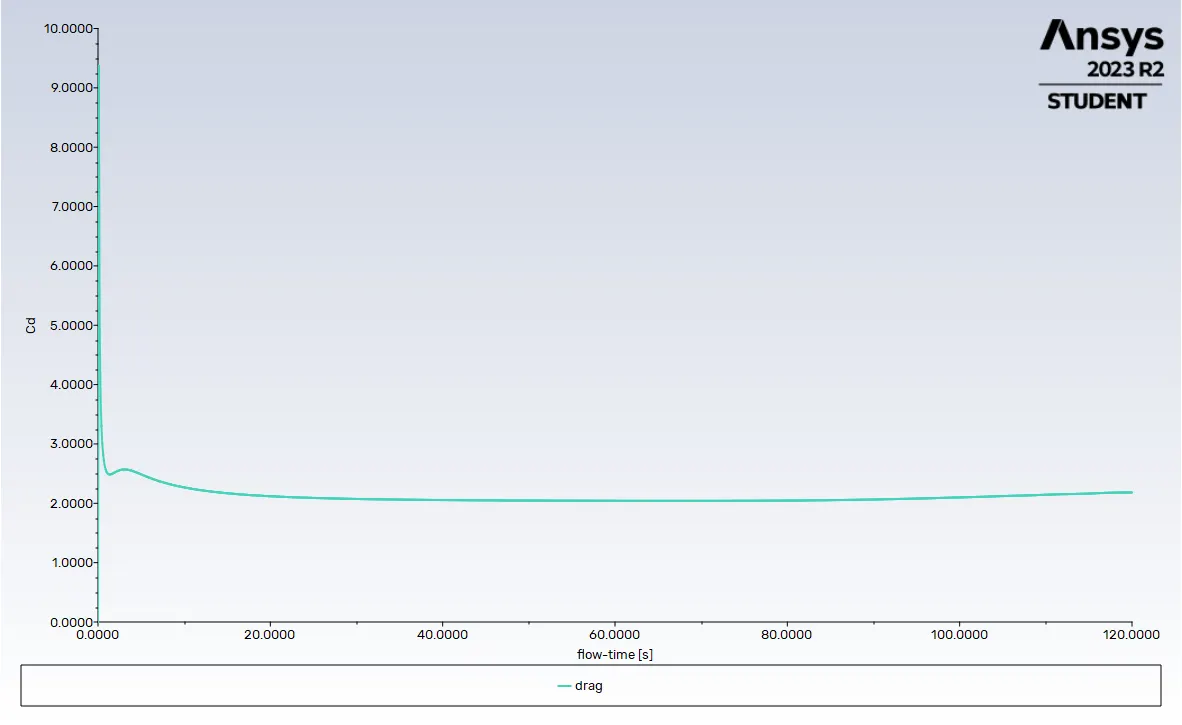
2]Unsteady State:- In the state we are using the unsteady state solver. For Re=100, we have density is 1 kg/m3,Velocity is 1 m/s and cylinder diameter is 2m Based on that we are using the dynamic viscosity of 0. 02 kg/m-s. We are controlling the Re number by changing the dynamic viscosity.
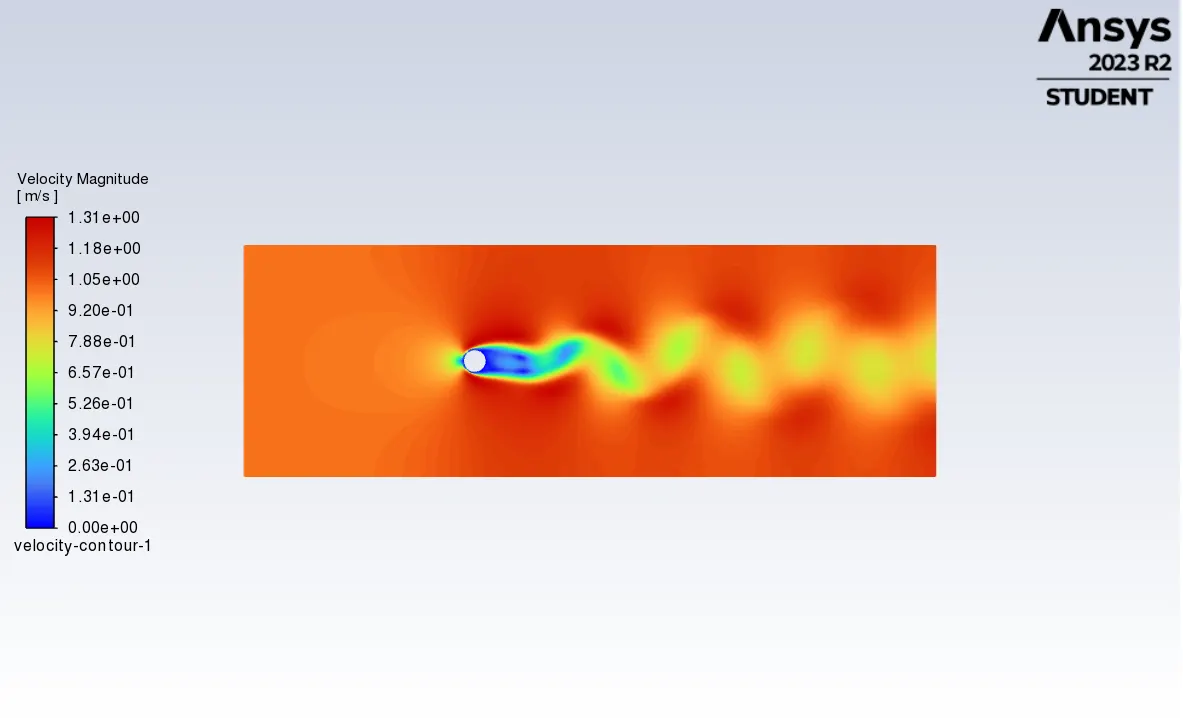
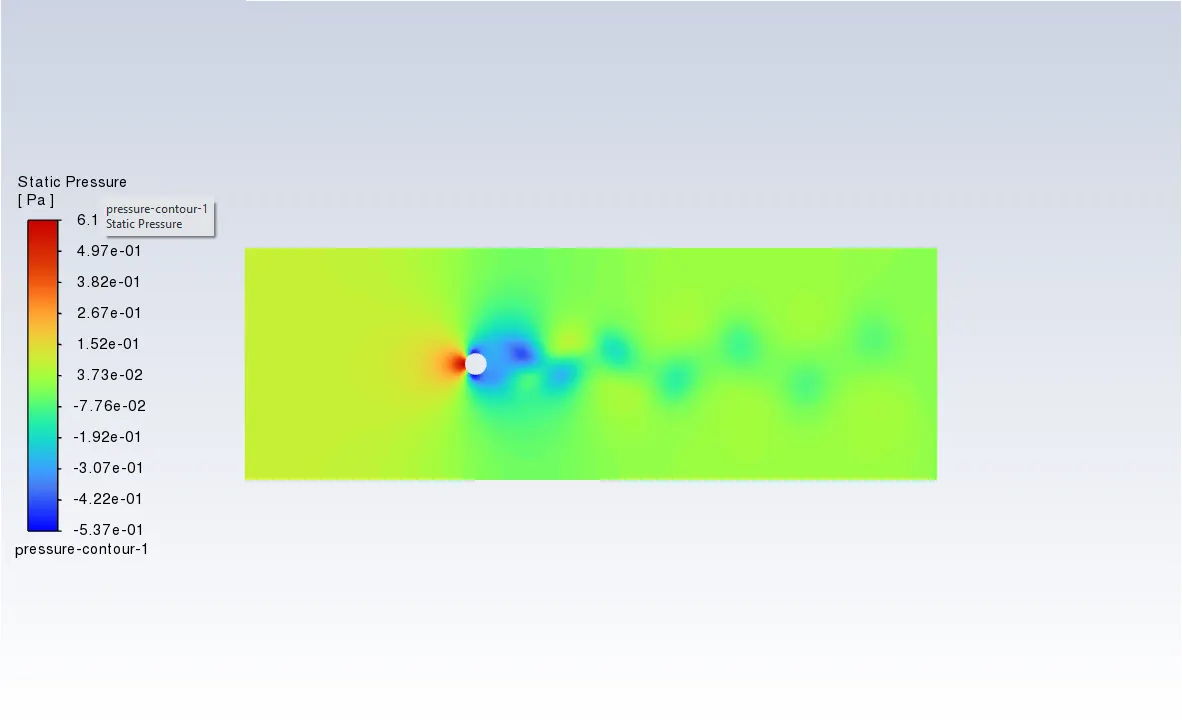
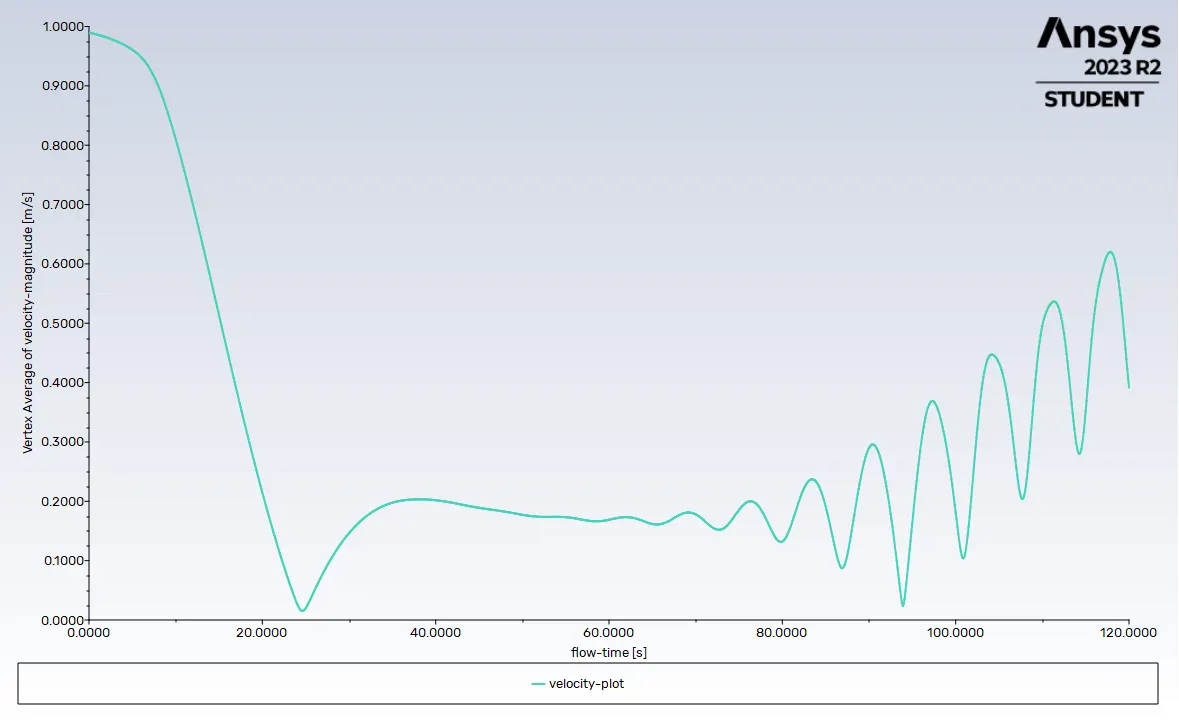
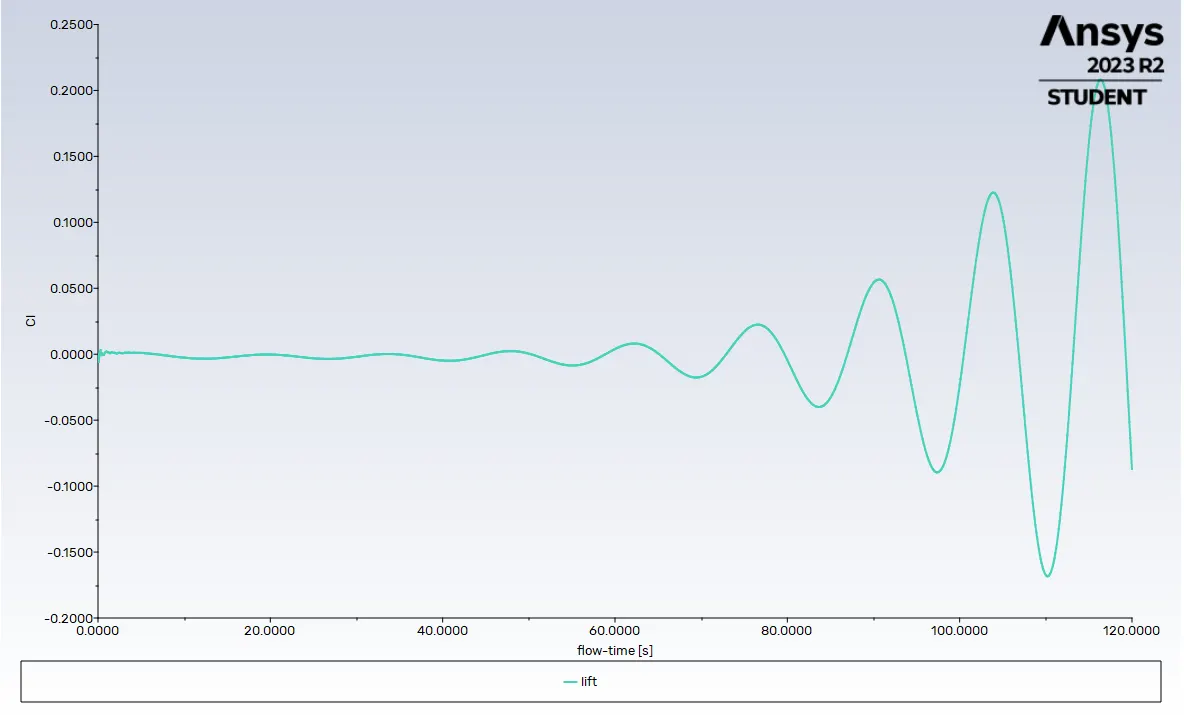
From above we can see that the we have achieved the von karman vortex street at Re=100 and dynamic viscosity= 0.02.
Strouhal number: To know the accuracy of the simulation we need to find the strouhal number. To do that we need to find out frequency of lift. We have plotted the frequency curve of the lift.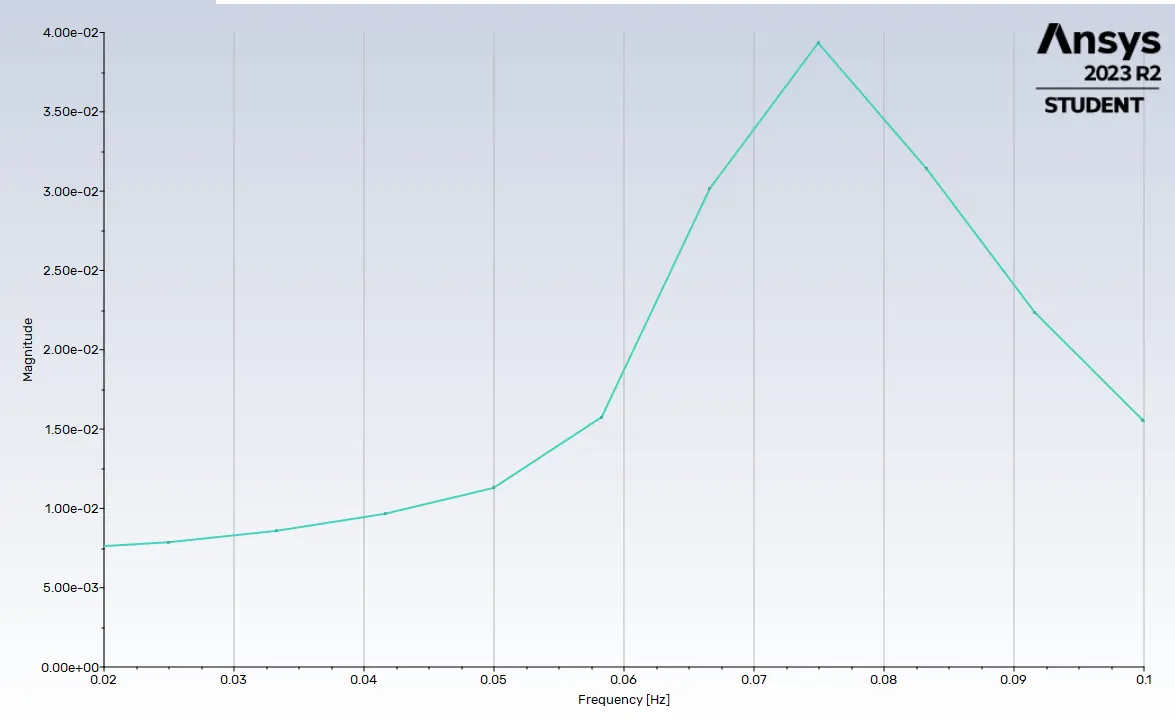
From above graphe we can know the frequency at which the lift is oscillating. In this case the frequency is 0.00743. Now place these value in strouhal number equation we will get a strouhal number.
The Strouhal number (St) is approximately 0.01.
For flow over a cylinder at a Reynolds number (Re) of 100, the typical Strouhal number (St) is indeed around 0.2 to 0.22. So based on that we can conclude that our simulation has achieved low number of the von karman vortex shedding.
Case-II:- Calculate the coefficient of drag and lift over a cylinder by setting the Reynolds number to 10,100,1000,10000 & 100000. (Run with steady solver)
| Re Number | Dynamic Viscosity kg/m-s | Density kg/m | Cd | CL | Vortex Shedding |
|---|---|---|---|---|---|
| 10 | 0.2 | 1 | 5.4506 | -0.0009 | No |
| 100 | 0.02 | 1 | 2.1526 | 0.1095 | Yes |
| 1000 | 0.002 | 1 | 2.4482 | 1.1396 | Yes, Small turbulence apperares |
| 10000 | 0.0002 | 1 | 2.4482 | 1.1395 | Yes, Turbulent Appears. |
| 100000 | 2 x 10^5 | 1 | 2.6775 | -0.5125 | Total Turbulence |
For Steady cases, as Re value increases Cd and Cl values increases as evident from the tabular data achieved from the simulations.
Higher values of Cd implies the wake region is broadening and boundary layer is transitioning from laminar to turbulent.
Higher values of Cl refers to high pressure difference between top and bottom of the body hinting again that the flow is transitioning towards turbulency.
References-
https://www.sciencedirect.com/science/article/pii/S0307904X08000243
Numerical simulation of laminar flow past a circular cylinder,Volume 33, Issue 3, March 2009