Week - 2 - Explicit and Implicit Analysis
REPORT
Aim:-
To provide a detailed explanation of the implicit and explicit analysis schemes. To carry out the calculation for the same using the equation provided. Compare the results and provide a conclusion.
Explanation:-
Implicit and Explicit analyses are widely used in the field of engineering. Based on the nature of the problem which type of analysis should be used is decided. Basically, a problem is divided into 3 stages which are static,quasi-static, and dynamic. If we apply a load and we are interested in finding out what happens after a time duration when the load is released, the analysis is termed static analysis. If we are interested in finding out what happens in the middle of the time duration when the load is applied to the specimen then, the analysis is termed quasi-static analysis. However, if we are keen to find out what happens at the very initial phases of the time duration when the load is applied, then the analysis is termed Explicit dynamics analysis.
Mostly, A static problem is solved using the implicit method. Implicit and Explicit both are used to solve a quasi-static problem. The reason is that implicit alone cannot solve some rigid body problems because of its unconditionally stable nature. Therefore, Explicit methods are sometimes used to solve the problem.
Explicit dynamics Analysis is used to solve problems where the force and acceleration of a system change very rapidly and within a very short amount of time such as a car crash or bird strike on an aircraft.
In LS-DYNA, the software takes a non-linear, transient dynamic problem and solves it using the Explicit method.
Say, for a time step n to (n+1), what is happening we solve using Explicit Dynamics
u(n+1)=u(n)+delta t*F(u(n))
To understand what is the displacement at the time step (n+1) time step, we first take the displacement at the "n" time step and use the force at the time step 'n' to find the displacement. In a nutshell, we use the data of displacement from the previous time step to calculate the displacement at the next stage.
However, In Implicit, to find the displacement at the (n+1) time step we take the displacement at a previous time step and express the force as a function of the present time step i.e,
u(n+1)=u(n)+delta t* F(u(n+1))
u(n)=(I-A)*delta t*u(n+1), where I is Identity matrix.
The physical significance of Explicit Dynamics is that each time step in it is fast, but the method is stable only when the time step 'delta t ' is small hence is called the conditionally stable method.
Problem:-
The problem statement is to show the calculation involved in the explicit and implicit analyses and conclude which is better.
1)Explicit Analysis
We take a bar with tension and gradually increment the loads. Now, we suppose that the force in the bar is a nonlinear function of displacement
f(u)=u^3+9u^2+4u
Therefore, the stiffness of the bar is
k(u)=df/du=3u^2+18u+4
Let u=displacement
f=Internal force
F=External force
k=stiffness
delta u = Incremental displacement
delta F = Incremental externally applied force
Use is made of the equation
deltaF=k*delta u
Step 1-
u0=0 =>k(u0)=4,deltaF=1, delta u1=(deltaF)/k(u0)=1/4=0.25, u1=u0+delta u1=0.25
Step 2-
k(u1)=0.1875+4.5+4=8.68 , deltaF=1, delta u2=(deltaF)/k(u1)=1/8.68=0.115, u2=u1+delta u2=0.25+0.115=0.365
Step 3-
k(u2)=0.388+6.48+4=10.868 , deltaF=1, delta u3=(deltaF)/k(u2)=1/10.868=0.0920, u3=u2+delta u3=0.365+0.0920=0.457.
Fext = deltaF+deltaF+deltaF
=3
fint = u3^3+9u3^2+4u
=(0.457)^3+9*(0.457)^2+4*(0.457)
=0.095+1.879+1.828
=3.802
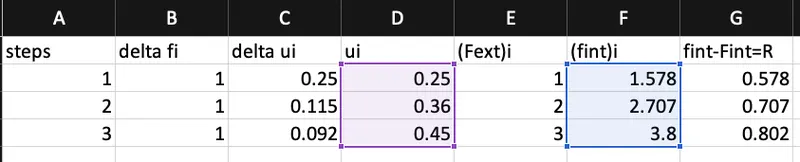
| Steps | delta Fi | delta ui | ui | (Fext)i | (fint)i | fint-Fint=R |
| 1 | 1 | 0.25 | 0.25 | 1 | 1.578 | 0.578 |
| 2 | 1 | 0.115 | 0.36 | 2 | 2.707 | 0.707 |
| 3 | 1 | 0.0920 | 0.45 | 3 | 3.802 | 0.802 |
Implicit
for implicit analysis we use the newton raphson methd to enforce equilibrium before moving to the next step.
We carry out the calculation as follows:-
Residual, R(u)=fint-Fext
Step1-
u0=0, k(u0)=4, delta F= 1, delta u1=(delta F/k(u0))=1/4=0.25
u1=u0+delta u1
=0+0.25
=0.25
Check the Residual, Fext=delta F=1
fint=u1^3+9u1^2+4u1
=(0.25)^3+98(0.25)^2+4(0.25)
=1.578125
R0=fint-Fext
=1.578125-1
=0.578125
ll R0 ll >10^-3 => Newton Raphson Iteration is required
Calculate the correction to u1=u1(0)
del u(1)=-[k(u1(0)]^-1 * R0
=-[3(0.25)^2+18(0.25)+4]^-1*(0.578125)
=8.6875^-1*(0.578125)
=-0.0665467
The update value of u1(1)=u1(0)+delu(1)
=0.25+(-0.0665467)
=0.18345323741
Check the residual again, Fext=1
fint= (u1(1))^3+9(u1(1))^2+4u1(1)
=(0.1834)^3+9(0.1834)^2+4(0.1834)
=1.0428828
R(1)= fint-Fext
=1.0428828-1
=0.0418828
ll R(1) ll > 10^-3 , Newton-Raphson Iteration is necessary
Calculate the new total correction to u1=u1(0)
del u (2)= del u (1)-[k(u1(1)]^-1 * R(1)
del u (2)= - 0.06654676-[3*(0.18345)^2+18(0.18345)^2+4]^-1*0.00418828
=-0.08951004
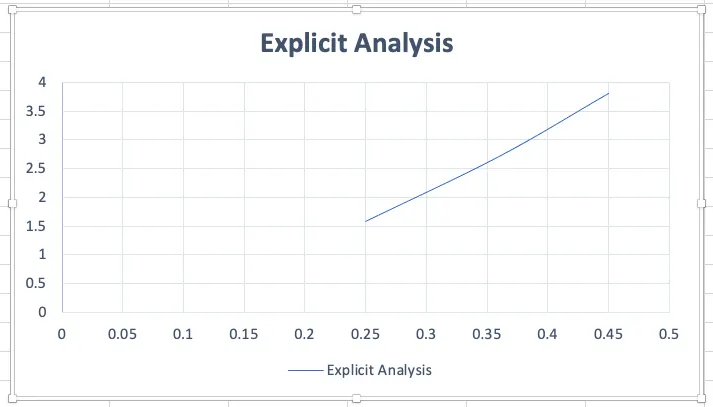
Plots
Conclusion:-
It can be concluded that both methods are necessarily based on the type of analysis. Explicit dynamics analysis deviates more from the true solution when compared to implicit dynamics.