Week - 2 - Explicit and Implicit Analysis
AIM:
To solve the problem and derive solutions using explicit and implicit methods(have a tolerence of 0.001).
EXPLICIT ANALYSIS:
Explicit and implicit techniques are methodologies in numerical analysis that are used to derive numerical approximations to the solutions of time-dependent ordinary and partial differential equations. Explicit methods calculate the state of a system at a later time from the state of the system at the current time. The explicit method is constructed by using the most straight-forward difference approximations for the derivatives in the partial differential equations.
IMPLICIT ANALYSIS:
Implicit methods find a solution by solving an equation involving both the current state of the system and the state of system at later time. Implicit techniques need an additional computation and can be substantially more difficult to implement. Implicit techniques are employed because many issues encountered in practise are difficult, and using an explicit approach would necessitate impractically short time increments  to keep the error in the result bounded. It used newton raphson iteration to reduce the residue in each step inorder to achieve exact solution.
PROBLEM:
F(u) = u3+9u2+4u use this equation and solve using both Explicit and Implicit Methods ( have a tolerence of 0.001).
SOLUTION:
Explicit analysis:
 ---------------equ 1
Step 1:
u0=0 sub in equ 1,
 F=1, k(u0)=F/u1, u1=1/4=0.25
u1=u0+u1, u1=0+0.5=0.5
Step 2:
u1=0.25
k(u1) = 3(0.25)^0.25+(18*0.25)+4 = 8.6875
u2=F/k(u1) = 1/8.6875 = 0.11511
u2=u1+u2 = 0.25+0.11511 = 0.36511
Step 3:
u2=0.36511
k(u2)=3(0.36511^2)+(18*0.36511)+4 = 10.97185
u3=F/k(u2)=1/10.97185=0.09114
u3=u2+u3=0.36511+0.09114 = 0.45625
u3=0.45625
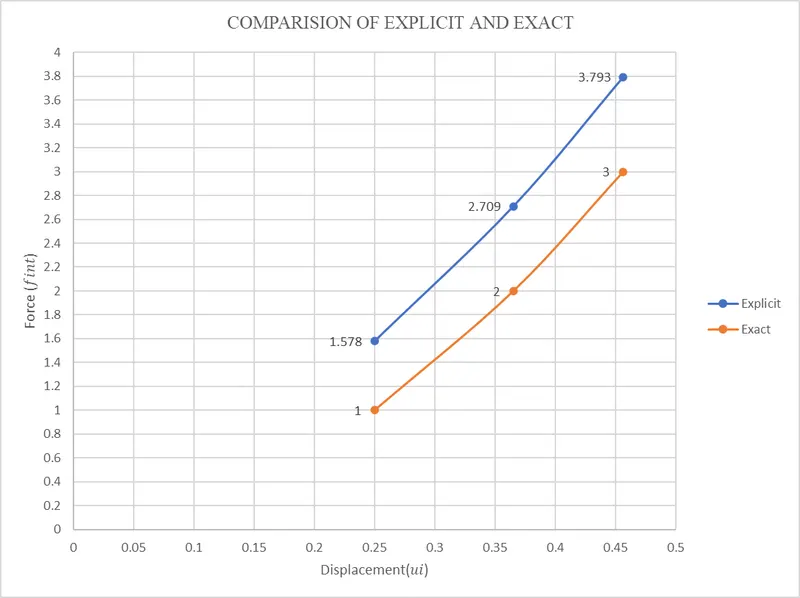
From the above three steps the following results are obtained,
Fext = ∆F + ∆F + ∆F = 3.0
fint=u^3+(9*u^2)+(4*u) = 3.793
| Step | ∆F | ui |
ui | (Fext)i | (fint)i | (Fext)i-(fint)i=R |
| 1 | 1 | 0.25 | 0.25 | 1 | 1.578 | 0.578 |
| 2 | 1 | 0.11511 | 0.36511 | 2 | 2.709 | 0.709 |
| 3 | 1 | 0.09114 | 0.45625 | 3 | 3.793 | 0.793 |
Implicit analysis:
Here the residual value is calculated at each step and set to less than 0.0001 tolerence value for that we use newton raphson iteration. The correction equation is obtained after solving the taylor series and we consider only higher order value then we get,

Step 1:
u0 = 0.0
k(u0) = 4, ∆F = 1, ∆u1 = ∆F/k(u0)=1/4=0.25
u1 = u0 + ∆u1= 0+0.25 = 0.25
Now check the residual,
Fext = ∆F = 1, fint = u^3+9u^2+4u = 1.5781
fint=1.5781
R0= fint − Fext=1.5781-1=0.5781>0.001, so the obtained residual value is greater than the tolerance value so newton raphson iteration is necessary.
calculate the correction to u1 = u1(0)
δu1= -R0/k(u1(0))=-(0.5781/8.6875)=-0.0665
u1(1)=u1(0)+δu1 = 0.25-0.0665=0.18346
Now check the residual, fint= u^3+9u^2+4u=1.04293
R1=fint-Fext = 1.04293-1=0.04293>0.001,
so the obtained residual value is greater than the tolerance value so newton raphson iteration is necessary.
calculate the correction to u1 = u1(0)=0.25,
δu2=δu1-[R1/k(u1(1))]=-0.0665-(0.04293/7.40325)= -0.0723
The updated value of u1(2)=u1(0)+δu(2)=0.25-0.0723 = 0.1777
Now check the residual,
fint=u^3+9u^2+4u=1.000606
R=fint-Fext = 1.000606-1 = 0.000606<0.001
u1=0.1777
Step 2:
Similarly u2=0.29616
Step 3:
Similarly u3=0.3911
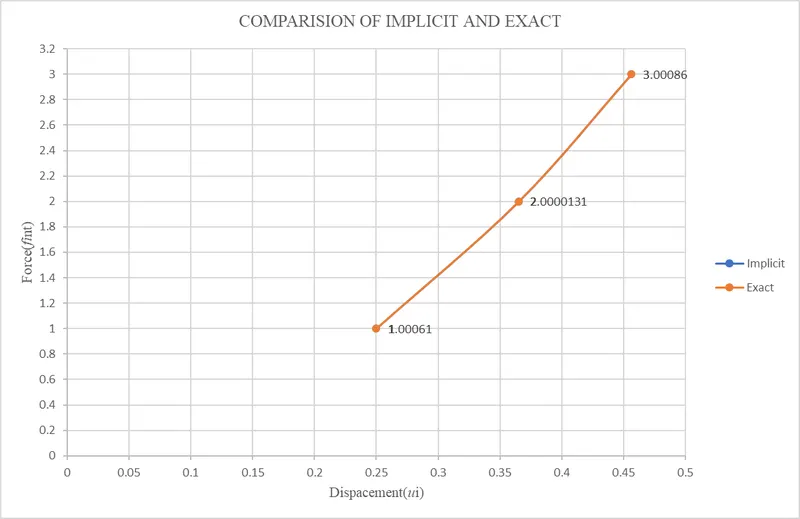
From the above three steps the following results are obtained,
Fext = ∆F + ∆F + ∆F = 3.0
fint=u^3+9u^2+4u = 3.00086
fint∼Fext=0
| Step | ∆F | ui |
ui | (Fext)i | (fint)i | (Fext)i-(fint)i=R |
| 1 | 1 | 0.25 | 0.1777 | 1 | 1.00061 | 0.00061 |
| 2 | 1 | 0.13711 | 0.29616 | 2 | 2.0000131 | 0.0000131 |
| 3 | 1 | 0.10423 | 0.3911 | 3 | 3.00086 | 0.00086 |
COMPARISION BETWEEN EXPLICIT AND IMPLICIT ANALYSIS:
RESULT:
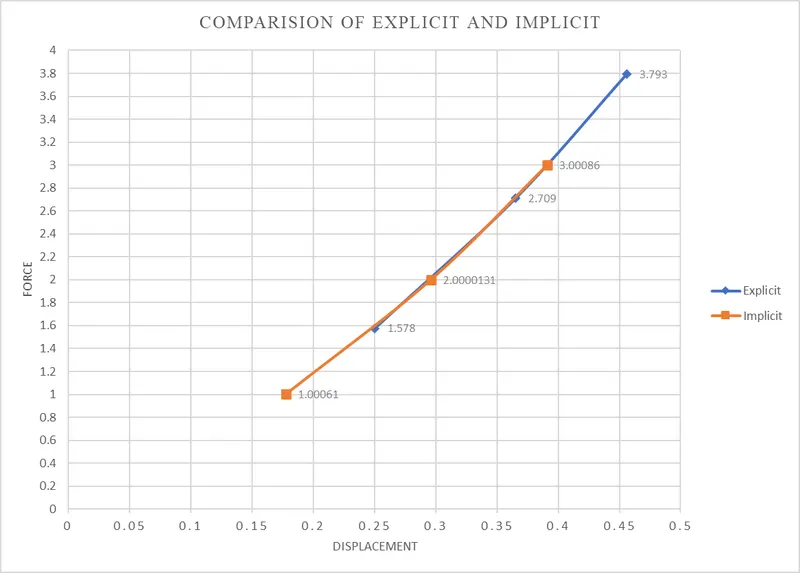
Thus from the explicit vs exact solution graph the deviation is too much but the explicit can quickly find solution with out taking much time. From the implicit vs exact solution graph the implicit line overlaps on exact solution which represents that the implicit analysis can give precise solution but it consumes more time to solve. Thus for the given equation the solution is obtained using implicit and explicit analysis and comparision is done.