Week - 2 - Explicit and Implicit Analysis
AIM:
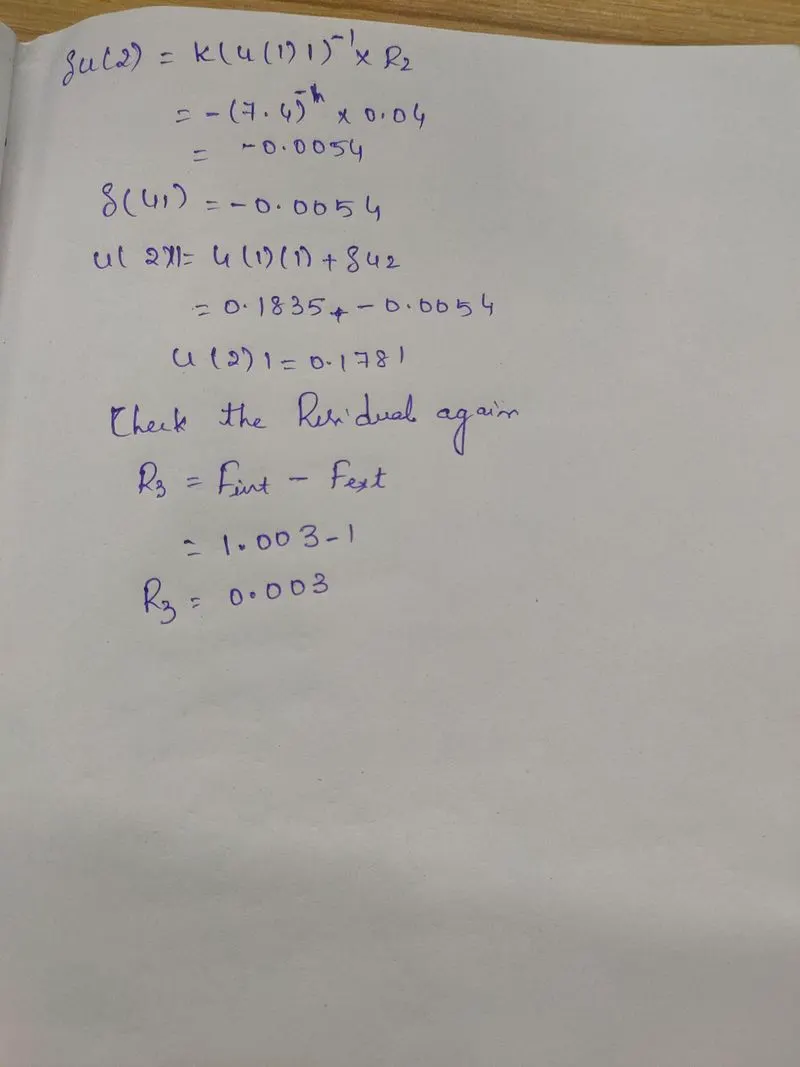
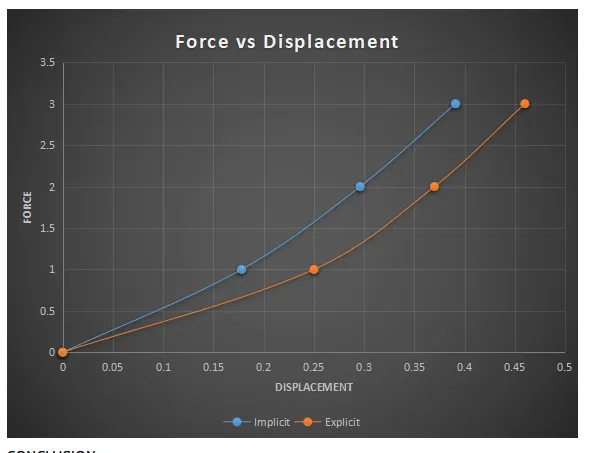
To solve the equation F(u)=u3+9u2+4u in Explicit and Implicit meyhods with tolerance of 0.001.
Implicit Method;
One method of solving for the unknown {x} is through matrix inversion .This is known as implicit analysis.when the problem is non linear, the solution is obtained in a number of steps and the solution for the current step and the solution for the current step in based on the solution from the previous step.For large modles,inverting the matrix is highly expensive and we will require advanced iterative solvers sometimes,this is also known as the backward Euler intergration scheme.The solution are unconditinally stable and facilitate large time steps.Despite this advantages the implicit method can be extremely time sonsuming when solving dynamic and non linear problems.
Explicit Analysis:
Explicit analyses aim to solve for acceleration.In most of the cases the mass matrix is considered as lumped and thus a digonal matrix.Inversion of a diagonal matrix is straight forward and includes inversion of the terms on the diagonal only.Once the accleration are calculated at the nth step the velocity at n+1/2 step and displacement at n+1 step are caluclated accordingly.In these calculation the scheme is not unconditionally stable and thus smaller time step are required.To more precise ,the time in an explicit finite element analysi must be less than the courant step.while implicit analyses have no such limitations.
| Implicit | Explicit |
| It deals static and dynamics problems | It deals dynamic and shock probems |
| It is always stable | It is conditional stability |
| It is a global resolution need to convergence | It is element caluclation |
| It is too expensive | It is less exensive |
| Time step is very large | Time step is very low |
| It is low Robustness | It is high Robustness |
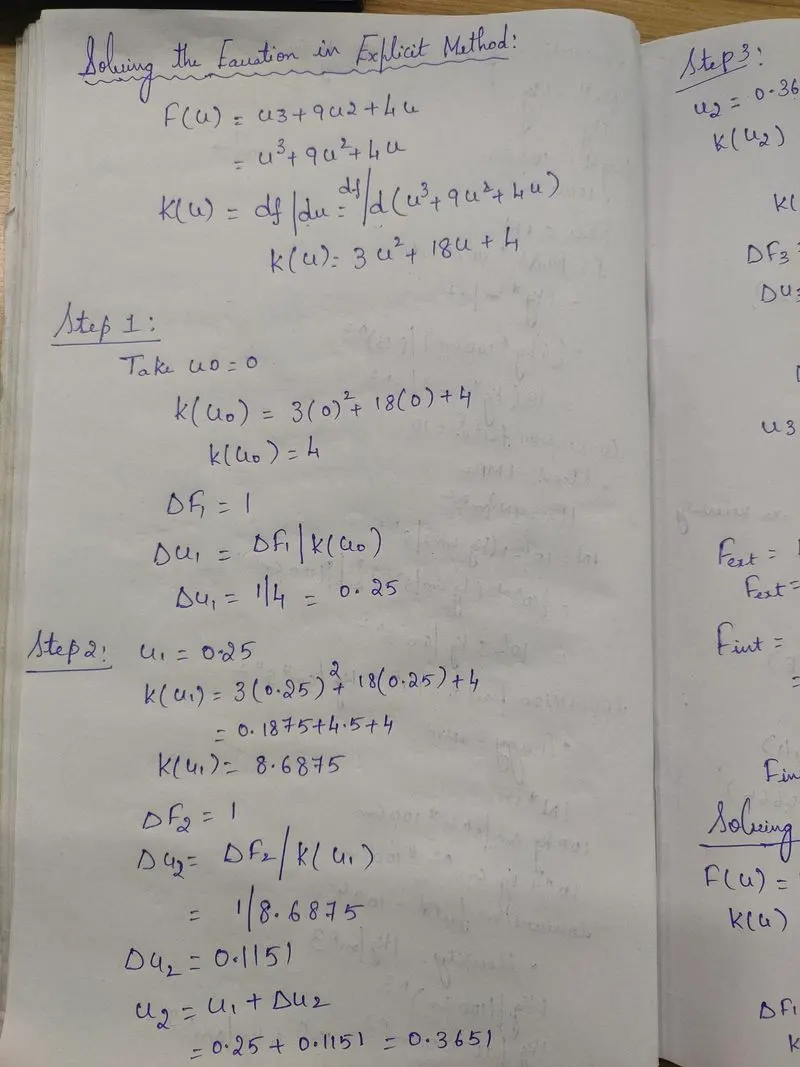
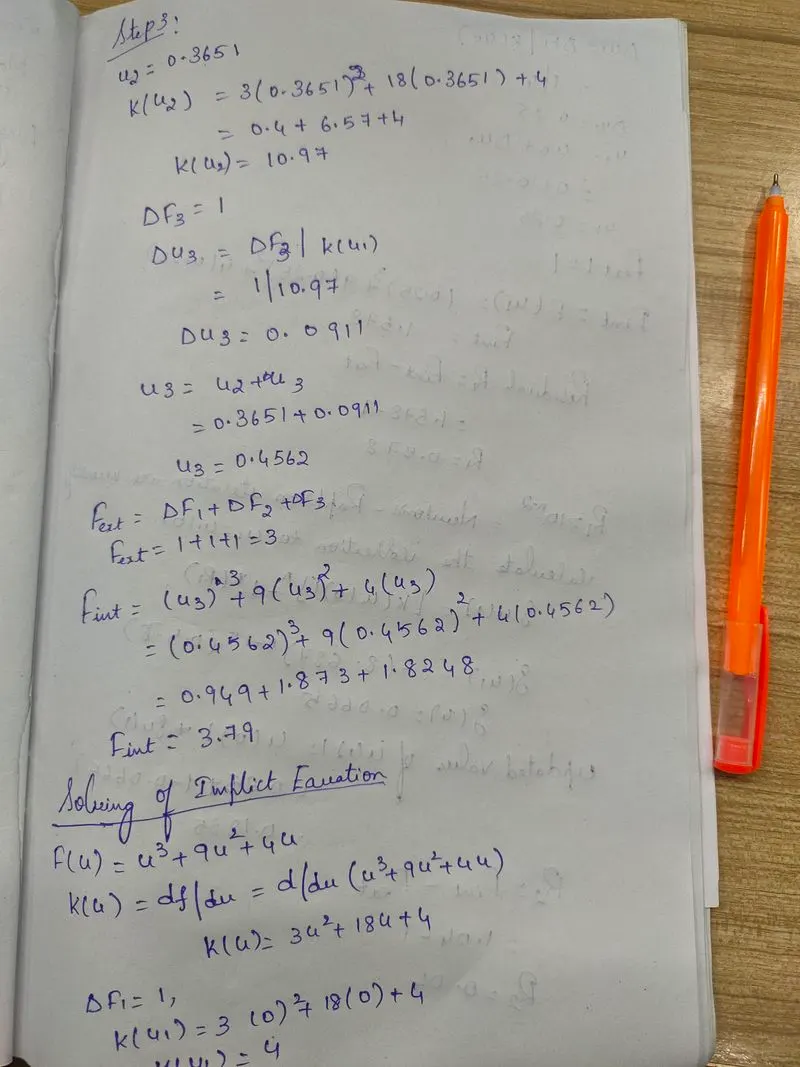
From the above equation were showed that the external and internal force are not in equilibrium.Because external force is not equal to internal force.

Implicit
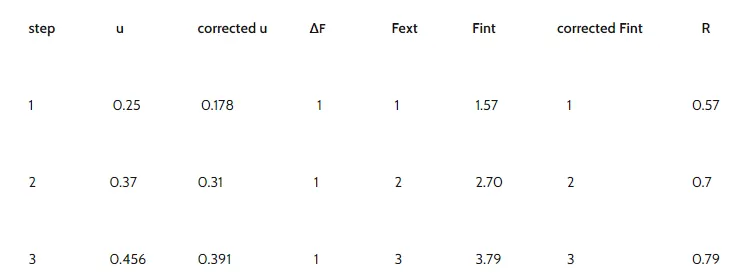
Conclusion
Hence the Implicit and Explicit we calculated under third order polynomial problem of under tensile strain