Explicit and Implicit Analysis
AIM:
To study the difference in Implicit and Explicit Analysis by solving an equation.
OBJECTIVES:
To use f (u) = u3+9u2+4u the equation and solve using both implicit and explicit method with tolerance of 10-2.
SYMBOLS AND ABBREVATIONS:
∆F = Incremental force
K = Stiffness
u = Displacement
∆u = incremental displacement
F = External force
f = Internal force
R = Residual Forces
GIVEN DATA:
Force as a function of displacement: f (u) = u3+9u2+4u
Stiffness : K (u) = df/du = 3u2+18u+4
Tolerance : 10-2
ESSENTIAL FORMULAS:
Stiffness Method expression : ∆F = K∆u
Newton-Raphson iterations for residual corrections: δuj-1 = δuj -[k(uj(0))]-1 x R0
Current Displacement : ui = u(i-1) + ∆ui
PROBLEM:
Explicit:
In Explicit dynamic analysis, mostly the nodal accelerations are solved directly as the inverse of the diagonal mass matrix times the net nodal force vector. At time t=0, we know the value of u and v and use them to compute M and K and use them to compute acceleration at time t=n, from which velocity and displacement can be calculated at time n+1. Then from displacements comes strain and from strain comes stress.
Explicit analysis works well with Non-linearities.
Using relation, ∆F= K∆u,
f (u) = u3+9u2+4u …. (i)
K (u) = df/du = 3u2+18u+4…. (ii)
Step (1)
Put, u=0 in eqn (ii)
K (u=0) = 3x02+18x0+4 = 4
∆F = 1
∆u1 = ∆F/K (u=0) = ¼ = 0.25
u1 = u0 + ∆u1 = 0.25
f = (0.25)3 + 9x(0.25)2 + 4x0.25 = 1.578
Step (2)
Put, u1 = 0.25 in eqn (ii)
K (u=0.25) = 3x(0.25)2 + 18x0.25 + 4
= 8.6875
∆u2 = ∆F/K (u=0.25) = 1/8.6875 = 0.1151
u2 = u1 + ∆u2 = 0.3651
f = (0.3651)3 + 9x(0.3651)2 + 4x0.3651 = 2.708
Step (3)
Put, u2 = 0.3651 in eqn (ii)
K (u=0.3651) = 3x(0.3651)2 + 18x0.3651 + 4
= 10.9716
∆u3 = ∆F/K (u=0.3651) = 0.09114
u3 = u2 + ∆u3 = 0.4562
f = (0.4562)3 + 9x(0.4562) + 4x0.4562 = 3.7928
Finally, to determine whether the analysis is in equilibrium,
F = ∆F + ∆F + ∆F = 3
f = 3.7928
F≠ f, so they are not in equilibrium.
|
Step i |
∆Fi |
∆ui |
ui |
(F)i |
(f)i |
f – F = R |
|
1 |
1 |
0.25 |
0.25 |
1 |
1.578 |
0.578 |
|
2 |
1 |
0.1151 |
0.3651 |
2 |
2.708 |
0.708 |
|
3 |
1 |
0.09114 |
0.4562 |
3 |
3.7928 |
0.7928 |
Implicit:
Implicit analysis requires a numerical solver to invert the stiffness matrix once and even several times over the course of load or time step. Matrix inversion is an expensive operation, especially in case of large models. Implicit method uses Newton-Raphson iterations to enforce equilibrium.
Implicit transient analysis has no inherent time limit on the size of the time step.
f (u) = u3+9u2+4u …. (i)
K (u) = df/du = 3u2+18u+4…. (ii)
Step (1)
Put, u=0 in eqn (ii)
K(u=0) = 3x02 + 18x0 + 4 = 4
∆u1 = ∆F/K (u=0) = ¼ = 0.25
u1 = u0 + ∆u1 = 0.25
f = (0.25)3 + 9x(0.25)2 + 4x0.25 = 1.578
R = f – F = 1.578 – 1 = 0.578 > 10-2
So Newton Raphson iterations are necessary,
Now, u1 = u1(0)
δu(1) = -[k(u1(0))]-1 x R0
= -[(3x0.252) + (18x0.25) + 4]-1 x 0.578
= -0.0665
Update, u1(1) = u1(0) + δu(1)
= 0.25 – 0.0665
= 0.1835
Check Residual again, R1,
F = 1,
f = (0.1835)3 + 9x (0.1835)2 + 4x0.1835
= 1.0432
R1 = f – F = 1.0432 – 1 = 0.0432 > 10-2, another Newton-Raphson iteration needed.
Now, u1 = u1(1),
δu(2) = δu1-[k(u1(1))]-1 x R1
= (-0.0665)-[(3x0.18352) + (18x0.1835) + 4]-1 x 0.0432
= -0.0723
Update, u1(2) = u1(0) + δu(2)
= 0.25 – 0.0723
= 0.1777
Check Residual again, R2,
F= 1,
f = (0.1777)3 + 9x(0.1777)2 + 4x0.1777
= 1.0006
R1 = 1.0006 – 1 = 0.0006 < 10-2
Therefore, no further iterations needed, final u1 = 0.1786
|
Step i |
∆Fi |
∆ui |
ui |
Fi |
fi |
f – F = R |
|
1 |
1 |
0.25 |
0.1777 |
1 |
1.0006 |
0.0006 |
|
2 |
1 |
0.1374 |
0.2966 |
2 |
2.0042 |
0.0042 |
|
3 |
1 |
0.1041 |
0.3911 |
3 |
3.0008 |
0.0008 |
Implicit Vs Explicit:
|
Implicit |
Explicit |
|
|
Deformation |
Small |
Large |
|
What causes large deformation |
Pure Force, dynamic |
Velocity/acceleration with mass and inertia |
|
K matrix inversion |
Yes |
No |
|
Time step size |
Large |
Small |
|
What limits the timestep |
Accuracy |
Stability |
|
Cost per timestep |
Large |
Small |
|
What dominates the cost |
Matrix inversion |
Element processing |
|
Cost increasing for doubling mesh density |
X128 |
X16 |
|
Parallel processing |
Possible |
Not possible |
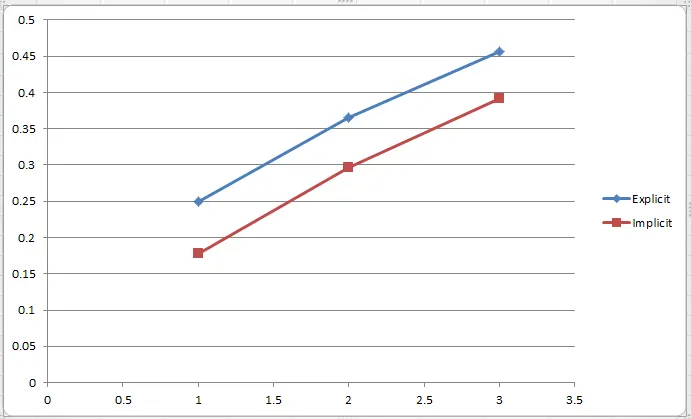
GRAPH:
Force vs Displacement:
X axis: Force
Y axis : Displacement
CONCLUSION:
The Implicit and Explicit analysis is performed for the given equation using numerical method.
Implicit method is more accurate but time consuming and depends on element size and time step.
Explicit analysis deviates slightly from exact result and needs more iterations to obtain good results.