Week - 2 - Explicit and Implicit Analysis
AIM:
To solve the given equation F(u)=`u^3`+`9u^2`+4u using both Implicit method and Explicit method of solving.
OBJECTIVE:
Solve the given equation by using the reference in both Explicit solving method and Implicit solving method with the tolerance value as 0.01 or `10^-2`
PROCEDURE:
Implicit and Explicit analysis differ in the approach to time incrementation. In Implicit analysis each time increment has to converge, but you can set large time increments. Explicit on the other hand doesn’t have to converge each increment, but for the solution to be accurate time increments must be small.
EXPLICIT METHOD :
The explicit dynamics procedure performs a large number of small time increments efficiently. An explicit central-difference time integration rule(Euler's method) is used; each increment is relatively inexpensive because there is no solution for a set of simultaneous equations. In general, the explicit method doesn't care whether for each increments, the equilibrium is achieved or not and so, If there are any errors in the initial increments it maginifies in the explicit method.This is why the explicit solvers need very small time increments.This makes the explicit method conditionally stable.
In explicit dynamic analysis, nodal accelerations are solved directly (not iteratively) as the inverse of the diagonal mass matrix times the net nodal force vector where net nodal force includes contributions from exterior sources (body forces, applied pressure, contact, etc.), element stress, damping, bulk viscosity, and hourglass control. Once accelerations are known at time n, velocities are calculated at time n+1/2, and displacements at time n+1. From displacements comes strain. From strain comes stress. And the cycle is repeated.
In explicit method, there is no need of Inversion of the stiffness matrix unlike the Implicit method which would be more hectic since the Stiffness matrix size is propotional to the total degrees of freedom of all the nodes. However In explicit method, the lumped mass matrix inversion is very easier since it a just an inversion of the diagonal matrix. The explicit method handles non-linearities at easy such that material and contact non linearities are done easily in explicit solvers.
Both the Explicit and the Implicit method needs the data from the previous increment. The explicit method will have direct caculation of dependant variable from the known values of independant variables. It calculates the future condition of the system by using the present condition of the system.
IMPLICIT METHOD :
In Implicit method the analysis is carried out both in Incremental and Iterative schemes. The Implicit method uses Newton-Raphson method to solve all the problems. The Implicit method can solve Static problems more accurately and efficiently than the dynamic problems. These Implicit methods are said to be unconditionally stable. In nonlinear implicit analysis, solution of each step requires a series of trial solutions (iterations) to establish equilibrium within a certain tolerance.
Since the Implicit method uses Newton-Raphson differentiation scheme, it has a differentiation term in it. It's general form is given by :
`xunderset(n+1)` = `xundersetn`- (`fxundersetn`/`f'xundersetn`)
Implicit solver will solve the problem in increments and iterations in which in suppose in the first increment if the static equilibrium condition is not acheived the solver will reduce the load applied to some percentage and will re-initiate the increments such that the error stays within the given tolerance limit. In this case, since the increments are re initiated and in each and every step the equilibrium is checked, It makes the process much larger and makes it more costlier per timestep when compared to the explicit method.
Since the non linearities would affect the stiffness matrix, It is not an ideal way to be solved nonlinear problems in Implicit since it has inversion of the stiffness matrix. The Implicit method would calculate the dependant variables based on the values of the known quantities in the present and the future increment of the system.
Here are the distnguishing factors that differs from the Explicit and the Implicit Method :
| Factors | Implicit method | Explicit method |
| Deformation type | Small Deformation | Large deformation |
| Cause for large deformation | Pure force, Dynamic | Velocity & acceleration with mass(momentum) & inertia(angular momentum) |
| Matrix inversion | Stiffness matrix inversion (tedious) | Lumped mass matrix (Diagonal matrix) |
| Time step size | It can be large, arbitrary | Smaller time step to be used since we consider acceleration to be almost constant over the timestep. |
| Limitation for time step | Accuracy | Stability |
| Cost per timestep | Expensive | Relatively Inexpensive |
| Cost dominating factor | Stiffness matrix inversion | Elemental processing |
| Parallel Processing | Possible | Not Possible |
| Conditions | Unconditionally stable | Conditionally stable |
| Method used for solving problems | Newton-Raphson method | Euler's method |
Given equation F(u)=`u^3`+`9u^2`+4u
Solution in Explicit method :
F(u)=`u^3`+9`u^2`+4u
K(u)= `frac(dF) (du)`= 3`u^2`+18u=4
Tolerance = 0.01 ; Each increment is about 1, so `triangle F`= 1
u = displacement ; K = stiffness ; `f underset i`= Internal force ; `F underset e`= External force applied
`triangleu`= Incremental displacement ; `triangleF`= 1 ( Incremental ext.applied force)
We know that `triangleF`= K`triangleu`
Now, take `u underset0`= 0 and substitute in K(u)
K(`u underset0`) = 3 (`0^2`) + 18 (0) + 4 = 4. So `u underset0`= 4
For the first increment, use `u underset0` to find `u underset1`
`triangleu underset1`= `frac (triangleF) (Ku underset0` = `frac 1 4`= 0.25
`triangleu underset1`= 0.25
Now, `u underset1`= `u underset0`+ `triangleu underset1`= 0+0.25 = 0.25
`u underset1`= 0.25
Now, for 2nd increment, use `u underset1`to find `u underset2`
K(`u underset1`) = 3(`0.25^2) + 18 (0.25) + 4 = 8.6875
K (`u underset1`) = 8.6875
Now, `triangleu underset2`= `frac (triangleF) (Ku underset1`= `frac 1 8.6875` = 0.1151
`triangle u underset2`= 0.1151`triangleFunderseti`
so, `u underset2`= `u underset1`+ `triangleu underset2`= 0.25+0.1151 = 0.3651
`u underset2`= 0.3651
Similarly, K(`u underset2`) = 3 (`0.3651^2`)+18(0.3651)+4 = 10.9716
K(`u underset2`) = 10.9716
Now, `triangleu underset3`= `frac (triangleF) (Ku underset2`= `frac 1 10.9716`
`triangleu underset3`= 0.0911
so, `u underset3`= `u underset2`+ `triangleu underset3`= (0.3651+0.0911) = 0.4562
`u underset3`= 0.4562
After finding the incremental displacements at each increment, let's see whether the system is in equilibrium.
Check the Residue by comparing the `funderseti`and `Fundersete`values.
`Fundersete`= `triangleF+triangleF+triangleF`= 1+1+1 = 3
For `funderseti` use the final increment displacement value and substitute in K(u) to find the total internal force at the final increment.
`f underseti`= (`0.4562^3`)+9(`0.4562^2`)+4(0.4562) = 3.792
R = `funderseti`- `Fundersete`= 3.792-3 = 0.792
Since `funderseti` `ne` `Fundersete`
This shows that the system is not in an equilibrium.
| STEP i | `triangleFunderseti` | `triangleu underseti` | `u underseti` | `F undersete` | `f underseti` | R=`funderseti`-`Fundersete` |
| 1 | 1 | 0.25 | 0.25 | 1 | 1.578 | 0.578 |
| 2 | 1 | 0.1151 | 0.3651 | 2 | 2.708 | 0.708 |
| 3 | 1 | 0.0911 | 0.4562 | 3 | 3.792 | 0.792 |
Solution in Implicit Method :
F(u)=`u^3`+9`u^2`+4u
K(u)= `frac(dF) (du)`= 3`u^2`+18u=4
Tolerance = 0.01 ; Each increment is about 1, so `triangle F`= 1
u = displacement ; K = stiffness ; `f underset i`= Internal force ; `F underset e`= External force applied
`triangleu`= Incremental displacement ; `triangleF`= 1 ( Incremental ext.applied force)
We know that `triangleF`= K`triangleu`
Now, Take `u underset0`= 0; K(`u underset0`) = 3`(0^2)`+18(0)+4 = 4
so, K(`u underset 0`) = 4
`triangle u underset1`= `frac (triangleF) (Ku underset0`= `frac 1 4`= 0.25
So, `triangleu underset1`= 0.25 Now, `u underset1`= `u underset0`+`triangleu underset1`= 0+0.25
`u underset1`= 0.25
Now, Substitute this value in F(u). We say `f underset (i)` as the Internal force and `F undersete`as Applied external force
`f underset i`= `(0.25)^3`+9`0.25^2`+4(0.25)
so `f underset i`= 1.578. Now we need to check whether the Residue R is within the tolerance range.
R = `f underseti`- `F underset e`= 1.578-1 = 0.578 > 0.01
So,Iteration is necessary.
Expanding the taylor series about current displacement `u^j` gives:
`R^(j+1)` = `R^j`(`u^j`)+ `frac (dR(u^j)) (du)`. `partialu^(j+1)`+.... = `R^j`+ K(`u^j`)`partialu^(j+1)`+...
Neglecting the higher order terms & setting `R^(j+1)` = 0, solving for `partialu^(j+1)`
`partialu^(j+1)`= - `[K(`u^j`)]^-1`. `R^j`
so,
`partialu^(1)`= - `[K (u underset1 (0)) ]^-1`. `R^0`
K(u)= 3`u^2`+18u+4 ; `u underset1`= 0.25; `R^0`=0.578
So,
`partialu^1`= -`(8.6875)^-1`* 0.578 = -(0.1151)*0.578 = -0.0665
`partialu^1`= -0.0665`u underset 3`
Now, update the value of `u underset1`
`u underset1`= `u underset1 0`+ `partialu^1`
`u underset1`= 0.25+(-0.0665) = 0.1835
`u underset1 (1)`= 0.1835
Now,to check the residue value use this `u underset1 1`in the equation.
`f underseti`= (`0.1835^3`)+9(`0.1835^2`)+4(0.1835) = 1.0432
`Fundersete`at 1st increment is 1
so, R=`funderseti`- `Fundersete`= 1.0432-1 = 0.0432>0.01
Again Iteration is needed since the tolerance value is crossed.
Iteration2:
`partialu^2`= `partialu^1`- `[K(u underset1 1)]^-1`.`R^1`
`partialu^2`= (-0.0665)-`(7.4040)^-1`*(0.0432)
`partialu^2`= (-0.0665)-(0.1351)*0.0432 = -0.0723
`partialu^2`= - 0.0723
Now, update this value to get the u value
`u underset1 2`= `u underset1 0`+ `partialu^2`
`u underset1 2`= 0.25+(-0.0723) = 0.1776
`u underset1 2`= 0.1776
Now, check the residue value using this `u underset1 2`value
`f underseti`= `(0.1776)^3`+9 `(0.1776)^2`+4(0.1776)
`f underseti`= 1.00035
R = `f underseti`- `F undersete`= 1.00035-1
R = 0.00035 < 0.01
So, the final value of `u underset1`is 0.1776
Similarly we need to derive the values for `u underset2`& `u underset3`
To find the value of `u underset2`: use the final `u underset1`value
K(`u underset1`)= 3`(0.1776^2)`+18(0.1776)+4 = 7.291
K(`u underset1`)= 7.291
`triangleu underset2`= `frac (triangleF) (Ku underset1` = `frac 1 7.291`= 0.1371
`triangleu underset2`= 0.1371
`u underset2`= `u underset1`+`triangleu underset2` = 0.1776+0.1371 = 0.3147
`u underset2`= 0.3147
Now, check the residue value using this `u underset2`value
`f underseti`= `(0.3147^3)`+9`(0.3147)^2`+4(0.3147)= 2.1812
`f underseti`= 2.1812
`F undersete`= 2 at the second increment, so comparing these two,
R = `f underseti`- `F undersete`= 2.1812-2=0.1812
R = 0.1812>0.01
So, Iteration for `u underset2`is needed.
`partialu underset2 1`= - `[Ku underset2 0]^-1`. `R^2`
`partialu underset2 1`= - `[3 (0.3147)^2+18(0.3147)+4]^(-1)`* (0.181) = - `(9.9617)^(-1)`* 0.181 = -(0.10038)*(0.181)
`partialu underset2 1`= -0.0182
Now, update this value to get the `u underset2`value:
`u underset2 1`= `u underset2 0`+ `partialu underset2 1` = 0.3147+(-0.0182) = 0.2965
`u underset2 1`= 0.2965
Now, check the Residue value by using this value of `u underset2 1`
`f underset i`= `(0.2965)^3+9(0.2965)^2+4(0.2965)`= (0.0260659821+0.79121025+1.186) = 2.0032
`f underset i`= 2.0032
Now, the residue value is R = `f underseti`- `F undersete`= (2.0032-2)
R = 0.0032<0.01
So, the final value of `u underset2`is 0.2965
Now, to find the value of `u underset3`; use the final value of `u underset2`in the K(`u underset2`) equation.
K(`u underset2`) = `3(0.2965)^2+18(0.2965)+4`= 9.60073
K(`u underset2`) = 9.60073
`triangleu underset3`= `frac (triangleF) (Ku underset2`= `frac 1 9.60073`= 0.1041
`triangle u underset3`= 0.1041
`u underset3 0`= `u underset2`+ `triangle u underset3`= 0.2965+0.1041 = 0.4006
`u underset3 0`= 0.4006
Now, check the residue by using the above `u underset3`value
`f underseti`= `(0.4006)^3+9(0.4006)^2+4(0.4006)`= 0.06429+1.4443+1.6024 = 3.11099
`F underset e`= 3 at the third increment.
So, R = `F undersete`- `f underseti`= (3.11099-3) = 0.11099
R = 0.11099 > 0.01
So, Iteration for `u underset3`is necessary.
`partial u underset3 1`= - `[K (u underset3 0)]^-1`. `R^3 underset 0`
`partial u underset3 1`= -`[ 3(0.4006)^2+18(0.4006)+4]^-1`* 0.11099 = -`(11.6922)^-1`* (0.11099) = (-0.0095)
`partial u underset3 1`= - 0.0095
Now, update this value to get the new `u underset3`value
`u underset3 1`= `u underset3 0`+ `partial u underset3 1`= (0.4006)+(-0.0095) = (0.3911)
`u underset3 1`= 0.3911
Now, check the residue value using the `u underset3`= 0.3911 value.
`f underseti`= `(0.3911)^3+9(0.3911)^2+4(0.3911)`= (0.059822347)+(1.37663289)+(1.5644) = 3.00085
`f underset i`= 3.00085
`F undersete`= 3 at the third increment
So, R = `f underseti`- `F underset e`= 3.00085 - 3 = 0.00085
R = 0.00085 < 0.01
Thus, the final value of `u underset3`is 0.3911
| Step i | `triangleF underseti` | `triangleu underseti` | `u underseti` | `F undersete` | `f underset i` | R =(`f underset i`- `F undersete`) |
| 1 | 1 | 0.25 | 0.1776 | 1 | 1.00035 | 0.00035 |
| 2 | 1 | 0.1371 | 0.2965 | 2 | 2.0032 | 0.0032 |
| 3 | 1 | 0.1041 | 0.3911 | 3 | 3.00085 | 0.00085 |
By using Exact solution method :
Take F(u) = `u^3+9u^2+4u-1=0` and solve using scientific calculator with polynomial degree 3 to find the u value.
Here u is found to be 0.1776
Similarly for F(u) = `u^3+9u^2+4u-2 = 0` we got u = 0.2961
for F(u) = `u^3+9u^2+4u-3=0` we got u = 0.3910
As we can see that the Implicit values were found more accurate and very close to the exact values which tells us that the Implicit method of calculation results are very accurate and close to the real values however the process is quite lengthy than the explicit method.
Force Vs Displacement graph of Explicit method and Implicit method :
For all the graphs, X-axis is plotted for the Force applied at increments and the Y-axis is the value of corresponding incremental displacement.
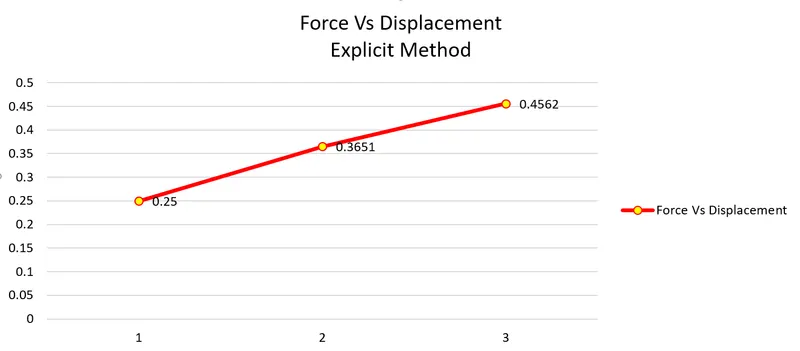
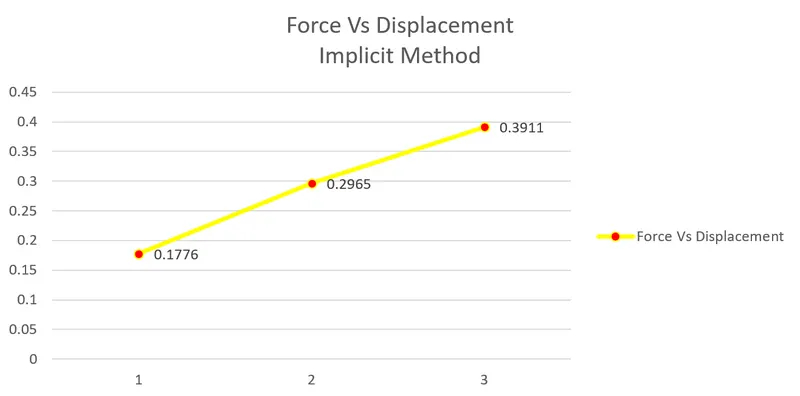
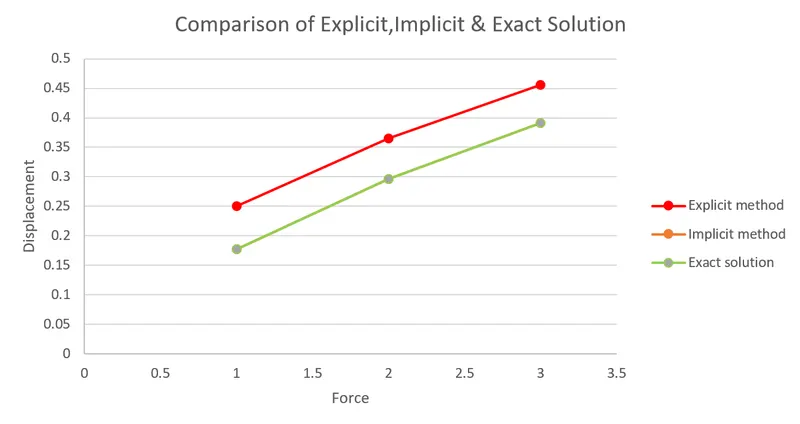
From the comparison with the exact solution, It is observed that the Implicit method values were similar to the exact solution and thus proves its accuracy.
RESULTS:
Thus, the Implicit and the Explicit analysis have been clearly explained and its method of problem solving is discussed. Also, the given problem has been solved using Explicit method, Implicit method and its results were compared to the exact solution. It is found that the Implicit method provides more accurate results however It took more computation time and effort to solve.