Explicit and Implicit Analysis
INTRODUCTION
Explicit examples are the ones in which the solution of the current time-step depends only on the previous time-step, whereas in implicit examples the current time-step depends on the previous as well as current time-step. This is because the implicit analysis tries to maintain the equilibrium by converging the solution to the convergence tolerance. And thus, at least one iteration is required in each time-step of implicit analysis.
On the other hand, explicit analysis has no convergence criteria. However, the explicit analysis depends on conditional stability or Courant's stability condition, which states that the time-step should be less than the ratio of the length of the element and the speed of the elastic wave in the element.
`Deltat <= (l)/(c)`
This creates the condition because of which the time-step in the explicit analysis is very small. Only then the explicit analysis can be stable. And because the implicit analysis depends on convergence criteria, its time-step can be large.
One more significant difference between explicit and implicit is that explicit analysis considers constant time-step throughout its calculation, and therefore it doesn't require the inversion of stiffness matrix and only requires the inversion of the mass matrix which is trivial. On the other hand,
In this work, an analytical method is demonstrated to solve a simple problem using both the explicit and the implicit methods. In both methods, an incremental load control scheme is used. And those results, of both the methods, are compared with the exact solution.
OBJECTIVE
- To analytically determine the deformation in a simple bar in tension, by both explicit and implicit methods.
- To determine which method gives close results to the exact solution.
PROCEDURE
In this work, the relationship between force and displacement depends on the stiffness equation i.e.,
`f=k.u`
where,
f = internal force,
k = stiffness, and
u = displacement.
Some other parameters used are
`DeltaF =` External Load Increment
R = Residual = Difference between internal and external force.
The function of the force in the bar is as shown below,
`f(u) = u^3+9u^2+4u`...................................(1)
from equation (1), the stiffness of the bar is,
`k(u)=(df)/(du)= 3u^2+18u+4`...........................(2)
EXPLICIT ANALYSIS
`u0 = 0.0, => k(u0)=4, DeltaF = 1, Deltau1=(DeltaF)/(k(u0)) = (1)/(4) = 0.25, u1 = u0 + Deltau1 = 0.25`
`u1 = 0.25, => k(u1) = 3u^2+18u+4 = 8.6875, DeltaF = 1, Deltau2 = (DeltaF)/(k(u1)) = (1)/(8.6875) = 0.1151, u2 = u1 +Deltau2 = 0.3651`
`u2 = 0.3651, => k(u2) = 3u^2+18u+4 = 10.9717, DeltaF = 1, Deltau3 = (DeltaF)/(k(u2)) = 0.0911, u3 = u2 + Deltau3 = 0.4562`
`u3 = 0.4562`
From these three steps, it is found that,
External Force, `Fext = DeltaF + DeltaF + DeltaF = 3.0`
Internal force, `f(u) = u^3+ 9u^2 + 4u = 3.793`
It means that external force is not equal to internal force.
| Step i | `DeltaF` | `Deltau` | u | F(external) | f(internal) | f(internal)-F(external) = R |
| 1 | 1.0 | 0.25 | 0.25 | 1 | 1.578 | 0.578 |
| 2 | 1.0 | 0.1151 | 0.3651 | 2 | 2.709 | 0.709 |
| 3 | 1.0 | 0.0911 | 0.4562 | 3 | 3.793 | 0.793 |
IMPLICIT ANALYSIS
`u0 = 0.0, k(u0) = 4, DeltaF = 1, Deltau1 = (Deltaf)/(k(u0)) = (1)/(4) = 0.25, u1 = u0 + Deltau1 = 0.25`
Fext = `DeltaF = 1`, fint `= u^3 + 9u^2 + 4u = 1.578, R0 =`fint - Fext `0.578 > 10^-3 =>Newton-Raphson iteration is necessary
To calculate the correction to u1, assume `u1 = u1^((0))`
`delta(u1) = -[k(u1^((0)))]^-1.R^((0)) = -(0.1167).(0.578) = -0.0674`
`=> u1^((1)) = u1((0)) + delta(u1) = 0.25 + (-0.0674) = 0.1825`
Checking the residual again,
Fext = 1, fint `= u^3 +9u^2 + 4u = 1.035`
`R^((1)) = 1.035 - 1 = 0.035 > 10^-3`
`=>`another iteration is necessary.
To calculate the correction to u1, assume `u1 = u1^((1))`
`delta(u2) = -[k(u1^((1)))]^-1.R^((1)) = -(0.1354).(0.035) = -0.0047`
`=> u1^((2)) = u1((1)) + delta(u2) = 0.1825 + (-0.0047) = 0.1777`
Checking the residual again,
`ext = 1, fint `= u^3 +9u^2 + 4u = 1.0006`
`R^((2)) = 1.0006 - 1 = 0.0006 < 10^-3`
Therefore, the final value of u1 = 0.1777
`u1 = 0.1777, k(u1) = 7.3, DeltaF = 1, Deltau2 = (Deltaf)/(k(u1)) = (1)/(7.3) = 0.137, u2 = u1 + Deltau2 = 0.3147`
Fext = `DeltaF = 1`, fint `= u^3 + 9u^2 + 4u = 2.1813, R0 =`fint - Fext `0.1813 > 10^-3 => Newton-Raphson iteration is necessary
To calculate the correct value of u2, assume `u2 = u2^((0))`
`delta(u2^((1))) = - [ k(u2^((0)))]^-1.R^((0)) = -0.0182`
`=> u2^((1)) = u2^((0)) + delta(u2^((1))) = 0.3147 + (-0.0182) = 0.2965`
Checking th residual,
Fext = 1, fint = `u^3 + 9u^2 +4u = 2.0032`
`R^((1)) = 2.0032 - 2 = 0.0032 < 10^-3`
`=>`another Newton-Raphson iteration is necessary.
To calculate correct value of u2, assume `u2 = u2^((1))`
`delta(u2^((2))) = -[k(u2^((1)))]^-1.R^((1))=-0.0003`
`=> u2^((2)) = u2^((1)) + delta(u2^((2))) = 0.2965 + (-0.0003) = 0.2962`
Checking the residual,
Fext = 1, fint = `u^3 + 9u^2 + 4u =2.0003`
`R^((2)) = 2.0003 - 2 = 0.0003 < 10^-3`
Therefore, the final value of u2 = 0.2962
`u2 = 0.2962, k(u2) = 9.5948, DeltaF = 1, Deltau3 = (DeltaF)/(k(u2)) = (1)/(9.6007) = 0.1042, u3 = u2 +Deltau3 = 0.2962 +0.1042 = 0.4004`
Fext = `DeltaF = 1`, fint = `u^3 +9u^2 + 4u = 3.1086, R0 = fint -Fext = 0.1086 > 10^-3
`=>`Newton-Raphson iteration is necessary.
To calculate the correct value of u3, assume `u3 = u3^((0))`
`delta(u3^((1))) = -[k(u3^((0)))]^-1.R0 = -0.0093`
`=>u3^((1)) = u3^((0)) + delta(u3^((1))) = 0.4004 + (-0.0093) = 0.3911`
Checking the residual,
Fext = 1, fint = 3.0008
`R^((1)) = 3.0008 - 3 = 0.0008 < 10^-3`
Therefore, the final value of u3 = 0.3911
| Step i | `DeltaF` | u | F (external) | f (internal) | Residual, R |
| 1 | 1.0 | 0.1777 | 1.0 | 1.0006 | 0.0006 |
| 2 | 1.0 | 0.2962 | 2.0 | 2.0003 | 0.0003 |
| 3 | 1.0 | 0.3911 | 3.0 | 3.0008 | 0.0008 |
EXACT SOLUTION
To calculate the exact solution, three polynomial equation has to solve for the three different external loadings. When calculating the exact solution, let's assume the system is in equilibrium, and therefore the internal force is equal to an external force.
Therefore,
`f(u) = F = u^3 + 9u^2 + 4u`
At first loading increment,
`1 = u^3 + 9u^2 + 4u`, or
`u^3 + 9u^2 + 4u -1 = 0`
Solutions for this equation are,
u1 = -8.5165, u2 = 0.1776, and u3 = -0.661
One possible answer out of these three solutions is u2 = 0.1776
Therefore, at first time-step u1 = 0.1776
At second loading increment,
`2 = u^3 + 9u^2 + 4u`, or
`u^3 + 9u^2 + 4u -2 = 0`
Solutions for this equation are,
u1 = -8.502, u2 = 0.2961, and u3 = -0.794
One possible answer out of these three solutions is u2 = 0.2961
Therefore, at second time-step u2 = 0.2961
At third loading increment,
`3 = u^3 + 9u^2 + 4u`, or
`u^3 + 9u^2 + 4u -3 = 0`
Solutions for this equation are,
u1 = -8.487, u2 = 0.391, and u3 = -0.904
One possible answer out of these three solutions is u2 = 0.391
Therefore, at third time-step u3 = 0.391
A summary of the exact solution interpretation is given below.
| Step i | `DeltaF` | u | F (external) | f (internal) |
| 1 | 1 | 0.1776 | 1.0 | 1.0 |
| 2 | 1 | 0.2961 | 2.0 | 2.0 |
| 3 | 1 | 0.3910 | 3.0 | 3.0 |
RESULT
From the analytical approach, it is evident that the explicit analysis had a considerable error at each time-step, or was not in equilibrium. And thus was far from the exact solution. On the other hand, implicit analysis tries to minimize the error and bring the solution close to equilibrium with a tolerance of 10^-3. Thus it is very close to the exact solution. The figure below shows the plot of displacement vs. external force increment of explicit and implicit analysis. In the figure, it can be observed that the implicit solution is almost over-lapping with the exact solution.
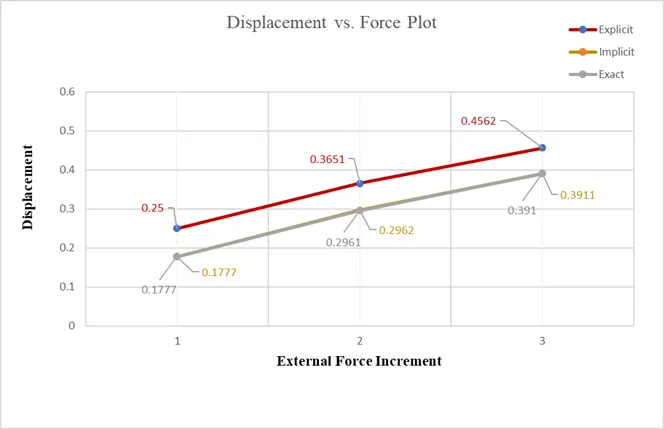
Figure: Displace/Deformation vs. external force plot.
CONCLUSION
A non-linear example was solved using the explicit method, however, it was much shifted from the exact solution. The implicit method as an alternative to an explicit method minimized the error and brought the solution to equilibrium.