Week - 2 - Explicit and Implicit Analysis
Week - 2 - Explicit and Implicit Analysis
Aim :- To solve the given equation by explicit and implicit method
Problem statement :-
Consider, the case of a simple bar in tension. Suppose that the applied force is non-linear function of displacement
f(u) = u3 + 9 u2 + 4u
the stiffness of the bar is
k(u) = df/du = 3u2 + 18u + 4
Solution :-
In the solution variables are used as
u is used for displacement
f is used for internal force
F is external applied force
k is used for stiffness
Exact values :-
We know that the value of Force at each step increases by 1 unit. Therefore by substituting the value in the force equation provided and solving for displacement we get.
STEP 1 :
F = 1;
1 = u3 + 92 + 4u
u = 0.178
STEP 2 :
F = 2;
2 = u3 + 92 + 4u
u = 0.296
STEP 3 :
F = 3;
3 = u3 + 92 + 4u
u = 0.391
|
Step |
Force |
Displacement |
|
0 |
0 |
0 |
|
1 |
1 |
0.178 |
|
2 |
2 |
0.296 |
|
3 |
3 |
0.391 |
Explicit analysis :-
We know that,
Given equation for displacement is f(u) = u3 + 9 u2 + 4u
Therefore, equation for stiffness is k(u) = df/du = 3u2 + 18u + 4
Assume load step increment is Δ F = 1
Step 1 :
u0 = 0,
F (u0) = 0,
k (u0) = 3 (0 )2 + 18 (0) + 4 = 4.
Δ u1 = = = 0.25
u1 = u0 + Δ u1 = 0 + 0.25 = 0.25
F(u1) = (0.25)3 + 9 (0.25)2 + 4(0.25) = 1.578
Fext-1 = dF = 1
Step 2 :
u1 = 0.25,
k (u1) = 3 (0.25 )2 + 18 (0.25) + 4 =8.6875
Δ u2 = = = 0.115
u2 = u1 + Δ u2 = 0.25 + 0.115 = 0.365
F (u2) = (0.365)3 + 9 (0.365)2 + 4(0.365) = 2.709
Fext-2 = dF + dF = 2
Step 3 :
u2 = 0.365,
k (u2) = 3 (0.365 )2 + 18 (0.365) + 4 = 10.972
Δ u3 = = = 0.091
u3 = u2 + Δ u3 = 0.365 + 0.091 = 0.456
F (u3) = (0.456)3 + 9 (0.456)2 + 4(0.456) = 3.793
Fext-2 = dF + dF +dF = 3
|
Step |
dF |
Δ ui |
ui |
Fext-i |
F(ui) |
R= Fext-I - F(ui) |
|
0 |
0 |
0 |
0 |
0 |
0 |
0 |
|
1 |
1 |
0.25 |
0.25 |
1 |
1.578 |
0.578 |
|
2 |
2 |
0.115 |
0.365 |
2 |
2.709 |
0.709 |
|
3 |
3 |
0.091 |
0.456 |
3 |
3.793 |
0.793 |
Implicit analysis :-
An implicit analysis is the same as the explicit analysis, except that at the end of each step Newton-Raphson iterations are used to enforce equilibrium before moving to the next step. Basically, an incremental force is applied to advance the solution forward at the beginning of a step. However, internal forces and external forces will not be in equilibrium unless the stiffness is linear for the given step. Hence, in order to achieve equilibrium, corrections must be made to the displacement. This is accomplished by using Newton-Raphson iterations to minimize the residual,
R(u) = Fint − Fext.
Expanding the residual as a Taylor series about the current displacement u j gives
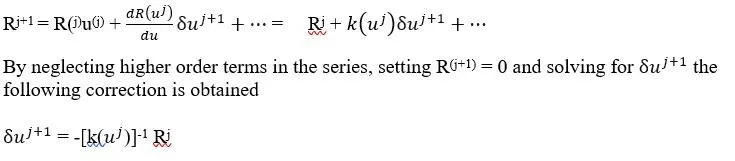
Notice that the iteration variable is j and it may take several iterations for the norm of the residual, ||R||, to be reduced below the chosen tolerance criteria (in this case, below a tolerance of 10−2). The implicit analysis proceeds as follows.
Step - 1 :
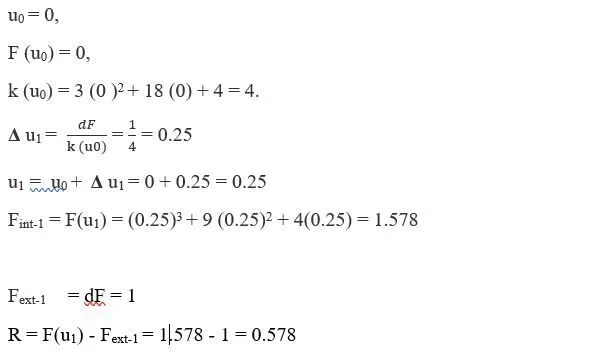
||R|| > 0.01 => Newton-Raphson Iterations are necessary.
Newton Raphson Iteration for Step 1 :
Iteration 1
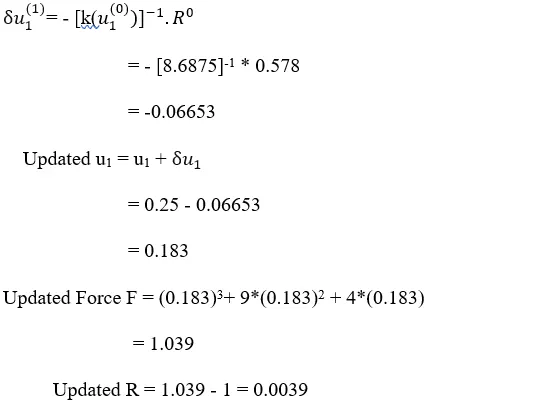
||R|| > 0.01 => Further Newton-Raphson Iterations are necessary.
Iteration 2
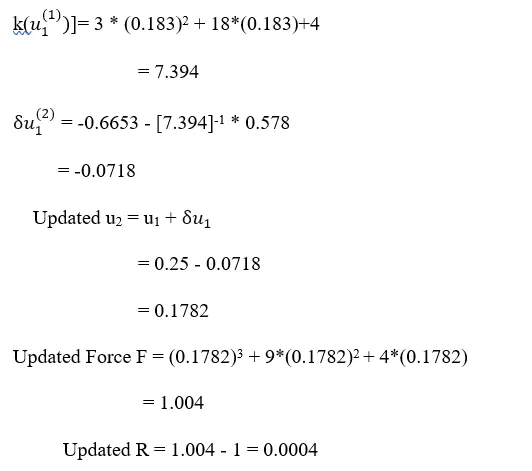
||R|| is within tolerance limit, there is no need for further iterations.
Therefore, F(u1) = 1.004 and displacement u1 = 0.1782.
Step - 2 :
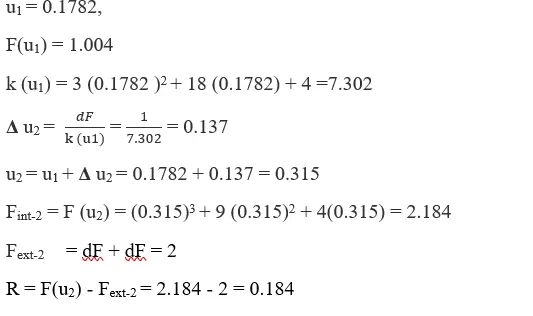
||R|| > 0.01 => Newton-Raphson Iterations are necessary.
Newton Raphson Iteration for Step 2 :
Iteration 1
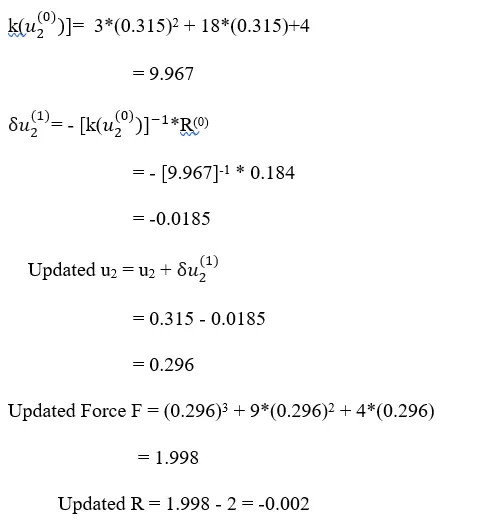
|| R || is within tolerance limit, there is no need for further iterations.
Therefore, F(u2)= 1.998 and displacement u2= 0.296.
Step - 3 :
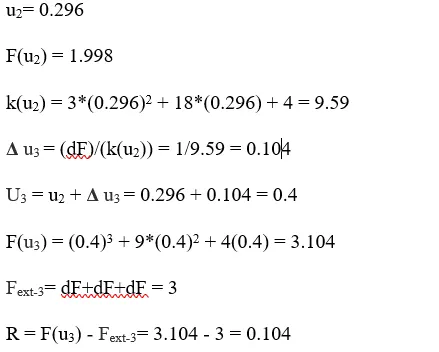
|| R || > 0.01 =>` Newton-Raphson Iterations are necessary.
Newton Raphson Iteration for Step 3 :
Iteration 1
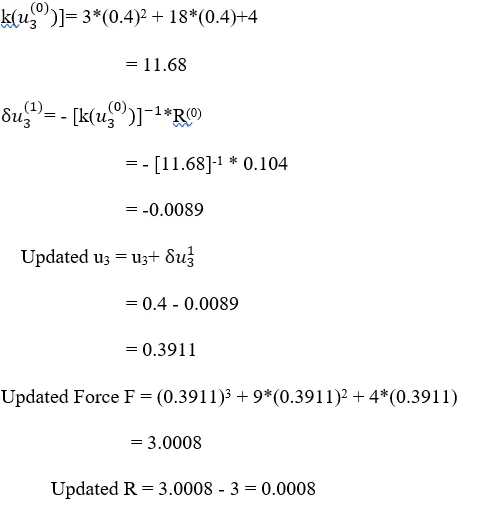
|| R || is within tolerance limit, there is no need for further iterations.
Therefore, F(u3) = 3.0008 and displacement u3 = 0.3911.
|
Step |
dFi |
Δ ui |
ui |
Fext-i |
Fint-i |
Fint-i - Fext-I = R |
|
0 |
0 |
0 |
0 |
0 |
0 |
0 |
|
1 |
1 |
0.178 |
0.178 |
1 |
1.004 |
0.004 |
|
2 |
1 |
0.118 |
0.296 |
2 |
1.998 |
-0.002 |
|
3 |
1 |
0.095 |
0.391 |
3 |
3.0008 |
0.0008 |
Plot the Results :- Based on above numerical results, summery table is obtained which is given below.
|
Step |
Force |
Displacement |
||
|
Exact Values |
Explicit values |
Implicit values |
||
|
0 |
0 |
0 |
0 |
0 |
|
1 |
1 |
0.178 |
0.25 |
0.178 |
|
2 |
2 |
0.296 |
0.365 |
0.296 |
|
3 |
3 |
0.391 |
0.456 |
0.391 |
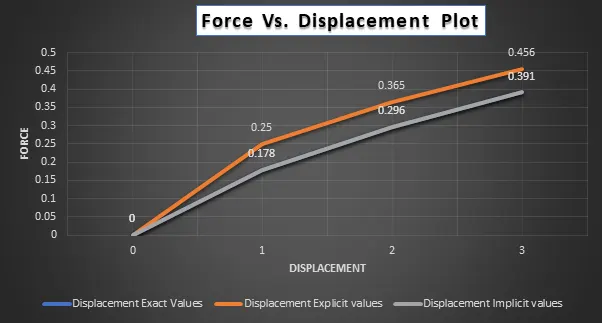
Conclusion :-
Thus, the given equation was solved using both Explicit and Implicit Methods and compared with the exact result. In the plot the comparison done on Exact, Explicit and Implicit solution, where Explicit analysis is deviating from the exact solution due to lack of equilibrium between the internal and external forces.