Week 2 Challenge
1.Compare four different types of fuel cells and state their applications.
Fuel cell:
Fuel cells require a continuous input of fuel and an oxidization agent (generally oxygen) in order to sustain the reactions that generate the electricity. Therefore, these cells can constantly generate electricity until the supply of fuel and oxygen is cut off.
Despite being invented in the year 1838, fuel cells began commercial use only a century later when they were used by NASA to power space capsules and satellites. Today, these devices are used as the primary or secondary source of power for many facilities including industries, commercial buildings, and residential buildings.
A fuel cell is similar to electrochemical cells, which consists of a cathode, an anode, and an electrolyte. In these cells, the electrolyte enables the movement of the protons.
Types of fuel cells:
Despite working similarly, there exist many varieties of fuel cells. Some of these types of fuel cells are discussed in this subsection.
The Polymer Electrolyte Membrane (PEM) Fuel Cell
- These cells are also known as proton exchange membrane fuel cells (or PEMFCs).
- The temperature range that these cells operate in is between 50oC to 100oC
- The electrolyte used in PEMFCs is a polymer which has the ability to conduct protons.
- A typical PEM fuel cell consists of bipolar plates, a catalyst, electrodes, and the polymer membrane.
- Despite having eco-friendly applications in transportation, PEMFCs can also be used for the stationary and portable generation of power.
Phosphoric Acid Fuel Cell
- These fuel cells involve the use of phosphoric acid as an electrolyte in order to channel the H+
- The working temperatures of these cells lie in the range of 150oC – 200oC
- Electrons are forced to travel to the cathode via an external circuit because of the non-conductive nature of phosphoric acid.
- Due to the acidic nature of the electrolyte, the components of these cells tend to corrode or oxidize over time.
Solid Acid Fuel Cell
- A solid acid material is used as the electrolyte in these fuel cells.
- The molecular structures of these solid acids are ordered at low temperatures.
- At higher temperatures, a phase transition can occur which leads to a huge increase in conductivity.
- Examples of solid acids include CsHSO4 and CsH2PO4 (cesium hydrogen sulfate and cesium dihydrogen phosphate respectively)
Alkaline Fuel Cell
- This was the fuel cell which was used as the primary source of electricity in the Apollo space program.
- In these cells, an aqueous alkaline solution is used to saturate a porous matrix, which is in turn used to separate the electrodes.
- The operating temperatures of these cells are quite low (approximately 90oC).
- These cells are highly efficient. They also produce heat and water along with electricity.
Solid Oxide Fuel Cell
- These cells involve the use of a solid oxide or a ceramic electrolyte (such as yttria-stabilized zirconia).
- These fuel cells are highly efficient and have a relatively low cost (theoretical efficiency can even approach 85%).
- The operating temperatures of these cells are very high (lower limit of 600oC, standard operating temperatures lie between 800 and 1000oC).
- Solid oxide fuel cells are limited to stationary applications due to their high operating temperatures.
Molten Carbonate Fuel Cell
- The electrolyte used in these cells is lithium potassium carbonate salt. This salt becomes liquid at high temperatures, enabling the movement of carbonate ions.
- Similar to SOFCs, these fuel cells also have a relatively high operating temperature of 650oC
- The anode and the cathode of this cell are vulnerable to corrosion due to the high operating temperature and the presence of the carbonate electrolyte.
- These cells can be powered by carbon-based fuels such as natural gas and biogas.
Applications of fuel cell
Fuel cell technology has a wide range of applications. Currently, heavy research is being conducted in order to manufacture a cost-efficient automobile which is powered by a fuel cell. A few applications of this technology are listed below.
- Fuel cell electric vehicles, or FCEVs, use clean fuels and are therefore more eco-friendly than internal combustion engine-based vehicles.
- They have been used to power many space expeditions including the Appolo space program.
- Generally, the byproducts produced from these cells are heat and water.
- The portability of some fuel cells is extremely useful in some military applications.
- These electrochemical cells can also be used to power several electronic devices.
- Fuel cells are also used as primary or backup sources of electricity in many remote areas.
2.Using a plot with energy density and power density on the X and Y axis, arrange various battery types like lithium ion, lead acid, Nickel Cadmium, Ultracapacitor, fuel cell.
The devices are,
- Lithium-ion batteries.
- Lead acid batteries.
- Nickel cadmium batteries.
- Ultracapacitors.
- Fuel cells.
Li-ion batteries:
A lithium-ion battery is a type of rechargeable battery that is charged and discharged by lithium ions moving between the negative (anode) and positive (cathode) electrodes.
Because lithium-ion batteries are suitable for storing high-capacity power, they are used in a wide range of applications, including consumer electronics such as smartphones and PCs, industrial robots, production equipment, and automobiles.
Lead acid batteries:
A lead acid battery consists of a negative electrode made of spongy or porous lead. The lead is porous to facilitate the formation and dissolution of lead.
The positive electrode consists of lead oxide. Both electrodes are immersed in an electrolytic solution of sulfuric acid and water.
In case the electrodes come into contact with each other through the physical movement of the battery or changes in the thickness of the electrodes, an electrically insulating, but chemically permeable membrane separates the two electrodes.
- This membrane also prevents electrical shorting through the electrolyte.
- These are employed in emergency lighting to provide power for sump pumps.
- Used in electric motors
- Submarines
- Nuclear submarines
Ni-cadmium batteries:
The nickel-cadmium battery is the same as lead-acid-based batteries. It consists of three fundamental layers.
The first one is a nickel layer, then the separator layer, and the cadmium layer. The nickel acts as a positive electrode collector and the cadmium layer acts as a negative layer collector.
The separator layer between the two layers is made up of KOH or NaOH. Its purpose is to provide OH ions.
It also consists of a safety valve, sealing plate, insulation ring, insulation gasket, and an outer case. The purpose of the insulator ring is to provide insulation between the two layers.
The insulator gasket is the place where the insulation ring is kept nearby. The separator layer is connected to this ring.
It has various applications like toys, small DC motors, calculators, fans, computers, etc.
Ultracapacitors:
Supercapacitors, Ultracapacitors, or EDLC (Electric Double Layer Capacitors) as they are also called, look very much like batteries.
They have double layer construction consisting of two carbon electrodes immersed in an organic electrolyte.
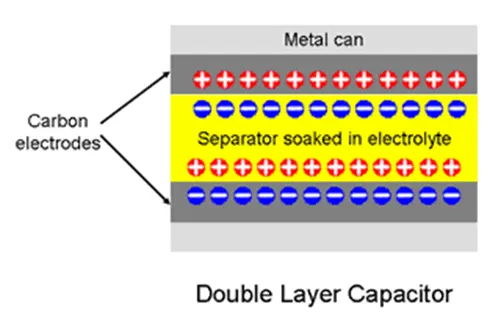
During charging, the electrically charged ions in the electrolyte migrate towards the electrodes of opposite polarity due to the electric field between the charged electrodes created by the applied voltage.
Thus two separate charged layers are produced. Although similar to a battery, the double-layer capacitor depends on electrostatic action.
Since no chemical action is involved the effect is easily reversible and the typical cycle life is hundreds of thousands of cycles.
They are majorly used in all EVs to initiate high torque requirements and many other low/high power equipment.
Fuel cell:
Fuel cells work like batteries, but they do not run down or need recharging. They produce electricity and heat as long as fuel is supplied.
A fuel cell consists of two electrodes—a negative electrode (or anode) and a positive electrode (or cathode)—sandwiched around an electrolyte.
A fuel, such as hydrogen, is fed to the anode, and the air is fed to the cathode.
The electrons go through an external circuit, creating a flow of electricity. The protons migrate through the electrolyte to the cathode, where they unite with oxygen and electrons to produce water and heat.
Comparison based on its energy density Vs Power densities from the above plot:
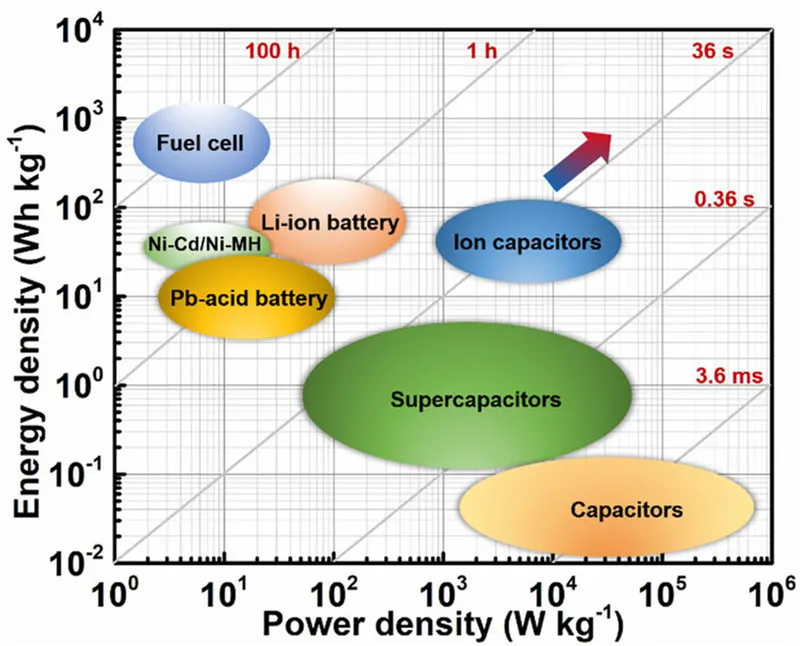
Here from the plot, we can summarize that,
The Fuel cells are having high energy density but the power density is very less when compared to other types of batteries. As they produce the electrical energy based on their fuel supply, their reaction time is given as 100Hrs. Here shown the energy density is 1000Wh/Kg whereas its power density is produced given as nearly 10W/Kg. They require boost converters to match load requirements.
Lithium-ion batteries have high energy density and also its power density matching their load requirements without boost converters. Here shown for 100Wh/Kg energy density, the power density is given as nearly 100W/Kg. They are in equal ratios.
For lead acid batteries, the energy density and power density are nearly equal ration. Here given for energy density of 10Wh/Kg the power density is also 10W/Kg. Thus increase in energy density also increases the power density in an equal ratio to Li-ion batteries.
For Ni-cd batteries, the energy density is quite high as same as Li-ion and Lead acid battery types. But its specific power is less when compared with other batteries. Here given the energy density is 50Wh/Kg but its power density is only near 9W/kg. Thus they are used in less power-consuming devices.
Ultracapacitors/Supercapacitors are having less energy density but they will produce high power in a short duration of time. Here shown supercapacitors having nearly 1 Wh/Kg of energy density produces nearly 5KW/kg of specific power or said to be its power density. Thus they are used in certain applications that need high power requirements in a short duration of time. Its reaction time is given as 0.36 seconds.
Capacitors are normally used in most electronic devices to produce high-power balancing regions. Thus they are having nearly 0.05Wh/Kg as energy density but the power output is extremely higher. Its reaction time as given is 3.6 microseconds.