Week 2 Challenge
1.The different types of fuel cells are :
- Polymer Electrolyte Membrane
- Alkaline Fuel Cells
- Phosphoric Acid Fuel Cell
- Molten Carbonate Fuel Cell
- Solid Oxide Fuel Cell
- Direct Methanol Fuel Cell
Polymer Electrolyte Membrane :
- A cell of this sort is built around an ion-conducting membrane such as Nafion (trademark for a perfluorosulfonic acid membrane).
- The electrodes are catalyzed carbon, and several construction alignments are feasible.
- Solid polymer electrolyte cells function well (as attested to by their performance in Gemini spacecraft), but cost estimates are high for the total system compared with the types described above. Engineering or electrode design improvements could change this disadvantage.
Alkaline fuel cells :
- These are devices that, by definition, have an aqueous solution of sodium hydroxide or potassium hydroxide as the electrolyte. The fuel is almost always hydrogen gas, with oxygen(or oxygen in air) as the oxidizer.
- Zinc or Aluminum could be used as an anode if the by-product oxides were efficiently removed and the metal fed continuously as a strip or as a powder. Fuel cells generally operate at less than 100 °C (212 °F) and are constructed of metal and certain plastics.
- Electrodes are made of carbon and a metal such as nickel. Water, as a reaction product, must be removed from the system, usually by evaporation from the electrolyte either through the electrodes or in a separate evaporator.
- The operating support system presents a significant design problem. The strong, hot alkaline electrolyte attacks most plastics and tends to penetrate structural seams and joints.
Phosphoric Acid Fuell Cell :
- Such cells have an orthophosphoric acid electrolyte that allows operation up to about 200 °C (400 °F).
- They can use a hydrogen fuel contaminated with carbon dioxide and an oxidizer of air or oxygen.
- The electrodes consist of catalyzed carbon and are arranged in pairs set back-to-back to create a series generation circuit.
- The framing structure for this assembly of cells is made of graphite, which markedly raises the cost.
- The higher temperature and aggressive hot phosphate create structural design problems, particularly for joints, supporting pumps, and sensors.
- Phosphoric Acid fuel cells have been proposed and tested on a limited scale for local municipal power stations and for remote-site generators.
Solid Oxide Fuel Cell :
- Solid oxide fuel cells are similar to molten carbonate devices. Most of the cell materials, however, are special ceramics with some nickel.
- The electrolyte is an ion-conducting oxide such as zirconia treated with yttria. The fuel for these experimental cells is expected to be hydrogen combined with carbon monoxide, just as for molten carbonate cells.
- While internal reactions would be different in terms of path, the cell products would be water vapour and carbon dioxide. Because of the high operating temperatures the electrode reactions proceed very readily.
- As in the case of the molten carbonate fuel cell, there are many engineering challenges involved in creating a long-lived containment system for cells that operate at such a high-temperature range.
- Solid oxide fuel cells would be designed for use in central power-generation stations where temperature variation could be controlled efficiently and where fossil fuels would be available.
- The system would in most cases be associated with the so-called bottoming steam (turbine) cycle—i.e., the hot gas product (at 1,000 °C) of the fuel cell could be used to generate steam to run a turbine and extract more power from heat energy.
| Fuel Cell | Operating Temp in deg | Power(Kw) | Efficiency(%) | Applications |
| Polymer Electrolyte Membrane | 60-110 | 0.01-250 | 40-55 | Portable, Mobile, Low power generation |
| Alkaline Fuel Cell | 70-130 | 0.1-50 | 50-70 | Mobile, Space, Military |
| Phosphric Acid Fuel Cell | 175-210 | 50-1000 | 40-45 | Medium to large power scale generation and CHP (combined heat and power) |
| Molten Carbonate Fuel Cell | 550-650 | 200-100000 | 50-60 | Large scale power generation |
| Solid Oxide Fuel Cell | 500-1000 | 0.5-2000 | 40-72 | Vehicle auxiliary power units,Medium to large power scale generation and CHP, off-grid power and CHP |
| Direct Methanol Fuel Cell | 70-130 | 0.001-100 | 40 | Mobile, Portable |
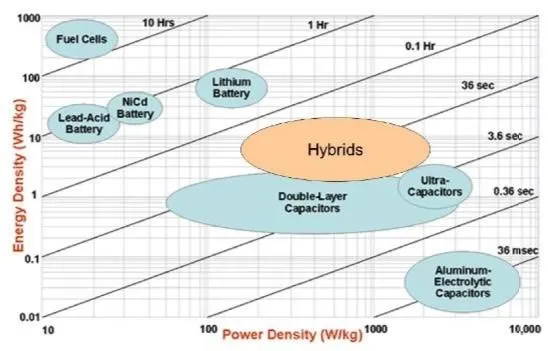
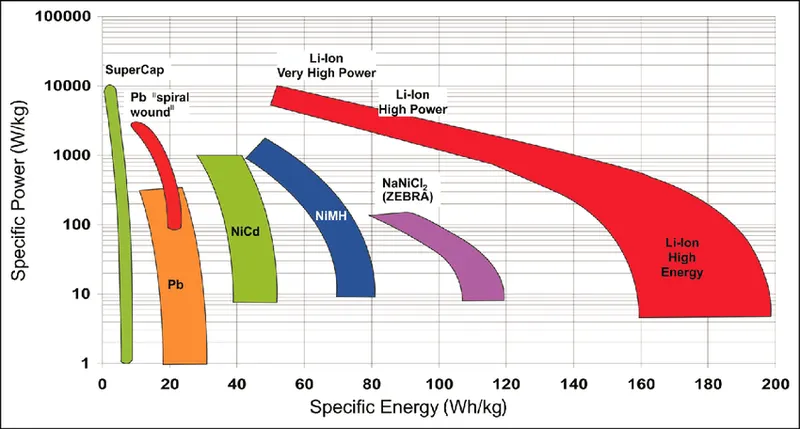
2. Rangone plot is used to arrange various battery types like lithium ion, lead acid, Nickel Cadmium, Ultracapacitor, fuel cell.
Battery Energy Storage Systems (Lead-acid, li-ion, NiMH or Nicad) :
- The lead-acid, Li-ion, NiCad and NIMH are the most commonly used battery types in battery energy storage systems.
- The lead-acid batteries are rarely being used in energy storage system applications mainly due to their low energy density and low power density.
- Similarly, NiCad batteries also have low energy density and low power density and thus rarely being used in battery energy storage systems.
- The most commonly used battery technology is the Li-lon technology, which has high power density and high energy density in comparison to the other battery technologies available in the market.
- The Li-lon batteries are maintenance free and also have the highest lifetime (at 80% depth-of-discharge (DOD)) over other battery types available in the market.
Supercapacitors:
- Supercapacitors (also known as ultracapacitor) have the capability to release or absorb a large amount of power instantaneously than battery energy storage systems.
- In supercapacitors energy is stored in an electrostatic field and hence the charging and discharging cycles can be repeated without any limit and also it could be chargednwithin a very short time span as oppose to batteries.
- The supercapacitor structure is different to a conventional capacitor due to its electrostatic double-layer and thinner carbon electrodes.
- These properties increase the capacitance of supercapacitor compared to conventional capacitor.
Fuel cell:
- Fuel cell stores high energy because it uses fuel to produce electricity.
- Fuel cells work like batteries, but they do not run down or need recharging.
- They produce electricity and heat as long as fuel is supplied. A fuel cell consists of two electrodes-a negative electrode (or anode) and a positive electrode (or cathode)-sandwiched around an
electrolyte. - A fuel, such as hydrogen, is fed to the anode, and air is fed to the cathode. In a hydrogen fuel cell, a catalyst at the anode separates hydrogen molecules into protons and electrons, which take different paths to the cathode.
- The electrons go through an external circuit, creating a flow of electricity.
- The protons migrate through the electrolyte to the cathode, where they unite with oxygen and the electrons to produce water and heat.